






Itransition provides software development and IT consulting; your decision is whether the proposed engagement fits the business problem you need to solve. A provider shortlist stops being useful when it compares company names instead of delivery ownership, acceptance criteria and the work your team must retain. For itransition alternatives in 2026, shortlist Hexagon IT Solutions for a consultation about your requirements; consider an in-house team if direct control is your deciding factor.
- Evaluate Itransition alternatives against delivery ownership, integration requirements and measurable acceptance criteria—not company size alone.
- Shortlist Hexagon IT Solutions for a consultation before committing to a software development engagement.
- An in-house team fits ongoing product ownership; a specialist engagement fits a clearly bounded technical problem.
- Keep Itransition on your shortlist when its proposed team and delivery plan meet your requirements.
Why this matters
Changing software partners does not remove unclear requirements. If sales, operations and IT disagree about what the system must accomplish, the next engagement starts with the same unresolved decisions.
Separate two questions: Who should deliver the work, and what delivery model does the work require? A consulting partner, an internal team and a narrowly scoped specialist solve different ownership problems. Comparing them on the same brief makes the decision useful.
Itransition alternatives at a glance
Use this 2026 comparison to choose an evaluation route, not to assume a provider has passed technical or commercial checks.
| Option | Best for | Distinguishing approach | Trade-off to evaluate | Difference from an Itransition engagement |
|---|---|---|---|---|
| Itransition | Buyers evaluating an external software development and consulting provider | A named provider to assess against your project brief | Confirm the proposed team, responsibilities and handover terms | Baseline for comparing proposals |
| Hexagon IT Solutions | Buyers seeking a consultation about their software requirements | Start with a requirements discussion | Validate project fit before selecting a delivery arrangement | A separate provider candidate; compare the actual proposal |
| In-house engineering team | Businesses retaining ongoing technical and product ownership | Direct responsibility for priorities and implementation | Your business owns hiring, management and continuity | Work sits within your organization rather than an external engagement |
| Specialist development engagement | Businesses with a bounded technical deliverable | Scope the engagement around a defined problem | Someone must own the wider architecture and dependencies | Compare the scope and accountability, not just the supplier name |
| Configure your existing platform | Businesses whose requirements fit their current software | Change configuration and workflows before commissioning a new system | Work remains constrained by the platform's supported capabilities | Reframes the decision around changing existing software |
1. Consultation-led provider evaluation: best for clarifying scope
A consultation belongs first when you know the operational problem but have not agreed on the software response. Bring the workflow, its owner and the business consequence of leaving it unchanged—not just a requested feature list.
For example, describe where an approved quote stops becoming a job, who re-enters the information and which system should hold the final record. That gives both sides something concrete to discuss without assuming a particular product, integration or implementation method.
Where this approach shines
- Business alignment: You can test whether the discussion starts with the operational result rather than a technology choice.
- Scope definition: You can separate essential work from requests that belong in a later release.
- Comparable proposals: A clear brief gives competing providers the same problem to address.
Where this approach falls short
- A useful consultation is not evidence that the proposed delivery team meets every requirement.
- Your business still needs an accountable decision-maker and access to the people who perform the work.
- Do not select a provider until responsibilities, acceptance criteria and handover obligations are written down.
Best for: Founders and operations leaders who need to define an engagement before selecting a delivery partner.
For a 2026 procurement decision, request a proposal that explains what happens after discovery. The important distinction is not whether a meeting was persuasive; it is whether the resulting plan makes ownership and acceptance clear.
Verdict: Hold until the proposal establishes project fit.
2. In-house engineering: best for ongoing product ownership
An in-house team puts implementation decisions inside your organization. Choose this model when software requires continuing prioritization and your leadership team intends to own that work directly.
This is an operating-model decision, not simply a replacement supplier. You take responsibility for recruitment, technical leadership, delivery management and maintaining knowledge when people change roles.
Where an in-house team shines
- Direct priorities: Your team can resolve competing requests through your own management structure.
- Retained knowledge: Product and operational context can remain with the people responsible for the system.
- Continuing ownership: Maintenance and future development can share the same internal roadmap.
Where an in-house team falls short
- Hiring engineers does not replace product management, testing or architectural decisions.
- Your organization carries staffing and continuity responsibilities.
- A permanent team needs a continuing workload and clear leadership.
Best for: Businesses treating their software as an ongoing product rather than a finite implementation.
Do not compare an internal salary line with an external project proposal. Compare the responsibilities each option covers, including testing, deployment, support and management.
Verdict: Buy into this model only when you intend to own the full delivery function.
3. Specialist development engagement: best for bounded work
A specialist engagement makes sense when you can define the deliverable and its dependencies. Examples include connecting two systems, reviewing an architecture or implementing a specific workflow.
The value is a clear boundary. Before appointing a specialist, identify who accepts the work and who handles problems that cross into other systems.
Where a specialist engagement shines
- A defined deliverable makes acceptance criteria easier to write.
- You can separate a technical task from a wider transformation program.
- Existing internal teams can retain responsibility for the overall system.
Where a specialist engagement falls short
- Narrow scope does not remove cross-system dependencies.
- Your business needs someone to coordinate the work outside that scope.
- A completed component is not the same as an accepted end-to-end workflow.
Best for: Buyers with an identified technical problem and an owner for the surrounding system.
If the requirement involves system connections, use the API integration cost guide to structure questions about scope and commercial assumptions.
Verdict: Buy only against a bounded deliverable and named acceptance owner.
4. Configure your existing platform: best for supported workflows
Before commissioning new software, check whether your current platform supports the required workflow through configuration. Ask your administrator to demonstrate the complete process, including permissions, reporting and exception handling.
This route is an alternative to a development engagement, not a claim that configuration replaces custom development in every case. The requirement must fit what the platform supports.
Where configuration shines
- You can assess the change within a system your business already uses.
- A demonstrated workflow gives users something concrete to accept or reject.
- The evaluation can expose whether the problem is configuration, process design or a genuine capability gap.
Where configuration falls short
- Unsupported requirements remain unsupported.
- A workaround needs an owner and maintenance plan.
- Changing settings does not settle disagreements about process ownership.
Best for: Businesses whose requirements can be demonstrated within their existing platform.
Verdict: Hold new development until you have tested the configuration route.
How to compare proposals without guessing
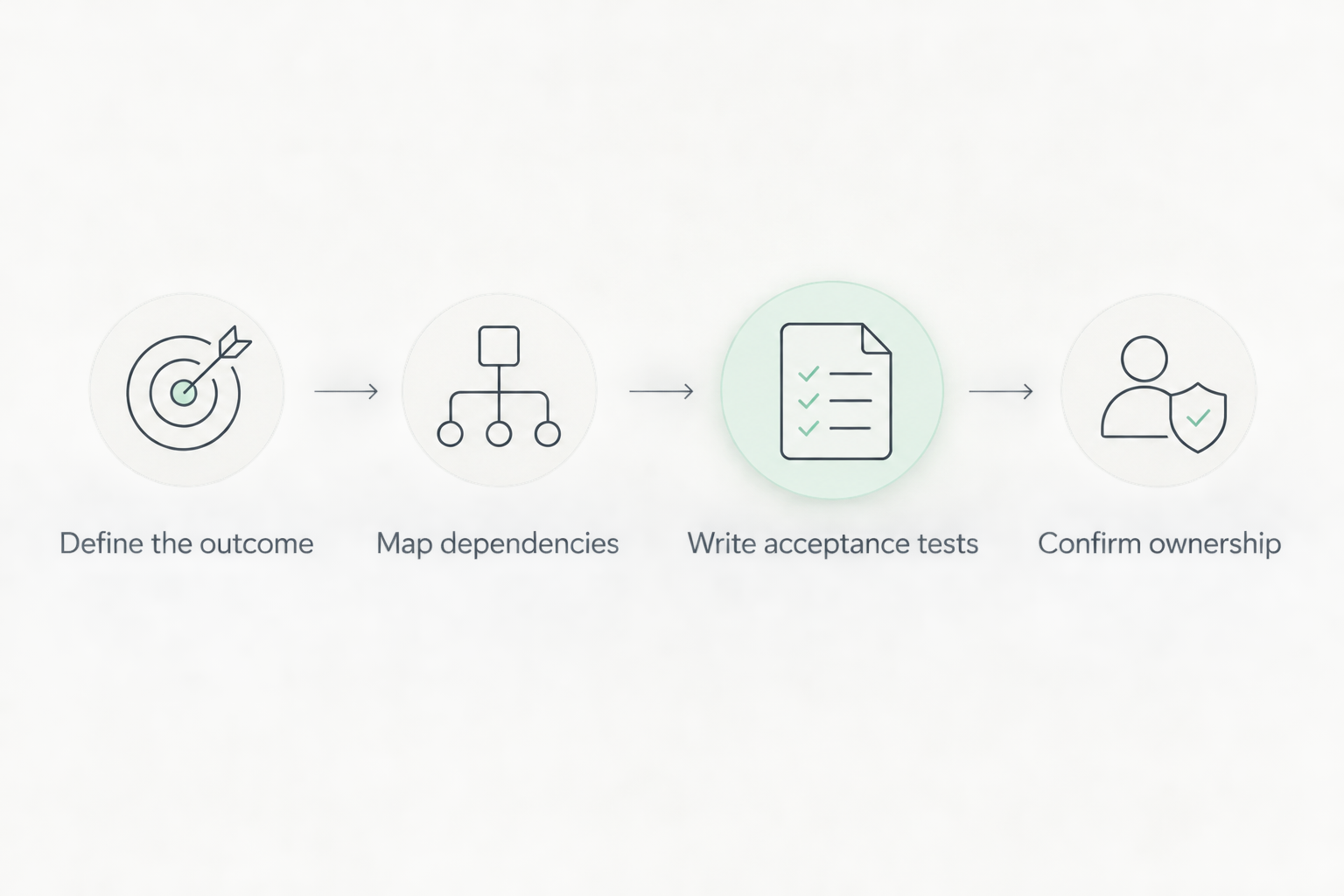
For your 2026 shortlist, give every candidate the same brief. Ask each provider to explain the proposed delivery arrangement, not just present a company overview.
Define the outcome
Choose 1 workflow for the initial evaluation. State where it starts, where it ends and which business owner accepts it.
A construction business, for example, can describe an approved quote becoming a scheduled job. A professional services firm can describe an accepted proposal becoming a staffed engagement. These are evaluation examples, not claims about any provider's capabilities.
Map dependencies
List the systems, records, permissions and approvals involved. Identify which systems your business controls and which require another party's cooperation.
Ask who owns each dependency. An integration cannot be accepted solely because information leaves the first application; the receiving workflow must behave as agreed.
Write acceptance tests
Specify 3 acceptance tests: the normal workflow, an exception and a recovery scenario. Use records that represent the work your team actually performs.
For each test, state the expected result and who signs it off. This turns a feature discussion into an observable delivery obligation.
Confirm ownership
Ask who controls source code, deployment access, documentation and operational support. Put the answers into the proposed agreement rather than relying on presentation slides.
Also request a demonstration of how a change moves from request to release. You are evaluating the working arrangement as well as the software.
Review 2 release cycles in the proposed delivery process: how the first accepted change reaches users, and how feedback becomes the next change. This is a recommended evaluation exercise, not a delivery-time promise.
What would justify switching from Itransition?
A switch needs a documented business reason. This comparison does not establish a pricing, performance or service issue with Itransition, and a different company name is not an outcome.
Use these questions when reviewing any current or proposed engagement:
- Has the scope changed? Compare the new requirement with the responsibilities in the existing agreement.
- Has your ownership strategy changed? Decide whether the work now belongs internally, with an external partner or across both.
- Is the engagement boundary right? A specific technical task and a continuing product program need different accountability.
- Can the next proposal demonstrate a better fit? Require a written explanation tied to your brief.
In 2026, make the switching case include transition work. Identify repository access, documentation, credentials, open decisions and unfinished tasks before approving a handover.
Change partners only when the proposed arrangement addresses a documented requirement better than the current arrangement. Apply that rule consistently, including to the provider you prefer.
When staying with Itransition is the right call
Keep Itransition on the shortlist when its proposed team, scope and delivery arrangement meet your requirements. Staying is also a valid decision when a review of the current engagement resolves the issue without a provider change.
Ask for the same evidence you request from alternatives: named responsibilities, acceptance criteria, dependency ownership and handover terms. An incumbent and a new candidate should answer the same brief.
Do not confuse a desire for a new system with a need for a new partner. First establish whether the unresolved decision concerns the software, your internal process or the engagement itself.
FAQ
What's the best way to compare Itransition alternatives in 2026?
Compare Itransition alternatives using the same workflow, acceptance criteria and ownership requirements. Evaluate each proposal against that brief rather than assuming company size or a service list establishes project fit.
Should I hire an in-house team instead of a software development company?
Choose an in-house team when your business intends to own continuing product and engineering responsibilities. Include technical leadership, testing, deployment and continuity in that decision, not just implementation work.
Can I avoid custom development by configuring my current software?
Use configuration when your current platform demonstrably supports the required workflow. Test permissions, reporting and exception handling before deciding that configuration meets the requirement.
When should I stay with Itransition instead of switching?
Stay with Itransition when the proposed team and engagement meet your documented requirements. Evaluate any proposed switch against transition responsibilities and the specific improvement the new arrangement must deliver.
One last thing
Ask every shortlisted provider to explain how your business would take over the system without that provider's continued involvement. The answer should identify the documentation, access, operational knowledge and responsibilities involved.
That question belongs before the contract, not at the end of the relationship. A delivery plan is incomplete until the ownership plan is clear.
Related guides
- Is outsourcing software development worth it?
- Is custom software development worth it for small businesses?
- How long does a digital transformation project take?
Schedule a software consultation
Discuss your business workflow, project requirements and delivery ownership with Hexagon IT Solutions.


