






A digital transformation project takes as long as its defined business changes require: a single-workflow rollout and a company-wide systems replacement need different schedules. Set separate deadlines for a working pilot, an operational rollout and a measured business outcome. A software launch does not finish the work if data migration, employee adoption or the retirement of old processes remains incomplete.
- How long does digital transformation take? Define scope and acceptance criteria before committing to a delivery date.
- Separate the pilot, operational rollout and business outcome; software deployment alone does not complete digital transformation.
- CRM integration timelines must include data cleanup, exception handling and user acceptance, not just development.
- Use a Hexagon IT Solutions consultation to clarify project scope before setting a digital transformation timeline.
Why this matters
Your 2026 transformation plan needs a finish line that finance, operations and IT recognize. Otherwise, a delivery team can report completion while employees still copy information between systems and managers still question the reports.
A workflow such as connecting property management software to QuickBooks illustrates the distinction: establishing a connection is different from confirming that records reach the right accounts and exceptions reach the right people. Schedule the business handoff, not just the technical connection.
The practical consequence is budget control. When your definition of completion includes training, ownership and operational acceptance, those activities belong in the original plan rather than appearing as unfinished work after launch.
How long does digital transformation take?
The defensible timeline is the schedule for a defined outcome, not a standard duration attached to the words digital transformation. Start with the process you want to change, identify its dependencies and establish what must be true before employees rely on the new way of working.
Define 3 completion milestones in your 2026 project brief. Each answers a different executive question.
| Milestone | What it demonstrates | Best for | Limitation |
|---|---|---|---|
| Working pilot | A bounded workflow works with representative users and data | Testing the proposed approach before expanding | Does not establish readiness across the business |
| Operational rollout | Intended users can perform the agreed work with support and exception handling | Moving the workflow into everyday operations | Does not by itself prove the expected business result |
| Business outcome | The agreed operating measure meets its acceptance target | Evaluating whether the change delivered its purpose | Requires a baseline and a suitable measurement period |
Do not ask a supplier for a final date before agreeing which milestone the date represents. A pilot estimate presented as a full transformation estimate leaves migration, rollout and measurement outside the commitment.
Ask for the assumptions behind each milestone, too. A schedule that depends on access to your accounting system is not an unconditional promise if that access still needs approval.
A single-workflow project: define a narrow finish line
Best for: a specific operational bottleneck with a clear owner. Start with a process such as routing incoming leads, handing an approved job to operations or transferring an approved invoice into accounting.
The advantage is a bounded acceptance test. You can state what starts the workflow, what should happen next and what evidence confirms completion. The limitation is equally important: improving that workflow does not automatically resolve problems elsewhere in the business.
For your 2026 scope, write the boundary explicitly. Include the systems involved, the people affected and the exceptions the first release must handle.
A lead-routing project, for example, is not complete merely because a record appears in a CRM. Your acceptance criteria should also address ownership, duplicate records, failed transfers and the response expected from the receiving team. Treat these as scope decisions, not discoveries to postpone until launch.
A department rollout: plan the handoffs
Best for: replacing a department's fragmented working process. A sales or operations rollout needs agreement on how people work together, not just how individual screens behave.
The benefit is a shared operating process within the department. The trade-off is coordination: managers, frontline users and connected teams must agree on responsibilities before you can test the complete workflow.
Set acceptance criteria around handoffs. If sales marks a deal ready for delivery, operations needs the required information and a clear next action; a status change without that handoff is incomplete.
Also identify what remains outside the rollout. Keeping the accounting system unchanged can be a valid boundary, but the plan must still explain how information crosses that boundary and who resolves errors.
A company-wide program: release outcomes in stages
Best for: changing connected processes across departments. A company-wide program needs an overall sequence and smaller releases with independent acceptance criteria.
Its advantage is the ability to address business-wide dependencies. Its limitation is that decisions in one department can change requirements elsewhere, particularly where teams share customer, job or financial records.
For a 2026 company-wide plan, avoid making every improvement depend on a single final launch. Separate releases where the business can operate safely, and document the temporary arrangements between old and new processes.
Do not confuse staged delivery with disconnected projects. Each release still needs to fit the agreed data ownership, operating responsibilities and future process. Otherwise, temporary workarounds become permanent interfaces nobody owns.
Why digital transformation timelines vary
These factors determine the work your schedule must contain. Use them to challenge an estimate before approving it.
- Scope boundaries: A workflow, a department and a company-wide operating change have different acceptance requirements. List what the release excludes as carefully as what it includes.
- Data readiness: Duplicate records, inconsistent identifiers and unclear ownership require decisions before migration results can be trusted. Name the business owner who approves corrections.
- System dependencies: Connected applications need agreed access, data mappings and failure handling. Put external approvals and vendor dependencies on the schedule.
- Decision ownership: Requirements cannot be finalized when stakeholders disagree about the process. Give unresolved decisions an owner and a decision deadline.
- Operational readiness: Training, support, access permissions and fallback procedures determine whether employees can use the release. Include them in acceptance rather than treating them as follow-up tasks.
Ask your delivery partner to connect each dependency to a milestone. A risk register without a scheduling consequence does not tell you what happens when a dependency slips.
How to build a timeline you can defend
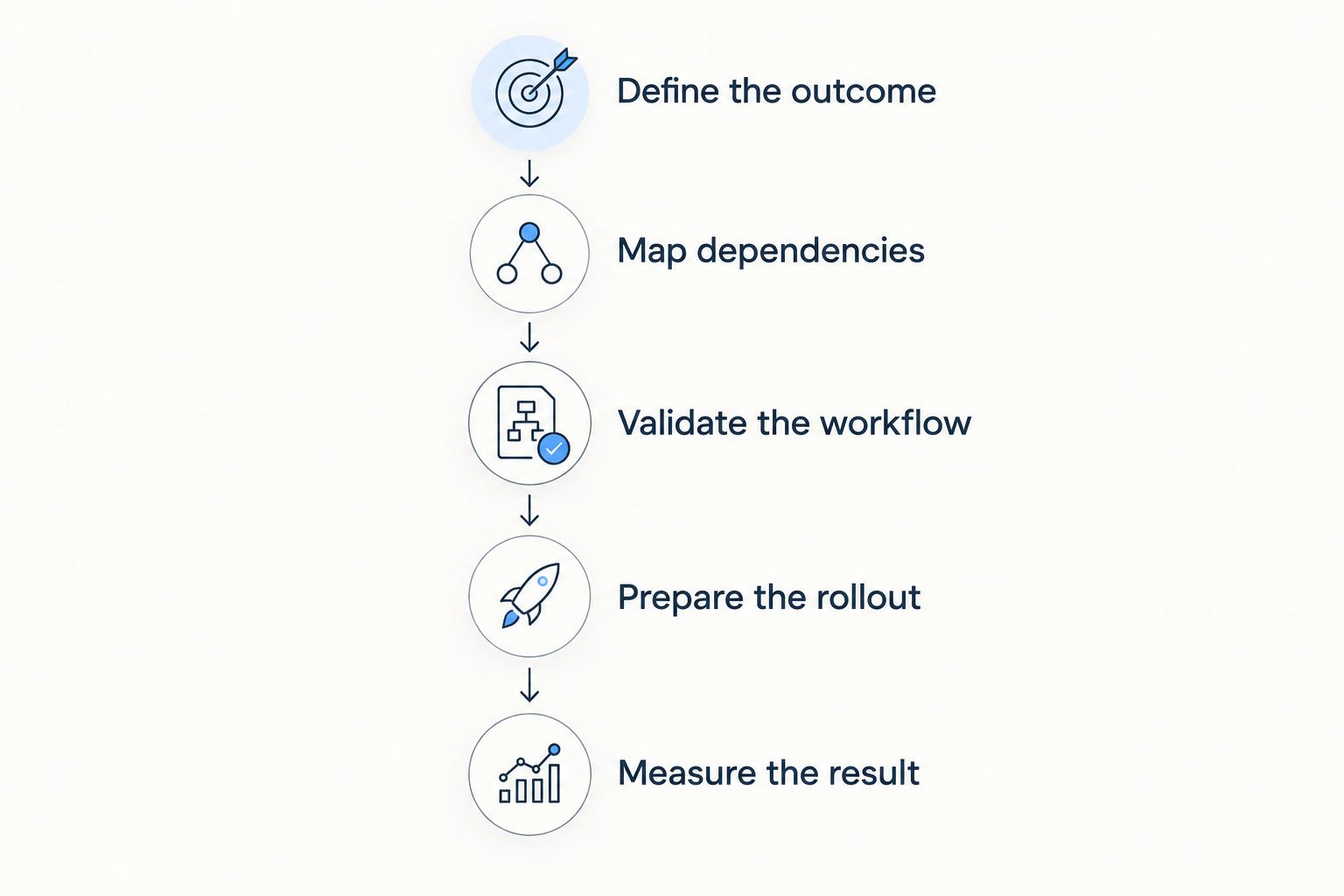
Use the following sequence to turn a broad ambition into a delivery plan. These are planning steps, not promised project durations.
Define the outcome
Choose 1 workflow for the initial scope and state the business problem it must solve. Describe the current failure in operational terms: an unassigned lead, repeated data entry or a report that requires manual reconciliation.
Then name the acceptance measure. Use your current baseline and an agreed target; do not substitute a vendor's general productivity claim for evidence from your operation.
Map dependencies
List the systems, data owners, approvals and connected teams needed to deliver that outcome. Distinguish work your team controls from work that depends on another party.
Assign 1 accountable owner to each unresolved dependency. Shared involvement is useful, but a dependency still needs someone responsible for getting it resolved.
Validate the workflow
Test the proposed process with representative records and the people who perform the work. Include rejected requests, incomplete information and failed transfers, not just the successful path.
Require evidence against the acceptance criteria. A demonstration establishes that a feature can work; an acceptance test establishes whether the agreed workflow works under the conditions you defined.
Prepare the rollout
Confirm access, training, support ownership and the treatment of work already in progress. Establish what employees should do if a transfer fails or information looks wrong.
Also decide when the old process stops accepting new work. Leaving both routes active without clear rules creates conflicting records and makes operational acceptance harder to judge.
Measure the result
Review the agreed operating measure after rollout using the same definition as the baseline. Keep software defects separate from adoption problems and process-design problems so each issue reaches the right owner.
A 2026 delivery plan should identify who accepts each stage and what evidence they need. A date without an acceptance decision is a calendar entry, not a completion commitment.
Keep approval decisions on the critical path
A project schedule must include business decisions as well as development tasks. Someone must approve field definitions, resolve disputed ownership and accept changes to the way work moves between teams.
When evaluating enterprise approval workflow software, define approvers, escalation rules and exception ownership before configuring the workflow. Software can route a request, but your operating policy must establish who has authority to decide it.
Apply the same discipline to project governance. Give scope changes a named decision-maker and document their effect on acceptance criteria, dependencies and release dates.
For example, adding another department to an approved workflow is not merely adding users. It requires checking whether permissions, reporting, training and handoffs still match the agreed design. Make that assessment before accepting the change into the current release.
What should a delivery estimate actually contain?
Ask for a milestone plan that explains the work behind the date. You need enough detail to distinguish an executable commitment from a target built on unresolved assumptions.
Require the estimate to identify:
- The business outcome and explicit exclusions.
- The deliverables and acceptance owner for each milestone.
- Data preparation, migration and reconciliation responsibilities.
- Integrations and dependencies outside the delivery team's control.
- Training, operational support and fallback arrangements.
- The process for approving changes to scope and schedule.
Keep effort and elapsed time separate. A task can require limited hands-on work but remain blocked while a business decision or system-access request waits for approval.
Reject precision without assumptions. A detailed calendar is not evidence of delivery certainty when the scope, data condition or decision rights remain unresolved.
Can you speed up digital transformation without cutting corners?
Yes: reduce the initial scope and remove decision bottlenecks rather than deleting acceptance work. Keep the first outcome narrow enough to validate, while preserving the controls needed to operate it safely.
Move data review and access requests ahead of the work they can block. Make decision-makers available when process questions arise, and freeze the release boundary once the team agrees on acceptance criteria.
Do not call skipped testing acceleration. It transfers unresolved work into live operations, where employees must manage the consequences alongside their normal responsibilities.
When is a digital transformation project finished?
A defined project is finished when the agreed scope meets its acceptance criteria and the business accepts operational ownership. The wider transformation program can continue through subsequent releases without keeping the completed project permanently open.
Record what moved into routine support, what remains in the improvement backlog and what was explicitly excluded. That separation lets you close a project honestly without claiming that every future improvement is complete.
FAQ
How long does digital transformation take for a small business?
A small business needs a timeline based on its workflow scope, systems, data and rollout requirements, not company size alone. Define the initial outcome and acceptance criteria before committing to a completion date.
Is a digital transformation pilot the same as a full rollout?
A pilot is not a full rollout. It validates a bounded workflow with representative users and data; operational rollout also requires the intended users, support arrangements and agreed exception handling.
What should I ask a consultant before accepting a project timeline?
Ask which completion milestone the date represents and what assumptions support it. Require named dependencies, acceptance owners, migration responsibilities and a process for approving scope changes.
Can we finish digital transformation when the software goes live?
Software going live finishes the deployment milestone, not necessarily the project. Close the project only after the agreed operational acceptance criteria are met and responsibility transfers to the business.
One last thing
Write the shutdown criteria for the old process before building its replacement. If nobody can say when the spreadsheet, duplicate entry or manual approval route stops, the new system has no clear operational finish line.
A Hexagon IT Solutions consultation is best for founders who need to define digital transformation scope before committing to a delivery date. Bring the workflow, its business owner and the outcome you want to change.
Related guides
- Digital transformation consulting firms
- Is custom software development worth it for small businesses?
- QuickBooks to automated ERP reporting: the complete workflow
Schedule a consultation with Hexagon IT Solutions to define your first transformation milestone and its acceptance criteria.


