






Yes—digital transformation consulting is worth it for manufacturers when it addresses a measurable operating problem, such as unreliable inventory records, repeated production rescheduling, or duplicate order entry. Judge the investment against implementation effort, production disruption, training, and ongoing support—not just the consultant’s proposal.
- Digital transformation consulting is worth it for manufacturers when operational gains justify the full delivery effort.
- ERP replacement is not the default answer; compare process changes, integration, and existing-system improvements first.
- Approve a limited pilot with an accountable owner before committing to a broader rollout.
- Reject proposals that promise savings without a baseline, acceptance criteria, or an implementation handover.
Why this matters: Your manufacturing business needs a better operating result, not another technology roadmap. A 2026 investment decision should connect spending to an observable change in production, inventory, delivery, or administrative work.
Use the digital transformation consulting cost guide to frame the spending discussion, but make operational evidence the approval gate. A detailed proposal does not establish that the underlying project deserves funding.
Is digital transformation consulting worth it for manufacturers?
Consulting earns its place when it resolves a decision your team cannot confidently make or execute alone. That decision might involve connecting disconnected systems, choosing between improving and replacing an ERP system, or redesigning how orders reach production.
Start by comparing the available approaches. The right choice depends on the constraint, not the size of the proposed technology program.
| Approach | Best for | Main benefit | Main limitation | Decision rule |
|---|---|---|---|---|
| Internal-led improvement | A clearly understood problem with an available owner | Keeps process knowledge and decisions inside the business | Depends on internal capacity and technical skills | Use when your team can diagnose, deliver, and support the change |
| Focused consulting | A specific workflow blocked by integration, process, or architecture questions | Adds specialist input to a bounded decision | Still requires internal access, ownership, and implementation work | Use when the engagement produces an executable answer |
| Broad transformation program | Connected changes across departments or sites | Coordinates dependencies that separate projects would miss | Creates a larger governance and change-management burden | Approve only after validating priorities and delivery capacity |
Do not treat the broadest option as the most valuable. A narrowly scoped engagement that removes a recurring bottleneck has a clearer business case than a company-wide program built around an undefined ambition.
For your 2026 approval process, require a written problem statement, an accountable operational owner, and an acceptance test. If those are absent, narrow the assignment before authorizing delivery.
What should a manufacturing consulting engagement deliver?
A useful engagement leaves your team with decisions it can act on. Ask for deliverables that explain what changes, who owns the change, and how the business will judge the result.
Require the following in the scope:
- A current-state workflow: Show where work begins, where information moves, and where people correct or re-enter it.
- A baseline: Record the existing outcome using agreed definitions and a traceable source.
- An options assessment: Compare process correction, existing-system configuration, integration, and replacement where relevant.
- An implementation plan: Identify dependencies, responsibilities, operating constraints, and acceptance criteria.
- A support handover: Define documentation, access, issue ownership, and responsibilities after launch.
A presentation that identifies disconnected systems without specifying the next decision is not a sufficient deliverable. Your operations lead should be able to explain what happens next without asking the consultant to interpret the slides.
Separate assessment from implementation approval. Buying advice should not automatically commit you to buying the recommended build.
Why the value of manufacturing consulting varies
The same consulting scope does not fit every manufacturer. These factors determine whether external advice addresses the actual constraint or adds another layer of coordination.
- Problem clarity: A defined scheduling handoff is easier to evaluate than a general request to modernize operations. Write the operating problem before discussing software.
- Data usability: Conflicting item records or unclear transaction definitions weaken both diagnosis and measurement. Assign ownership for corrections rather than treating cleanup as an unnamed technical task.
- System dependencies: A change touching orders, inventory, production, and accounting needs agreement on which system owns each record. Include exception handling, not just the normal transaction path.
- Operational access: Consultants need input from people who perform the work. Protect that time and account for it in the project plan.
- Delivery ownership: Advice has limited value without someone authorized to make decisions, resolve conflicts, and accept the result. Name that person before kickoff.
- Change readiness: New workflows require training, support, and a controlled transition. A technically complete system is not the same as an adopted operating process.
For a 2026 proposal, ask the provider to explain how each relevant factor changes the scope. Reject a standard package that ignores the constraints your plant actually faces.
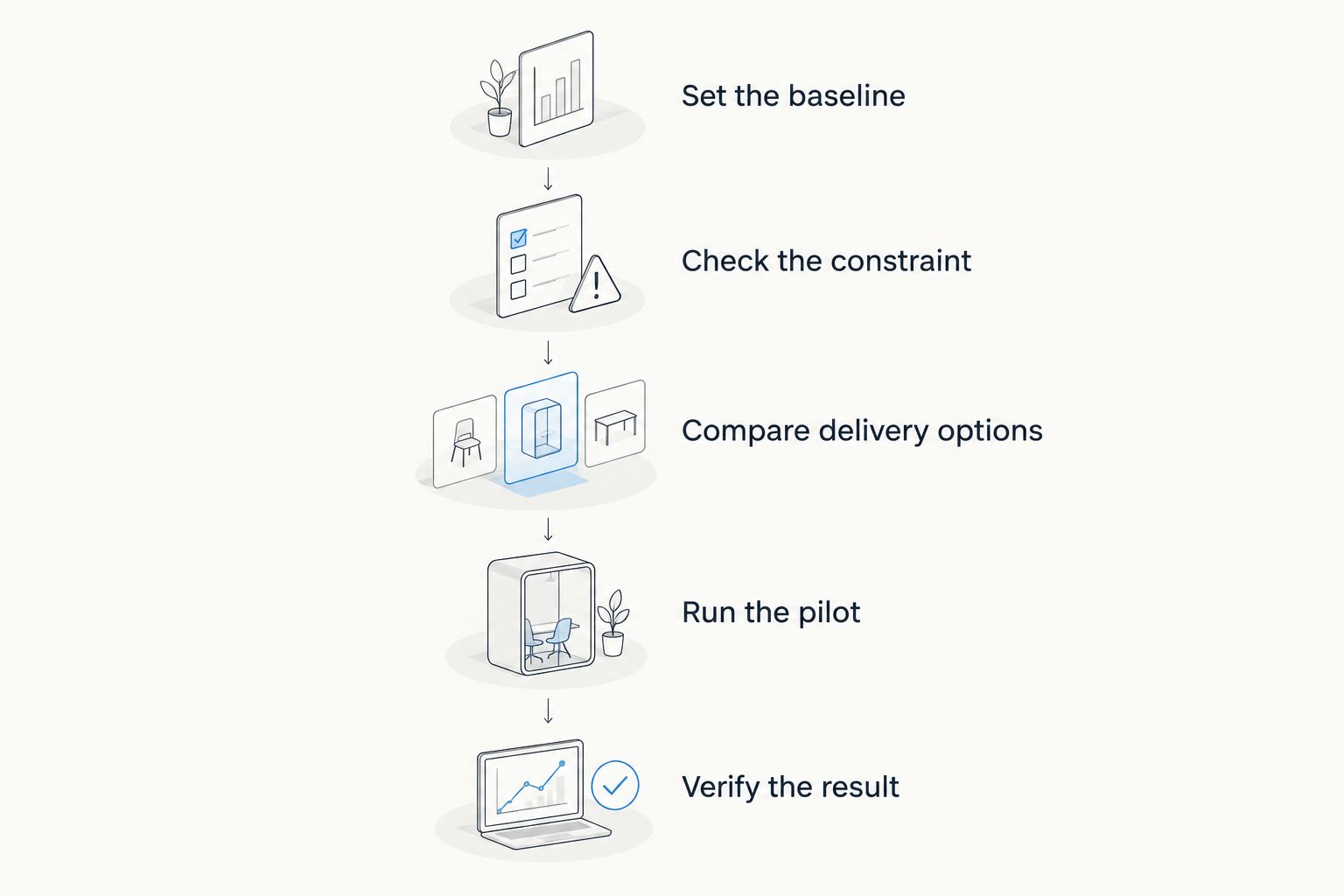
How to test the business case before a wider rollout
Use a sequence that makes evidence available before the larger commitment. Each stage should produce a decision, not simply another document.
1. Set the baseline
Choose a workflow with an observable outcome. Record what happens today, where the records come from, and which exceptions belong in the measurement.
For example, an order-entry project should distinguish time spent entering information from time spent waiting for customer clarification. Combining those activities would make it difficult to tell whether the software change solved the intended problem.
2. Check the constraint
Follow the work with the people responsible for it. Establish whether the obstacle is missing information, unclear approval authority, inconsistent processes, or a technical limitation.
Do not automate an unresolved policy question. If production and sales disagree on who can change a promised delivery date, software alone does not settle that responsibility.
3. Compare delivery options
Ask what your existing systems can support before approving replacement. Compare the operating consequences of configuration, integration, process redesign, and a new build.
If ERP replacement is under consideration, use the manufacturing ERP software guide to prepare evaluation questions. The selection still needs evidence from your own workflows, data, and support requirements.
4. Run the pilot
Limit the initial change to a manageable operating scope, such as a workflow or production area. Define the test, the exception cases, and the conditions that require a pause or rollback.
Include the people who will use and support the change. A demonstration performed only by the delivery team does not establish that your staff can operate the process independently.
5. Verify the result
Compare the outcome against the original baseline and record relevant changes in operating conditions. Confirm that the improvement did not shift extra work into another department.
Expand only after the responsible business owner accepts the result. If the pilot does not meet the agreed test, revise the approach or stop; completing the build is not sufficient justification to continue.
How do you calculate the return on consulting?
Calculate the return from the full change, not the advisory engagement in isolation. Include implementation, internal staff effort, data preparation, training, support, and any operating disruption attributable to the project.
Use a consistent evaluation period:
Net benefit = attributable operational benefit minus total change effort and expenditure.
Then compare the net benefit with the total investment. Keep recurring benefits and one-time benefits separate, and have finance review the assumptions before approval.
Be precise about what counts as a benefit:
- Released staff capacity: Record the work removed and identify how the available time will be used. Time saved is not automatically a payroll reduction.
- Additional production: Confirm that demand and downstream capacity support the extra output. Faster processing alone does not establish additional revenue.
- Reduced rework or scrap: Use production and quality records, with consistent definitions before and after the change.
- Lower inventory exposure: Distinguish reduced purchasing or holding expenditure from the release of cash tied up in stock.
Avoid counting the same improvement twice. If a reduction in manual work supports extra output, do not also claim the full value of that time as a separate financial gain without explaining the distinction.
Your 2026 business case should show which benefits are measured, which remain assumptions, and who will validate them. An unsupported payback claim is not a substitute for that record.
Do manufacturers need a new ERP system to transform operations?
No—manufacturers should not assume that digital transformation requires ERP replacement. First establish whether the current problem comes from the software itself, its configuration, disconnected applications, inconsistent data, or the way people use it.
Replacing a system does not eliminate the need to define ownership and operating rules. Those decisions still have to be made, and postponing them transfers uncertainty into implementation.
Ask the consultant to demonstrate why a less disruptive option would not meet the requirement. If replacement is justified, document which capabilities are essential and which requests can wait.
Keep the business requirement stable while comparing technical approaches. Otherwise, every demonstration adds features to the scope without proving that the original operating problem will be solved.
How should you choose a consulting partner?
Evaluate the proposed working method before the presentation quality. Ask how the provider will observe your workflows, challenge assumptions, test exceptions, and transfer responsibility to your staff.
Use these questions in the selection meeting:
- Who will perform the assessment and make technical recommendations?
- What access and staff participation does the engagement require?
- Which deliverables allow another team to execute the plan?
- How will the provider distinguish an integration problem from a process problem?
- What evidence is required before recommending replacement?
- Who owns documentation, system access, and support responsibilities at handover?
For manufacturers evaluating Hexagon IT Solutions, the best starting point is a defined software problem with a measurable acceptance test. Apply the same standard to every provider; a relevant proposal should explain the operational result before listing technology choices.
Treat unclear deliverables, untested savings claims, and automatic expansion into a larger program as reasons to pause. A provider should be able to explain both the benefits and the limits of the recommended approach.
FAQ
Is digital transformation consulting worth it for a small manufacturer?
Digital transformation consulting is worth it for a small manufacturer when a specific operating problem requires expertise or delivery capacity the business lacks. Start with a bounded assessment or pilot rather than an undefined company-wide program.
Can our internal IT team lead digital transformation?
Your internal IT team can lead digital transformation when it has the capacity, authority, and skills to deliver the required change. Operations must still own process decisions and acceptance; IT should not be asked to resolve business rules alone.
How do we know whether a consultant's savings estimate is credible?
A credible savings estimate identifies the baseline, calculation, assumptions, and person responsible for validation. Reject estimates that treat all released staff time as cash savings or assume that additional production automatically becomes revenue.
Should we replace our manufacturing systems before hiring a consultant?
Do not replace manufacturing systems before establishing the operating requirement and evaluating the alternatives. Configuration, integration, process correction, and replacement should be assessed against the same acceptance criteria.
What should we include in a manufacturing transformation brief?
Include the operating problem, affected workflow, baseline, business owner, constraints, and expected deliverables. Require a pilot acceptance test and a handover plan before authorizing broader implementation.
One last thing
Before approving a 2026 transformation project, ask the proposed owner to describe how the process will run when the new system is unavailable. The answer exposes dependencies, manual fallback needs, and responsibilities that a successful demonstration can leave untested.
Define the fallback before launch. It turns business continuity from an assumption into an explicit delivery requirement.
Related guides
- How long does a digital transformation project take?
- How much does a custom manufacturing ERP system cost?
- How long does ERP implementation take?
Schedule a consultation with Hexagon IT Solutions to discuss your manufacturing workflow, its constraints, and the outcome your project needs to deliver.
Discuss your manufacturing project
Bring a defined workflow problem and the business outcome you need to improve.


