






A custom CRM is worth it for your construction company in 2026 when documented gaps in bid tracking, relationship management, or project handoffs justify the responsibility of building and maintaining it. If your real problem is inconsistent follow-up or unclear ownership, fix the process before commissioning software; custom development adds maintenance, testing, and training obligations beyond the initial build.
- Is a custom CRM worth it for construction companies? Yes, when measurable workflow gaps justify development and ongoing ownership.
- Configure an existing CRM first when standard relationship tracking and follow-up meet your needs.
- Separate construction sales workflows from project delivery before setting the development scope.
- Bring documented workflow gaps to a Hexagon IT Solutions consultation before approving custom development.
Is a custom CRM worth it for construction companies in 2026?
Build a custom CRM only when the business case survives comparison with configuring an existing system. Your requirements should explain what breaks today, who experiences the problem, and how you will verify that the replacement works.
For a construction business, that assessment starts with the relationship between an opportunity, its bidders, its estimates, and the eventual project. The CRM development guide for construction companies provides a starting point for defining that scope.
| Approach | Best for | Main advantage | Main limitation |
|---|---|---|---|
| Configure an existing CRM | Teams whose sales process fits available configuration | Uses existing software capabilities without commissioning the entire application | Your requirements must fit the platform’s configuration boundaries |
| Extend an existing CRM | Teams with a suitable core system and specific workflow gaps | Retains the current foundation while addressing selected gaps | Extensions depend on the platform and require ongoing testing |
| Build a custom CRM | Teams with documented requirements that existing options cannot meet | Lets you specify the application around approved requirements | You take responsibility for development, maintenance, and future changes |
Do not select custom development because the feature list looks more ambitious. Select it because a specific requirement matters to your operation and the alternatives fail a practical test.
Why this matters
Construction relationship tracking is not always a simple contact-to-sale sequence. A useful requirements exercise asks whether your team needs to connect owners, developers, general contractors, subcontractors, consultants, and separate bidding organizations to the same opportunity.
Consider an illustrative workflow: your estimator prices a package, business development follows up with different contacts, and operations receives the awarded scope. If those teams cannot establish which scope was accepted, another dashboard does not resolve the underlying handoff.
The business outcome is a reliable next action and an accurate transfer of responsibility—not a larger contact database. Define that outcome before discussing screens, automation, or reporting.
When configuration is the better choice
Best for: teams with straightforward pipelines and inconsistent execution. Start with configuration when you need clear stages, required fields, assigned tasks, and usable reporting rather than a different application structure.
Ask a provider to demonstrate your actual workflow using representative records. Require the demonstration to include an exception, such as a revised estimate or a changed decision-maker, instead of accepting a polished sequence that only covers the easiest case.
Configuration still requires decisions about ownership, data quality, and adoption. Its limitation is fit: if essential relationships or approval rules cannot be represented clearly, documenting workarounds is not the same as solving the requirement.
When extending your current CRM is the better choice
Best for: teams with a working CRM and an identifiable gap. An extension deserves consideration when the existing system handles relationship management adequately but a particular integration, approval, or handoff needs additional work.
Preserve what works. Specify the extension’s inputs, outputs, permissions, and failure handling before approving it.
The trade-off is dependency. Changes to the underlying platform or connected application require testing, so an extension still needs a named technical owner and a support plan.
When a custom CRM earns its place
Best for: teams whose documented operating requirements do not fit the alternatives. Custom development makes sense when the application must represent relationships, approvals, or handoffs that configuration and extensions cannot satisfy acceptably.
Describe each requirement as a business event. For example: when an opportunity becomes an awarded job, the approved scope and responsible contacts must transfer to the receiving team without creating a second opportunity.
A custom application does not automatically deliver that outcome. The contract, acceptance tests, data model, and implementation work must make it explicit.
Why the value of a custom construction CRM varies
Your 2026 decision should turn on operational differences, not the assumption that a larger company automatically needs custom software. Evaluate these factors against your own records:
- Relationship structure: Identify whether an opportunity involves separate organizations, contacts, bidders, and project stakeholders that must remain connected.
- Bid and estimate revisions: Establish how your team distinguishes current scope, earlier submissions, alternates, and follow-up responsibilities.
- System boundaries: Decide which application owns customer records, estimates, awarded jobs, and financial information.
- Handoff requirements: Specify what operations needs from sales before accepting responsibility for a job.
- Data and access rules: Define required fields, duplicate handling, role-based access, and responsibility for correcting records.
- Internal ownership: Name the business owner who approves changes and the technical owner who maintains the application.
These factors affect both the potential benefit and the implementation burden. A complicated workflow is not automatically a reason to reproduce every existing step in software; first remove approvals, fields, and duplicate entry that serve no clear purpose.
How to test the business case before approving a build
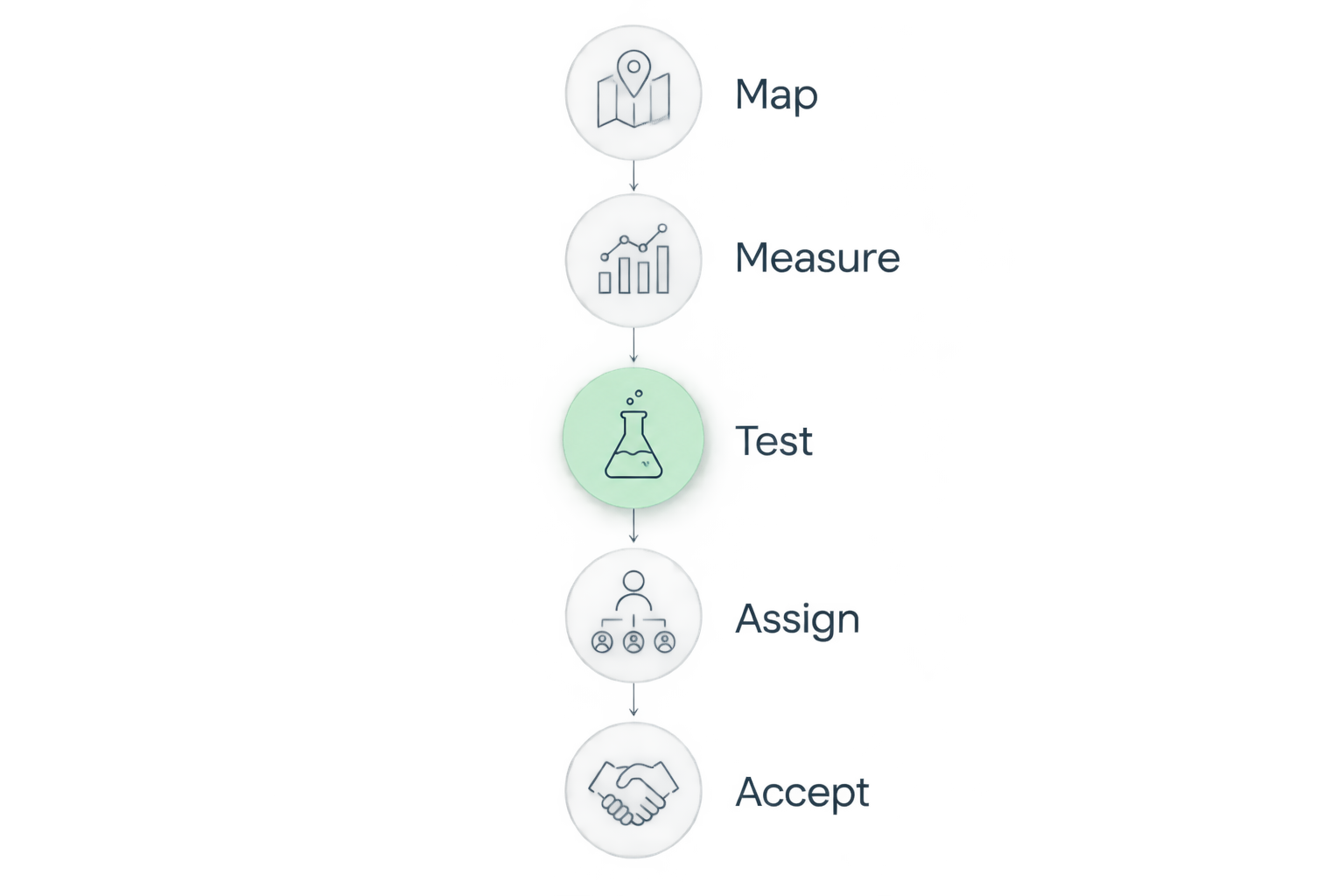
Use a small, documented evaluation rather than a feature wish list. The following sequence is a recommended decision process, not an implementation timeline.
Map 1 workflow
Choose 1 workflow from initial inquiry through award and handoff. Record its steps, responsible people, required information, and exceptions.
Use a real completed opportunity with sensitive information removed. Ask the people who perform the work to identify where they re-enter information, wait for clarification, or lose track of the next action.
Establish 3 measures
Choose 3 measures tied to the selected workflow: administrative time per opportunity, elapsed time between defined stages, and handoff records requiring correction. Define exactly when measurement starts and stops.
Separate recorded results from estimates. For the 2026 business case, preserve the original baseline so later improvements are not judged against a moving target.
Test the alternatives
Run the same example through configuration, an extension, and a proposed custom workflow. Mark each requirement as demonstrated, dependent on additional work, or unmet.
Do not let a presentation substitute for evidence. Ask the evaluator to revise an estimate, change a contact’s role, transfer ownership, and recover from a failed data transfer wherever those actions are relevant.
Assign 1 owner
Assign 1 business owner authority over scope, acceptance, and priorities. Give that person access to representatives from estimating, sales, operations, and IT as required.
Without a decision-maker, conflicting preferences remain unresolved. A developer should not have to decide which department’s definition of an awarded job is authoritative.
Set acceptance criteria
Write acceptance criteria before development begins. Each criterion should identify an action and an observable result: a status change creates the required handoff record, for example, without duplicating the underlying opportunity.
Include failure cases. State what happens when required information is missing, a connected application is unavailable, or a user lacks permission to approve a change.
How should you calculate the return?
Measure released capacity separately from cash savings. Reducing administrative work creates usable time, but it does not automatically reduce payroll or produce additional revenue.
For each task, multiply the measured time reduction by the number of times the task occurs. Then state what your team will do with the released capacity, such as following up on open bids or preparing estimates.
Keep these benefit categories separate:
- Capacity: Time no longer spent re-entering information, finding records, or correcting handoffs.
- Execution: Fewer overdue actions or incomplete transfers, measured against defined rules.
- Financial impact: A documented change in expenditure or contribution, supported by your own business records.
Do not treat the full value of an opportunity as a CRM benefit. Winning work involves factors beyond the system, and contract revenue is not the same as profit.
For your 2026 approval, compare verified benefits with the full ownership commitment. Include migration, integration work, user training, hosting, security maintenance, support, and future changes in the evaluation without assuming that the initial development agreement covers them.
Where should a construction CRM stop?
A construction CRM scope should distinguish relationship and opportunity management from project execution. Otherwise, a focused sales improvement can turn into an undefined replacement for every business application.
Decide where estimating, scheduling, procurement, accounting, and document control belong. Then define what information the CRM needs from those systems and what it must send back.
| Information | Decision to make | Acceptance question |
|---|---|---|
| Customer and organization records | Choose the authoritative record | Can users identify the correct customer without creating a duplicate? |
| Estimate and scope status | Define what the CRM stores or references | Can sales distinguish the accepted scope from an earlier revision? |
| Awarded opportunity | Define the handoff event | Does the receiving team get the approved information and ownership? |
| Financial status | Define the required visibility and source | Can users identify where the financial information originated? |
A unified workflow does not require every function to live in a single application. It requires clear ownership and dependable information transfer.
What should you require from a development proposal?
Require a proposal to distinguish agreed functionality from assumptions. A list of modules does not explain how your team will work or how you will establish that delivery is complete.
Ask for written answers covering:
- Scope: Included workflows, exclusions, and acceptance criteria.
- Data: Migration responsibilities, duplicate handling, exports, and deletion procedures.
- Integration: Connected systems, transfer direction, error handling, and maintenance responsibilities.
- Security: Access controls, authentication requirements, logging, and responsibility for updates.
- Ownership: Contract terms for source code, documentation, accounts, and access credentials.
- Support: Defect handling, change requests, release responsibilities, and handover arrangements.
These are procurement requirements, not assumed features of a custom CRM or any provider’s service. Put the agreed answers in the contract rather than relying on a demonstration or verbal assurance.
When should you postpone custom development?
Postpone the build when your team cannot agree on the workflow it needs. Custom software records decisions; it does not remove the need to make them.
Wait if nobody owns customer data, departments use conflicting stage definitions, or your requirements amount to reproducing existing spreadsheets without questioning them. Fixing those foundations gives you a clearer specification and a better test of existing software.
Also postpone when the business case depends entirely on assumed revenue growth. Start with observable problems, measure them, and approve development only after the evidence supports the scope.
FAQ
Is a custom CRM worth it for a small construction company?
A custom CRM is worth it when documented workflow requirements justify development and ongoing maintenance, not simply because the business works in construction. Test configuration and targeted extensions before approving a build.
Is a custom CRM better than an off-the-shelf CRM for contractors?
A custom CRM is better only when it meets essential requirements that the evaluated alternatives cannot satisfy acceptably. Existing software remains a valid choice when its configuration supports your relationships, follow-up, and handoffs.
How much does a custom construction CRM cost?
A meaningful estimate requires an agreed scope covering workflows, data migration, integrations, security, and support. Ask providers to separate initial delivery from ongoing responsibilities so you can compare proposals consistently.
Should a construction CRM replace project management software?
A construction CRM should replace project management software only if the approved scope explicitly includes the required delivery functions. Otherwise, define the handoff and information exchange between the systems.
What should construction companies evaluate before building a CRM in 2026?
In 2026, construction companies should evaluate workflow fit, measurable operational benefits, system boundaries, and long-term ownership. Require demonstrated acceptance criteria rather than relying on a feature list.
One last thing
Before approving development, ask your team to reconstruct an awarded opportunity from first contact to operational handoff. Require them to identify the accepted scope, decision-makers, next action, and accountable owner using the current records.
The gaps in that exercise give you a practical starting specification. Build around those gaps—not around every feature that looked useful in a demo.
Related guides
- Is a custom CRM better than off-the-shelf software?
- ERP development for construction companies
- How long does it take to build a custom CRM system?
Schedule a consultation with Hexagon IT Solutions to discuss your construction CRM requirements and the workflow you need to improve.


