






Mortgage software development cost depends on the workflows you need to build, the systems you must connect, and the responsibilities your team will retain after launch. For a 2026 budget, separate implementation from ongoing hosting, external services, maintenance, and operational support; comparing development alone leaves part of the commitment out of view.
- Mortgage software development cost starts with scope: distinguish a borrower portal from a complete loan origination system.
- Compare configuration, integration, and custom development against the same workflow requirements before choosing an approach.
- Budget for migration, testing, security, and ongoing ownership—not just the initial build.
- Keep credit decisioning separate from routine loan tracking when defining responsibilities and acceptance criteria.
Why this matters
You cannot compare proposals when each supplier is pricing a different interpretation of “mortgage software.” A borrower application, an internal loan tracker, and a replacement loan origination system are different projects, even when their screens look similar.
Before discussing a build with Hexagon IT Solutions, identify the operational problem: repeated data entry, unclear ownership, missing documents, or slow handoffs. Choose the smallest scope that fixes the documented problem without creating another disconnected system.
The business case should name the affected process and its owner. “Improve the borrower experience” is not enough; “let applicants submit documents and see outstanding requests without calling operations” gives a development team something concrete to estimate and test.
How much does mortgage software development cost?
There is no single defensible cost for mortgage software without a defined scope. The useful answer is a project-specific estimate that separates initial delivery, external dependencies, and ongoing operation.
For a 2026 estimate, ask every supplier to complete the same breakdown. Require each line to identify its deliverable, assumptions, exclusions, and acceptance criteria rather than presenting one unexplained total.
| Budget component | What the estimate should cover | What to clarify before approval |
|---|---|---|
| Discovery and design | Workflow mapping, user roles, requirements, interface design | Which workflows and exceptions are included? |
| Application development | Agreed screens, business rules, permissions, reporting | What constitutes a completed feature? |
| Integrations | Data mapping, authentication, synchronization, error handling | Which systems and interfaces are confirmed? |
| Migration | Data extraction, cleanup, mapping, validation | Who fixes incomplete or inconsistent records? |
| Testing and release | Functional testing, security checks, deployment, rollback planning | Who approves release readiness? |
| Ongoing operation | Hosting, monitoring, maintenance, support | What remains the lender’s responsibility? |
Approve a defined scope, not a headline estimate. An apparently simpler proposal can exclude migration, integration failures, or post-launch support that another proposal includes.
Ask suppliers to distinguish confirmed work from work dependent on discovery. That distinction makes uncertainty visible without treating every unresolved question as a committed deliverable.
Borrower portal: best for improving application handoffs
A borrower portal is the narrower choice when your existing mortgage systems remain in place and the problem sits at the customer-facing handoff. A proposed scope might include application intake, document submission, status visibility, and communication preferences.
Its advantage is focus. You can define the borrower journey without replacing every internal lending process, provided the existing systems can exchange the required information.
The limitation is dependency on those systems. A polished portal does not resolve conflicting loan statuses, unclear document ownership, or slow internal approvals by itself.
Before requesting an estimate, specify which system owns each field and how borrowers receive updates. Include failed uploads, duplicate submissions, and incomplete applications in the workflow—not only the successful path.
Loan tracking integration: best for connecting existing operations
An integration project fits when your team already has the necessary applications but staff repeatedly copy information between them. The proposed work should center on data ownership, status mapping, handoffs, and exception handling.
The advantage is preserving useful systems while addressing a specific operational gap. The trade-off is that your process remains dependent on the interfaces and data quality of those systems.
Use the mortgage software to automated loan tracking workflow to frame the handoffs you need to specify. Your estimate should identify what happens when a record changes, a connection fails, or the destination rejects an update.
Do not accept “integration included” as a complete description. Require the supplier to name the exchanged records, update direction, triggering events, and recovery responsibilities.
Custom origination platform: best for requirements existing tools cannot meet
A custom origination platform is the broader option when your documented requirements cannot be met through configuration or targeted integration. Depending on the agreed scope, it can involve borrower intake, processing workflows, document handling, permissions, reporting, and connections to external services.
The advantage is control over the agreed workflows. The limitation is ownership: your organization must make decisions about requirements, releases, support, and changes after deployment.
Custom development is not automatically the right answer to an inconvenient process. First distinguish an actual platform limitation from inconsistent operating procedures or unused configuration options.
| Approach | Best for | Main advantage | Main limitation |
|---|---|---|---|
| Configure an existing platform | Requirements already supported by the platform | Uses existing capabilities | Constrained by configuration and vendor interfaces |
| Add a portal or integration | A defined gap around existing systems | Limits replacement scope | Retains dependencies on existing systems |
| Build a custom platform | Documented requirements existing tools cannot meet | Control over agreed workflows | Requires ongoing technical and operational ownership |
Why mortgage software development cost varies
The important drivers are not the number of screens alone. The same screen can support a straightforward task or conceal complicated rules, permissions, and external dependencies.
For your 2026 scope, examine these factors:
- Workflow boundaries. A document request workflow and a complete origination process involve different responsibilities. Define where the application starts and stops.
- Business rules. Conditional fields, approval routes, exceptions, and rule changes require explicit definitions and testing.
- System connections. Each connection needs agreed data mappings, access arrangements, error handling, and an owner.
- Data migration. Existing records require assessment before a supplier can define cleanup and validation work.
- Security and access. Borrower information requires deliberate decisions about permissions, storage, logging, and access removal.
- Operational support. Monitoring, incident handling, software updates, and release management remain necessary after deployment.
Separate requirements you need at launch from ideas for later releases. Otherwise, optional features become mixed with essential work, making the estimate harder to challenge and the release harder to approve.
How do you get a mortgage software development estimate?
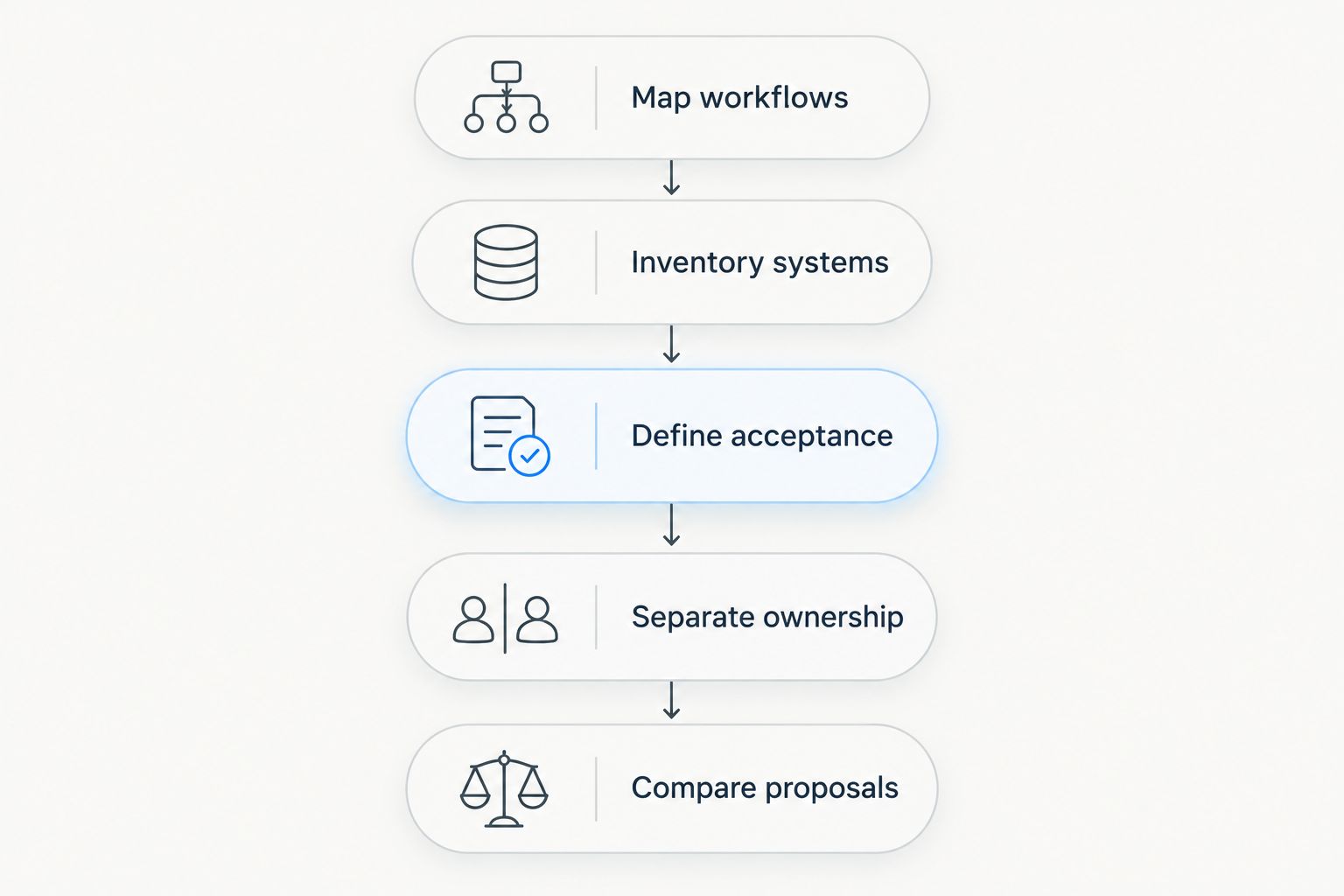
Give suppliers a shared decision package rather than a feature wish list. The following sequence creates a basis for comparing proposals and exposes questions your team must answer before committing to delivery.
Map workflows
Describe how a loan moves through the specific process you want to change. Name the people involved, the information they need, and the conditions that prevent work from progressing.
Include exceptions such as missing documents, withdrawn applications, reassigned files, and corrections. These cases reveal requirements that a simple demonstration can hide.
Inventory systems
List the applications that hold borrower, loan, document, and reporting data. For each relevant field, identify the authoritative source and who can change it.
Confirm access to documentation and test environments before treating an integration as settled. A connection shown in a sales presentation is not a substitute for a defined implementation dependency.
Define acceptance
Write acceptance criteria in operational language. For example, a status change should reach the intended destination, preserve the correct record relationship, and produce a visible exception when delivery fails.
Specify who verifies the outcome. Business users should approve workflow behavior, while technical owners verify the supporting implementation.
Separate ownership
Assign responsibility for data cleanup, security decisions, user training, release approval, and support. Mark work that belongs to the lender, the development supplier, or another provider.
This prevents a proposal from appearing complete while essential responsibilities remain unassigned. Include these boundaries in the contract and project plan.
Compare proposals
Compare deliverables and exclusions before comparing totals. Ask each supplier to explain dependencies, change control, and what happens when an assumption proves incorrect.
For a 2026 procurement decision, keep the approved scope version attached to the estimate. A proposal loses its meaning when the requirements change but the commercial comparison does not.
Keep credit decisioning separate from routine automation
Moving a document request or updating a loan status is not the same as determining a credit outcome. If credit decisioning enters the proposed scope, define its rules, authorized changes, validation requirements, and review responsibilities separately.
The scope of credit decision engine implementation should identify policy ownership, data dependencies, testing, and exception review—not stop at connecting an interface. Those responsibilities belong in the delivery plan even when another provider supplies the engine.
Ask how the proposed system records the information and rule version associated with an outcome. Your legal, compliance, and risk teams should determine which records and controls apply to your lending activities; a development proposal is not a legal assessment.
Do not treat a working demonstration as approval to automate a lending decision. Technical behavior, business policy, and release authorization need separate acceptance.
Account for the work that continues after launch
A mortgage software development budget should distinguish the release project from the operating commitment. Hosting and external services are only part of that commitment; someone must also investigate failures, maintain connections, manage permissions, and approve changes.
Ask suppliers to describe support boundaries in plain language. “Maintenance included” does not explain who handles an interrupted connection, a changed external interface, or a new reporting requirement.
Your 2026 operating plan should also identify who receives alerts and who can authorize corrective action. A notification without an accountable owner leaves the operational problem unresolved.
Make migration an acceptance decision
A successful import is not proof that the migrated records are usable. Agree how your team will check field mappings, document relationships, ownership, and the treatment of incomplete records.
Keep a record of exceptions and assign remediation. Do not allow unresolved migration problems to disappear into a general launch checklist.
Define an exit path
Ask how your organization can retrieve its data, access relevant documentation, and transfer operational responsibility. Include these questions before signing, not when a supplier relationship ends.
Custom software creates control only when your organization can exercise it. Documentation, access arrangements, and clear ownership make that control practical.
FAQ
How much does mortgage software development cost in 2026?
Mortgage software development cost requires a project-specific estimate covering scope, integrations, migration, testing, and ongoing operation. Request an itemized proposal tied to written acceptance criteria rather than treating a generic figure as a budget.
Is building mortgage software better than buying a platform?
Building mortgage software fits requirements that configuration or targeted integration cannot meet. An existing platform is the stronger starting point when it already supports your essential workflows and your team accepts its constraints.
What should a mortgage software development quote include?
A mortgage software development quote should identify deliverables, assumptions, exclusions, dependencies, acceptance criteria, and ownership. It should distinguish initial delivery from ongoing support and external services.
Can we start with loan tracking instead of replacing our entire system?
A loan tracking integration is a narrower option when the operational problem is data handoffs between existing systems. Confirm data ownership, interface access, and failure handling before approving that scope.
Does custom mortgage software automatically meet compliance requirements?
Custom mortgage software does not automatically satisfy applicable compliance requirements. Your legal, compliance, and risk teams must define the obligations and approve the relevant controls for your lending activities.
One last thing
Before approving development, ask who owns a failed handoff after launch. If the answer depends on discovering which supplier is responsible during an incident, the scope is not finished.
Define recovery ownership alongside the successful workflow. That small procurement decision makes the proposal more accountable and gives operations a clear action when something breaks.
Related guides
- How much does custom software development cost?
- Best mortgage software platforms for lenders
- How long does a digital transformation project take?
Schedule a consultation with Hexagon IT Solutions to discuss your mortgage software scope, system dependencies, and delivery responsibilities.


