





Your firmware development cost in 2026 depends on the hardware, required behavior, testing obligations and release scope—not just the time spent writing code. Budget for hardware bring-up, verification, production handoff and maintenance alongside implementation, and require each supplier to identify what its estimate excludes.
- Firmware development cost needs a defined hardware baseline, acceptance tests and release scope before supplier estimates are comparable.
- Prototype firmware proves behavior; production firmware also needs recovery, testing, manufacturing support and maintainable releases.
- Compare firmware development companies on deliverables and assumptions, not an isolated engineering rate.
- Separate device firmware from cloud services, mobile applications, certification work and ongoing maintenance in your budget.
How much does firmware development cost in 2026?
Firmware development requires a scope-based estimate rather than a universal project average. Ask for an engineering breakdown tied to your actual device, supported hardware revisions and acceptance criteria. A supplier should explain what it will deliver, how it will verify that work and which dependencies remain your responsibility.
When evaluating firmware development companies, use the same requirements brief for every candidate. Otherwise, you risk comparing a demonstration build with a production release while treating them as equivalent proposals.
Use this breakdown to check whether a proposal covers the complete release:
| Work package | What the estimate should describe | Boundary to clarify |
|---|---|---|
| Requirements and architecture | Device behavior, interfaces and technical constraints | Who resolves incomplete requirements? |
| Hardware bring-up | Boot behavior, peripheral checks and board-level investigation | Who fixes hardware defects? |
| Firmware implementation | Drivers, application logic and communications | Which functions and interfaces are included? |
| Verification | Test procedures, equipment and acceptance evidence | Which failure conditions must be tested? |
| Release and handoff | Build instructions, source code and production artifacts | Who owns programming and deployment? |
| Maintenance | Defect handling, updates and supported releases | What happens after acceptance? |
Treat the table as a purchasing checklist, not a mandatory package. A narrowly scoped engineering task does not need every deliverable. A production commitment needs explicit decisions about each one.
Why this matters
A device that works on a developer's desk has not yet demonstrated that it can recover from interrupted power, handle invalid input or enter production consistently. Those behaviors require requirements and verification, not assumptions.
Your 2026 budget should distinguish between proving an idea and supporting a released product. That distinction gives founders a clearer funding decision and gives operations teams a clearer handoff. It also prevents a supplier from meeting a narrow demonstration milestone while your business expects a production-ready device.
Define the release outcome before negotiating the engineering rate. A rate tells you how work is billed; it does not tell you how much work your product requires.
Prototype firmware: best for validating a technical assumption
Prototype firmware is best for answering a specific feasibility question before you commit to a production design. That question might concern sensor communication, actuator control or whether the selected processor can execute the required behavior.
The advantage is focus. You can isolate the uncertain part of the product without specifying every production workflow. The limitation is equally important: a successful demonstration does not establish production readiness.
Write down which shortcuts are acceptable. For example, a prototype might depend on a developer's debugging connection or a manual setup procedure. Those dependencies need replacement if the release must operate without engineering assistance.
Before accepting prototype work, ask for:
- The technical question the build answers.
- The hardware and conditions used for the demonstration.
- Known limitations and unresolved failures.
- The work required to move beyond the prototype.
Do not describe prototype completion as product completion in your internal budget. Keep the next engineering decision visible.
Production firmware: best for a defined product release
Production firmware is best for a device with agreed operating requirements, release conditions and ownership responsibilities. Its scope extends beyond successful behavior to include defined responses when something goes wrong.
The benefit is an explicit release standard. The trade-off is additional work on testing, recovery, traceability and handoff that a feasibility build can omit.
For a 2026 production proposal, specify how the device should behave during startup, communication loss, invalid configuration and interrupted operations. Also identify which hardware versions the release must support.
Production readiness is a contract boundary, not a label. Ask the supplier to connect each promised behavior to an acceptance test and a deliverable. If the proposal says only that the firmware will be production-ready, request the underlying criteria before approval.
Existing firmware changes: best for bounded improvements
An existing-code engagement is best for a clearly defined change to firmware you can build, inspect and test. Examples include correcting a reproducible defect, adding a documented interface or supporting an agreed hardware revision.
Reusing working software avoids replacing functions that already meet requirements. The limitation is that unfamiliar code, missing dependencies or absent tests can make the change harder to estimate.
Separate initial code assessment from the implementation commitment when the baseline is uncertain. Require the assessment to establish whether the supplied source matches the deployed device and whether the team can reproduce a release.
Which firmware scope fits your project?
| Scope | Best for | Main benefit | Main limitation |
|---|---|---|---|
| Prototype firmware | Testing a specific feasibility question | Keeps work focused on the unknown | Does not establish production readiness |
| Production firmware | Delivering an agreed product release | Defines behavior, verification and handoff | Requires broader acceptance criteria |
| Existing firmware changes | Modifying a reproducible baseline | Preserves working functionality | Depends on code quality and build access |
Choose the scope that matches your next business decision. Do not purchase a prototype while promising customers a supported production release.
Why firmware development cost varies
The engineering work changes when the device, its environment or its release obligations change. Use these factors to explain differences between proposals rather than assuming every supplier has estimated the same job.
- Hardware maturity: A stable board and documented components give the team a clearer baseline. Unresolved electrical issues introduce investigation that application coding alone cannot address.
- Peripheral and protocol requirements: Sensors, storage, radios and external systems each need defined interactions. Document expected behavior, error handling and ownership of interface specifications.
- Timing and resource constraints: Response deadlines, memory limits and power requirements influence implementation and verification. State measurable acceptance conditions instead of asking for fast or efficient firmware.
- Security and update requirements: Authentication, credential handling, update verification and recovery need explicit scope. Decide which functions the product requires rather than treating security as an undefined allowance.
- Verification obligations: Environmental conditions, fault scenarios and release evidence shape the test plan. Identify applicable product requirements before the supplier commits to delivery.
- Handoff and support: Manufacturing programming, diagnostic tools, documentation and maintenance are separate deliverables. Assign owners so these tasks do not appear only when the product reaches release.
Ask suppliers to tie uncertainty to a specific assumption. A proposal that explains its dependencies is easier to manage than one that hides them inside a single total.
How do you get a usable firmware estimate?
Give suppliers a brief that lets them identify engineering tasks and dependencies. Follow this sequence before asking for a delivery commitment.
Define behavior
Describe what the device must do, what triggers each action and what constitutes failure. Include startup, normal operation and recovery. Replace vague requirements such as reliable connectivity with observable behavior that your team can accept or reject.
Confirm hardware
Provide the processor, board revision, schematics, component documentation and access to representative devices. Mark unresolved hardware decisions clearly. A supplier cannot treat an undecided component as a confirmed integration dependency.
Set acceptance
Define the tests and evidence required for approval. Assign responsibility for fixtures, test equipment and external assessment. Your acceptance criteria should distinguish a firmware defect from a hardware issue or an unavailable external service.
Assign ownership
Specify ownership of source code, build scripts, signing credentials, documentation and release artifacts. Name the party responsible for manufacturing programming and field deployment. These decisions determine whether another team can reproduce and maintain the release.
Review assumptions
Ask for exclusions, dependencies and a process for approving changes. Every assumption should identify what happens if it proves false. Keep unresolved questions visible rather than allowing them to become implied commitments.
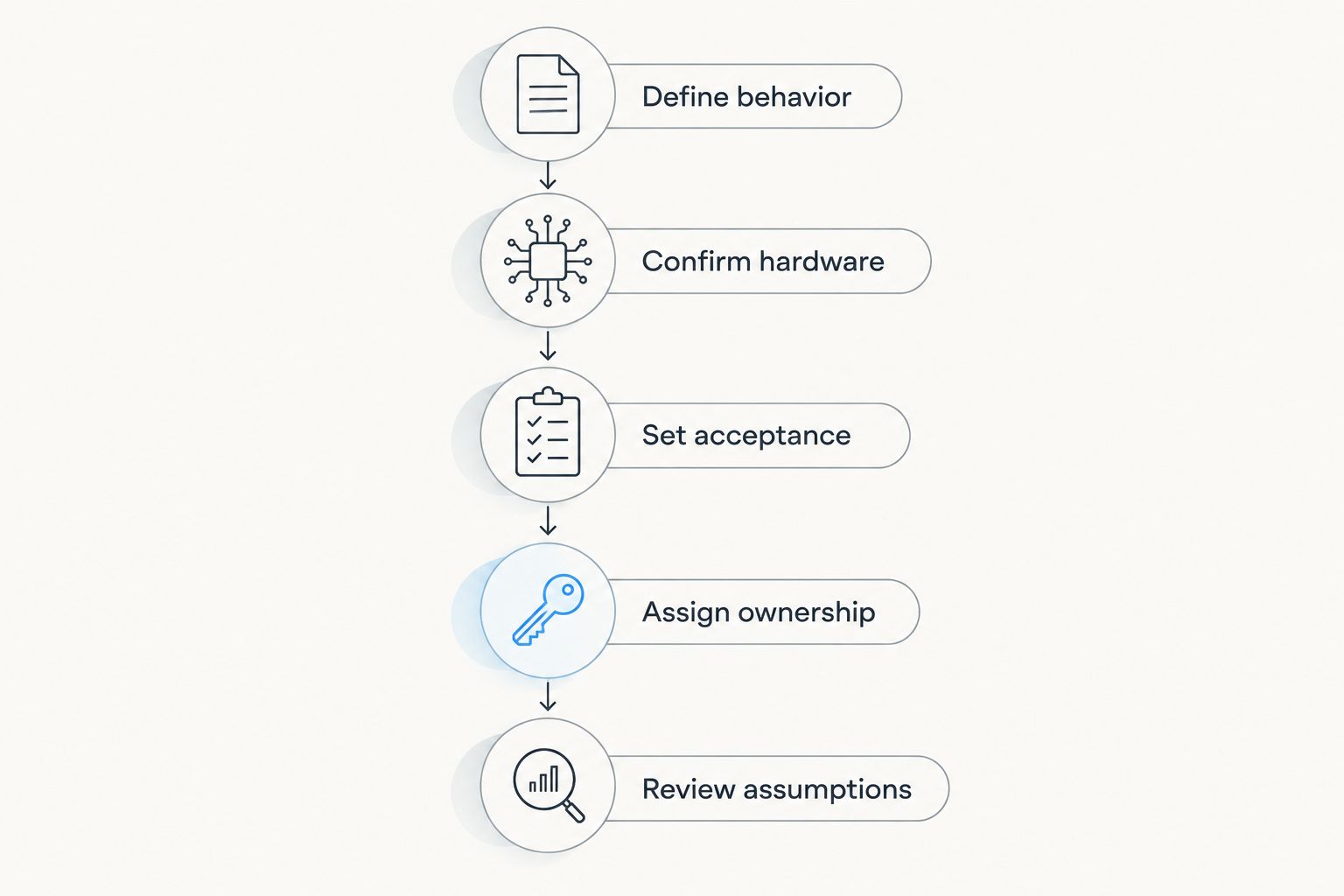
A useful estimate connects this brief to work packages and acceptance evidence. You should be able to trace a promised outcome back to an owner and a deliverable without interpreting technical shorthand.
Keep the device budget separate from the wider system
Connected products can include firmware, a mobile application, cloud services and business-system integrations. Those components interact, but they are not interchangeable deliverables.
For your 2026 plan, identify which team owns each interface. Define the messages exchanged, the handling of rejected requests and the behavior when connectivity disappears. Otherwise, an integration problem can remain unresolved while each supplier considers its own component complete.
Also separate firmware verification from external product testing or certification activity. Ask who determines the applicable requirements, prepares evidence and resolves findings. Do not assume a firmware development agreement includes every obligation associated with selling the finished device.
This separation is not an argument for more suppliers. It is a way to make responsibility explicit whether you appoint a single delivery partner or several specialist teams.
How should you compare firmware proposals?
Compare the same release boundary before comparing commercial terms. Match supported hardware, functions, tests, documentation and post-release responsibilities across proposals.
Ask each supplier to demonstrate how it will reproduce a build and show that the release meets acceptance criteria. For existing firmware, request a clear account of the baseline assessment and any conditions attached to its estimate.
Keep business outcomes in the discussion: what decision will the milestone enable, and who can use the delivered work without the original developer present? Hexagon IT Solutions is a consultation option for buyers defining the software scope around a firmware project.
A consultation still needs to produce useful boundaries. Ask any prospective partner to identify the capabilities required for your device and confirm who will perform the embedded engineering work.
Does maintenance belong in the initial budget?
Firmware development cost should include a separate maintenance scope when your business expects post-release support. Define supported hardware, defect reporting, release approval and responsibility for distributing updates.
Ownership matters as much as the support arrangement. Keep access to the source repository, build dependencies and required credentials under an agreed process. A support handoff is incomplete if the receiving team cannot reproduce the released firmware.
Can reusing existing firmware reduce development work?
Firmware development cost depends partly on whether existing code provides a usable baseline. Reuse preserves working behavior, but undocumented dependencies and missing tests still require investigation.
Before approving reuse, establish that the code builds, matches the deployed hardware and permits the intended use. Then estimate the requested change separately from any necessary baseline repair.
FAQ
What should a firmware development quote include?
A firmware development quote should define hardware, required behavior, work packages, acceptance tests, deliverables, exclusions and ownership. It should also distinguish the initial release from ongoing maintenance.
Is prototype firmware ready for production?
Prototype firmware is not automatically ready for production. A production release needs its own acceptance criteria, including the required failure handling, verification and handoff.
Can I compare firmware developers using hourly rates?
Hourly rates alone do not establish the total work required. Compare proposals against the same hardware baseline, functions, testing obligations and release responsibilities.
Who should own the firmware source code?
Your agreement should explicitly assign source-code ownership and access rights. It should also cover build scripts, dependencies, release artifacts and credentials needed to maintain the device.
One last thing
Ask a receiving engineer to reproduce the release from the handoff materials before you accept the project. A working device proves behavior; a reproducible build proves your team can create that firmware again.
Make that distinction part of your 2026 acceptance criteria. It gives you a concrete check on maintainability without relying on a supplier's description of the handoff.
Related guides
- How much does custom software development cost?
- How much does API integration cost?
- How long does a digital transformation project take?
Schedule a consultation with Hexagon IT Solutions to discuss your device's software scope and delivery requirements.
Define your software scope
Discuss requirements, system boundaries and acceptance criteria before requesting a delivery estimate.


