






Construction management software cost depends on your users, project scope, contract terms and implementation requirements—not a single industry-wide figure. To set a usable 2026 budget, compare the subscription or development agreement with the full cost of data migration, integrations, training, internal staff time and ongoing support.
- Construction management software cost requires a defined scope, not just a subscription quote.
- Compare licensing, implementation, integrations and support over the same ownership period.
- Custom development fits distinctive workflows; packaged software fits requirements you can meet through configuration.
- Hexagon IT Solutions offers a consultation path for teams assessing their software requirements.
Why this matters
Your budget can look acceptable while leaving essential work outside the agreement. A subscription does not tell you who will clean historical records, connect accounting systems or teach site supervisors the new approval process.
Compare the cost of a working process, not just access to software. Before requesting proposals, document what must change between the office and the jobsite. You can discuss that scope in a consultation with Hexagon IT Solutions.
How much does construction management software cost?
There is no universal cost that answers the question for every contractor. A useful quote must identify what you are buying, how usage affects billing and which deployment tasks remain your responsibility.
For your 2026 evaluation, require the following breakdown from every shortlisted provider. Keep recurring obligations separate from initial deployment work so a lower opening commitment does not obscure later expenses.
| Budget component | What to include in your request | What to clarify before signing |
|---|---|---|
| Software access | Required modules and user roles | Which activities or users trigger additional charges? |
| Implementation | Configuration, workflow setup and testing | Who delivers each task, and what counts as completion? |
| Data migration | Records, attachments and historical projects | Who cleans, maps and validates the imported data? |
| Integrations | Accounting and other required systems | Does the agreement cover setup and ongoing maintenance? |
| Training | Office staff, supervisors and administrators | Are onboarding materials and follow-up sessions included? |
| Support | Troubleshooting and operational assistance | What service commitments appear in the contract? |
| Exit work | Data exports and transition assistance | Which formats and assistance are included? |
Use this planning equation:
Total ownership cost = software access + implementation + migration + integrations + training + internal labor + ongoing maintenance + exit obligations.
Not every agreement separates these items. Ask the provider to mark each one as included, excluded or your responsibility; an unassigned task is not a finished budget.
Packaged software: best for workflows that fit configuration
Packaged construction software is the appropriate starting point when your requirements fit an existing product without extensive changes. Evaluate the actual workflows you need rather than the length of a feature list.
Ask the provider to demonstrate a project from setup through reporting. Include the handoffs between field staff, project managers and finance, then record any work that still happens outside the system.
- Advantage: You can assess existing functionality before committing to implementation.
- Trade-off: Your team must accept the product's supported workflows or fund work around the gaps.
- Best for: Contractors whose essential processes fit the demonstrated configuration.
Check the billing basis explicitly. Ask whether the agreement uses named users, active projects, business entities, usage or another measure; do not assume that every employee needs the same access level.
Choose packaged software when it completes your required process without creating a second administrative process beside it.
Custom development: best for requirements configuration cannot meet
Custom development deserves consideration when a necessary workflow cannot be met through configuration. Describe the operational requirement first: what information moves, who approves it and what result the business needs.
A development estimate should separate discovery, design, engineering, testing, deployment and maintenance. Require clear acceptance criteria so both sides can distinguish a completed requirement from a requested change.
- Advantage: You can define the workflow and required connections around your business process.
- Trade-off: You must make product decisions and assign responsibility for ongoing maintenance.
- Best for: Teams with documented requirements that existing configurations cannot satisfy.
Do not commission custom software merely because an existing interface feels inconvenient. First establish whether the limitation prevents necessary work, creates repeated manual handling or blocks a required connection.
Choose custom development for a proven requirement, not an undefined preference. A detailed scope makes competing proposals more comparable and gives you a basis for controlling changes.
Extending existing software: best for a bounded workflow gap
A replacement is not the only option to evaluate. If your existing software handles the core process, investigate whether configuration or a focused integration can address the remaining gap.
For example, your requirement might be to transfer approved project information into accounting without re-entry. Treat that as a specific integration question rather than immediately turning it into a full platform replacement.
- Advantage: You can preserve workflows that already meet your requirements.
- Trade-off: You must establish who owns failures and changes across the connected systems.
- Best for: Teams with a functioning core system and a clearly bounded missing connection.
Check the technical access and contractual permissions before approving this route. An integration plan needs a confirmed way to exchange the required information, not an assumption based on a sales demonstration.
Which approach should you budget for?
Compare the approaches against the same required outcome. Do not compare a configured subscription proposal with a custom build that includes substantially more work.
| Approach | Best for | Main benefit | Main limitation | Evidence to request |
|---|---|---|---|---|
| Packaged software | Requirements met through configuration | Existing functionality to evaluate | Product-defined workflow boundaries | A demonstration using your process |
| Custom development | Necessary, distinctive workflows | Control over specified requirements | Development and maintenance responsibility | Scope, acceptance criteria and ownership terms |
| Existing software extension | A bounded gap in a working system | Preserves suitable existing processes | Dependencies across connected systems | Confirmed access and an integration responsibility plan |
The right comparison is equivalent scope, not equivalent labels. A proposal called a complete implementation still needs an explicit list of deliverables.
Keep optional functionality outside the initial comparison. Otherwise, a proposal can appear more expensive simply because it includes work you have not decided to buy.
Why construction management software cost varies
Build your 2026 requirements around these five questions. Each question identifies something that belongs in the proposal rather than an assumption to resolve during deployment.
- Access scope: Which employees, subcontractors and external stakeholders need access, and what must each role do? Request the billing treatment for every required role.
- Workflow scope: Which project activities must the system support at launch? Separate mandatory approvals and reporting from optional improvements.
- Data migration: Which records and attachments must move? Specify what your team will clean and what the provider must validate.
- System connections: Which information must pass between construction software, accounting and other systems? Define the direction, frequency and owner of each transfer.
- Operational responsibility: Who configures, trains, supports and maintains the system? Assign the work before approving the budget.
These are scope decisions, not reasons to accept an unexplained estimate. When a proposal changes, require the provider to connect the change to a specific requirement or contractual obligation.
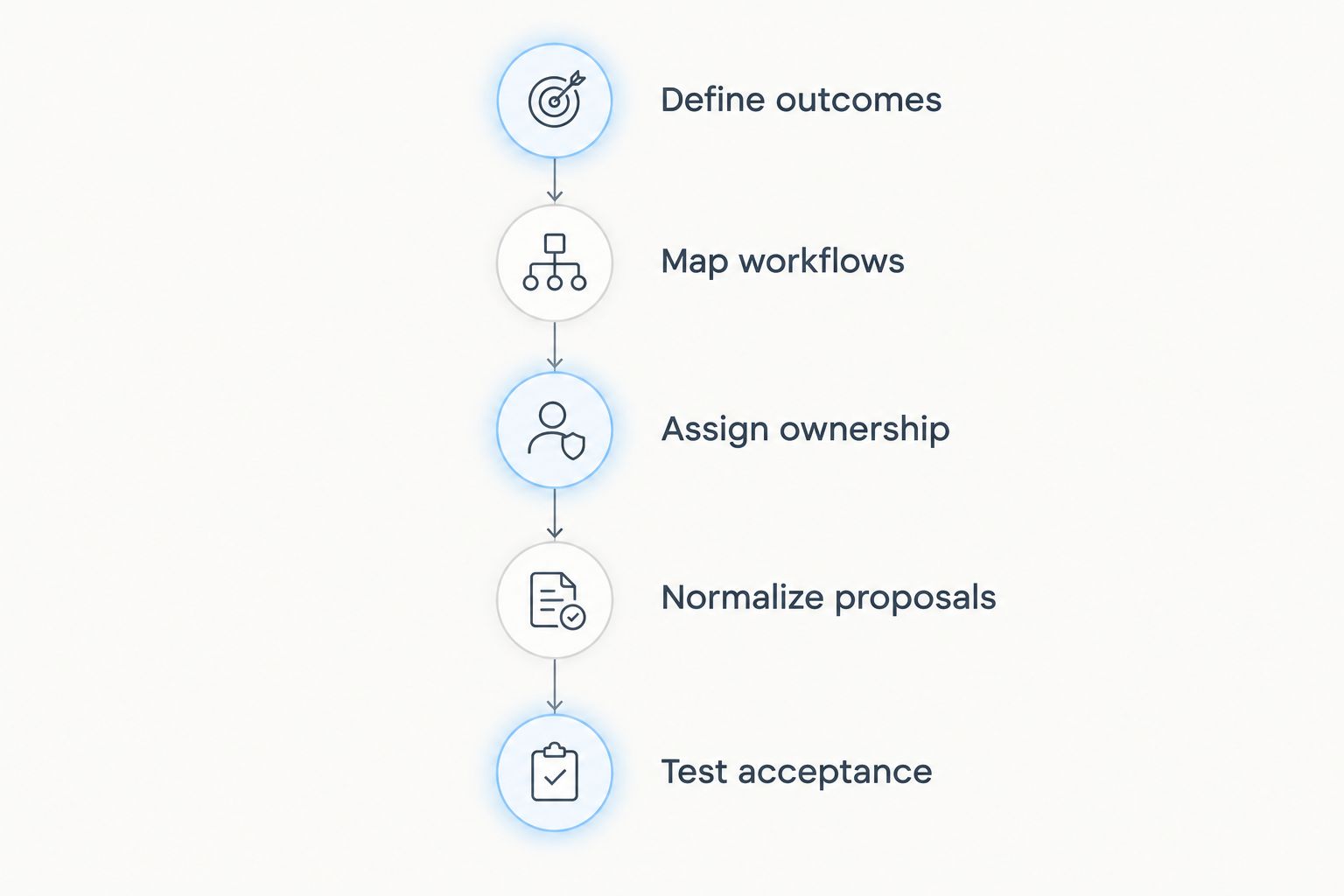
How do you build a defensible software budget?
Use the following sequence to turn a broad software request into an approval-ready decision. Give each step an owner and retain the resulting document with the proposal.
1. Define outcomes
State what the business needs to accomplish. Examples include eliminating repeated entry of approved information or making project status available without assembling separate spreadsheets.
Avoid promising a financial return before measuring the current process. Record how the work happens today and which parts the proposed system must change.
2. Map workflows
Document who creates, reviews, approves and receives information. Include exceptions such as rejected submissions, corrected records and staff absences.
A demonstration that follows only the ideal path does not establish whether the system fits your operation. Ask the provider to show what happens when information needs correction.
3. Assign ownership
Name the person responsible for data preparation, configuration decisions, user training and acceptance testing. Distinguish your internal work from the provider's deliverables.
Internal effort belongs in the budget even when it does not appear on an invoice. Use your own labor assumptions rather than treating staff time as costless.
4. Normalize proposals
Request the same deliverables, user roles and ownership period from every provider. Compare 12 months for the initial operating view and 36 months for a longer planning view; these are comparison windows, not contract recommendations.
Keep assumptions visible. If a proposal excludes a required task, add your estimate for completing it before comparing totals.
5. Test acceptance
Write the evidence required to approve deployment. That evidence should demonstrate a completed business process, including the required reporting and system connections.
Tie approval to documented results rather than a general statement that setup is complete. Record who can accept the work and how unresolved issues will be handled.
What should a 2026 quote include?
Request a written statement of work alongside the commercial agreement. The proposal should explain what the provider will deliver, what your team must supply and how changes receive approval.
Use this checklist during procurement:
- Required functionality, roles and deployment scope.
- Named deliverables and acceptance criteria.
- Migration sources, exclusions and validation responsibilities.
- Integration scope and ongoing maintenance ownership.
- Training responsibilities and support commitments.
- Billing basis, renewal terms and change-control process.
- Data access, export rights and termination obligations.
Ask the provider to walk through a realistic change: another required workflow, an additional user role or a changed accounting connection. The purpose is to understand the contractual mechanism, not to negotiate against an imagined scenario.
Do not approve a quote while essential work remains described as “to be determined.” Resolve it, exclude it deliberately or create a separately approved discovery stage.
How do you judge whether the investment is worthwhile?
Evaluate the proposed improvement against your own operating baseline. Count the work the system is expected to remove, then confirm through acceptance testing that the new process actually removes it.
For a 2026 business case, distinguish three categories: measurable labor changes, measurable error-related work and benefits you cannot yet quantify. Keep the last category visible without presenting it as guaranteed savings.
Use measured task frequency and measured handling time to estimate labor impact. Then identify what the business will do with any released capacity; time saved is not automatically a reduction in payroll.
Include adoption in the decision. If field staff must continue submitting information outside the agreed workflow, investigate the cause before treating deployment as a completed improvement.
FAQ
How much should I budget for construction management software in 2026?
Budget for the complete agreed scope, including software access, deployment, migration, integrations, training and ongoing responsibilities. Request an itemized quote based on your users and workflows rather than applying a universal industry figure.
Is custom construction software better than a subscription?
Custom construction software fits necessary requirements that an existing product cannot meet through configuration; a subscription fits requirements an existing product can demonstrate. Compare equivalent scope and include maintenance responsibility in the decision.
What costs should I check beyond the software agreement?
Check data preparation, migration, integration maintenance, training, internal staff time and exit obligations. Ask the provider to identify whether each item is included, excluded or your responsibility.
Should subcontractors and field staff count toward the budget?
Include subcontractors and field staff in your access requirements when they must use the system. Ask the provider how each required role affects the agreement instead of assuming all access is billed identically.
How do I compare construction software proposals fairly?
Compare proposals against the same workflows, user roles, deliverables and ownership period. Add the work excluded from each proposal before evaluating the total commitment.
One last thing
Ask to see how you will export your project information before signing. Specify the records, attachments and usable formats you need, then put that requirement in the agreement.
A system evaluation should cover both entry and exit. Your approval decision is stronger when you understand how the business will retain access to its information.
Related guides
- Best construction management software
- How much does custom software development cost?
- How much does API integration cost?
Schedule a consultation with Hexagon IT Solutions to discuss your construction software requirements and define the scope you need quoted.


