






Supply chain software implementation time depends on the workflows, data, integrations, and locations included in your rollout—not a universal number of weeks. To set a defensible launch date in 2026, separate initial deployment from operational readiness, including data reconciliation, user acceptance, and post-launch support.
- Supply chain software implementation time needs a defined scope and acceptance criteria, not a generic calendar estimate.
- ERP integration belongs in the schedule before you commit to a launch date.
- A phased rollout limits initial exposure but requires temporary coordination between old and new processes.
- Approve go-live only after business users validate transactions, inventory records, and exception handling.
Why this matters
A software launch date and a usable operating process are different commitments. Your warehouse team needs to receive goods, your purchasing team needs reliable order information, and finance needs records that reconcile—not just working login credentials.
Define completion by business transactions, not installation. Otherwise, a project can appear finished while employees still reconcile spreadsheets or repair failed transfers manually.
If your supply chain rollout also changes finance or purchasing, review how long ERP implementation takes alongside the operational plan. Shared data and approval dependencies belong on the same schedule, even when separate teams own the systems.
How long does supply chain software implementation take?
A credible implementation estimate starts with a scoped work plan and ends with agreed acceptance criteria. Ask the implementation team to show the work behind the proposed date rather than accepting a duration based solely on company size or software category.
Use this sequence to build your 2026 implementation schedule:
- Define the first release. Name the workflows, locations, users, and systems included at launch. Record exclusions just as clearly.
- Inspect the data. Identify the source of each required record, the cleanup needed, and who approves the migrated result.
- Map dependencies. Document integrations, business decisions, access requirements, and external parties that must participate.
- Estimate the work. Have accountable owners estimate configuration, development, migration, testing, and training tasks.
- Find the critical path. Identify dependent tasks whose delay moves the launch date. Do not simply add every task duration together; some work can run in parallel.
- Approve the readiness gates. Agree on the evidence needed for pilot approval, production launch, and handover to support.
Ask for a target date, the assumptions behind it, and the conditions that trigger a revision. That gives leadership a schedule it can manage rather than a promise it cannot inspect.
What should the implementation schedule include?
| Workstream | Evidence needed before completion | Business owner to involve |
|---|---|---|
| Process design | Approved workflows, decisions, and exceptions | Operations leadership |
| Data migration | Reconciled records and documented corrections | Data owners and finance |
| Configuration | Approved rules, permissions, and workflows | Functional leads |
| Integration | Successful transfers and tested failure recovery | IT and system owners |
| User acceptance | Signed-off business scenarios | Purchasing, warehouse, and planning leads |
| Cutover | Approved transition and recovery plan | Project sponsor and operations |
| Stabilization | Clear issue ownership and support handover | Operations and support leads |
The schedule should name an owner for each deliverable. A task marked complete without business approval is not the same as an accepted outcome.
A focused rollout: define the smallest useful release
Best for: A team that can improve a specific workflow without immediately replacing every connected process.
A focused rollout narrows the first release to a defined operating problem. For example, you can scope purchasing approvals separately from a broader warehouse redesign if the required dependencies allow it. Treat this as a planning choice, not a guaranteed shortcut.
The advantage is a smaller initial testing and training scope. The limitation is that excluded processes still need a clear interface with the new workflow, whether through an integration or a documented manual handoff.
For a focused 2026 rollout, write a release statement that names the business outcome, included users, required data, and acceptance evidence. Reject additions that do not support that outcome unless the sponsor explicitly changes the schedule and scope.
A phased rollout: separate local readiness from final completion
Best for: A business that can introduce changes by site, workflow, or operating group.
A phased rollout lets you test a defined operating scope before expanding. The first release can expose issues that need correction before other locations adopt the same process.
The trade-off is coexistence. Teams must know which system controls each record, how transactions move between environments, and who resolves discrepancies during the transition.
Do not describe the first site going live as full implementation. Your schedule needs separate milestones for the initial release, subsequent releases, and retirement of replaced processes.
A coordinated cutover: prepare for a shared transition
Best for: A business whose included processes cannot operate independently during the transition.
A coordinated cutover moves the agreed scope into production together. It avoids an extended period of different teams operating under different system rules, but it concentrates transition risk into the launch window.
Preparation must cover transaction cutoff, data transfer, access, validation, communications, and recovery decisions. Rehearse the sequence before launch and assign authority to stop the transition when an agreed readiness condition fails.
Which rollout approach fits your business?
| Approach | Best for | Main advantage | Main limitation |
|---|---|---|---|
| Focused rollout | A separable workflow with a clear outcome | Narrower initial change scope | Excluded workflows still need handoffs |
| Phased rollout | Sites or teams that can transition separately | Learning before wider deployment | Temporary coexistence needs management |
| Coordinated cutover | Processes that must transition together | A shared changeover point | Readiness failures affect the combined scope |
Choose the rollout approach around operational dependencies, not the earliest-looking date. A smaller first release is useful only when the business can operate it safely alongside the remaining processes.
Why supply chain software implementation time varies
These factors belong in the estimate because they change the work required—not because they justify an unexplained contingency allowance.
- Process scope. Purchasing, inventory, fulfillment, and planning have different requirements. Name the transactions included rather than using a broad label such as complete supply chain.
- Data readiness. Duplicate item records, inconsistent units of measure, and incomplete supplier details create cleanup and validation work. Assign correction ownership before migration.
- Integration behavior. Define what moves between systems, which system owns the record, and how failures are recovered. A successful connection alone does not prove a complete workflow.
- Customization. Distinguish required business controls from preferences about how the existing process looks. Each approved change needs design, testing, and support ownership.
- Business participation. Purchasing, warehouse, finance, and IT teams need time to make decisions and validate results. Put their commitments into the schedule rather than treating them as informal availability.
- Cutover constraints. Operating hours, inventory counts, transaction cutoff, and business commitments affect when a transition is practical. Confirm those constraints before approving a launch window.
For each factor, record the current assumption, accountable owner, and unresolved decision. Review changes against the schedule so leadership can see why a milestone moves.
How do you build a schedule you can defend?
Start with business acceptance and work backward. For your 2026 plan, each phase should produce evidence that allows the next phase to proceed.
Scope approval
Document the workflows and exceptions the first release must handle. Include decision rights: who approves a purchase, corrects an inventory record, or authorizes a shipment exception.
The output is an approved scope, not just meeting notes. Keep requested additions in a separate change list until someone approves their effect on delivery.
Data approval
Map required fields, transformation rules, and ownership. Test a migration with representative records before treating the data-transfer process as ready.
Reconcile the result against the agreed source. Include quantities and units of measure, not just whether a record appeared in the destination.
Workflow approval
Test complete business scenarios across system boundaries. A purchase order that reaches the next application still needs the right status, quantities, permissions, and exception behavior.
Include failure cases. Ask what happens when a transfer fails, a receipt differs from the order, or a user lacks approval authority.
Launch approval
Confirm training, access, support ownership, and recovery procedures before production use. Have the responsible business leads approve readiness for their workflows.
Make the decision explicit: proceed, resolve a named blocker, or revise the release scope. An unresolved issue needs an owner and a disposition—not a hopeful status label.
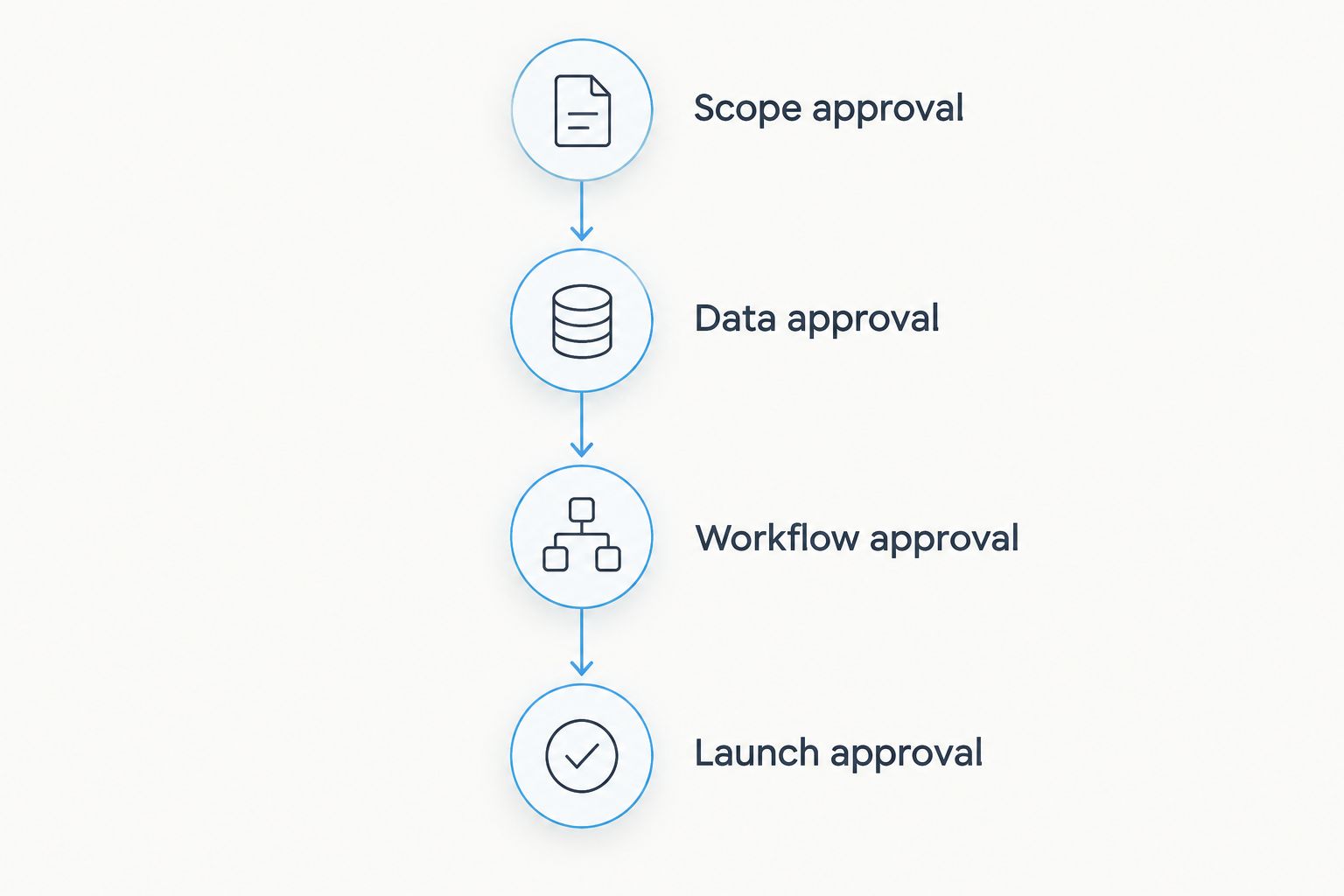
A readiness-based schedule makes stalled decisions visible. It also separates technical completion from the business approval needed to operate the system.
How can you shorten implementation without moving risk into operations?
Reduce the first-release scope before reducing validation. Removing an optional report changes the deliverable; skipping inventory reconciliation leaves uncertainty inside the operating process.
Use these actions when the proposed schedule does not meet the business deadline:
- Defer requirements that do not support the first release's business outcome.
- Assign decision-makers before configuration work starts.
- Begin data cleanup while process design is underway where dependencies permit.
- Confirm access and participation with external system owners early.
- Resolve disagreements about record ownership before integration development.
- Train users on approved workflows rather than unfinished screens.
Do not assume extra developers will remove a waiting period for business approval or third-party access. Match the corrective action to the actual constraint.
Does implementation finish at go-live?
Go-live marks production use, not automatic completion. Define stabilization as a separate milestone with named owners, issue priorities, and handover criteria.
After launch, verify that the business can complete the included workflows and resolve exceptions through the agreed support process. Close implementation when the handover conditions are met—not merely when the project team stops attending meetings.
Can implementation run alongside normal operations?
Parallel operation requires explicit record ownership and reconciliation. Tell employees which system they must use for each transaction and how the team will prevent duplicate or conflicting updates.
Keeping the old system available is not, by itself, a recovery plan. Document the conditions and steps for resuming work if the new process cannot continue.
FAQ
What's the first thing to define before estimating supply chain software implementation time?
Define the first release's workflows, locations, users, and acceptance criteria before estimating supply chain software implementation time. The estimate needs a specific deliverable and clear exclusions.
Is cloud supply chain software automatically faster to implement?
Cloud delivery does not remove data migration, integration, process design, training, or business acceptance work. Compare the work included in each proposal rather than treating the hosting model as a launch-date guarantee.
Should we clean inventory data before implementation starts?
Start identifying inventory data problems before migration and assign owners to correct them. Validate required fields, units of measure, duplicates, and record ownership against the agreed operating process.
What should we ask an implementation partner for in 2026?
Ask for a scoped delivery plan with dependencies, accountable owners, acceptance gates, and a cutover approach. Require the partner to distinguish initial production use from stabilization and final handover.
Can we launch supply chain software before every requested feature is finished?
You can defer requested features when the approved release still supports its required workflows and controls. Document exclusions, temporary handoffs, and responsibility for the later work before launch.
One last thing
Before approving a 2026 launch date, ask someone to demonstrate what happens when an integration fails halfway through a transaction. The recovery process deserves the same attention as the successful transaction because operations must know what to do next.
For a supply chain software implementation consultation with Hexagon IT Solutions, bring your workflow scope, system list, data owners, and launch constraints. Use the discussion to establish the work behind the date; confirm delivery scope and responsibilities before making a commitment.
Related guides
- Supply chain management software
- Custom software development for logistics companies
- How long a digital transformation project takes
Schedule an implementation consultation
Discuss your supply chain workflows, integration dependencies, and launch requirements with Hexagon IT Solutions.


