





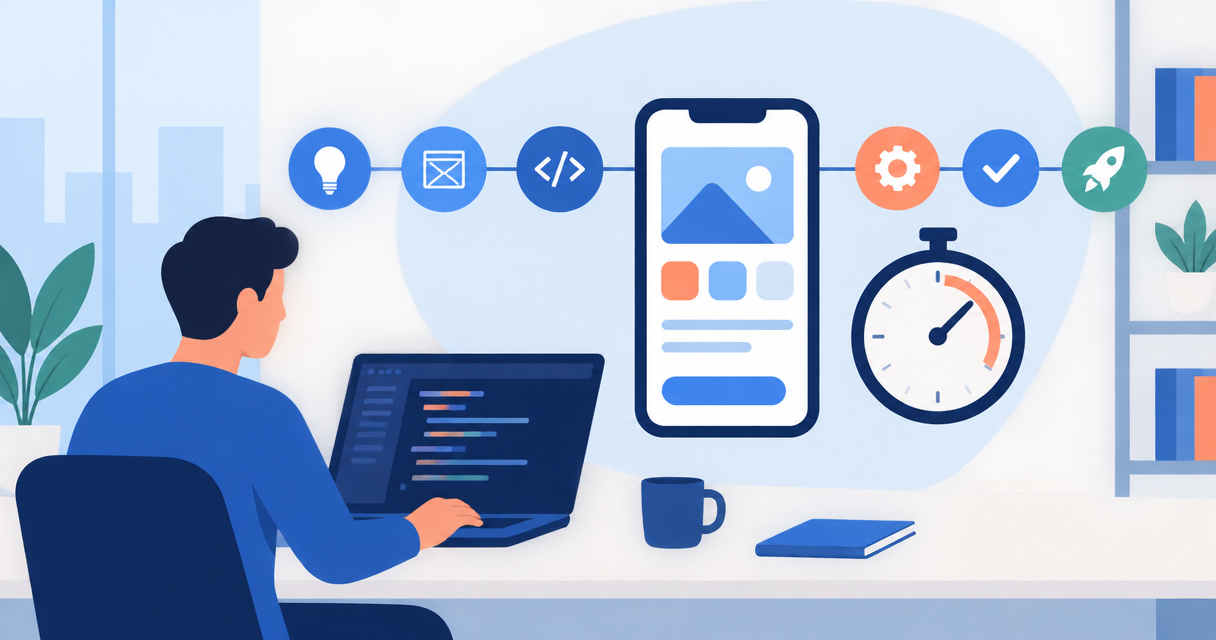
Mobile app development takes the time required to define, build, test and release your agreed launch scope—not a fixed number of months that applies to every app. If you need a dependable launch date in 2026, ask for a milestone schedule that includes backend work, business approvals and release preparation, not just coding.
- How long does mobile app development take? Scope and dependencies determine the schedule, not screen count alone.
- Separate prototype approval, working software and production launch; they are different milestones.
- Keep the first release focused on a complete customer or employee workflow.
- Use a Hexagon IT Solutions consultation to discuss mobile app development scope before committing to a launch date.
How long does mobile app development take?
A credible mobile app development timeline is a scope-based forecast, not a universal average. Your schedule must cover the work required to make the app usable in its intended operating environment, including dependencies outside the development team.
Use the following milestones to examine an estimate. Each milestone needs an owner, completion criteria and a clear relationship to the next stage.
| Milestone | What must be ready | What approval means |
|---|---|---|
| Scope agreement | Launch workflow, users and exclusions | The team knows what it must deliver |
| Design validation | Navigation, key screens and interaction rules | Business users accept the proposed workflow |
| Technical validation | Architecture, system access and integration checks | Critical technical assumptions have been examined |
| Working release | App, backend and required connections | The launch workflow runs end to end |
| Acceptance testing | Test results and business sign-off | The agreed release criteria are satisfied |
| Launch readiness | Distribution, support and operational preparation | The business is ready to release and operate the app |
For your 2026 launch plan, request dates against these milestones rather than accepting one final delivery date. If you are still choosing a build approach, examine whether no-code platforms can replace custom mobile app development before approving a custom-build schedule.
Why this matters
A launch date often drives hiring, training, customer communications and operational changes. When the date covers only software construction, those business commitments rest on an incomplete plan.
Define what launch means before discussing speed. An internal pilot, a public store release and a company-wide rollout have different completion requirements; treating them as the same event makes estimates difficult to compare.
Tie the deadline to a usable business outcome. For a field-service app, that outcome might be submitting a job report and making it available to the office—not simply opening a finished-looking reporting screen.
Choose the release you actually need
Your first decision is not how many features to build. It is what evidence or operational result you need from the next release.
The options below serve different purposes. None replaces the others automatically, and each creates a different scope for estimation.
| Release option | Best for | Main advantage | Main limitation |
|---|---|---|---|
| Clickable prototype | Checking navigation and workflow assumptions | Lets users respond before full implementation | Does not prove backend behavior or production readiness |
| Focused production release | Delivering a defined business workflow | Keeps launch scope tied to a usable outcome | Leaves additional workflows for later releases |
| Broader operational release | Supporting connected roles and processes at launch | Covers more of the intended operating model | Requires more acceptance and dependency coordination |
Clickable prototype: validate the workflow
Choose a prototype when you need to resolve questions about how people will use the app. Ask users to complete a realistic task rather than commenting only on individual screens.
The benefit is early feedback on navigation and process. The limitation is equally important: prototype approval does not establish how long production engineering, integration or release work will take.
Focused production release: complete the essential job
Choose a focused release when a defined group can obtain value from a narrow but complete workflow. Write down the starting event, the required actions and the successful business result.
A construction example is capturing a site issue, attaching supporting information and routing it to the responsible person. If offline submission is essential on site, excluding offline behavior does not create a smaller usable release; it removes a requirement the workflow depends on.
Broader operational release: coordinate connected processes
Choose a broader release when several roles must work together for the app to serve its purpose. Map the handoffs before approving separate feature lists for each department.
This approach supports connected operations, but the acceptance process must reflect that breadth. A manager approving a dashboard does not establish that field entry, permissions and downstream records work correctly.
Why mobile app development timelines vary
Screen count is not enough to explain delivery effort. Use these factors to expose the work behind the interface and identify what must be resolved before the schedule becomes dependable.
- Workflow scope: Each launch-critical action needs defined inputs, rules, exceptions and a successful outcome. An unclear approval process remains unclear when displayed inside an app.
- Platform requirements: Specify the devices, operating systems and distribution methods you need. The team must account for the behavior and validation required across that agreed scope.
- Backend readiness: Establish where records live, how users authenticate and which business rules the server must enforce. A mobile interface does not remove backend work.
- Integration dependencies: Confirm system access, documentation, test environments and ownership. A connection is not validated merely because an external system offers an API.
- Data and permission requirements: Define who can see, change and approve information. Include relevant security, privacy and retention requirements in the acceptance criteria.
- Decision ownership: Name the people authorized to approve designs, resolve business rules and accept releases. Unanswered decisions belong in the schedule as dependencies, not invisible assumptions.
For a 2026 procurement decision, require vendors to state how each factor affects their proposed plan. Compare the assumptions first; only then compare delivery dates.
How do you get a dependable app development estimate?
Build the estimate around evidence and explicit decisions. The following sequence gives your internal team and any development partner a shared basis for discussing the deadline.
Define the outcome
Write a concise statement of who uses the app and what they must accomplish. Include the business event that starts the workflow and the result that ends it.
For example, a professional-services app might let an employee submit an expense and allow an authorized manager to approve it. That description still needs rules for rejected submissions, supporting documents and record ownership before it becomes an estimable scope.
Map dependencies
List the systems, people and external decisions required to deliver the outcome. Assign an owner to each dependency and distinguish confirmed access from access someone expects to obtain later.
Do not treat a promised integration as a completed prerequisite. Ask the team to demonstrate a representative exchange with the target system before relying on that connection in the launch plan.
Validate assumptions
Identify the assumptions with the greatest effect on feasibility or sequencing. Test those assumptions through an appropriate technical check or user walkthrough before committing the full implementation plan.
The goal is not to build every feature early. It is to avoid treating an unresolved question as an established fact.
Agree acceptance
Document the conditions under which the business will accept the release. Cover normal use, relevant exceptions, access rules and the operating conditions that matter to your users.
Make these conditions observable. A statement such as “the app works well” does not tell a tester or business owner what qualifies as complete.
Plan release
Work backward from the intended launch event and identify the activities required before it. Include business sign-off, distribution preparation, support ownership and user readiness alongside technical delivery.
A public release also involves processes outside your team's direct control. Keep submission, approval and customer availability distinct in the plan rather than treating them as an interchangeable deadline.
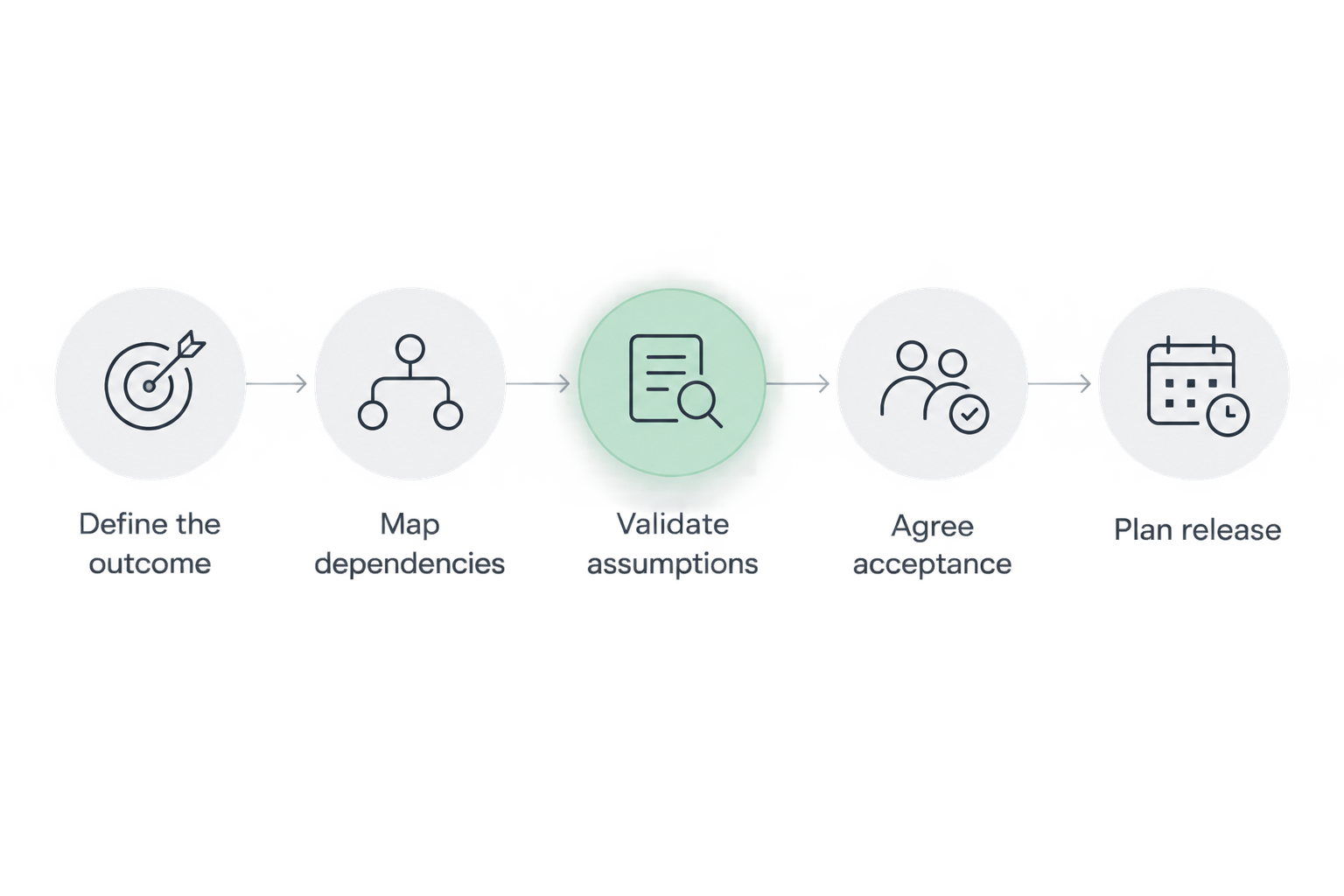
The result should be a schedule with named responsibilities, visible assumptions and agreed completion criteria. Do not approve a deadline without knowing what evidence will demonstrate completion.
How do you prevent scope changes from moving the launch?
Separate clarification from expansion. Clarifying an existing requirement establishes what the team already agreed to deliver; adding a new workflow changes the delivery obligation.
Maintain a launch scope and a later-release backlog. When someone requests a change, ask whether it replaces existing work, changes the deadline or belongs after launch.
Testing must follow the decision. After a requirement changes, testing changed acceptance criteria connects the revised business expectation to what the team verifies; testing only the original behavior leaves the new requirement unproven.
Use a change record that captures:
- The business reason for the request.
- The affected workflow and acceptance criteria.
- The implementation and testing implications.
- The decision owner and approved release.
For a 2026 launch commitment, make that decision process explicit before development begins. Calling every request essential does not establish priority; it removes the distinction between launch requirements and future improvements.
Can adding developers shorten the schedule?
Adding developers addresses capacity only when work can be divided and the team has the access, decisions and review capacity to support it. It does not settle an unresolved business rule or obtain an external approval.
Ask which specific work the additional people will own. Then ask what prevents that work from starting now and who will review the result.
The advantage of extra capacity is the ability to assign independent tasks. The limitation is the coordination and onboarding work that comes with a larger team; evaluate both rather than assuming headcount translates directly into an earlier release.
What should you ask before accepting a delivery date?
Ask the development partner to explain the schedule in business terms. You should be able to identify what will be usable at each milestone and what decisions you must make to keep work moving.
Use these questions during proposal review:
- Does the estimate include backend implementation and administrative workflows?
- Which integrations have been examined, and which remain assumptions?
- What devices and operating conditions are included in testing?
- Who accepts the release, and against which written criteria?
- What happens when a required dependency is late?
- Which responsibilities remain with your business after technical delivery?
Hexagon IT Solutions is a consultation option for founders and IT buyers planning a mobile app development project. Bring the same scope questions to that conversation; a useful consultation should help you distinguish business requirements from implementation assumptions.
Approve the delivery plan, not just the delivery date. A proposal with explicit exclusions is easier to evaluate than a confident deadline whose meaning remains undefined.
FAQ
How long does it take to build a mobile app from scratch?
A mobile app's development time depends on its agreed scope, technical dependencies, acceptance requirements and release process. Ask for a milestone-based estimate that includes design, backend work, integrations, testing and launch preparation.
Is an app prototype the same as a finished app?
No. A clickable prototype can validate navigation and workflow ideas, but it does not establish that backend systems, permissions, integrations or production operations work.
Does building for both iOS and Android affect the timeline?
Supporting both iOS and Android adds platform coverage to the delivery plan. Ask which implementation work is shared and which platform-specific behavior and testing remain necessary.
Can I launch sooner by removing features?
Removing nonessential features reduces the work included in the release, but the remaining workflow must still be complete and usable. Preserve the security, reliability and operational requirements that the launch outcome depends on.
When should I announce my app's launch date?
Announce a committed launch date when the delivery evidence and remaining dependencies support it. Distinguish an internal target from a public commitment, particularly when acceptance or distribution decisions remain outside your team's control.
One last thing
The most useful question in a 2026 scheduling discussion is not simply when the app will be finished. Ask: What must be true for users to complete the launch workflow without someone rescuing the process manually?
That question exposes missing administration, support and exception handling. Keep deliberate manual steps if they fit your operating plan, but document them rather than allowing them to become accidental launch dependencies.
Related guides
- How much does mobile app development cost?
- Mobile app development for healthcare providers
- How long does a digital transformation project take?
Schedule a consultation with Hexagon IT Solutions to discuss your launch workflow, dependencies and delivery plan.


