





You need a software partner that can connect a business problem to a working system, not just supply developers. ScienceSoft offers software development and IT consulting, but choosing among ScienceSoft alternatives in 2026 requires a closer look at your scope, ownership requirements and delivery model. Hexagon IT Solutions is the alternative to evaluate for a business-focused consultation; Thoughtworks is an alternative to evaluate for technology consulting and software engineering.
- Compare ScienceSoft alternatives against a written business outcome, not a list of development technologies.
- Evaluate Hexagon IT Solutions for a business-focused software consultation before defining your build.
- Consider Thoughtworks and EPAM when your shortlist calls for technology consulting and software engineering.
- Keep ScienceSoft on the shortlist when its proposed team, scope and handover meet your requirements.
Why this matters
A custom application is a business commitment, not just a development project. Your team must operate it, connect it to existing systems and change it when your processes change. The selection decision therefore extends beyond whether a provider can write the code.
For your 2026 shortlist, start with the outcome: faster quote approval, clearer project ownership, fewer duplicate records or a better customer handoff. These are evaluation goals, not promised results. If the outcome remains vague, even a detailed technical proposal leaves you without a clear acceptance standard.
The strongest proposal explains what changes for your users, how you will verify that change and who owns the system afterward. Use that standard for every provider, including the incumbent.
ScienceSoft alternatives at a glance
The table below identifies evaluation routes, not a performance ranking. Broad service categories do not establish that a particular proposed team fits your project; use the same brief and demonstration requirements across the shortlist.
| Provider | Best for evaluating | Service category or selection focus | What to compare with ScienceSoft |
|---|---|---|---|
| Hexagon IT Solutions | A business-focused consultation before defining the build | Business problem, workflow boundaries and proposed solution | Whether the proposal connects delivery decisions to your operating goals |
| ScienceSoft | Software development alongside IT consulting | Software development and consulting | Baseline proposal for scope, team responsibilities and handover |
| Thoughtworks | Technology consulting alongside software engineering | Technology consultancy and software delivery | Proposed approach to architecture, delivery and internal team participation |
| EPAM | Software engineering alongside broader technology services | Digital engineering and technology services | Proposed staffing, integration responsibilities and ongoing ownership |
Do not select a provider from its service category alone. The comparison that matters is between the teams and commitments in your proposals, not between company descriptions.
1. Hexagon IT Solutions: best for a business-focused consultation
Begin with a consultation when your business problem is clear but the software specification is not. For example, a construction business might need a cleaner handoff between estimating and project delivery, while a professional-services firm might need clearer ownership between sales and operations. These are illustrative requirements, not client results.
The consultation should establish whether you need custom software, configuration of an existing platform or integration between systems you already use. The useful outcome is a defined decision, not an automatic recommendation to build. Ask for a proposed scope that separates essential workflows from later enhancements.
Where this evaluation route shines
- It puts the operating problem ahead of the technology choice.
- It gives founders, operations leaders and IT buyers a shared brief.
- It creates an opportunity to question whether a custom build is necessary.
- It makes workflow ownership part of the selection conversation.
Where this evaluation route falls short
- A consultation does not replace evidence of delivery capability.
- An initial discussion cannot establish the quality of the eventual project team.
- Business alignment still needs technical validation before you commit.
Treat these as limits of the selection method, not claims about a provider's performance. Request evidence relevant to your actual scope rather than accepting unrelated examples.
Best for: Buyers who need to translate an operating problem into a software brief before selecting a delivery partner.
Head-to-head evaluation against ScienceSoft
| Dimension | Consultation-led evaluation | ScienceSoft evaluation |
|---|---|---|
| Starting point | Ask how the business problem becomes a bounded project | Ask how the development and consulting proposal addresses the same problem |
| Scope | Request essential workflows and explicit exclusions | Request the same workflow boundaries and exclusions |
| Delivery confidence | Validate the proposed team and relevant work | Validate the proposed team and relevant work |
| Ownership | Require written handover responsibilities | Require the same written handover responsibilities |
Use a 60-minute requirements session as a practical first step, not a promised service duration. Bring the process owner, an IT representative and the person accountable for the business outcome. Leave with agreed questions that every shortlisted provider must answer.
Verdict: Hold the development commitment until the consultation produces a clear scope and the delivery evidence supports it.
2. Thoughtworks: best for evaluating consulting-led engineering
Thoughtworks is a technology consultancy associated with software engineering. Include it in your 2026 evaluation when you want to discuss both the system you intend to build and the way your organization will develop and maintain it.
The selection question is not whether consulting sounds valuable. It is whether the proposed consulting work resolves decisions that your team cannot already make. Ask which decisions the engagement will settle, what deliverables capture them and how those deliverables feed into implementation.
Where Thoughtworks shines as a shortlist option
- Its technology consulting and software engineering remit makes both topics relevant to the evaluation.
- You can assess architecture and delivery approach within the same selection conversation.
- It gives you a candidate to compare when internal engineering participation is part of your brief.
Where this evaluation route falls short
- A broad consulting remit does not prove fit for your specific application.
- Advisory deliverables are not substitutes for an accepted, working release.
- Your internal team still needs clear responsibilities for decisions and approvals.
These are reasons to define the engagement carefully, not negative judgments about the provider. If you only need a tightly specified application, ask whether every proposed advisory activity is necessary for that outcome.
Best for: Organizations evaluating software engineering alongside architecture and delivery-method decisions.
Thoughtworks versus ScienceSoft: what to request
| Dimension | Request from Thoughtworks | Request from ScienceSoft |
|---|---|---|
| Consulting scope | Decisions, deliverables and implementation connection | Decisions, deliverables and implementation connection |
| Engineering scope | Release boundaries and acceptance criteria | Release boundaries and acceptance criteria |
| Internal participation | Required roles and decision responsibilities | Required roles and decision responsibilities |
| Handover | Documentation, access and knowledge transfer | Documentation, access and knowledge transfer |
Ask both candidates to explain the same difficult workflow. A useful explanation identifies dependencies, unresolved questions and the evidence needed before implementation; a technology list alone does not answer the brief.
Verdict: Hold until the proposal shows why consulting work is necessary and how it leads to an accepted release.
3. EPAM: best for evaluating a broader engineering engagement
EPAM provides digital engineering and technology services. Include it when your selection process needs to examine software development alongside integration and ongoing engineering responsibilities.
Keep the evaluation specific. If your project connects customer records, project data and financial systems, ask who owns each interface, who resolves conflicting data and who supports failures after launch. The provider's broader service category does not answer those questions by itself.
Where EPAM shines as a shortlist option
- Its engineering and technology-services remit fits a broader technical evaluation.
- It gives you another candidate for comparing development and integration responsibilities.
- You can assess the proposed engagement against both release and ongoing-operation requirements.
Where this evaluation route falls short
- A broad service offering does not establish the composition of your project team.
- Multiple workstreams require explicit ownership rather than assumed coordination.
- Your own team must still define business priorities and acceptance authority.
Best for: Buyers evaluating an engineering engagement with several technical responsibilities, rather than an isolated feature build.
EPAM versus ScienceSoft: what to request
| Dimension | Request from EPAM | Request from ScienceSoft |
|---|---|---|
| Team | Named roles, responsibilities and substitution process | Named roles, responsibilities and substitution process |
| Integrations | Interface ownership and failure handling | Interface ownership and failure handling |
| Release | Demonstration and acceptance process | Demonstration and acceptance process |
| Operations | Support boundaries and escalation ownership | Support boundaries and escalation ownership |
Verdict: Hold until the proposed team and operating responsibilities match the actual scope.
How to compare proposals in 2026
Give every provider the same brief. Otherwise, you are comparing different interpretations of the problem rather than different approaches to solving it.
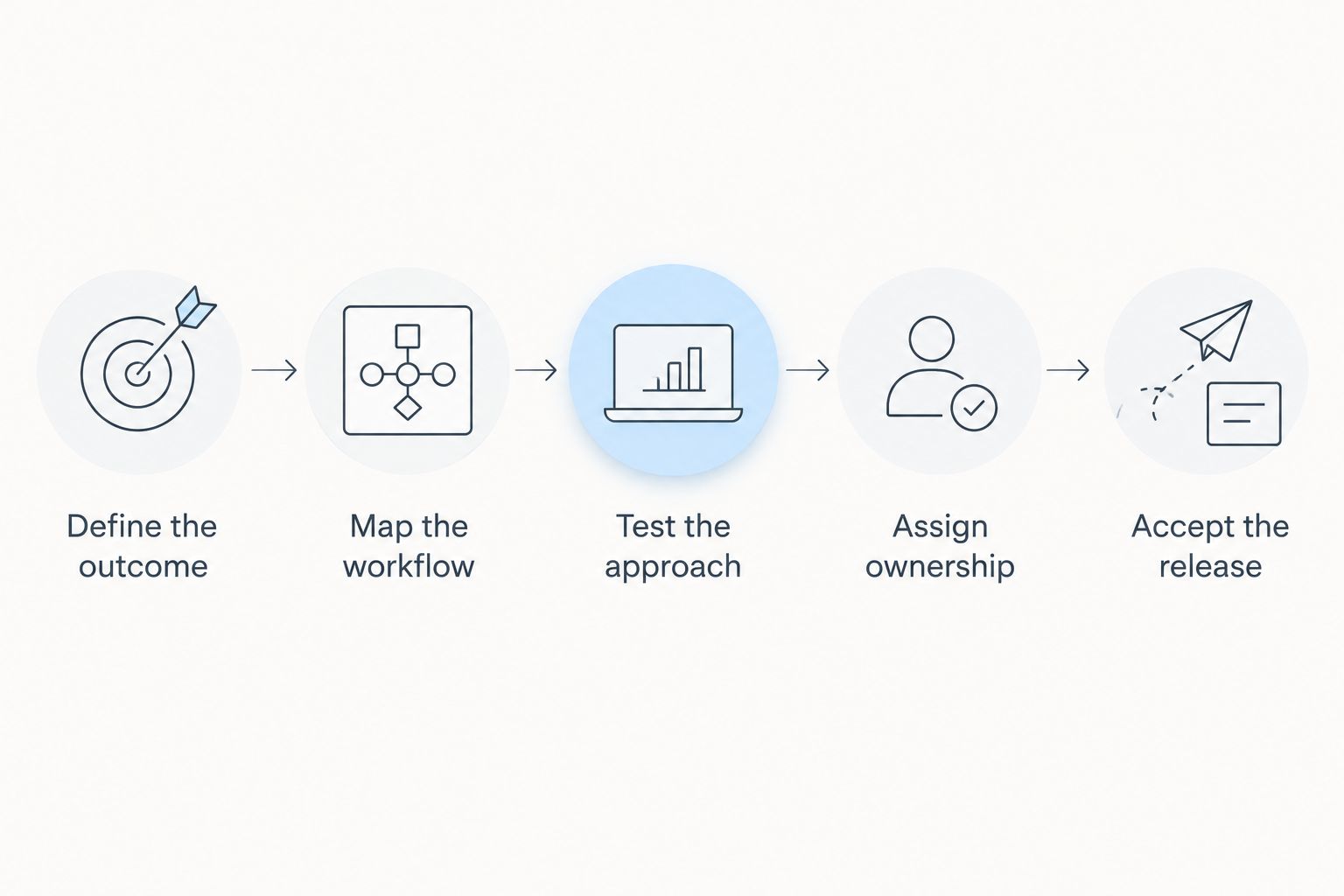
Use the following sequence to turn broad proposals into a decision you can defend.
Define the outcome
Write the business result in plain language. For example: the project manager should receive an approved estimate without re-entering its customer and job details. Avoid defining success as simply launching an application.
Map the workflow
Select 3 representative workflows for evaluation. Include an ordinary task, an exception and a handoff between teams. Ask each provider to explain what the user does, what the system does and where a human decision remains necessary.
Test the approach
Where uncertainty justifies it, propose a 2-week discovery exercise before committing to the full build. Treat this as a recommended evaluation format, not a provider promise. Agree on the outputs first: a workflow map, unresolved risks and a bounded implementation proposal.
Assign ownership
Document who controls the repository, deployment access, integrations and technical documentation. Separate access from ownership: being able to view a system does not establish who can change, operate or transfer it.
Accept the release
Define acceptance through observable behavior. A workflow is accepted when authorized users can complete the agreed task and exception handling works as specified. A demonstration without written acceptance criteria leaves the decision subjective.
This process also exposes unnecessary custom development. If an existing platform handles the agreed workflow without extensive modification, compare that route before approving a new application. Custom software should solve a defined gap, not become the default answer to an unclear brief.
Why consider a different software partner?
Switching makes sense when another proposal better matches your documented requirements. That is a decision about the engagement, not a claim that the incumbent provider lacks capability.
Use these requirement-based triggers:
- Your scope has changed. Reassess the shortlist when a standalone application becomes a wider integration project.
- Your ownership requirements are clearer. Compare written commitments for code, access, documentation and transition support.
- Your internal team's role has changed. Select a delivery model that reflects who will approve, maintain and extend the system.
- Your acceptance standard is now explicit. Compare proposals against the same workflows and release conditions.
For a 2026 procurement decision, record the reason for changing partners in a sentence tied to a requirement. If you cannot do that, revisit the brief before initiating a transition.
When staying with ScienceSoft is the right call
Stay with ScienceSoft when its proposed team, scope, acceptance process and ownership commitments meet your requirements. A different company name is not a business outcome.
If a project is already underway, compare continuation with transition explicitly. Review outstanding work, knowledge transfer, access changes and responsibility for existing defects. Do not switch to solve a problem that a clearer agreement with the current provider would resolve.
FAQ
What's the best way to choose ScienceSoft alternatives?
Choose ScienceSoft alternatives by comparing proposals against the same business outcome, workflows and ownership requirements. Evaluate the proposed team and acceptance process rather than relying on a provider's broad service description.
Should I choose custom software or configure an existing platform?
Choose custom software when your defined requirements justify a build rather than configuration or integration. First map the essential workflow and compare how each approach handles it, including maintenance and ownership responsibilities.
What should I ask a custom software development company before signing?
Ask who will deliver the work, what the release must do and who will own and operate it afterward. Require written scope exclusions, acceptance criteria, access arrangements and handover responsibilities.
When is staying with ScienceSoft better than switching?
Staying with ScienceSoft is the right decision when its proposed engagement meets your requirements and a transition does not solve a defined business problem. Compare outstanding delivery needs and transition responsibilities before changing partners.
One last thing
Before signing, ask the proposed delivery team to walk through an exception, not just the happy path. What happens when an estimate changes after approval, an integration fails or a user submits incomplete information?
That discussion gives you something concrete to evaluate: whether the proposal accounts for the way your business actually operates. Make exception handling part of acceptance, not a conversation postponed until launch.
Related guides
- AI development companies for enterprises
- API integration platforms for businesses
- Construction management software
Schedule a software consultation
Discuss your business workflow, project boundaries and software selection requirements.


