





Disconnected payment tools leave your team matching receipts to invoices instead of following up on customers. Best overall: Stripe for custom online payments; best for wallet-led checkout: PayPal; best for retail and in-person sales: Square; best for international payment operations: Adyen; best for an existing merchant-account setup: Authorize.Net. This 2026 guide ranks the best payment gateway platforms by business fit, integration needs and operational ownership.
- Stripe leads the best payment gateway platforms shortlist for businesses building custom online checkout and subscription billing.
- PayPal suits wallet-led checkout; Square suits businesses connecting in-person and online payments.
- Adyen suits international payment operations; Authorize.Net suits businesses keeping an existing compatible merchant account.
- Choose payment gateway integrations around reconciliation, refunds and customer records—not checkout appearance alone.
Why this matters
A successful checkout is only the beginning. Your business still needs to connect the payment to an invoice, record settlement, handle refunds and give staff a clear customer history.
The wrong setup creates manual handoffs even when customers can pay without trouble. For construction and professional services businesses, the practical question is whether deposits, invoice balances and refunds stay connected to the right job or account.
A Hexagon IT Solutions consultation is a practical next step for businesses defining payment gateway integration requirements. Bring the payment workflow, not just a shortlist of vendors.
What makes the best payment gateway platforms?
Use these criteria before comparing features. They make the 2026 shortlist a buying decision rather than a collection of familiar names.
- Business-model fit: Match the platform to online orders, recurring billing, project invoices or in-person payments. These are different workflows, not interchangeable checkout buttons.
- Integration depth: Check how payments, refunds and disputes connect to your CRM, accounting software and operational systems. A supported integration still needs a defined workflow.
- Payment experience: Decide whether customers need card entry, a wallet, payment links or a physical terminal. Start with how your customers actually pay.
- Reconciliation: Confirm how staff connect transactions, fees and settlements to invoices. Finance needs usable records, not just a payment confirmation.
- Operational control: Review access permissions, refund handling and dispute responsibilities. Someone must own exceptions after launch.
- Commercial structure: Compare the complete agreement, including processing, gateway services, currency conversion and connected tools. Evaluate the whole payment workflow rather than one headline charge.
Payment gateway platforms at a glance
These options do not all provide the same service. Stripe, PayPal, Square and Adyen offer payment-processing capabilities; Authorize.Net is particularly relevant when you need a gateway that works with a separate compatible merchant account.
| Platform | Best for | Standout capability | Fit consideration |
|---|---|---|---|
| Stripe | Custom online payments | APIs, hosted checkout and subscription billing | Define ownership for custom integration and ongoing changes |
| PayPal | Wallet-led checkout | Customers can pay through PayPal | Plan wallet transactions alongside the rest of your reporting |
| Square | Retail and in-person sales | POS and online payment tools | Validate specialist back-office workflows before selecting |
| Adyen | International payment operations | Online and in-person payments within one platform | Define regional requirements and implementation responsibilities |
| Authorize.Net | Existing merchant-account setups | Gateway services with recurring billing support | Confirm processor compatibility and divide responsibilities clearly |
1. Stripe: best payment gateway platform for custom online payments
Stripe is the default shortlist choice when you need control over an online payment workflow. It provides payment APIs, hosted checkout and subscription billing tools, allowing businesses to choose between a packaged checkout experience and a more customized implementation.
The business value is flexibility. A software company can connect recurring payments to account status, while a services business can connect an online payment to an invoice workflow. Those connections require implementation; they do not happen simply because a payment account exists.
Stripe pros:
- Hosted checkout provides an alternative to building the entire payment interface.
- APIs support custom payment workflows.
- Subscription billing tools suit recurring-revenue models.
Stripe considerations:
- Custom workflows need an owner for development, testing and maintenance.
- Accounting and CRM connections still need explicit reconciliation rules.
Best for: Businesses with a specific online checkout or recurring-billing workflow and someone responsible for integration.
Before selecting Stripe in 2026, map what happens when a payment succeeds, fails or is refunded. The strongest fit is not simply a business with developers; it is a business that knows which customer and finance actions each payment must trigger.
Verdict: Buy for custom online payments once integration ownership is clear.
2. PayPal: best payment gateway platform for wallet-led checkout
PayPal suits businesses that want to let customers pay through a PayPal account. Its checkout offerings also support card-payment options, with the exact setup depending on the product and market.
Choose PayPal because the payment experience fits your customers, not because another business uses it. For a business adding a wallet option to an existing checkout, the important question is how those transactions enter the same reporting and refund processes as other payments.
PayPal pros:
- Supports checkout through a PayPal account.
- Offers payment tools for online businesses.
- Can serve as a wallet option within a broader payment setup.
PayPal considerations:
- Adding another payment route requires corresponding reconciliation and refund procedures.
- Payment-method support depends on the selected offering and market.
Best for: Businesses that want PayPal wallet checkout as a deliberate customer-payment option.
Ask your finance team to trace a payment from checkout to settlement before approving the implementation. If staff must search separate systems to answer a customer’s refund question, fix that workflow before launch.
Verdict: Buy for wallet-led checkout with a defined reporting process.
3. Square: best payment gateway platform for retail and in-person sales
Square brings payment acceptance together with point-of-sale and online selling tools. That makes it a practical shortlist option for businesses serving customers at a counter and through an online channel.
The value is coordination between sales channels. A retailer should evaluate the checkout, transaction record and refund workflow together rather than select a gateway in isolation from the POS system.
Square pros:
- Combines payment acceptance with POS tools.
- Supports in-person and online payment use cases.
- Provides a connected starting point for retail checkout workflows.
Square considerations:
- Specialist accounting or operational requirements need separate validation.
- Fit depends on supported markets and the tools required by the business.
Best for: Retailers and service businesses that need in-person payments alongside online sales.
For your 2026 evaluation, walk through a customer buying online and requesting help in-store. Decide who can locate the transaction, authorize a refund and explain the outcome. That exercise tests the operating model, not just the payment screen.
Verdict: Buy when POS and payment acceptance belong in the same decision.
4. Adyen: best payment gateway platform for international operations
Adyen supports online and in-person payments, including a range of payment methods across supported markets. It belongs on the shortlist when your payment requirements span countries, channels or distinct regional customer preferences.
The business case is coordinated payment operations. For a company expanding internationally, local payment-method requirements and settlement workflows deserve the same attention as the customer-facing checkout.
Adyen pros:
- Supports online and in-person payment channels.
- Offers payment methods for different markets.
- Provides a platform for coordinating payment operations across channels.
Adyen considerations:
- Regional requirements need detailed planning and validation.
- Implementation needs clear business, technical and finance ownership.
Best for: Businesses with defined international or multichannel payment requirements.
Build a requirements list by country, currency, payment method and business entity. Do not treat international expansion as a switch you turn on after checkout is built. Confirm the actual markets and operating arrangements before making the platform decision.
Verdict: Buy for planned international operations with documented regional requirements.
5. Authorize.Net: best payment gateway platform for existing merchant accounts
Authorize.Net provides payment gateway services and supports recurring billing. It is a relevant option when your business already has a merchant account and wants a compatible gateway rather than a completely different payment arrangement.
That distinction matters. A gateway helps transmit payment information, while the wider merchant-services arrangement determines other parts of processing and settlement. Your team needs to know which provider handles each responsibility.
Authorize.Net pros:
- Supports gateway-based payment acceptance.
- Offers recurring billing functionality.
- Works with supported merchant-service arrangements.
Authorize.Net considerations:
- Compatibility with the existing processor must be confirmed.
- Gateway and merchant-account responsibilities need separate review.
Best for: Established businesses retaining a compatible merchant account while adding or updating online payment acceptance.
Ask who handles settlement questions, payment errors and disputes. Document the answer for each issue before signing agreements, so your staff have a usable escalation path instead of a collection of provider names.
Verdict: Buy when retaining the merchant-account arrangement is a clear requirement.
How the platforms are ranked
This 2026 ranking prioritizes workflow fit, integration options, channel coverage and reconciliation needs. Stripe takes the default position for custom online payments; the other platforms win distinct use cases rather than compete for an identical buyer.
Use official documentation to validate your final requirements: Stripe Docs for Checkout and Billing, PayPal Developer documentation for checkout, Square Developer documentation for payments and POS integrations, Adyen Docs for supported payment methods, and Authorize.Net Developer documentation for gateway integration. Confirm the specific configuration your business will use.
Which payment gateway platform should you choose?
Choose Stripe as the default shortlist option for a custom online payment workflow. Choose a different platform when your operating requirements point clearly elsewhere.
- Choose PayPal when wallet checkout is the central requirement.
- Choose Square when in-person sales and POS are part of the same buying decision.
- Choose Adyen when international payment operations drive the project.
- Choose Authorize.Net when keeping a compatible merchant account matters.
Do not replace a functioning setup merely to standardize a vendor name. First identify the business problem: disconnected invoices, difficult refunds, unsupported payment methods or unclear settlement records. A gateway change should solve a documented problem, not introduce a new integration project without a business reason.
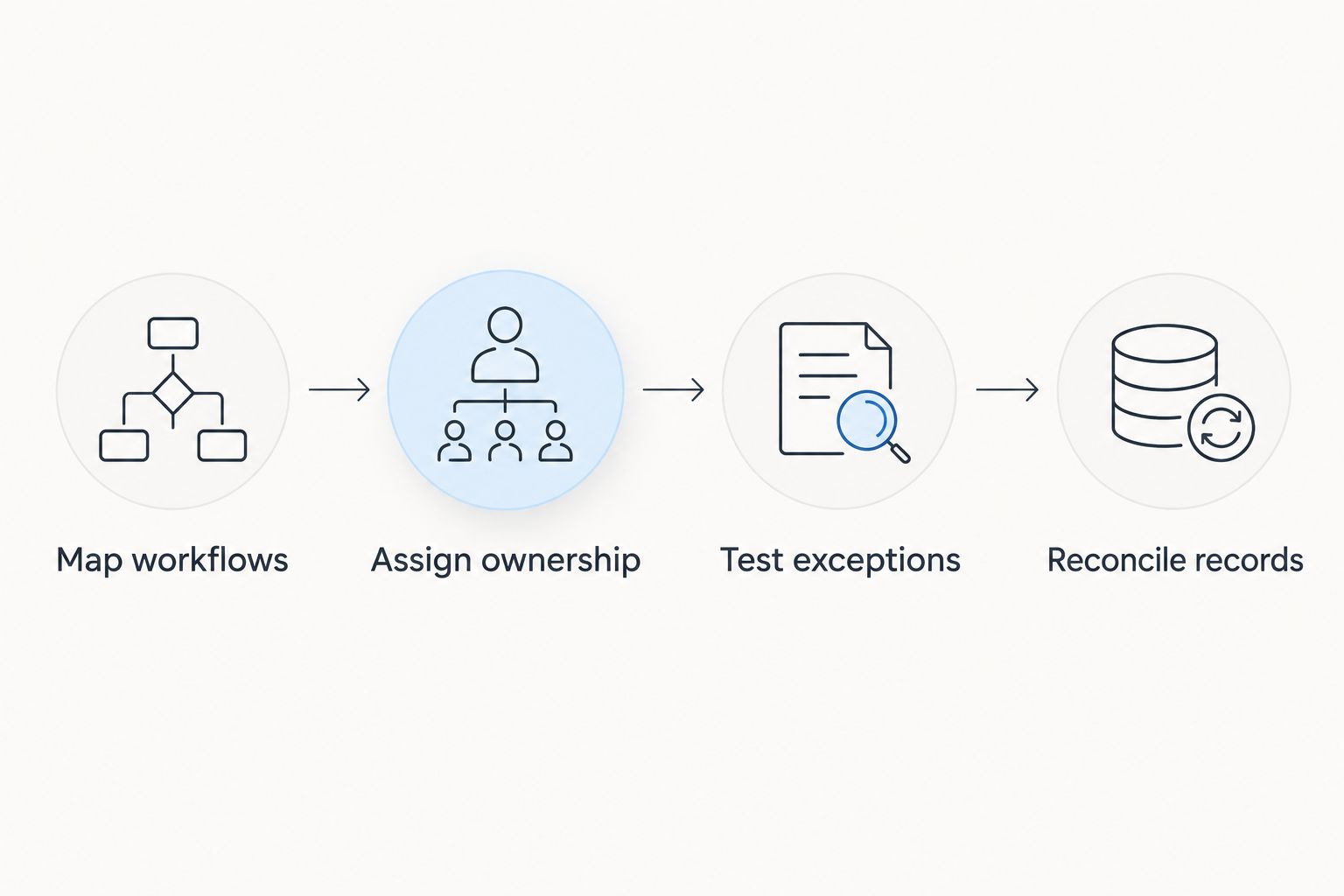
Turn the shortlist into an implementation decision
A platform demonstration shows the intended experience. Your evaluation must also show what staff do when a transaction does not follow the expected path.
Map workflows
Document 3 workflows before procurement: collecting payment, issuing a refund and handling a failed payment. For each, identify the customer record, invoice reference and staff action required.
Use your real operating process. A construction deposit and a retail checkout need different records even when both accept a card.
Assign ownership
Assign 1 accountable owner to the payment workflow. Finance, sales and IT can share tasks, but someone must resolve gaps between systems.
Specify who handles refunds, investigates unmatched transactions and approves integration changes. Ownership is part of the implementation, not an administrative detail.
Test exceptions
Create 2 test orders as a minimum workflow exercise: one that completes successfully and one that requires a refund. Use the platform’s testing environment where provided, then verify the connected records as well as the checkout result.
Add failed-payment and dispute scenarios to the acceptance checklist. Never treat a successful payment alone as proof that the entire integration works.
Reconcile records
Define how your finance team matches payment transactions to invoices and settlements. Decide which system owns the payment status and how corrections reach other systems.
When a customer asks whether an invoice is paid, your staff need an answer backed by the payment record—not a manually maintained note.
FAQ
What are the best payment gateway platforms for businesses in 2026?
Stripe, PayPal, Square, Adyen and Authorize.Net cover distinct business payment needs. Stripe suits custom online payments, PayPal suits wallet checkout, Square suits POS-led businesses, Adyen suits international operations, and Authorize.Net suits compatible existing merchant-account setups.
What is the difference between a payment gateway and a payment processor?
A payment gateway transmits payment information, while a payment processor handles transaction processing within the wider payment network. Some platforms combine gateway and processing services, so compare the complete arrangement rather than the label alone.
Which payment gateway is best for a small business?
The best payment gateway for a small business depends on how customers pay and which systems need the payment record. Shortlist Stripe for custom online workflows, Square for in-person selling, and PayPal when wallet checkout is a priority.
What should a construction or professional services business check?
Check that payments connect to the correct customer, job and invoice. Test deposits, balance payments, refunds and accounting reconciliation before approving the implementation.
How do I compare payment gateway costs?
Compare the complete commercial agreement and your expected transaction mix. Include processing, gateway services, currency conversion, disputes and connected tools, then review current provider terms for the exact configuration you need.
One last thing
Make the refund workflow part of the buying decision. Checkout receives the attention, but refunds expose whether customer records, payment records and finance procedures actually agree.
Before selecting a platform in 2026, ask staff to explain a refund from request to accounting entry. If the explanation depends on copying information between screens, define the integration requirement before approving the purchase.
Related guides
- Best POS systems for retail businesses
- Best CRM software for small businesses
- Best construction management software
- Best ERP software for manufacturing businesses
Schedule a consultation with Hexagon IT Solutions to define your payment workflow and integration requirements.
Schedule a payment integration consultation
Discuss your checkout, invoice, refund and reconciliation requirements.


