





Your startup needs an app partner that can turn a business hypothesis into a usable product without turning every idea into launch scope. Best overall for discovery-led startups: thoughtbot; best for design-led consumer apps: Fueled; best for cross-platform delivery: Cheesecake Labs; best for complex custom workflows: Atomic Object; best for enterprise-connected experiences: WillowTree.
- Among the best mobile app development companies for startups, thoughtbot is the default shortlist choice for discovery-led product development.
- Fueled fits design-led consumer apps; Cheesecake Labs fits cross-platform mobile development.
- Atomic Object fits complex custom workflows; WillowTree fits enterprise-connected mobile experiences.
- Choose an MVP development partner around ownership, acceptance criteria, and post-launch support—not a feature-count contest.
Why this matters
A startup app project is a business decision before it is a technology decision. You need to learn whether customers complete the action that creates value, then decide what deserves more investment.
For startup app development in 2026, select the company around your hardest unresolved problem: product definition, customer experience, platform delivery, workflow complexity, or integration. A strong portfolio does not replace a clear fit with your project.
If that problem is still unclear, discuss your requirements with Hexagon IT Solutions before committing to a delivery model. Start with the business result, the systems involved, and who will own the product after launch.
What makes the best mobile app development partner?
Use these criteria before comparing proposals. They separate a delivery agreement from a collection of attractive screens.
- Product judgment: The team challenges unnecessary scope and connects each feature to a user action or business outcome.
- Relevant delivery experience: Portfolio examples match your workflow, platform needs, or technical constraints—not just your industry label.
- Engineering ownership: Your agreement covers source code, repositories, credentials, documentation, and third-party dependencies.
- Release discipline: Acceptance criteria include failed requests, interrupted sessions, permissions, and recovery—not only the happy path.
- Operating continuity: Support responsibilities, maintenance, monitoring, and handover have named owners.
- Commercial clarity: The proposal explains assumptions, exclusions, change approval, and what happens when priorities change.
For a 2026 shortlist, ask every company to respond to the same brief. Different assumptions make proposals difficult to compare even when their deliverables look similar.
Startup app development companies at a glance
These are project-fit recommendations, not a claim that one company wins every engagement. The limitation column identifies the decision you must resolve before hiring.
| Company | Best for | Standout focus | Key fit limitation |
|---|---|---|---|
| thoughtbot | Discovery-led startup products | Product design and development | Define the handoff between discovery and implementation |
| Fueled | Design-led consumer apps | Digital product strategy, design, and development | Keep launch scope tied to customer behavior |
| Cheesecake Labs | Cross-platform mobile delivery | Mobile engineering, including React Native and Flutter | Validate requirements that need platform-specific work |
| Atomic Object | Complex custom workflows | Custom software design and development | Separate workflow essentials from later operational features |
| WillowTree | Enterprise-connected mobile experiences | Mobile and digital experience development | Resolve system ownership and integration access early |
Best budget approach: reduce the first release to a validated workflow. Do not label a company the budget winner without a comparable, project-specific proposal.
1. thoughtbot: best for discovery-led startup apps
thoughtbot provides product design and software development services. Its product-focused approach makes it a shortlist option when you need to decide what to build before committing to a large implementation.
thoughtbot is the best shortlist starting point for founders who need product discovery alongside app development. That fit is strongest when your core uncertainty concerns customer behavior rather than a settled technical specification.
thoughtbot pros
- Product design and engineering can address the same product question.
- Discovery gives you a place to challenge assumptions before they become requirements.
- A product-development engagement suits founders who need a working decision process, not just task execution.
thoughtbot cons and fit checks
- Discovery still requires a founder or product owner who can make decisions.
- Define which discovery outputs become implementation commitments.
- Specify how documentation and engineering ownership transfer to your team.
Best for: Founders with an unresolved product hypothesis and a need for design-development collaboration.
Ask thoughtbot to explain how a rejected hypothesis changes the delivery plan. The answer should connect learning to a smaller or different scope, not automatically to additional features.
Verdict: Buy the discovery-led engagement when product uncertainty is the main obstacle.
2. Fueled: best for design-led consumer apps
Fueled works across digital product strategy, design, and development. It belongs on the shortlist when the customer-facing experience is central to the product proposition.
For a consumer app, completing onboarding or reaching the first useful action matters more than collecting polished screens. Frame the brief around those behaviors so design decisions have a business purpose.
Fueled pros
- Product strategy and interface design can shape the same customer journey.
- Design-led work fits products where usability is part of the buying decision.
- A broader digital-product brief can address the experience beyond an isolated mobile screen.
Fueled cons and fit checks
- Decide which customer journey deserves attention first.
- Distinguish essential interaction design from optional launch polish.
- Assign an owner for content, feedback, and approval decisions.
Best for: Consumer-facing startups whose product depends on a clear, usable customer experience.
Ask Fueled to demonstrate how design review changes an actual user task. A screen presentation alone does not explain whether customers can complete that task.
Verdict: Buy when customer experience is the product’s main differentiator.
3. Cheesecake Labs: best for cross-platform startup apps
Cheesecake Labs provides mobile app development and works with cross-platform technologies, including React Native and Flutter. It is a shortlist option when you want to serve iOS and Android through a cross-platform delivery approach.
Shared development does not remove platform-specific requirements. Your proposal still needs to address permissions, device behavior, native integrations, and release testing.
Cheesecake Labs pros
- Cross-platform development fits a shared product experience across mobile platforms.
- React Native and Flutter provide established approaches to shared mobile code.
- Mobile-focused engineering helps turn platform requirements into explicit delivery decisions.
Cheesecake Labs cons and fit checks
- Identify features that require native code or platform-specific behavior.
- Confirm who maintains framework and dependency updates.
- Agree on separate acceptance checks for iOS and Android.
Best for: Startups with broadly shared mobile workflows across both major platforms.
Ask Cheesecake Labs to identify the part of your specification least suited to shared implementation. That discussion is more useful than accepting a blanket promise that every requirement belongs in one codebase.
Verdict: Buy when cross-platform delivery matches the actual requirements.
4. Atomic Object: best for complex custom workflows
Atomic Object designs and develops custom software, including mobile applications. Its custom-development focus fits products built around business rules, operational workflows, and interactions with other systems.
A construction or professional-services app can depend on approval states, assignments, or records that must remain consistent. Explain those rules before asking a team to estimate screens.
Atomic Object pros
- Custom software development suits workflows that do not fit a standard application template.
- Design and engineering can address usability and business rules together.
- A system-oriented brief gives operational constraints a place in product planning.
Atomic Object cons and fit checks
- Assign a business owner to resolve conflicting workflow rules.
- Define data ownership before building connections between systems.
- Keep later operational features outside the initial acceptance scope.
Best for: B2B startups whose mobile product must support a specific operational process.
Ask Atomic Object to map an exception: a rejected approval, a duplicate record, or an interrupted update. Exception handling reveals requirements that a normal user journey leaves hidden.
Verdict: Buy when workflow correctness matters as much as interface design.
5. WillowTree: best for enterprise-connected mobile experiences
WillowTree develops mobile applications and digital experiences. It belongs on a startup shortlist when the app must fit into a broader customer experience or connect with established business systems.
This is a different brief from testing a standalone product idea. You need to explain the existing environment, who controls access, and which teams approve changes.
WillowTree pros
- Mobile and digital-experience work fits products spanning multiple customer touchpoints.
- A broader experience brief accommodates requirements beyond the app interface.
- Enterprise-connected projects benefit from explicit attention to integration dependencies.
WillowTree cons and fit checks
- Name the owners of every connected system.
- Resolve procurement and approval responsibilities before delivery begins.
- Separate a focused mobile release from a wider transformation program.
Best for: Startups launching a mobile experience within an established business or customer ecosystem.
Ask WillowTree to distinguish app work from dependencies controlled by your organization or partners. Your schedule needs to reflect both, even when only one sits inside the development agreement.
Verdict: Buy when the mobile experience must work within a larger operating environment.
How the ranking works
The ranking prioritizes project fit against product judgment, relevant delivery, ownership, release discipline, continuity, and commercial clarity. Company service positioning informs the shortlist; your proposal and technical discussions determine the hiring decision.
For 2026, thoughtbot is the default for an undecided discovery-led founder. Move to another company when you can name the constraint that makes its use-case slot more relevant.
Turn the shortlist into a decision
Give each finalist the same brief and request a response organized around the following sequence. These are recommended planning boundaries, not promised delivery timelines.
Outcome definition
Define 1 core workflow that proves the product’s usefulness. Describe who performs it, what triggers it, and what successful completion means for the business.
Scope boundary
List launch requirements separately from later ideas. Include exclusions so a desirable feature does not silently become an obligation.
Acceptance checks
Require 2 acceptance checks per critical action as a starting rule: successful completion and a meaningful failure case. Add checks wherever permissions, payments, offline behavior, or data changes introduce additional risk.
Ownership handoff
Specify repository access, account ownership, documentation, and deployment responsibilities. Your startup should know how another team would continue the work.
Release review
Schedule a review 30 days after launch as a planning checkpoint. Use observed behavior, support issues, and product feedback to decide the next scope—not to defend the original feature list.
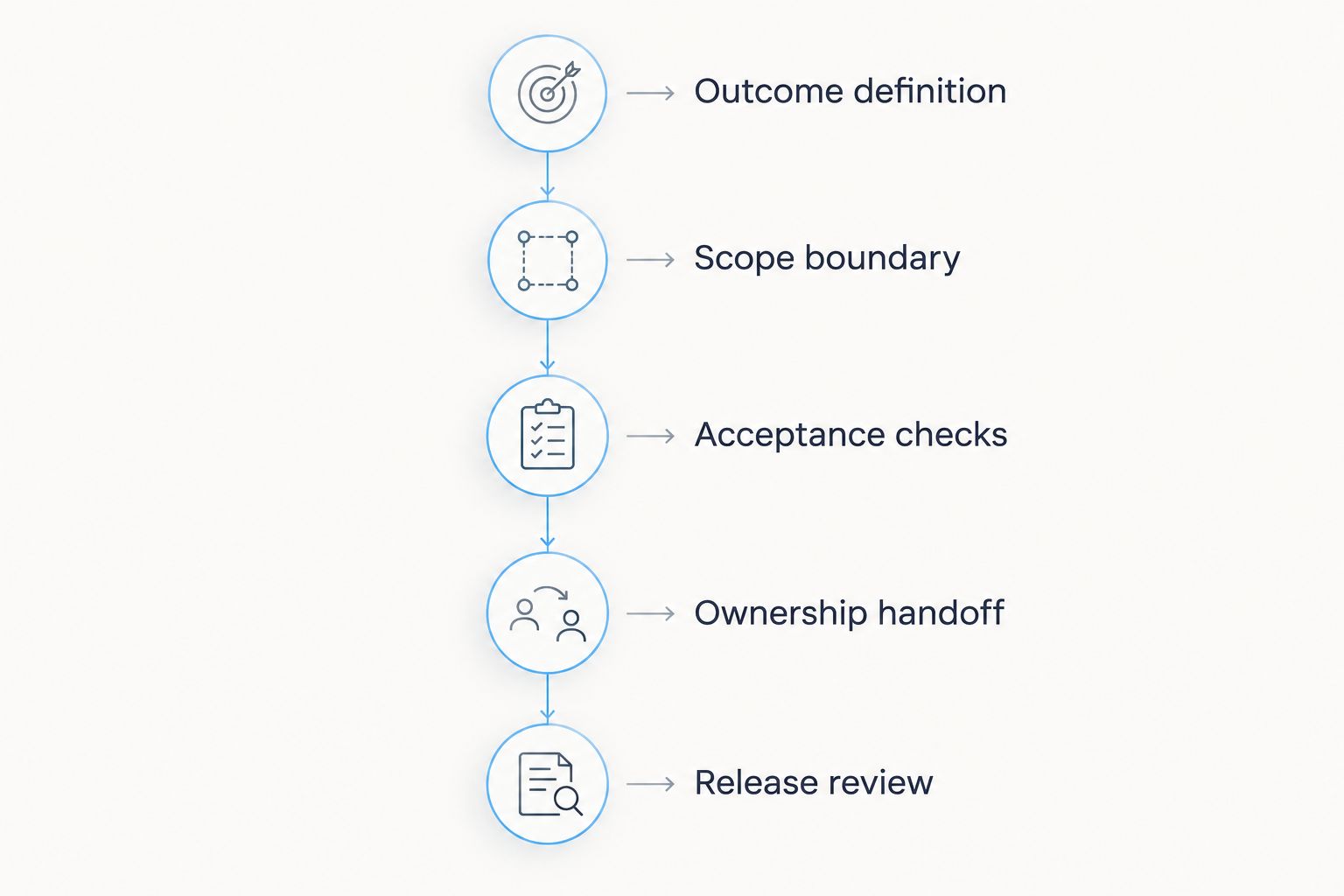
Your proposal should connect each stage to a named decision-maker. A process without decision ownership becomes a queue of unresolved questions.
Make testing part of the delivery agreement
A mobile app that passes a demonstration has not necessarily passed release acceptance. Specify the environments, devices, operating-system behavior, and failure conditions that matter to your customers.
The choice of mobile app testing tools affects where automated checks run: local runners and cloud services place different responsibilities on infrastructure, environment access, and test execution. Put that decision in the delivery plan rather than leaving it as an undocumented engineering preference.
For your 2026 agreement, require clarity on:
- Critical journeys: Which customer actions must pass before release?
- Failure recovery: What happens after a failed request or interrupted session?
- Device coverage: Which device and operating-system combinations are in scope?
- Release evidence: What results accompany the approval request?
- Issue ownership: Who investigates and fixes a failure after launch?
Keep acceptance tied to behavior. A completed ticket is evidence of activity; a passing user journey is evidence that the agreed function works.
Set contract boundaries before choosing a team
A unified product still needs clear interfaces between systems. Specify which application owns each record, how updates move, and what happens when a connection fails.
Do the same for the working relationship. Define who approves scope changes, who resolves conflicting feedback, and what evidence supports milestone acceptance.
Request these deliverables in the agreement:
- A written scope with assumptions and exclusions.
- A repository and access arrangement under your control.
- A release and rollback responsibility map.
- A documented maintenance and handover plan.
Choose the proposal that makes responsibilities inspectable. A long feature list does not compensate for unclear ownership.
Which mobile app development company should you choose?
Choose thoughtbot when you need help defining the product and building it. Choose Fueled for a design-led consumer experience, Cheesecake Labs for cross-platform delivery, Atomic Object for custom operational workflows, or WillowTree for enterprise-connected experiences.
For a 2026 decision, take the closest-fit company into a structured proposal discussion rather than treating this ranking as a substitute for diligence. Ask for relevant work, the proposed delivery team, contractual ownership, and acceptance criteria.
FAQ
What's the best mobile app development company for a startup?
thoughtbot is the default shortlist choice for a startup that needs product discovery alongside development. Fueled, Cheesecake Labs, Atomic Object, and WillowTree fit different constraints around design, platforms, workflows, and enterprise connections.
Should a startup choose cross-platform or native app development?
Choose around the requirements, not a blanket preference for either approach. Cross-platform development fits shared experiences, while platform-specific capabilities can require native implementation; ask the proposed team to explain the boundary.
How do I compare mobile app development proposals?
Give each company the same outcome, scope, and acceptance brief. Compare assumptions, exclusions, ownership, release responsibilities, and maintenance rather than treating every feature list as equivalent.
Who should own the app's source code and accounts?
Your agreement should specify source-code rights and your startup's control of repositories and operating accounts. Review third-party licenses separately and document how another team would continue development.
What should a startup include in its first app release?
Include the smallest complete workflow that demonstrates the product's value. Keep failure recovery, permissions, and essential data handling in scope; place unrelated features in a separate backlog.
One last thing
Ask every finalist: What would you remove from this release? The answer reveals how the team connects scope to your business goal. A smaller release with clear acceptance is a better decision framework than an expansive proposal with unresolved assumptions.
Related guides
- Best API integration platforms for businesses
- Best payment gateway platforms for businesses
- Best construction management software
Schedule a consultation with Hexagon IT Solutions to discuss your app requirements and delivery priorities.


