






Software development queries split into four intents, and most teams write the wrong page for the query. This page maps every common query pattern to its intent, the page type that wins it, and the budget logic behind it. Hexagon IT Solutions uses this mapping to decide what to build first in 2026.
- Search intent benchmarks for software development keywords reduce to four intents: informational, commercial, transactional and navigational.
- Commercial-investigation queries (best, vs, alternatives) are where software buyers shortlist vendors in 2026. Build these pages first.
- Transactional modifiers (hire, quote, cost, company) belong on service pages, not blog posts.
- Informational queries (how to, what is) earn traffic, not pipeline. Use them to feed comparison pages.
- No volume or click-share figures are published on this page. Pull your own from Search Console before sizing a roadmap.
Why intent decides whether software keywords pay back
A software development keyword is not a topic. It is a stage in a buying process. Someone typing how to build a CRM is a different person from someone typing custom CRM development company, even though both queries share three words.
Most software and SaaS sites publish for the first person and hope the second one finds them. The result is traffic that never turns into a conversation. Matching page type to intent fixes that before you spend anything on links or ads.
This benchmark is a classification benchmark. It tells you which intent a query pattern signals and which page format Google rewards for it in 2026. It does not hand you invented volume percentages. Where a number would be a guess, the page leaves it out.
The short answer: four intents, one dominant for buyers
Every software development query falls into one of four intents. For buyers with budget, commercial investigation is the dominant intent in 2026: the reader already knows the problem and is comparing vendors, tools or approaches.
The quotable version: informational queries bring readers, commercial queries build the shortlist, transactional queries close the deal, and navigational queries only reward brands people already know.
Benchmark table: intent by query pattern
Use the table as your yardstick. Find the pattern your keyword matches, then check whether your page type matches the winner.
| Intent | Query pattern | Example software development query | Page type that wins | Verdict |
|---|---|---|---|---|
| Informational | what is, how to, guide, examples | how to connect Shopify to a custom ERP | Step-by-step guide or workflow explainer | Publish, but feed it into comparison pages |
| Informational | benchmarks, statistics, trends | software development cost benchmarks | Data page with a table high on the page | Publish only with sourced numbers |
| Commercial | best, top, companies for | best mobile app development companies for startups | Ranked list with honest pros and cons | Build first |
| Commercial | vs, alternatives, compared | Salesforce alternatives | Comparison table with a verdict per option | Build first |
| Commercial | for [industry], complete guide | custom software development for logistics companies | Industry guide with a clear service angle | Build second |
| Transactional | hire, quote, pricing, cost of | hire custom software developers | Service page with a single conversion action | Own it on the main site |
| Transactional | company, agency, services near me | AI development services | Service page plus proof | Own it on the main site |
| Navigational | brand name, brand plus login | Hexagon IT Solutions | Homepage and brand pages | Protect, do not chase |
The table reads left to right as a decision: pattern, example, winner, action. Every example above maps to a real topic cluster on the Hexagon IT Solutions site.
Which intents lead and which trail
Commercial investigation leads for pipeline. Best-of, versus and alternatives queries sit one step from a sales call. The searcher has a shortlist problem, and the page that answers it fairly gets quoted by both Google and AI assistants.
Transactional queries are the narrowest and the most valuable. Hire, quote and cost queries are few per topic, but each reader is ready to talk. A blog post loses here to a service page every time.
Informational queries trail on revenue per visit. They produce the most impressions and the least intent. Treat them as a feeder: each guide should link to the comparison or service page that follows it.
Navigational queries trail on opportunity. You cannot rank for someone else's brand name in a way that helps you. Defend your own brand terms and move on.
This ordering is a ranking by buyer proximity, not a measured share of search volume. Your own Search Console data sets the real proportions.
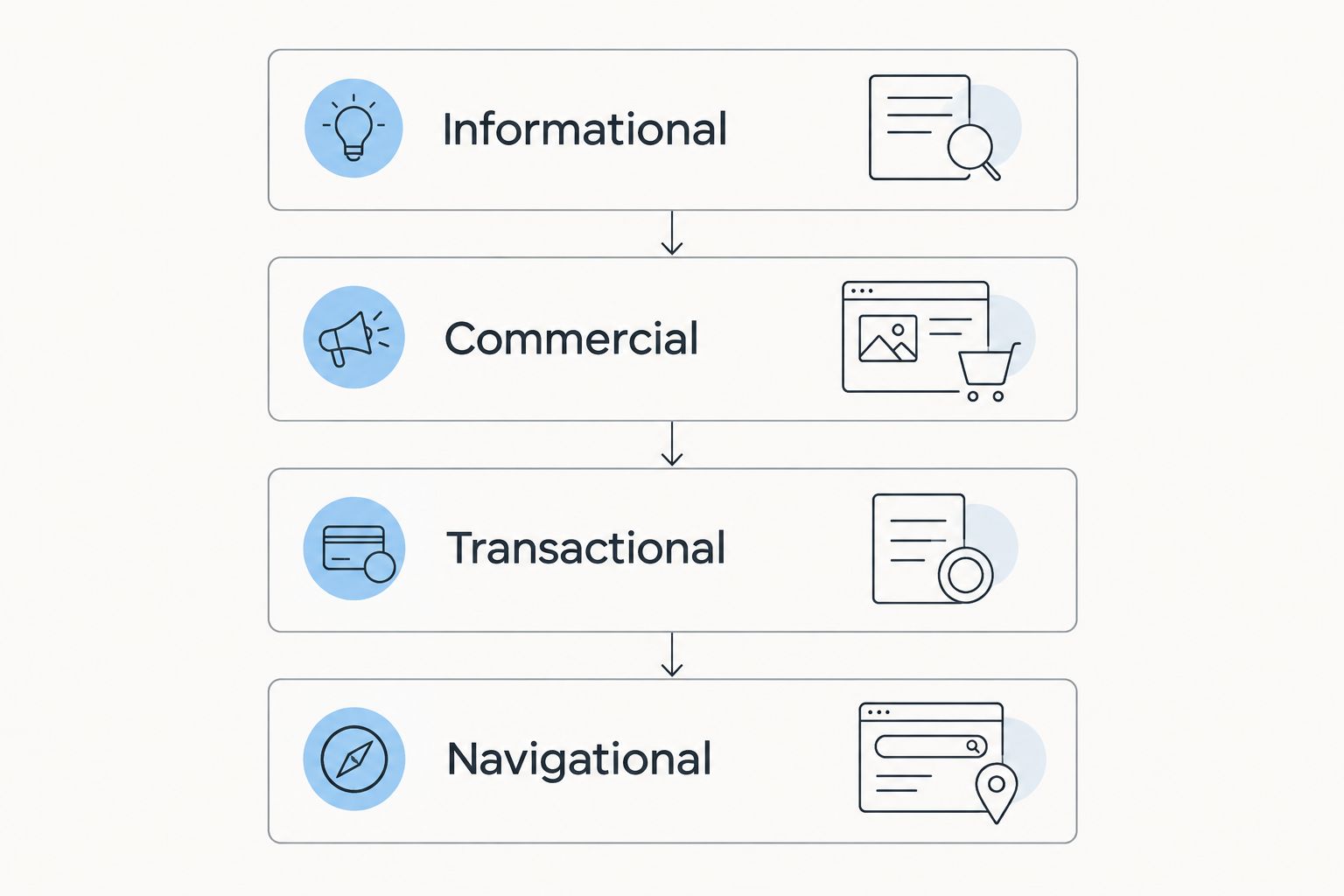
The diagram above is the order in which to staff content, not the order of traffic size.
Methodology and the limit of this benchmark
The classification follows the standard four-intent model used across search marketing: informational, commercial investigation, transactional and navigational. Query patterns come from the modifier language that software buyers use when they search for development partners, platforms and tools. The period is 2026.
One limitation matters. This page carries no search volume, click-through rate or keyword difficulty figures for the software development category, and the keyword data behind it has no volume attached. Anyone quoting an exact intent split for software development without naming a dataset and date is guessing. Validate every row against your own Search Console queries before committing budget.
Modifier cheat sheet for software development keywords
The fastest way to classify a keyword is to read its modifier. Use this second table when a query does not match the first one cleanly.
| Modifier in the query | Intent signal | What the reader wants | Match with |
|---|---|---|---|
| how to, what is, guide | Informational | To understand a process | Workflow guide |
| best, top | Commercial | A shortlist | Ranked list |
| vs, alternative, compare | Commercial | A decision between known options | Comparison table |
| for [industry] | Commercial to transactional | A vendor who knows the sector | Industry page |
| cost, pricing, quote | Transactional | A number to budget against | Service page with a conversion path |
| hire, company, services | Transactional | A partner to contact | Service page |
| brand name | Navigational | A specific site | Homepage |
Two modifiers cause most misclassification. The first is for [industry], which looks informational but usually signals a buyer screening vendors for sector experience. The second is cost, which looks informational but nearly always comes from someone building a budget.
How paid and organic intent line up
Intent also tells you where paid spend is justified. Transactional and commercial queries are where bids tend to be highest and where a click is most likely to become a lead. Informational queries rarely justify a bid.
For the cost side of this decision, see the Google Ads CPC benchmarks for software development keywords. Read it next to this page: intent tells you which queries matter, CPC tells you what they cost to buy.
The practical rule for 2026: win commercial queries organically with comparison pages, and buy transactional queries only if your service page converts.
How to use these benchmarks
Four moves, in order.
- Export your queries. Pull the last 28 days of Search Console queries and tag each one with an intent using the modifier table.
- Count pages by intent, not by topic. If most of your published pages are informational and you have no comparison or service page for the same topics, you have a traffic site, not a pipeline site.
- Fix the biggest mismatch first. A commercial query landing on a how-to post is the highest-return rewrite on the site. Change the page format to match the query.
- Link down the funnel. Every informational page links to one comparison page, and every comparison page links to one service page.
A founder with limited content budget should build in this order: transactional service page, then commercial comparisons, then informational feeders. Reversing that order is the most common reason a software site gets traffic and no leads.
Pros and cons of intent-first planning
Intent-first planning is not free of trade-offs.
Pros
- Every page has a clear job, so you can judge it by one outcome.
- Commercial pages get cited by AI assistants because they are comparison-framed and name specific options.
- You stop paying for traffic that was never going to buy.
Cons
- Informational content gets deprioritized, and that is where top-of-funnel awareness comes from.
- Intent classification is judgment, not measurement. Two analysts can tag the same query differently.
- Commercial pages need honest coverage of competitors. A page that only praises the author does not get quoted.
The verdict: use intent-first planning for any site with a sales team, and keep a thin layer of informational guides to feed it.
Where Hexagon IT Solutions fits
Hexagon IT Solutions publishes across all four intents on one site: workflow guides, industry guides, ranked lists and comparisons. If you are choosing a development partner and want a straight read on options, start with the best AI development companies for enterprises comparison, which follows the commercial-investigation format described above.
The point for your own site is the same: one query, one intent, one page built for it.
Map your keywords to intent
Schedule a consultation with Hexagon IT Solutions.
FAQ
What are the search intent benchmarks for software development keywords?
Software development keywords fall into four intents: informational, commercial investigation, transactional and navigational. For buyers, commercial investigation (best, vs, alternatives) is the dominant intent in 2026.
Which intent should a software development company target first?
Start with transactional service pages, then commercial comparison pages. These are closest to a sales conversation. Informational guides come third and feed the first two.
Is best software development company a commercial or transactional query?
It is commercial investigation. The searcher wants a shortlist, so a ranked list with pros, cons and a best-for label wins. A plain service page usually loses this query.
How do I know a keyword's intent without volume data?
Read the modifier. Words like how to signal informational, best and vs signal commercial, and hire, cost and quote signal transactional. Then check what format the current top results use.
Do informational software queries still matter in 2026?
Yes, as a feeder. They build topical coverage and awareness, but they rarely convert on their own. Each one should link to a comparison or service page.
Can one page serve two intents?
Rarely. A page that tries to be a guide and a sales page usually ranks for neither. Split the topic into two pages and link them.
Where can I get exact intent percentages for software keywords?
From your own Search Console data and a keyword tool export tagged by modifier. Treat any published split without a named dataset, date and scope as unreliable.
One last thing
The cheapest audit you can run in 2026 is a single filter: take your top ten landing pages by impressions and ask whether each page type matches its dominant query intent. Any mismatch is a rewrite that costs a few hours and no link building.


