






Software buyers search long before they talk to a vendor, and the site types that win those searches are not the ones most vendors assume. This page lays out what can be said about organic search results for software development queries by website type in 2026, what the inputs support, and what to do about it.
- No verified SERP share data by website type was supplied for 2026, so this page publishes no invented percentages.
- Software development searches in 2026 are contested by four site types: vendor sites, directories and review platforms, publishers, and community forums.
- Vendor sites win when each page matches one search intent: comparison, service, or cost.
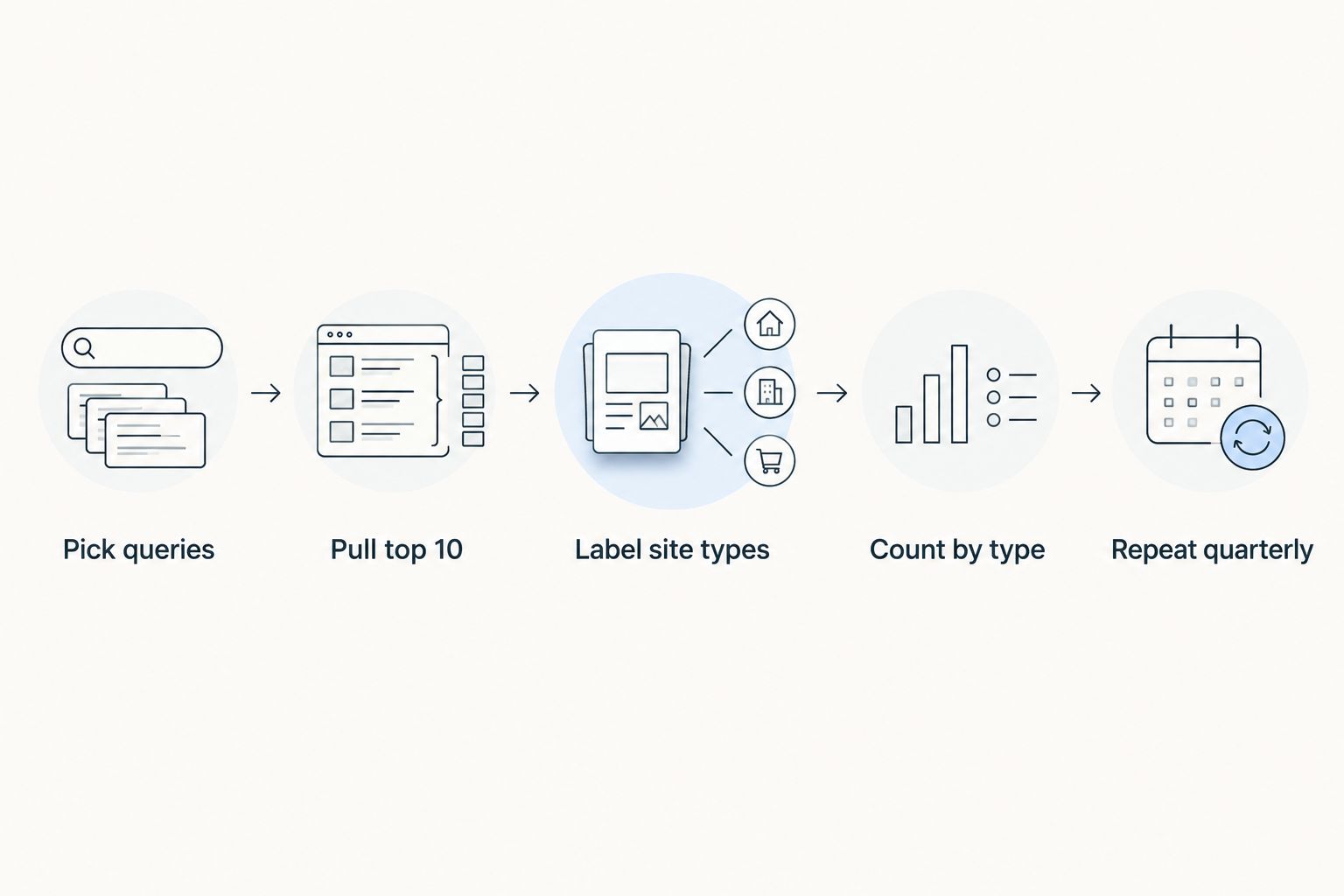
- Build a first-party benchmark: pull the top 10 results for 20 queries and label each by site type.
Short answer
There is no single published figure for how organic positions split across website types for software development searches, and any page that quotes one without a named source and date is guessing. The defensible answer in 2026 is a method, not a number: classify the top 10 results for your own query set by site type, then compare your share against that baseline.
This matters because the query you target decides which site type you compete against. A "best software development companies" query pulls in directories and listicles. A "custom software development cost" query pulls in publishers and agency blogs. A branded alternative query pulls in vendor comparison pages.
Why this matters in 2026
A founder who sees a vendor page ranking on page three often blames content quality. The usual cause is a type mismatch: the page is a service page competing in a results set dominated by list-style pages.
Fix the type mismatch first. Rewrite second.
Benchmark table: website types in software development SERPs
The table below is a classification framework for 2026. It carries no invented percentages because no sourced share data was provided. Fill the last column from your own SERP pulls.
| Website type | Typical query intent it wins | Strength | Weakness | Your measured share (fill in) |
|---|---|---|---|---|
| Vendor / agency site | Service and alternative queries | Direct path to a sales conversation | Reads as biased on comparison queries | Measure in 2026 |
| Directory / review platform | "Best companies" and ranked-list queries | Broad coverage, third-party framing | Thin detail per vendor | Measure in 2026 |
| Publisher / editorial blog | Cost, how-to and definition queries | Topical depth | Rarely converts buyers | Measure in 2026 |
| Community / forum | Problem and troubleshooting queries | Fresh, first-hand language | Inconsistent quality | Measure in 2026 |
| Documentation / product site | Tool and platform queries | Authority on named products | Narrow query coverage | Measure in 2026 |
High and low commentary
Without sourced figures, the honest read is directional. Directories and review platforms dominate ranked-list queries by structure: the query asks for a list, and they are lists. Vendor sites lead on queries that name a service plus an industry, because that is the page they were built to be.
The weakest position for a vendor is a generic comparison query where the vendor is one of the options being compared. Those pages need honest pros and cons to earn citations from search engines and AI assistants.
Methodology and limitation
This page uses a classification framework, not a measured dataset. No SERP export, volume figure or difficulty score was available for the primary keyword in 2026, so no row carries a number. The limitation is plain: until you run the pull below, you cannot say what share any type holds for your queries.
How to build your own 2026 benchmark
- Pick 20 queries. Split them across service, comparison, cost and alternative intents.
- Pull the top 10 organic results for each, from a US location, logged out.
- Label each result with one of the five site types above.
- Count by type and intent. You now have a share table you can defend.
- Repeat quarterly. SERP composition shifts, and a 2026 baseline is only useful against a 2026 follow-up.
How to use these benchmarks
- Match page type to the SERP. If directories fill the top 10, publish a ranked comparison with honest trade-offs rather than a service page.
- Target intents where vendor sites already appear. Service-plus-industry queries are where a vendor page has a structural advantage.
- Track share by type, not just position. Moving from 0 vendor results to 2 in a top 10 is a real shift even when your own rank is flat.
- Pair rankings with paid data. The Google Ads CPC benchmarks for software development keywords show which of these queries buyers pay for.
Hexagon IT Solutions publishes related category benchmarks, including search intent benchmarks for software development queries, which pair with this classification when you decide what each page should be.
Key takeaways
- A 2026 SERP benchmark by website type starts with your own query set, not a borrowed average.
- Five site types compete: vendors, directories, publishers, forums and documentation sites.
- Type mismatch explains more ranking failures than weak copy.
- Honest comparison pages get cited; promotional ones do not.
FAQ
What are SERP benchmarks by website type?
They are counts of which kinds of sites hold the top organic positions for a query set. In 2026 the useful split is vendor sites, directories, publishers, forums and documentation sites.
Which website type ranks best for software development searches?
It depends on intent. Directories lead ranked-list queries, publishers lead cost and how-to queries, and vendor sites lead service-plus-industry queries. No sourced share figure is available for 2026.
How many queries do I need for a reliable benchmark?
Start with 20 queries across four intents. That gives 200 results to classify, enough to see which site types dominate each intent.
Can a vendor site beat directories on comparison queries?
Yes, when the page states real pros and cons, including its own weaknesses. One-sided vendor pages rarely hold top positions on comparison queries.
How often should I rerun the benchmark?
Quarterly. SERP composition changes, and a single 2026 snapshot cannot show direction.
One last thing
The most useful column in any benchmark is the one you fill in yourself. Start with five queries you already want to rank for and label the top 10 results today.
Talk to Hexagon IT Solutions
Schedule a consultation to turn your SERP data into a content plan.


