






Outsourcing software development is worth it in 2026 when you need external delivery capacity for a defined business outcome and retain someone internally to make product decisions. It is not a substitute for ownership: include requirements, reviews, integration, maintenance, and handover in your decision, not just the development proposal.
- Is outsourcing software development worth it? Yes, when scope, internal ownership, acceptance criteria, and handover are clear.
- Managed delivery suits defined projects; staff augmentation suits businesses that already have technical leadership.
- Compare total delivery effort, not development rates alone.
- Discuss delivery responsibilities with Hexagon IT Solutions before committing to outsourced software development.
Is outsourcing software development worth it in 2026?
Outsource execution when the business problem is clear. Keep accountability for the outcome inside your business. The right arrangement depends on whether you need temporary expertise, additional engineering capacity, or responsibility for delivering an agreed project.
Before choosing a supplier, separate the outsourcing decision from the build decision. If you have not established that custom development is necessary, start with whether custom software is worth it for small businesses.
| Delivery model | Best for | Main advantage | Main drawback | Your responsibility |
|---|---|---|---|---|
| In-house development | Software requiring continuous internal decisions | Direct control over priorities and accumulated knowledge | Hiring, management, and ongoing staffing commitments | Lead product and engineering |
| Staff augmentation | An existing technical team needing additional capacity | External engineers work within your delivery process | Requires your team to direct and review the work | Manage backlog, architecture, and acceptance |
| Managed outsourced delivery | A defined project needing an external delivery team | Assigns project execution to a contracted team | Requires explicit boundaries and supplier oversight | Define outcomes and approve completed work |
| Hybrid delivery | Businesses retaining product leadership while outsourcing selected work | Keeps business knowledge internal while adding specialist help | Coordination across teams remains necessary | Set decision rights and integration responsibilities |
These are operating models, not quality rankings. A managed project is a poor fit when nobody can approve requirements; staff augmentation is a poor fit when nobody can manage engineers.
Why this matters
A founder evaluating outsourcing in 2026 is making an operating decision, not simply a purchasing decision. Development is only part of turning a business requirement into working software that employees or customers actually use.
Consider a construction business replacing spreadsheet-based job approvals. The outcome is not a new application; it is a working approval process with clear permissions, reliable records, and an agreed route for handling exceptions.
An external team can implement that process. Your business still needs to decide who approves a job, what happens when information is missing, and which existing system holds the authoritative record.
Outsourcing changes who builds the software. It does not remove the decisions that make the software useful.
When managed outsourced delivery makes sense
Best for: a bounded project with a business owner and testable acceptance criteria. Managed delivery fits work you can describe clearly enough for another team to estimate, implement, and demonstrate.
A suitable brief identifies the users, the workflow, the systems involved, and the evidence required for acceptance. For example, an approval workflow should specify what an authorized user can approve and what an unauthorized user cannot change.
The advantage is a defined delivery responsibility. The drawback is that changes outside the agreed scope need an explicit decision about effort, dependencies, and schedule.
Before choosing managed delivery, ask yourself:
- Can you describe the business problem without listing software features?
- Can an internal owner answer questions and approve trade-offs?
- Can you test the completed workflow with representative business scenarios?
- Can you identify what is outside the project?
If those answers are unclear, resolve them before asking for a fixed commitment. Buy a defined outcome, not an ambiguous promise to build whatever emerges.
When staff augmentation makes sense
Best for: an established engineering function with a specific capacity or skills gap. Staff augmentation adds external contributors to a process your business already manages.
Your team retains responsibility for prioritization, technical direction, code review, and release decisions. This arrangement suits work that belongs inside an existing codebase and requires continuing coordination with internal engineers.
The advantage is direct participation in your delivery process. The drawback is the management work: adding developers does not create an engineering leader, resolve architectural disagreements, or clarify a neglected backlog.
Ask who will review contributions, answer technical questions, and decide whether work is ready to release. If those responsibilities have no owner, choose a different delivery arrangement or establish that leadership first.
When keeping development in-house makes sense
Best for: work requiring continuous business judgment and long-term internal technical ownership. Keep development close when the software's direction changes through frequent conversations with customers, operators, and commercial leaders.
The benefit is proximity to those decisions. The trade-off is responsibility for recruitment, engineering management, continuity, and maintaining the capability after the initial project finishes.
Outsourcing remains an option for bounded components, reviews, or specialist work. You do not need to move every development responsibility outside the business to receive value from external help.
Choose the delivery boundary around the decisions you must retain, not around an assumption that everything belongs in the same team.
Why outsourcing value varies
For a 2026 outsourcing decision, assess these factors before comparing proposals. They determine what each supplier must deliver and how much work remains with your employees.
- Scope clarity: Defined workflows and exclusions give you a concrete basis for estimating and accepting work. Unresolved business rules remain decisions your team must make.
- Internal ownership: An available decision-maker keeps questions from sitting unanswered. Specify who can approve requirements, changes, and completed work.
- Integration dependencies: Existing systems, data access, and external interfaces affect implementation. Identify their owners and access requirements before development starts.
- Data and security requirements: Sensitive information requires explicit handling rules. Confirm access controls, test-data arrangements, and security responsibilities rather than assuming them.
- Working arrangements: Agree on communication, decision deadlines, and escalation. Geographic proximity alone does not establish a usable delivery process.
- Maintenance and handover: Decide who supports the software, controls the accounts, and maintains deployment instructions. Acceptance is incomplete without an operational owner.
These factors belong in the brief, contract, and delivery plan. A sales presentation is not a substitute for a written responsibility.
How do you compare the full business case?
Compare the work required to reach the same accepted outcome. A development proposal and an internal hiring plan are not directly comparable if they cover different responsibilities.
Build your 2026 business case around a common scope. Include the following categories on both sides, marking who performs each task and whether the proposal covers it.
| Work category | Question to resolve | Evidence to request |
|---|---|---|
| Discovery and requirements | Who documents workflows and resolves exceptions? | Agreed scope and decision log |
| Delivery management | Who coordinates tasks, dependencies, and approvals? | Named owners and delivery process |
| Engineering and testing | Who builds, reviews, and verifies the software? | Review process and acceptance tests |
| Integration and migration | Who connects systems and checks transferred records? | Integration plan and validation rules |
| Release and adoption | Who prepares users and authorizes production changes? | Release checklist and user instructions |
| Maintenance and exit | Who fixes defects and supports a future handover? | Support terms and handover deliverables |
Keep benefits equally concrete. Identify the workflow you expect to improve, how you will measure it, and who will confirm the result after release.
For an approval process, you might measure elapsed time from submission to decision. Record the baseline before implementation; do not insert a savings percentage into the business case without evidence.
A useful investment decision also names the alternative: retain the current process, configure existing software, hire internally, or outsource. The outsourcing proposal must beat a real alternative, not an undefined status quo.
How do you reduce outsourcing risk before signing?
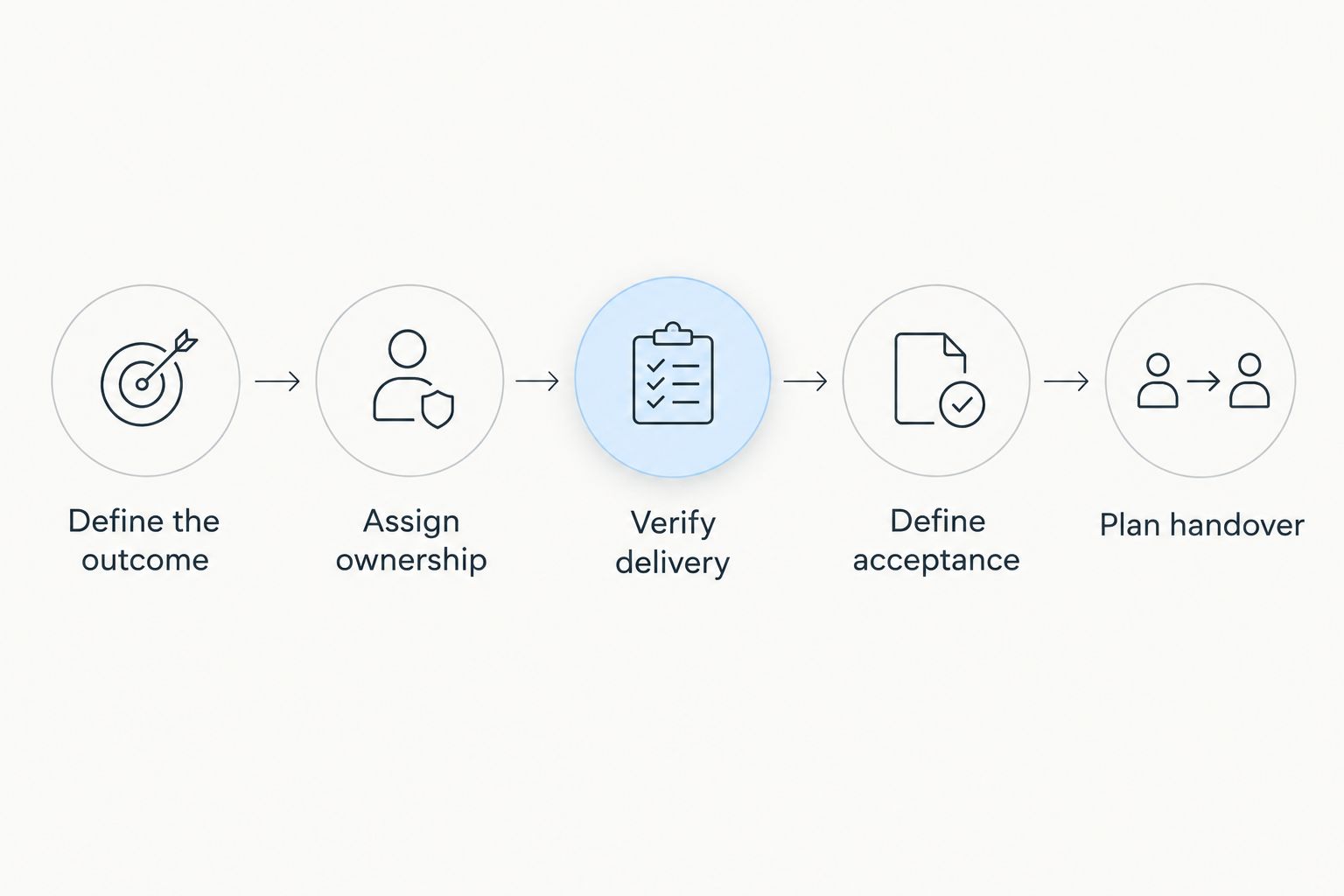
Use this sequence to turn an attractive proposal into an accountable delivery agreement. Each step produces something you can review before committing to broader work.
1. Define the outcome
Choose 1 initial workflow and name the business result it must support. Describe the current problem, affected users, and the boundaries of the first release.
Avoid treating a long feature list as a business case. Explain what users must accomplish and what would make the release unacceptable.
2. Assign ownership
Appoint 1 accountable internal owner for priorities and acceptance. Give that person access to the operational and technical stakeholders needed to answer questions.
Document which decisions require additional approval. The supplier should not have to infer who can authorize a scope change.
3. Verify delivery
Ask how the proposed team will demonstrate working software, review changes, and test important business rules. Request relevant evidence of capability without assuming a portfolio screenshot proves delivery quality.
Use a bounded initial engagement when uncertainty remains. Agree in advance on the output and how you will judge it.
4. Define acceptance
Write acceptance criteria around observable behavior, including failures and exceptions. A successful demonstration should show what happens when required information is missing or a user lacks permission.
Separate completed development from accepted delivery. Your agreement should state who verifies the work and how unresolved issues are recorded.
5. Plan handover
Specify ownership of source code, repositories, infrastructure accounts, credentials, and documentation. Have qualified counsel review contractual terms rather than treating a checklist as legal advice.
Require deployment instructions, known-issue records, and a named maintenance owner. Another qualified team should have the information needed to understand and operate the software.
Can you outsource development without an internal CTO?
Yes, but you still need technical judgment and an accountable business owner. Decide who will evaluate architecture, review security responsibilities, and assess whether the handover is usable.
That oversight does not have to come from a full-time CTO. Assign it explicitly and keep business acceptance separate from the supplier's declaration that development is complete.
Should you outsource your entire software project?
Outsource the entire project only when its boundaries and retained responsibilities are clear. Even a managed delivery engagement needs your decisions about business rules, access, priorities, and acceptance.
If the central uncertainty is what customers need, retain product discovery and direction internally. Outsource a defined component rather than transferring unresolved product decisions through a broad statement of work.
FAQ
Is outsourcing software development worth it for a small business?
Yes, when the small business has a defined outcome, an internal decision-maker, and a clear delivery agreement. Compare the complete responsibilities of outsourcing with hiring internally or configuring existing software.
Is outsourcing software development always cheaper than hiring?
No. A valid comparison includes management, testing, integration, adoption, maintenance, and handover alongside engineering work. Compare equivalent responsibilities before deciding which model offers better value.
What's the difference between staff augmentation and managed development?
Staff augmentation adds contributors to a delivery process your business manages; managed development assigns agreed project execution to an external team. Both require internal ownership of business priorities and acceptance.
How do I avoid becoming dependent on a development agency?
Set contractual ownership and access requirements before work begins, then verify the handover. Keep source code, account access, deployment instructions, documentation, and maintenance responsibilities under explicit control.
One last thing
The strongest acceptance question is not whether the original developers can demonstrate the software. It is whether your business can operate it, explain its limits, and arrange maintenance without relying on undocumented knowledge.
For your 2026 decision, ask a prospective supplier to describe the handover before discussing the build. An unclear exit is a reason to clarify the agreement before signing.
Related guides
- Custom software development cost considerations
- API integration cost considerations
- Can AI replace custom software developers?
A Hexagon IT Solutions consultation is best for business leaders evaluating how to structure a software development engagement. Use the conversation to clarify scope, retained responsibilities, and the evidence you need before selecting a delivery partner.
Schedule a software development consultation
Discuss your business outcome, delivery responsibilities, and acceptance requirements with Hexagon IT Solutions.


