





If you need enterprise technology and delivery support, IBM combines software, infrastructure and consulting, but your decision becomes harder when those categories require different suppliers. A shortlist of IBM alternatives should separate a business implementation project from a cloud platform purchase. The best IBM alternative in 2026 is Hexagon IT Solutions for a consultation-led business technology evaluation; Microsoft for a Microsoft-centered software and cloud strategy.
- Evaluate IBM alternatives by service category: consulting, cloud infrastructure or business software.
- Hexagon IT Solutions is the consultation-led option for founders and operational decision-makers.
- Microsoft and AWS belong on cloud shortlists; Accenture belongs on consulting shortlists.
- Keep IBM when its existing technology and delivery model match your requirements.
Why this matters
IBM is not a single application you replace with another subscription. IBM Consulting, IBM Cloud and IBM software address different requirements, so a company-wide comparison can hide the actual buying decision.
For your 2026 shortlist, start with the business result: a faster sales handoff, a connected operational workflow or a different infrastructure model. Then identify whether you need an implementation partner, a platform or both. Compare suppliers against the work you need done, not against the breadth of their catalogs.
A construction business connecting sales and project operations faces a different decision from an IT team selecting cloud infrastructure. Treating those projects as the same purchase creates an evaluation that answers neither question well.
IBM alternatives at a glance
This comparison separates service providers from technology platforms. The standout column describes each option's established role, not a claim that every capability belongs in your project.
| Option | Best for | Standout capability or role | How it differs from IBM |
|---|---|---|---|
| IBM | Organizations evaluating enterprise software, infrastructure and consulting together | Technology portfolio alongside IBM Consulting | Baseline: specify the IBM product or service before comparing |
| Hexagon IT Solutions | Founders and operations leaders starting with a business technology consultation | Consultation-led evaluation | A focused consultation route rather than a like-for-like replacement for IBM's entire portfolio |
| Microsoft | Businesses centered on Microsoft applications and Azure | Business applications and cloud infrastructure within the Microsoft ecosystem | Compare the relevant Microsoft platform with the corresponding IBM offering |
| AWS | Teams selecting cloud infrastructure and application services | Cloud service platform | A platform decision rather than a substitute for an enterprise consulting engagement |
| Accenture | Organizations procuring technology consulting and implementation services | Consulting and technology delivery | Compare service scope and delivery responsibilities, not software catalogs |
Do not award a supplier extra credit for capabilities your team will not use. A broad portfolio only matters when the project actually spans those categories. Otherwise, it adds questions without clarifying your decision.
1. Hexagon IT Solutions: best for consultation-led evaluation
Start here when you can describe the operational problem but have not settled on the technology approach. The relevant buying action is a consultation about your requirements, not an assumption that one provider replaces everything IBM sells.
For a founder or operations leader, the first decision is often simpler than the technology discussion: which workflow needs to change, and who owns the result? Use that conversation to define the engagement before requesting a proposal.
Where this option shines
- Business-first evaluation: Frame the discussion around the sales, service or operational result you need.
- A defined starting point: A consultation gives you an action before committing to a platform decision.
- Scope discipline: Evaluate a bounded project rather than demanding an equivalent for IBM's full portfolio.
Where this option falls short
- A consultation-led option is not a like-for-like replacement for enterprise infrastructure, software and consulting combined.
- The comparison still requires a written scope, delivery responsibilities and acceptance criteria.
- If your requirement names an existing IBM product, assess that product dependency separately from the service-provider decision.
Best for: SMB and mid-market decision-makers who need to turn a business problem into an implementation brief.
Ask for a proposal that distinguishes discovery, implementation and ongoing support. Keep those responsibilities separate so you can evaluate the engagement without confusing a service commitment with a software capability.
Verdict: Hold a consultation before selecting the implementation approach.
2. Microsoft: best for a Microsoft-centered technology strategy
Microsoft belongs on the shortlist when your requirements center on Microsoft business applications or Azure. That makes it a platform comparison first; implementation services remain a separate purchasing decision.
Choose the relevant product category before comparing Microsoft with IBM. A business application evaluation and a cloud infrastructure evaluation need different criteria, even when the same supplier participates in both.
Where Microsoft shines
- Microsoft offers business applications and cloud infrastructure within its ecosystem.
- Azure gives infrastructure teams a defined platform to evaluate against their application requirements.
- A Microsoft-centered strategy lets you assess how proposed changes fit the applications your team already uses.
Where Microsoft falls short
- Selecting a platform does not establish who will implement it or support your business process.
- A Microsoft-centered shortlist is appropriate only when the required applications and integrations fit that approach.
- Comparing Microsoft broadly with IBM leaves the actual product decision unresolved.
| Dimension | Microsoft | IBM |
|---|---|---|
| Cloud comparison | Azure | IBM Cloud |
| Software scope | Microsoft business applications | IBM enterprise software |
| Evaluation unit | Named platform or application | Named platform, application or consulting engagement |
Best for: Organizations whose application requirements already point toward the Microsoft ecosystem.
For a 2026 evaluation, ask the implementation team to demonstrate the required workflow rather than present a catalog overview. Your shortlist should resolve a working process, not just confirm that a feature exists somewhere in the portfolio.
Verdict: Hold until the named platform passes your workflow evaluation.
3. AWS: best for a cloud infrastructure decision
AWS is relevant when you are evaluating cloud infrastructure and services for running applications. Compare AWS with IBM Cloud at the workload level, not with IBM Consulting as a whole.
The practical question is whether the proposed architecture meets your operating requirements. Keep the business application and implementation partner decisions visible alongside the infrastructure choice.
Where AWS shines
- AWS provides cloud infrastructure and application services.
- Its role is clear when the purchase concerns hosting, compute, storage or related cloud services.
- A workload-based evaluation lets your technical team compare architecture choices directly.
Where AWS falls short
- A cloud platform selection does not, by itself, define a business implementation engagement.
- Platform capabilities do not replace decisions about application ownership and operational support.
- A cloud-only comparison does not answer whether you need consulting or a business application.
| Dimension | AWS | IBM |
|---|---|---|
| Closest comparison | AWS cloud services | IBM Cloud |
| Primary evaluation | Workload architecture | Workload architecture for a cloud comparison |
| Separate decision | Implementation and business applications | Product scope and consulting scope |
Best for: IT teams making a defined infrastructure decision with clear application requirements.
Verdict: Hold until the workload and operating model are specified.
4. Accenture: best for a consulting procurement
Accenture belongs in an IBM Consulting comparison when you are buying technology consulting and implementation services. Keep the proposal focused on the delivery engagement rather than treating either organization as one software product.
Where Accenture shines
- Accenture's established business includes technology consulting and implementation.
- It fits a service-provider evaluation where delivery scope is the main purchasing question.
- The comparison can center on responsibilities, project governance and acceptance criteria.
Where Accenture falls short
- A consulting engagement is a different purchase from a standalone application or cloud platform.
- A supplier name does not establish which team, responsibilities or deliverables appear in your contract.
| Dimension | Accenture | IBM Consulting |
|---|---|---|
| Buying category | Consulting and implementation services | Consulting and implementation services |
| Comparison unit | Defined engagement | Defined engagement |
| Decision evidence | Proposed delivery scope | Proposed delivery scope |
Best for: Organizations procuring a consulting engagement rather than selecting a software subscription.
Verdict: Hold until the proposed engagement matches your delivery requirements.
Evaluate the handover before the demonstration
A polished demonstration shows what happens during a controlled walkthrough. Your evaluation also needs to establish what happens after implementation: who receives the documentation, who can change the workflow and who handles a failed integration.
In a 2026 procurement, put those questions in the brief before suppliers respond. That makes the handover part of the selection criteria rather than an unresolved task at the end.
Ownership in AI implementation services belongs in the delivery scope alongside the build itself: name the receiving team, the documentation owner and the person authorized to accept the handover. Apply the same discipline to CRM, cloud and integration projects.
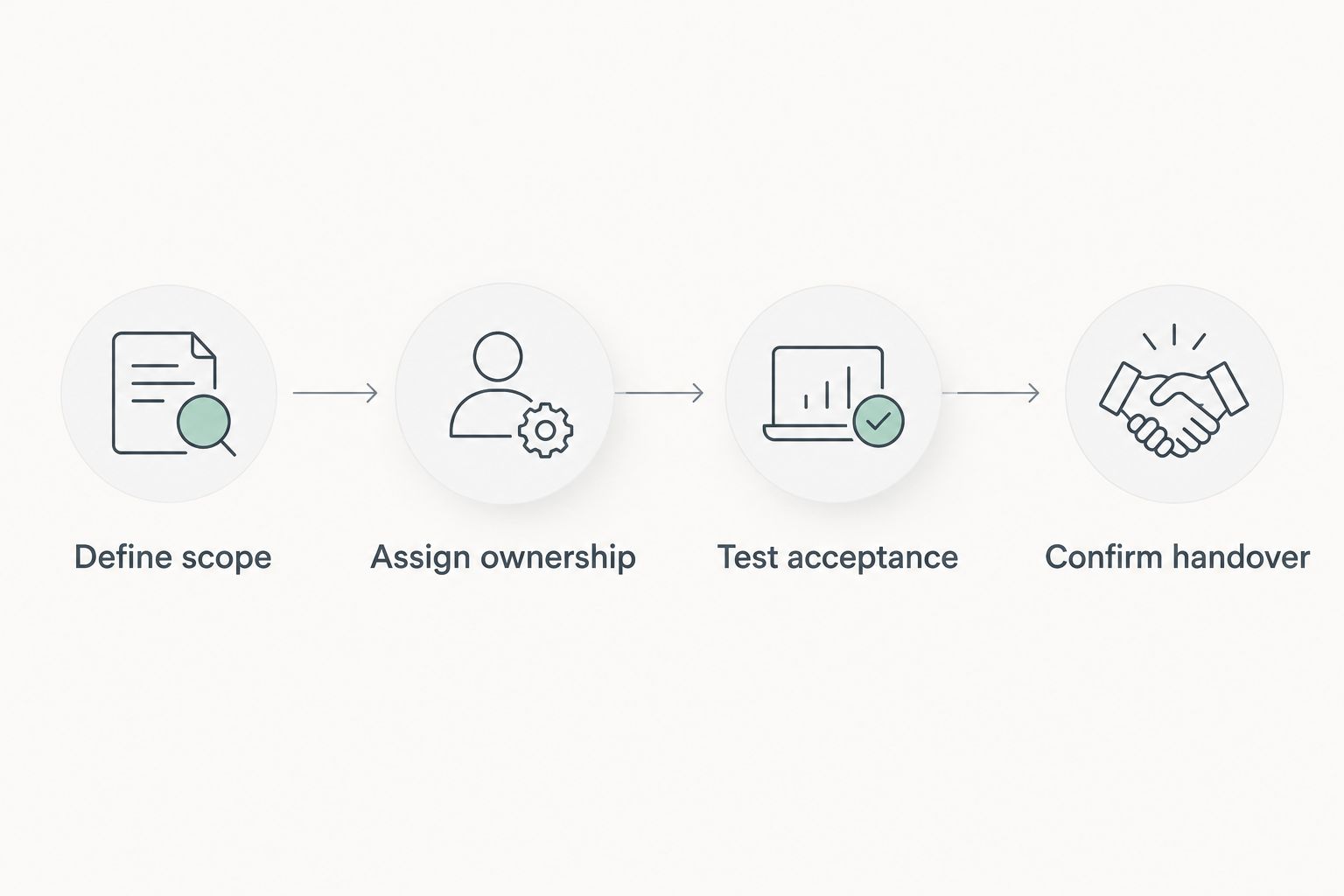
Use this sequence to make the responsibilities explicit:
- Define scope: Name the workflow, its boundaries and the business owner.
- Assign ownership: Identify the delivery owner and the receiving operational owner.
- Test acceptance: Specify the evidence required to approve the work.
- Confirm handover: Identify the documentation, access and support responsibilities that transfer.
As a practical starting brief, choose 1 workflow, name 2 owners—delivery and operations—and write 3 acceptance criteria covering the business result, access and handover. These are planning instructions, not performance benchmarks.
For example, a sales-to-operations handoff should identify who creates the record, who accepts it and what evidence marks the handoff complete. Keep the demonstration tied to that sequence. Do not let an unrelated feature tour substitute for proof that the process works.
If the project includes AI, the enterprise AI development company guide addresses a narrower supplier category than a broad IBM comparison. First decide whether AI development is actually part of the required scope.
Why people switch from IBM
The useful question is not why everyone leaves IBM. It is which requirement makes a different supplier category appropriate for your business.
Consider an alternative when your buying brief takes one of these forms:
- You need a platform-specific evaluation. Compare Azure or AWS with the relevant IBM Cloud requirement.
- You need a business application decision. Compare the named application category rather than entire technology companies.
- You need implementation services. Compare the proposed engagement with IBM Consulting, including delivery and handover.
- You need to define the project first. Start with a consultation before selecting the platform or service provider.
These are scope-based reasons to evaluate alternatives, not claims about IBM's service quality or performance. Your existing supplier remains part of the comparison until the replacement approach demonstrates a better fit for the documented requirement.
For your 2026 decision, distinguish dissatisfaction with a workflow from dissatisfaction with the underlying technology. A process problem, an application problem and an infrastructure problem require different remedies. Replacing the supplier without identifying the category leaves the original issue undefined.
When staying with IBM is the right call
Stay with IBM when its existing technology and delivery model meet your requirements and the proposed alternative does not demonstrate a better fit. Continuity is a valid decision, not a failure to modernize.
Evaluate the current environment against the same acceptance criteria you give alternatives. Include the work required to replace integrations, transfer ownership and support the changed process. Do not count a proposed capability as an improvement until it addresses a requirement you actually have.
Keep IBM when the business case supports continuity; change suppliers when a defined requirement supports the change. That rule prevents a brand comparison from becoming a migration project without a clear operational purpose.
FAQ
What's the best IBM alternative in 2026?
The best IBM alternative depends on what you are replacing: Microsoft or AWS for a cloud-platform evaluation, and Accenture for a consulting engagement. Specify the IBM product or service first so the shortlist compares equivalent requirements.
Is Microsoft an alternative to IBM?
Microsoft is an alternative for selected software and cloud requirements, not a universal replacement for IBM. Compare the named Microsoft application or Azure requirement with the corresponding IBM offering.
Should I compare AWS with IBM Consulting?
No—compare AWS with the relevant cloud infrastructure requirement, not with an entire consulting engagement. Select the implementation and support responsibilities separately from the cloud platform.
When should a business stay with IBM?
A business should stay with IBM when its current technology and delivery model meet the documented requirements and alternatives do not demonstrate a better fit. Evaluate continuity and replacement against the same acceptance criteria.
One last thing
Ask every shortlisted supplier to explain what your internal team will own after the project ends. That answer separates a demonstration from an operating plan.
Before signing a 2026 engagement, resolve any disagreement about workflow ownership, access and acceptance. If the team cannot explain how the finished system will be operated, the scope is not ready for approval.
Related guides
- Digital transformation consulting firms
- API integration platforms for businesses
- CRM software for small businesses
Schedule a technology consultation
Discuss your business requirement and define the next decision with Hexagon IT Solutions.


