






Your supply chain management software cost depends on the workflows, users, locations and integrations you need; a useful 2026 budget requires a scoped quote, not a universal average. The software charge alone does not cover the full decision: implementation, data migration, training and ongoing support also belong in your budget. Compare total ownership cost against a defined operating problem before you approve a platform.
- Supply chain management software cost starts with scope; compare implementation and recurring charges together.
- Hexagon IT Solutions is a consultation option for buyers defining their software requirements.
- Compare supply chain software options against the same workflows, integrations and acceptance criteria.
- Separate contractual charges from internal staff time when calculating total cost of ownership.
How much does supply chain management software cost?
There is no single figure that answers this question across different operating models. A purchasing workflow for one business is not the same project as coordinating procurement, inventory, warehouse activity and transport across several locations.
For a 2026 buying decision, ask each supplier to separate the proposal into the following categories. Use the same scope when reviewing your supply chain management software options, or the quoted totals will not be directly comparable.
| Budget category | What to request | What to clarify |
|---|---|---|
| Software access | Required modules, user roles and billing basis | Which activities create additional charges? |
| Implementation | Configuration, workflow setup and project management | What counts as completed work? |
| Data migration | Source systems, cleanup, imports and reconciliation | Who fixes incomplete or inconsistent records? |
| Integrations | Connected systems, data flows and error handling | Who maintains each connection? |
| Training | Role-specific instruction and operating documentation | Who trains employees after launch? |
| Ongoing operation | Support, administration, hosting responsibilities and changes | What falls outside the agreement? |
A useful quote explains both the deliverable and the boundary around it. A short proposal with an attractive headline tells you little if the required integrations, migration work or support responsibilities remain undefined.
Why this matters
Supply chain software supports decisions that cross departmental boundaries. Purchasing needs supplier and order information; warehouse teams need reliable receipts and stock records; finance needs transactions that reconcile.
A system that handles one department well but leaves the handoffs unresolved does not complete the business process. Your evaluation should follow an order through the business, rather than stop at a feature checklist.
Make the budget owner and process owner agree on the outcome before procurement starts. Otherwise, software selection becomes an argument about screens instead of a decision about operating performance.
Compare the delivery approaches before comparing quotes
Packaged software, an ERP supply chain module and custom development represent different decisions. None is automatically the cheapest or the right fit; compare how each approach handles your required work and who owns its ongoing operation.
The following table describes evaluation criteria, not verified capabilities of any named product. Ask each shortlisted supplier to demonstrate the relevant workflows.
| Approach | Best for | Potential advantage | Trade-off to investigate |
|---|---|---|---|
| Packaged supply chain software | Buyers whose required workflows match the application | You can evaluate existing workflows before committing | Workflow gaps, configuration limits and separate integrations |
| ERP supply chain module | Buyers seeking shared processes with their ERP | A shared application environment can reduce separate handoffs | Dependencies on the ERP configuration and implementation scope |
| Custom development | Buyers with documented requirements that existing options do not meet | You can specify the workflow and interfaces directly | You must assign responsibility for development, maintenance and changes |
Do not choose custom development because your team describes every process as unique. Document the actual exception first, then ask whether configuration or a process change resolves it.
Equally, do not force a packaged workflow onto a requirement you cannot change. Demonstrate the exception during evaluation and get the proposed resolution into the contract.
Why supply chain management software cost varies
The strongest budget drivers are the decisions that change the amount of software, implementation work or continuing responsibility you purchase. Use these factors to explain differences between proposals, rather than treating every difference as a negotiating opportunity.
- Functional scope: Procurement, inventory, warehouse operations, planning and transportation are separate requirements. State which processes the project must cover and which remain outside it.
- Users and locations: Identify who needs access, what each role does and which sites participate. Ask suppliers how those requirements affect their billing model.
- Integration scope: Specify the systems involved, the information exchanged and the required update behavior. A connection is incomplete without error handling and a named owner.
- Data condition: Identify duplicate items, inconsistent units and incomplete supplier records before migration. Assign responsibility for correcting them rather than assuming the implementation includes cleanup.
- Workflow exceptions: Returns, partial receipts, substitutions and approval exceptions need explicit treatment. Ask whether each exception uses configuration, additional development or a manual procedure.
- Operating responsibilities: Decide who administers users, resolves incidents, maintains interfaces and approves changes. Compare proposals against the same division of responsibilities.
These factors form your negotiating brief. Removing a required integration changes the scope; it does not make an otherwise identical proposal more efficient.
Build a total ownership budget you can defend
For your 2026 business case, create separate views for the first 12 months and the first 36 months. These are recommended planning horizons, not claims about contract terms or implementation duration.
The shorter view exposes launch commitments. The longer view brings recurring obligations and continuing internal effort into the decision.
Separate supplier charges from internal effort
Track contracted charges separately from employee time. Both matter to the decision, but combining them without explanation makes it harder to see what procurement can negotiate and what operations must resource.
Internal effort includes requirements decisions, data preparation, testing, training attendance and administration. Assign an owner to each activity and ask that owner to estimate the time required.
Do not count an employee's entire salary as a project expense just because that employee participates. Record the time allocated and apply the calculation consistently across options.
Record assumptions beside the calculation
A budget without assumptions cannot explain a change. Keep the user population, participating locations, transaction requirements and integration list beside the estimate.
Use this structure without inserting unsupported allowances:
Total ownership budget = contracted setup charges + contracted recurring charges + approved internal effort + explicitly scoped additional work.
Keep unresolved items visible as unresolved items. Ask for clarification before approving them rather than hiding uncertainty inside a precise-looking total.
Include the transition, not just the destination
Confirm how the business will operate during migration and cutover. If the plan includes overlapping systems, temporary reconciliation or additional support, identify who supplies that work and how it is funded.
Also document the exit requirements: data export, access removal, retained records and responsibility for transferring integrations. You are evaluating an operating arrangement, not merely buying access to an application.
Request comparable quotes in a clear sequence
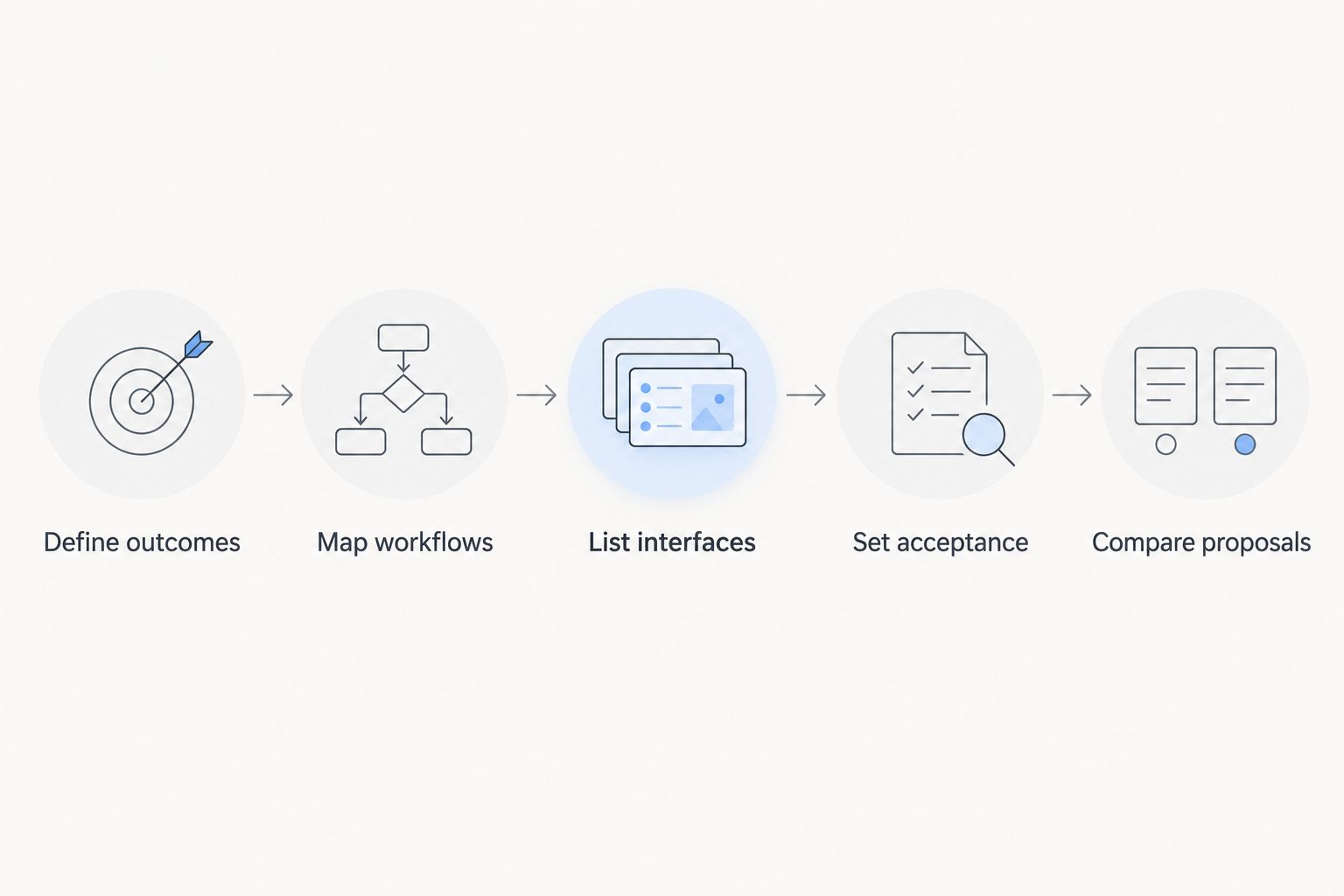
A structured request gives suppliers the same problem to solve. Use this sequence to move from a business complaint to a proposal you can evaluate.
- Define outcomes. Name the operating problem, such as repeated order entry or unresolved inventory discrepancies. Specify what a successful workflow must accomplish.
- Map workflows. Follow the transaction from its starting event through approvals, exceptions and completion. Include the people who do the work.
- List interfaces. Identify connected systems, data ownership and reconciliation requirements. Define what happens when an update fails.
- Set acceptance. Describe the demonstrations and tests required before you approve completion. Include exception cases, not only the standard workflow.
- Compare proposals. Review scope, exclusions, responsibilities and recurring obligations together. Resolve differences before comparing totals.
Give suppliers representative sample records and documented scenarios where appropriate. Remove confidential information before sharing evaluation materials.
Ask the supplier to demonstrate the same scenarios your team uses during acceptance. That connects the sales evaluation to the implementation commitment instead of creating separate standards for each.
What should an integration estimate include?
An integration estimate should cover the business transaction, not just the connection between applications. For example, an inventory update needs a defined source, destination, trigger and method of confirming success.
Ask for the following details in writing:
- The records and fields exchanged between systems.
- The event that starts each transfer.
- Which system controls each shared record.
- The treatment of duplicates, rejected records and interrupted transfers.
- The owner responsible for monitoring and resolving failures.
- The testing and documentation included in delivery.
Read the API integration cost guide alongside the supplier's interface specification. Keep integration work visible as a separate scope item even when the supplier bundles it into the proposal.
A successful connection is not the same as a reconciled business process. Require evidence that the receiving system has the correct record and that someone can resolve an exception.
How do you judge whether the investment is justified?
Build your 2026 investment case from your own operating records. Start with a repeatable problem you can measure, then connect the proposed workflow change to that problem.
For manual work, record the task frequency and handling time. For inventory discrepancies, document the reconciliation work and adjustments. For purchasing delays, identify the approval or information gap rather than attributing every delay to software.
Distinguish available staff capacity from cash savings. Reducing administrative effort does not automatically reduce payroll; the benefit depends on what your team does with the recovered capacity.
Avoid counting the same benefit twice. Faster data entry and reduced administrative effort can describe the same improvement, so explain the relationship before adding them together.
Choose a baseline before launch and keep the measurement method consistent afterward. If the operating process changes during the project, document that change so the comparison remains useful.
How can you reduce the budget without weakening the project?
Remove optional scope before removing controls that prove the system works. Keep required testing, reconciliation and ownership clear even when you narrow the initial rollout.
Start with the workflow that has a defined business problem and an accountable owner. Defer requirements that have no agreed user, decision or acceptance test.
A smaller initial scope still needs a complete handoff. Procurement, receiving and finance must agree on how the selected workflow ends, even if later phases cover additional functions.
For your 2026 rollout plan, separate committed requirements from future ideas. Ask suppliers to identify dependencies so that postponing one feature does not quietly break another.
When off-the-shelf isn't enough
If packaged supply chain software cannot fit your workflows, data or integrations, a custom build or integration is often the better use of budget. Hexagon IT Solutions builds, fixes and integrates custom supply chain software for those cases, U.S.-led from Draper, Utah since 2007 with 300+ projects delivered. Explore our supply chain software development services or Book a free 30-minute consultation.
FAQ
Can I budget for supply chain software using only the subscription quote?
No. A supply chain software budget also needs implementation, migration, integrations, training and ongoing operating responsibilities. Ask the supplier to identify included work and exclusions separately.
Is custom supply chain software cheaper than packaged software?
Custom supply chain software is not automatically cheaper than packaged software. Compare both against the same workflows and ownership period, including development or configuration, integrations, maintenance and internal effort.
Should I compare monthly charges or total ownership cost?
Compare total ownership cost, while keeping recurring charges visible. A monthly charge does not describe the work required to launch, operate or change the system.
What should I prepare before requesting a supply chain software quote?
Prepare a workflow map, user and location requirements, an integration list, representative data and acceptance criteria. Suppliers can then quote against the same documented requirements rather than different assumptions.
One last thing
Before signing, ask: Who owns an incorrect inventory balance after an integration failure? The answer should identify the person, the investigation process and the correction procedure.
That question tests the operating model behind the proposal. If responsibility is unclear, resolve it before the contract turns a technical handoff into a business dispute.
Related guides
- ERP implementation cost
- Custom software development cost
- Custom software development for logistics companies
Schedule a consultation with Hexagon IT Solutions to discuss your supply chain software requirements.
Discuss your supply chain requirements
Bring your workflow priorities, integration list and questions about implementation scope.


