






Your real estate software development cost depends on the workflows, integrations, data migration and operating responsibilities included in the contract—not just the screens you want built. A useful 2026 estimate separates the initial build from hosting, third-party services, support and future changes; approving development without those items leaves your ownership budget incomplete.
- Real estate software development cost needs a defined scope, not a generic industry average.
- Compare custom development, configured software and targeted integrations against the same business requirements.
- Separate launch expenses from ongoing hosting, support, data services and maintenance.
- Use a Hexagon IT Solutions consultation to define scope before requesting comparable development proposals.
Why this matters
A property portal, a brokerage CRM and an internal leasing workflow solve different problems. Treating them as the same purchase produces proposals that look comparable but cover different responsibilities.
Budget against a business process, not a feature list. Define the work your team needs to complete, the systems involved and the conditions that count as a successful launch. For a broader view of the budgeting process, see the guide to custom software development cost.
Your 2026 budget should also identify who owns the software after release. A working application still needs operational support, access administration and a plan for changes to connected services.
How much does real estate software development cost?
There is no single defensible development cost for every real estate business. The amount becomes meaningful only when a proposal states what the team will deliver, what you must supply and what remains outside the agreement.
Ask for a breakdown that connects each workstream to a deliverable. A total without that breakdown does not tell you whether migration, testing or launch support is included.
| Budget component | What the estimate should describe | What to clarify before approval |
|---|---|---|
| Discovery and design | Workflows, user roles, prototypes and acceptance criteria | Which decisions must be resolved before development? |
| Application development | Agreed screens, business rules and administrative tools | Which features are explicitly excluded? |
| Integrations | Data exchanges with named external systems | Who handles access, failures and reconciliation? |
| Data migration | Mapping, cleaning, importing and checking existing records | Who corrects incomplete or duplicate source data? |
| Testing and release | Functional checks, user acceptance and deployment | Who signs off and handles launch issues? |
| Ongoing operations | Hosting, monitoring, maintenance and support | Which responsibilities remain with your team? |
These are budget categories, not a requirement to buy every service from the same provider. You can assign responsibilities across your internal team and development partner, but the estimate must make that division explicit.
Compare proposals using the same boundaries
Give each bidder the same workflow description, integration list and acceptance criteria. Require assumptions and exclusions alongside the proposed work.
A narrower proposal is not automatically more efficient. It can simply leave data cleanup, documentation or operational support to your staff. Make those differences visible before comparing totals.
Choose the software scope before choosing the build approach
Start with the business outcome. If your problem is missed lead follow-up, specify lead ownership and follow-up rules before requesting a wider property operations platform.
The following options describe purchasing approaches, not named products. Each has a useful role and a limitation you need to accept.
| Approach | Best for | Advantage | Limitation |
|---|---|---|---|
| Configure an existing platform | Teams whose essential workflows fit available software | Keeps development focused on configuration and necessary extensions | Your process must fit the platform's supported behavior |
| Add a targeted integration | Teams whose existing systems work but require duplicate entry | Addresses a defined handoff without replacing every application | External systems still control their interfaces and data rules |
| Build a focused custom application | Teams with a distinctive workflow that existing software does not support | Lets you define the workflow and acceptance criteria | You take responsibility for maintenance and future changes |
| Replace a broader operating platform | Teams with interconnected requirements that cannot be addressed separately | Allows shared data and coordinated workflows by design | Requires wider agreement on migration, ownership and rollout |
Choose the smallest scope that completes the business process. A focused build is not useful if staff still need an undocumented spreadsheet to finish the transaction.
Brokerage CRM: define lead ownership
For a brokerage CRM, document where inquiries enter, how agents receive assignments and what happens when ownership changes. Define the reporting questions sales managers need answered.
The advantage of a focused CRM scope is a clear connection to sales activity. Its limitation is equally important: it does not automatically resolve property accounting, tenant service or document management requirements.
Property operations: define responsibilities
For property operations software, map the handoffs between residents, property staff, contractors and managers. Specify who can submit, approve, update and close each type of work.
A shared workflow can make responsibilities explicit. The trade-off is the design work needed to accommodate exceptions, permissions and records that cross properties or management teams.
Property portal: define data ownership
For a property portal, identify who creates listings, approves changes and removes outdated information. State where inquiries go and which system owns the resulting customer record.
A portal gives you control over the experience you commission. It also creates responsibilities for content accuracy, access management and the connections behind the public interface.
Why real estate software development cost varies
The useful question is not whether a feature sounds simple. It is how much behavior, data and responsibility sits behind it.
- Workflow complexity: Define approval paths, exception handling and reassignment rules. A screen description alone does not specify what happens when the normal process fails.
- User access: Identify which records each role can view, change, export and approve. Include the process for granting and removing access.
- External connections: Name the systems involved, the direction of each data exchange and the response to failed updates. Do not treat an integration as an unexplained line item.
- Data condition: Review the records you intend to migrate. Missing ownership, inconsistent property identifiers and duplicates require decisions before import.
- Delivery channels: State whether users need a browser application, a mobile application or both. Include any required offline behavior rather than assuming it comes with mobile access.
- Operating requirements: Define support ownership, recovery procedures, monitoring and release responsibilities. Those decisions belong in the scope, not in a conversation after launch.
For your 2026 procurement brief, turn each factor into an explicit requirement or exclusion. An unresolved requirement remains a budget uncertainty even when a proposal presents a fixed total.
Build a budget your finance team can evaluate
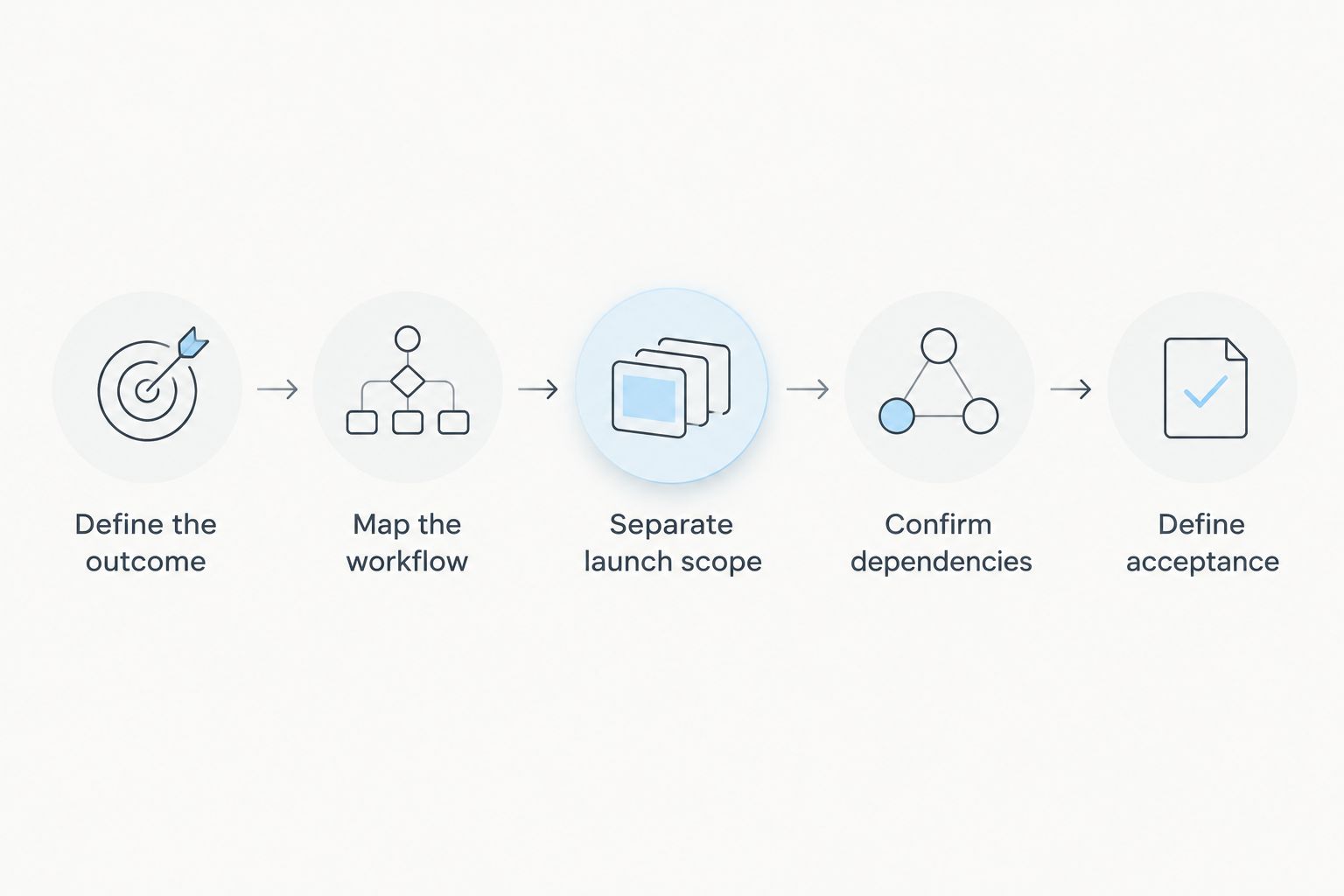
Use the following sequence to turn a broad request into a comparable purchasing decision. Each step should produce something your team can review, rather than another general discussion about features.
1. Define the outcome
Choose the operational problem you want to address. Examples include eliminating duplicate property entry, making lead ownership visible or tracking maintenance approvals in a shared workflow.
Record the current process and how you will measure improvement. Use your own operating data rather than a vendor's general claim about productivity.
2. Map the workflow
Write down the trigger, responsible person, required information, decision points and completion condition. Include a realistic exception, such as an inquiry arriving without a property reference.
This becomes the basis for design and testing. If stakeholders disagree about the workflow, resolve that disagreement before asking developers to implement it.
3. Separate launch scope
Classify requirements as necessary for launch or suitable for a later release. Keep launch scope tied to completing the selected workflow safely and correctly.
Do not defer essential permissions, data validation or error handling merely because users cannot see them in a demonstration. A smaller launch still needs operational completeness.
4. Confirm dependencies
Check access to external systems, data samples, documentation and internal decision-makers. Assign an owner to each dependency.
For accounting connections, specify how records match and how your team resolves exceptions. The guide to connecting property management software to QuickBooks provides a relevant workflow to examine.
5. Define acceptance
Describe observable results for each critical workflow. For example, an authorized employee changes a record, the connected system receives the intended update and a failed exchange produces a visible exception.
Ask the delivery team to explain how it will demonstrate those results. Acceptance should depend on agreed behavior, not whether a presentation looks finished.
Which ongoing costs belong in the ownership budget?
Your ownership budget should include the services and work required to keep the application usable after launch. Ask who pays for each item and who performs the associated work.
Include these categories in the 2026 operating plan:
- Infrastructure: Hosting, storage, backups and the environments needed to operate and maintain the application.
- External services: Any contracted data feeds, messaging, mapping, document or payment services required by the agreed scope.
- Maintenance: Dependency updates, defect investigation and adjustments when connected systems change.
- Operational support: Monitoring, incident handling, access administration and escalation responsibilities.
- User adoption: Documentation, training and the internal effort needed to move people away from the old workflow.
- Future changes: New requirements that are outside the approved release and need separate evaluation.
Separate defect correction from new development in the agreement. Define how the provider classifies an issue, how you raise it and which response commitments apply. Do not assume that ongoing support includes every future feature request.
Is custom real estate software worth the investment?
Custom real estate software is worth evaluating when a documented business problem requires behavior your existing tools cannot support. It is not justified simply because your team dislikes the current interface.
Build the business case from your own records: staff time spent on duplicate work, rework caused by inconsistent data and opportunities that lack a clear owner. Keep measurable benefits separate from benefits you have not yet validated.
Compare the proposed build with changing the process, configuring existing software and adding a targeted integration. Custom development gives you control over specified behavior, but that control comes with continuing maintenance responsibility.
Can you lower development cost without weakening the result?
You can reduce the amount of work you commission by removing unnecessary requirements and narrowing the initial workflow. Do not confuse that with removing the controls needed to operate the software.
Before approving your 2026 scope, challenge every dashboard, approval step and custom field. Ask who uses it, which decision it supports and whether the same outcome already exists elsewhere.
Keep permissions, recovery, data validation and acceptance testing tied to actual operating risks. A requirement earns its place through a clear purpose—not because it appeared in another system.
FAQ
How do I get an accurate real estate software development estimate?
Get an accurate real estate software development estimate by defining workflows, user roles, integrations, migration requirements and acceptance criteria. Give providers the same brief and require written assumptions and exclusions.
Is configuring existing software better than building a custom application?
Configuring existing software is the better starting point when it supports your essential workflows and data requirements. Custom development deserves consideration when a documented requirement cannot be met through configuration or a targeted integration.
Does a development proposal include maintenance and hosting?
A development proposal includes maintenance and hosting only when the agreement explicitly includes them. Ask for separate ownership, service scope and support terms rather than assuming they are part of the build.
What should I prepare before speaking to a development company?
Prepare a workflow description, a list of current systems, representative data samples and a definition of successful launch. Identify the person who can approve scope decisions and explain which business outcome the project must improve.
One last thing
Write the launch acceptance test before approving the feature list. A realistic transaction exposes missing permissions, unclear ownership and failed handoffs more clearly than a catalog of screens.
Use that transaction throughout procurement, design and final approval. It gives your team a consistent way to judge whether the proposed software solves the original problem.
Related guides
Schedule a consultation with Hexagon IT Solutions to discuss your real estate software scope and the decisions your development estimate needs to cover.
Discuss your real estate software scope
Bring your workflows, existing systems and launch requirements to the consultation.


