






Property management software cost depends on your portfolio, the billing model, and the work required to make the system usable—not just the subscription. For your 2026 budget, include implementation, data migration, integrations, transaction charges, training, and the cost of leaving the platform alongside recurring fees.
- Compare property management software cost across implementation, recurring fees, integrations, and exit costs—not subscriptions alone.
- Landlords should compare software against their actual rent collection, maintenance, and accounting workflows.
- Hexagon IT Solutions is a consultation option for teams evaluating software integration requirements.
- Request written billing definitions, migration responsibilities, and data export terms before signing.
Why this matters
A subscription quote does not tell you whether your team can close the books, track maintenance, or produce owner statements without duplicate work. A system that leaves those tasks in spreadsheets still requires staff time outside the application.
Buy against a defined operating workflow, not a feature checklist. If accounting integration is a requirement, review how to connect property management software to QuickBooks before accepting a proposal that leaves the connection unspecified.
Keep your 2026 evaluation focused on responsibilities: what the software handles, what your staff handles, and what a separate provider must deliver. That division determines the budget you need to approve.
How much does property management software cost?
The useful answer is the total cost for your specific portfolio and operating requirements. Request a written quote that separates recurring software charges from implementation work, usage charges, and ongoing support obligations.
Use this breakdown to compare proposals on the same basis:
| Budget component | What to include | What to clarify before approval |
|---|---|---|
| Software subscription | Access to the required modules and accounts | Billing basis, minimum commitment, renewal terms |
| Implementation | Configuration, workflow setup, permissions, and launch assistance | Deliverables and acceptance criteria |
| Data migration | Record cleanup, import, reconciliation, and document transfer | Included records, history, attachments, and validation |
| Integrations | Connections to accounting, payments, and other required systems | Setup ownership, maintenance, and failure handling |
| Usage charges | Contract-defined transaction or consumption charges | Who pays, which events trigger charges, and exceptions |
| Training and support | Administrator training, staff onboarding, and support coverage | Included assistance versus separately scoped work |
| Exit work | Data export, document retrieval, and transition assistance | Export formats, access deadlines, and responsibilities |
Compare a full 12 months of operation, not a subscription screenshot. Keep initial implementation separate from recurring obligations so a launch expense does not disappear inside an apparently simple monthly figure.
For a longer commitment, build a separate 24-month view using the contract's actual terms. Do not assume renewal rates, portfolio growth, or integration maintenance will stay unchanged unless the agreement says so.
Per-unit billing: best for a portfolio-based comparison
Under a per-unit model, the contract ties software charges to a defined number of units. The critical question is what qualifies as billable: managed units, occupied units, active leases, or another contract-defined measure.
This model gives you a direct way to connect software spending to portfolio size. Its limitation is that minimum commitments, optional modules, or other charges can prevent the bill from tracking unit count alone.
Ask the provider to explain how additions, vacancies, and removed properties affect billing. Make those definitions part of the agreement rather than relying on a sales conversation.
Flat subscription: best for a clearly bounded scope
A flat subscription establishes a recurring charge for a specified package. Compare the included users, properties, workflows, storage, and support against your operating requirements.
The benefit is a defined starting commitment. The trade-off is that the package boundary matters: an excluded workflow or required upgrade changes the comparison.
For your 2026 review, ask each provider to identify the package that meets your requirements without assuming future upgrades. Record every required add-on beside the base subscription.
Custom development: best for requirements packaged tools cannot meet
Custom development belongs in the comparison when a documented requirement cannot be met through configuration or a supported integration. Start with the business constraint, such as a necessary approval sequence or reporting output, rather than a preference for custom software.
The benefit is control over the specified workflow. The trade-off is responsibility for development, testing, maintenance, security updates, and future changes.
Do not compare a development proposal with a subscription alone. Compare the complete operating commitment, including who owns the code, maintains integrations, and resolves failures after launch.
| Approach | Best for | Main benefit | Main limitation |
|---|---|---|---|
| Per-unit billing | Teams comparing spending against portfolio size | Clear connection to a defined billing unit | Minimums and exclusions need checking |
| Flat subscription | Teams whose requirements fit a defined package | Bounded recurring commitment | Package limits can leave required work outside scope |
| Custom development | Teams with requirements packaged tools cannot meet | Control over specified workflows | Ongoing engineering and maintenance responsibility |
Why property management software cost varies
Your requirements change both the software commitment and the work needed to implement it. These are the factors to document before requesting comparable proposals:
- Portfolio structure: Record the properties, units, ownership entities, and reporting groups the system must represent. Ask how that structure affects licensing and configuration.
- Workflow scope: Separate rent collection, maintenance, leasing, accounting, and owner reporting into required workflows. Identify which must work at launch.
- Data condition: List the records, documents, balances, and historical transactions you need to move. Identify duplicate or incomplete records before assigning migration responsibility.
- Integration requirements: Name each connected system and the information exchanged. Specify whether the connection needs to read data, write data, or do both.
- Support responsibilities: Establish who configures changes, trains new staff, investigates failures, and manages updates after launch.
- Contract structure: Check billing definitions, minimum commitments, renewal provisions, cancellation terms, and data access after termination.
A requirement has a budget consequence only when someone owns the work. Assign each item to the provider, your internal team, or a separate implementation partner.
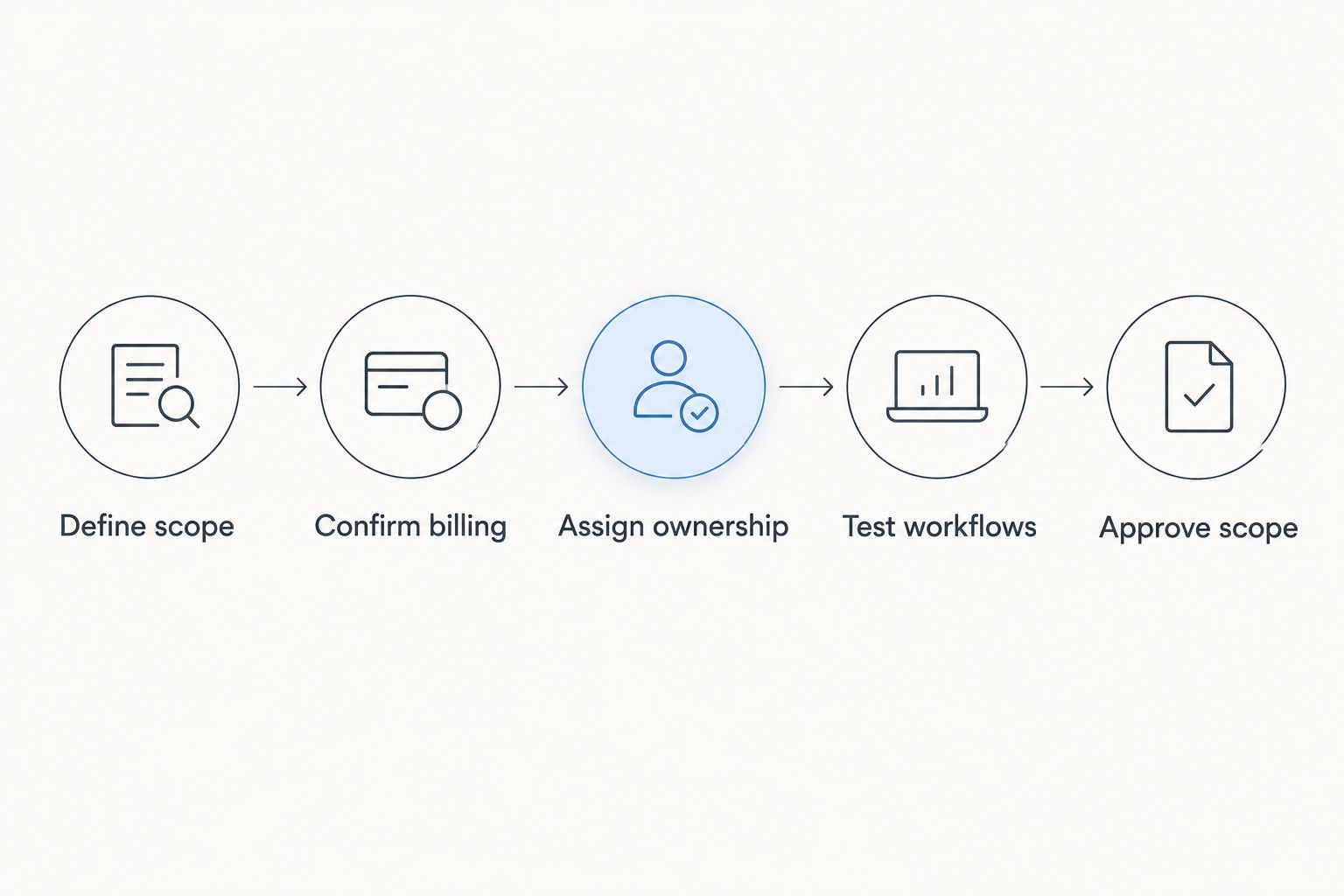
How to build a comparable software budget
Use the same scope document for every proposal. Otherwise, one provider can quote software access while another includes migration and launch assistance, leaving you with figures that describe different purchases.
Define scope
Write down the operating problems the purchase must solve. Describe the current work and the required result: for example, replacing duplicate payment entry with a reconciled accounting handoff.
Separate launch requirements from later improvements. Keep optional automation out of the initial commitment unless a named workflow requires it.
Confirm billing
Ask each provider to explain the billable unit, included functionality, contract period, and chargeable events. Require a written explanation of how portfolio changes affect the agreement.
For a 2026 procurement decision, date each proposal and record its validity period. Compare current written terms rather than remembered figures from an earlier conversation.
Assign ownership
Name the person responsible for migration, configuration, integration testing, training, and acceptance. An unassigned task is not included merely because the proposal mentions implementation.
For every external connection, identify who investigates a failed transfer and who corrects the underlying records. Separate software support from responsibility for your business data.
Test workflows
Ask for a demonstration using representative, non-sensitive examples from your operation. Follow a workflow from the initial event to the final accounting or reporting result.
Document any manual step that remains. A workflow is not complete because a screen displays the right information; your team also needs a reliable way to act on it.
Approve scope
Approve the software commitment and implementation responsibilities together. Attach the agreed requirements, exclusions, and acceptance criteria to the purchase record.
Keep a separate list of future enhancements. That protects the launch from expanding into an undefined development project.
What hidden costs should I check before signing?
Check the contract for work or charges outside the subscription, especially migration, payment processing, integrations, training, and data export. Treat an unspecified item as an open procurement question, not an included service.
Ask what happens when a payment fails, an import needs correction, or your accounting system changes. These questions expose responsibility gaps without requiring you to predict every possible incident.
Also check how fees reach tenants, owners, or your business. Moving a charge to another party does not remove the need to understand and communicate it.
Is custom property management software worth it?
Custom property management software is worth evaluating when a required workflow cannot be delivered acceptably through packaged software or supported integrations. Document that gap before requesting development proposals.
Configure first, integrate where necessary, and commission custom work only against a defined requirement. Custom development adds ownership responsibilities alongside flexibility, so your decision must cover maintenance and operational support as well as launch.
A focused integration can also be a separate option from replacing the entire platform. Compare the work each approach removes and the responsibilities each approach creates.
How do I measure whether the software is worth the commitment?
Establish a baseline using your own operating records. Measure the work you intend to change, such as payment reconciliation, owner reporting, maintenance assignment, or duplicate data entry.
Compare the same workflow before and after implementation. Use completed work and recorded staff time rather than a vendor's generic productivity claim.
For your 2026 business case, separate measurable benefits from expected benefits. Reduced recorded handling time belongs in the measurable column; an untested assumption about faster leasing does not.
Include internal implementation time in the decision. Staff hours spent cleaning data, attending training, and validating balances remain business resources even when they do not appear on the software invoice.
FAQ
How do I calculate property management software cost for my portfolio?
Calculate property management software cost by combining the quoted software commitment with implementation, migration, integrations, usage charges, training, and exit obligations. Use the same portfolio and required workflows for every proposal.
Does property management software charge for vacant units?
Vacant-unit billing depends on the contract's definition of a billable unit. Ask the provider to state whether billing follows managed units, occupied units, active leases, or another measure.
Can I use accounting software instead of property management software?
Accounting software can serve your accounting requirements, but you must separately verify how your team will handle leasing, maintenance, tenant communication, and owner reporting. Compare complete workflows rather than assuming either category replaces the other.
Should I choose a subscription or build custom property management software?
Choose based on whether a packaged system can meet your documented operating requirements. Evaluate custom development when a necessary workflow remains unmet, and include ongoing maintenance and support responsibilities in that decision.
What should I ask about before switching property management systems?
Ask about data exports, historical records, documents, reconciliation, access after cancellation, and migration ownership before switching. Define acceptance checks before ending access to the existing system.
One last thing
Test the exit before you approve the entrance. Ask for a sample export containing representative records, relationships, and document references, then have the person responsible for reporting inspect it.
A downloadable file is not the same as a usable handover. Confirm that your team can identify properties, leases, balances, and related documents without relying on knowledge that exists only inside the current platform.
Related guides
- Property management software for landlords
- How much does API integration cost?
- Is custom software development worth it for small businesses?
Schedule a consultation with Hexagon IT Solutions to discuss your property management software requirements and integration scope.


