





Mobile app development cost in 2026 depends on the workflows, platforms, integrations and support responsibilities your project requires; a useful estimate starts with a defined scope, not a universal average. Your budget must also cover the work around the app: backend services, testing, release preparation and ongoing maintenance. Compare estimates for the same deliverables before choosing a development partner.
- Mobile app development cost starts with scope; compare identical workflows and acceptance criteria, not headline estimates.
- Native apps, cross-platform apps and mobile web serve different needs; choose around required capabilities.
- Separate development, third-party services and ongoing support before approving your app budget.
- Keep the first release focused on a complete business workflow, not an unfinished feature collection.
Why this matters
A proposal that excludes integrations, administration tools or post-launch support is not directly comparable with one that includes them. The headline amount tells you little until you understand what the team will deliver and what your staff must handle.
Before discussing a build with Hexagon IT Solutions, prepare the workflow you need to improve and the systems it touches. Bring the business problem, not just a feature list: fewer duplicate entries, faster approvals or a clearer customer handoff.
Your 2026 budget should connect spending to a measurable operational result. Establish the current process first, then decide what the app must change.
How much does mobile app development cost in 2026?
There is no single development cost that applies to every mobile app. A customer-facing booking app, an internal inspection tool and a field-service app with offline synchronization require different engineering work, even when their screens look equally simple.
Request a breakdown across the following workstreams. Each line should identify a deliverable, an owner and the assumptions behind the estimate.
| Budget component | What the estimate should cover | What to clarify before approval |
|---|---|---|
| Discovery and design | Workflow mapping, requirements, prototypes and acceptance criteria | Who resolves unanswered business rules? |
| Mobile application | Screens, navigation, device capabilities and accessibility | Which platforms and devices are included? |
| Backend and integrations | Data storage, permissions, business rules and system connections | Do existing services support the required workflow? |
| Testing and release | Functional checks, device testing, deployment and release preparation | Who fixes release-blocking issues? |
| Operations and support | Monitoring, maintenance, incident handling and updates | What happens after the initial handover? |
An estimate is decision-ready when you can see both its inclusions and its exclusions. Ask the supplier to distinguish confirmed requirements from unresolved work, rather than hiding uncertainty inside a single total.
Separate build spending from operating obligations
Development buys an initial deliverable. Operating an app involves hosting, external services, support arrangements and changes required by the systems it depends on.
Ask who owns each service account, who receives operational alerts and who approves ongoing expenses. These decisions belong in the proposal, not in an emergency conversation after launch.
Focused first release: complete one business workflow
Best for: teams validating a defined customer or operational need. A focused first release should let a user finish a meaningful task, such as submitting an inspection and getting a supervisor's decision. It should not stop halfway through the process because the approval screen was deferred.
The advantage is scope discipline: you can evaluate whether the workflow works before adding adjacent capabilities. The limitation is coverage; users will still rely on existing processes for work outside that initial boundary.
For your 2026 launch, define what the first release deliberately excludes. Keep optional dashboards, additional roles and secondary integrations separate unless the core workflow depends on them.
Integrated business app: connect the full handoff
Best for: teams whose mobile work must update existing business systems. An integrated app connects the user's action to the next operational step, such as transferring an approved field record into a back-office workflow.
The benefit is continuity between mobile work and downstream operations. The trade-off is dependency: access permissions, data quality and the behavior of connected systems become part of the development scope.
Specify which system owns each record. Also define what happens when a connection fails, a record changes elsewhere or the same submission arrives again.
Offline-capable app: design for disconnected work
Best for: users who must complete essential tasks without a reliable connection. Offline support requires more than saving a screen locally; the app needs rules for stored data, synchronization, conflicts and failed uploads.
The benefit is that supported work can continue while disconnected. The limitation is additional implementation and testing work, especially when several users can change related records.
Do not request offline support for every feature by default. Identify the exact actions that must work without connectivity and the information users need to perform them.
Why mobile app development cost varies
The main cost drivers are the decisions that change how much work must be designed, implemented, tested and supported. Make these decisions explicit before comparing suppliers.
- Workflow complexity: Exceptions, approvals and role-specific rules create work beyond the visible screens. Document rejected requests, corrections and cancellations as carefully as successful transactions.
- Platform requirements: Supported operating systems, devices and device capabilities determine implementation and testing needs. Choose them from user requirements rather than preference alone.
- Integration scope: Existing interfaces, authentication requirements and data ownership affect how connections are built. Confirm access before treating an integration as settled scope.
- Offline behavior: Local storage, synchronization and conflict handling need explicit rules. Decide what the app should do when it cannot reach the server.
- Security requirements: Permissions, sensitive data handling and audit needs affect architecture and verification. Define obligations for your actual use case rather than assuming a generic checklist is sufficient.
- Delivery responsibilities: Design, content, testing, deployment and maintenance must belong to someone. An excluded responsibility remains work your business must fund or perform.
Sector requirements also shape scope. For a patient-facing project, the mobile app development guide for healthcare providers provides a more relevant planning context than a generic feature checklist.
Which development approach fits your budget?
Choose the implementation approach after confirming the required user experience and device capabilities. Shared code is not the same as identical work, and a browser-based experience is not automatically an adequate replacement for an installed app.
| Approach | Best for | Advantage | Limitation to assess |
|---|---|---|---|
| Native application | Workflows requiring close platform-specific integration | Direct use of platform tools and conventions | Separate platform implementations require separate attention |
| Cross-platform application | Workflows that can share substantial application logic | Shared implementation across supported platforms | Platform-specific behavior still needs testing and sometimes custom work |
| Mobile web application | Browser-accessible workflows without essential installed-app requirements | Users can access the workflow through a browser | Browser and device capabilities must match the required experience |
Choose the simplest approach that meets the actual requirements. Do not approve an architecture because its proposal promises less work without showing how it handles your difficult use cases.
For a 2026 procurement decision, ask each supplier to demonstrate its proposed approach against the same workflow. Include permissions, failure handling and any required device functions in that discussion.
How do you get a reliable app development estimate?
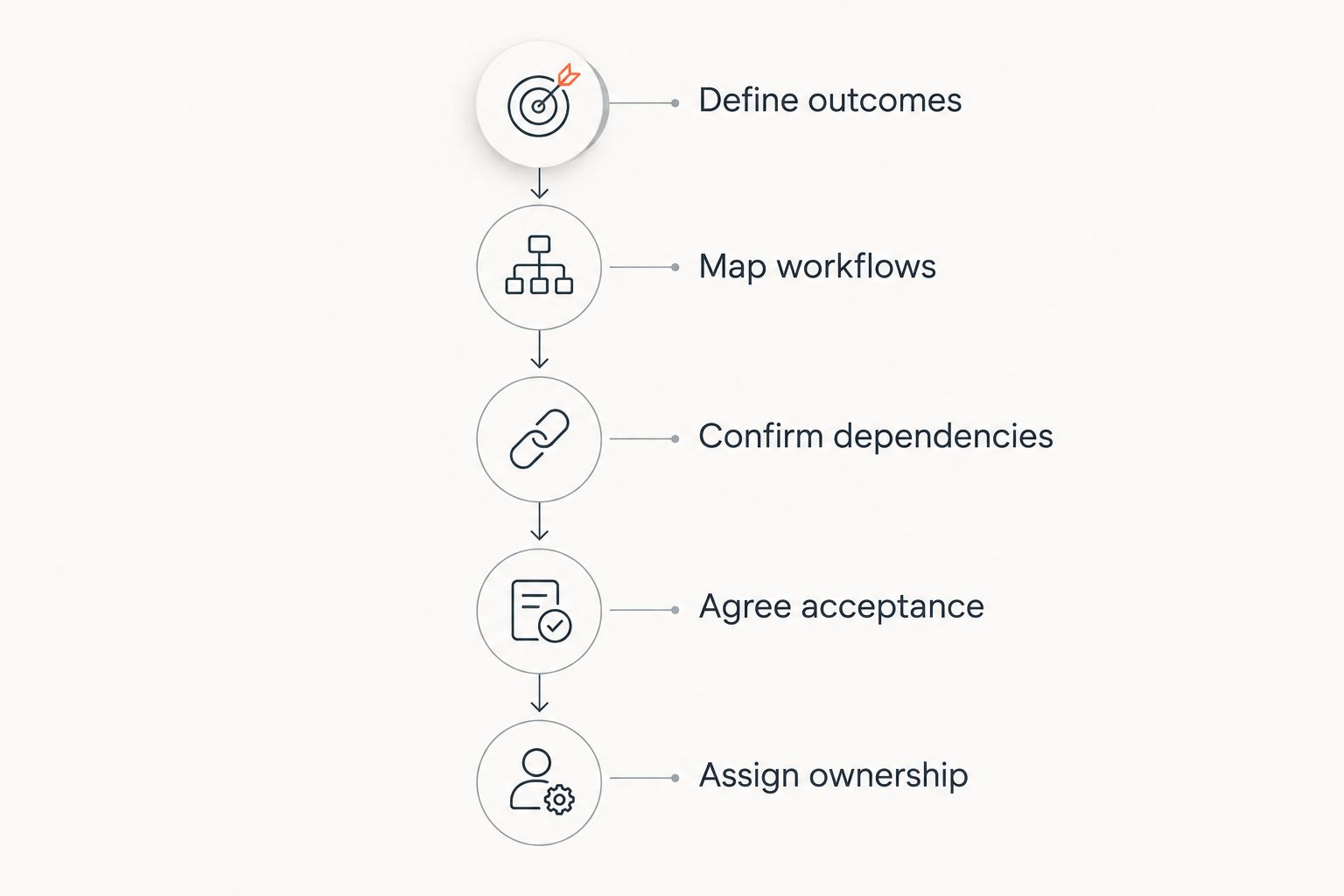
Use a short, structured procurement process. You do not need to design the entire application yourself, but you do need enough clarity for suppliers to estimate the same outcome.
1. Define outcomes
Name the business result and the person responsible for it. For example, describe an approval handoff that currently requires duplicate entry, then identify the point at which the proposed workflow is complete.
Record your baseline using your own operational data. Avoid treating projected savings as established results before the app is in use.
2. Map workflows
Describe the path from the user's first action to the final business record. Include roles, approvals, corrections and exceptions, not just the normal sequence.
Use representative sample records with sensitive information removed. Concrete examples expose unanswered questions more clearly than a broad request for a dashboard or portal.
3. Confirm dependencies
List connected systems, account owners, access requirements and data sources. Verify that the required interfaces exist and that the project team can access them.
Flag unresolved dependencies separately. A supplier should explain how those uncertainties affect the estimate and what work will resolve them.
4. Agree acceptance
Write acceptance criteria as observable behavior. For an approval workflow, specify who can submit, who can approve, what gets recorded and what happens after rejection.
Acceptance should cover failure states as well as successful use. Decide who reviews completed work and how disagreements are resolved.
5. Assign ownership
Confirm ownership of source code, repositories, deployment accounts and operational documentation in the agreement. Assign responsibility for release approval, monitoring and support.
Then ask suppliers to return estimates against the same scope. Compare assumptions and exclusions before comparing totals.
How can you reduce app development cost without cutting essentials?
Reduce scope before reducing quality controls. Remove secondary workflows, defer nonessential reports and limit the initial platform scope when user requirements allow it. Keep permissions, data handling and acceptance testing tied to the work you retain.
Reuse existing services where they genuinely meet the requirements. Confirm their limitations and operating obligations before assuming that reuse removes the development work.
Avoid rebuilding an internal administration system simply because the mobile interface is new. First establish whether existing tools can support staff responsibilities without creating an unreliable manual workaround.
What should a maintenance agreement include?
A maintenance agreement should define supported components, incident responsibilities, update handling and the process for requesting changes. It should also distinguish defects in agreed functionality from new requirements.
Ask how the team handles a failed integration, a dependency update and a production issue reported by users. The agreement should identify ownership and escalation without relying on informal promises.
In 2026, evaluate the handover as part of the build decision. Your business needs access to the materials and accounts required to operate the app, not merely a working demonstration.
FAQ
How much should I budget for mobile app development in 2026?
Base your mobile app development budget on an agreed scope covering design, implementation, integrations, testing and release. Separate ongoing services and support so the initial build estimate does not become your entire ownership budget.
Is cross-platform development always cheaper than native development?
Cross-platform development does not guarantee a lower total cost. Shared implementation can reduce duplicated work, but platform-specific requirements, integrations and testing still affect the estimate.
Can I get a fixed-price quote for a mobile app?
A fixed-price quote needs defined deliverables, assumptions, acceptance criteria and change rules. Ask how unresolved requirements and external dependencies will be handled before accepting the proposal.
Does an app development quote include maintenance?
Maintenance is included only when the proposal explicitly includes it. Confirm the support scope, ownership, exclusions and process for approving additional work.
What should I cut first to control my app budget?
Cut secondary workflows and optional capabilities before cutting controls needed for the retained scope. Preserve the testing, permissions and failure handling required to make the core workflow usable.
One last thing
The most revealing proposal question is not how many screens the team will build. Ask: What happens when the main workflow fails halfway through?
The answer exposes hidden requirements around saved progress, duplicate submissions, recovery and staff intervention. Resolve those requirements before signing; they are part of the usable product, not decorative extras.
Related guides
- Mobile app development companies for startups
- Mobile app development for restaurants
- Custom software development for logistics companies
Schedule a consultation with Hexagon IT Solutions to discuss your mobile app's business workflow, integration requirements and release scope.
Discuss your app development scope
Bring your workflow, integration requirements and release priorities to the conversation.


