






Your ERP implementation cost in 2026 depends on the work required to make the system run your business, not just the software you select. Budget for configuration, data migration, integrations, testing, training and launch support; subscription fees alone do not cover the implementation or your employees’ project time.
- ERP implementation cost starts with scope: workflows, data migration, integrations, testing and training.
- Separate implementation work from recurring software charges and internal staff time.
- Compare proposals against the same deliverables, exclusions and acceptance criteria.
- For founders defining ERP scope, a Hexagon IT Solutions consultation is a practical starting point.
Why this matters
An ERP proposal is only comparable with another proposal when both cover the same work. A smaller initial commitment can leave essential tasks with your finance team, operations managers or a separate integration partner.
Your purchasing decision should therefore answer a business question: what must work on launch day, and who is responsible for making it work? The same distinction applies to custom software development cost: software scope and delivery responsibilities determine what the estimate actually buys.
How much does ERP implementation cost in 2026?
ERP implementation cost is a project-specific budget, not a standard charge attached to an ERP license. Build your estimate from defined deliverables, then separate initial delivery from ongoing operation.
Use the breakdown below to request comparable proposals. Treat every line as a responsibility to assign, not an optional heading a supplier can leave unexplained.
| Budget component | What the scope should cover | What to clarify before approval |
|---|---|---|
| Discovery and design | Current workflows, requirements and future processes | Who approves the design and resolves disagreements? |
| Configuration | Settings, roles, approvals and business rules | Which requirements use standard functionality? |
| Data migration | Extraction, cleanup, mapping, loading and reconciliation | Who fixes source data and signs off balances? |
| Integrations | Connections with other business systems | Are monitoring, failures and recovery included? |
| Custom development | Agreed extensions and nonstandard workflows | Who maintains the changes after launch? |
| Testing | Business scenarios, permissions and end-to-end checks | What evidence proves the system is ready? |
| Training | Role-specific instruction and operating documentation | Who trains new employees after the project? |
| Launch support | Cutover assistance, issue handling and handover | When does project support become ongoing support? |
Keep software subscriptions, infrastructure, internal labor and ongoing maintenance visible outside this implementation breakdown. Otherwise, you cannot distinguish the delivery budget from the cost of operating the system.
For a 2026 budget request, ask each supplier to identify included work, excluded work, client responsibilities and the assumptions behind the estimate. Require the same headings across proposals so that missing work stays visible.
Choose an implementation approach before comparing estimates
An implementation approach is a scope decision. Choose it around operational requirements rather than treating the approach as a shortcut to a smaller proposal.
| Approach | Best for | Main advantage | Main drawback |
|---|---|---|---|
| Standard configuration | Businesses willing to adopt supported workflows | Limits the amount of bespoke behavior to maintain | Requires process changes where existing habits differ |
| Phased rollout | Teams that can separate deployment into workable stages | Lets you validate a bounded scope before expanding | Requires careful management of temporary handoffs |
| Customized implementation | Businesses with documented requirements that standard configuration cannot meet | Addresses specific operational gaps | Adds development, testing and maintenance responsibilities |
Standard configuration: prioritize process fit
Use standard configuration when the supported workflow meets your business requirements. Ask process owners to demonstrate the proposed workflow using realistic transactions before approving it.
The trade-off is organizational change. If employees must follow different approval steps or reporting routines, include training and updated procedures in the scope rather than assuming adoption will happen automatically.
Phased rollout: define a usable stopping point
Use a phased rollout when each phase can operate without an unfinished dependency. A phase needs its own acceptance criteria, accountable owner and supported handoff to the rest of the business.
Do not describe an incomplete process as a finished phase. If finance still needs spreadsheets to reconcile transactions from an undeployed operation, document that temporary work and assign responsibility for it.
Customized implementation: justify each exception
Approve custom development only against a documented business requirement. State the problem, why standard configuration does not resolve it, and what evidence will demonstrate success.
Customization also needs an owner after implementation. Your agreement should address documentation, testing when the underlying platform changes, and responsibility for fixing defects.
Why ERP implementation cost varies
The strongest cost drivers describe work, not company labels. An employee count or broad industry category does not explain the condition of your data or the complexity of your approvals.
Use these factors to explain differences between proposals:
- Process scope: Identify which departments, workflows, entities and locations the implementation must support. Specify where procedures differ rather than assuming every location works alike.
- Data readiness: Distinguish records that can be mapped directly from records requiring cleanup, deduplication or business decisions. Assign ownership of unresolved data.
- Integration behavior: Define what each connection sends, receives and does when something fails. A connection name alone does not describe the work.
- Configuration versus development: Separate supported settings from custom code. Ask suppliers to identify the requirements that create ongoing maintenance obligations.
- Testing and controls: Specify approval rules, permissions, reconciliations and the business scenarios that users must validate. Testing effort follows these requirements.
- Deployment and adoption: Account for cutover constraints, employee availability, training and post-launch support. These responsibilities remain even when a proposal excludes them.
Your 2026 estimate should connect each assumption to one of these drivers. If an assumption changes, the project team should be able to explain which deliverables and responsibilities change with it.
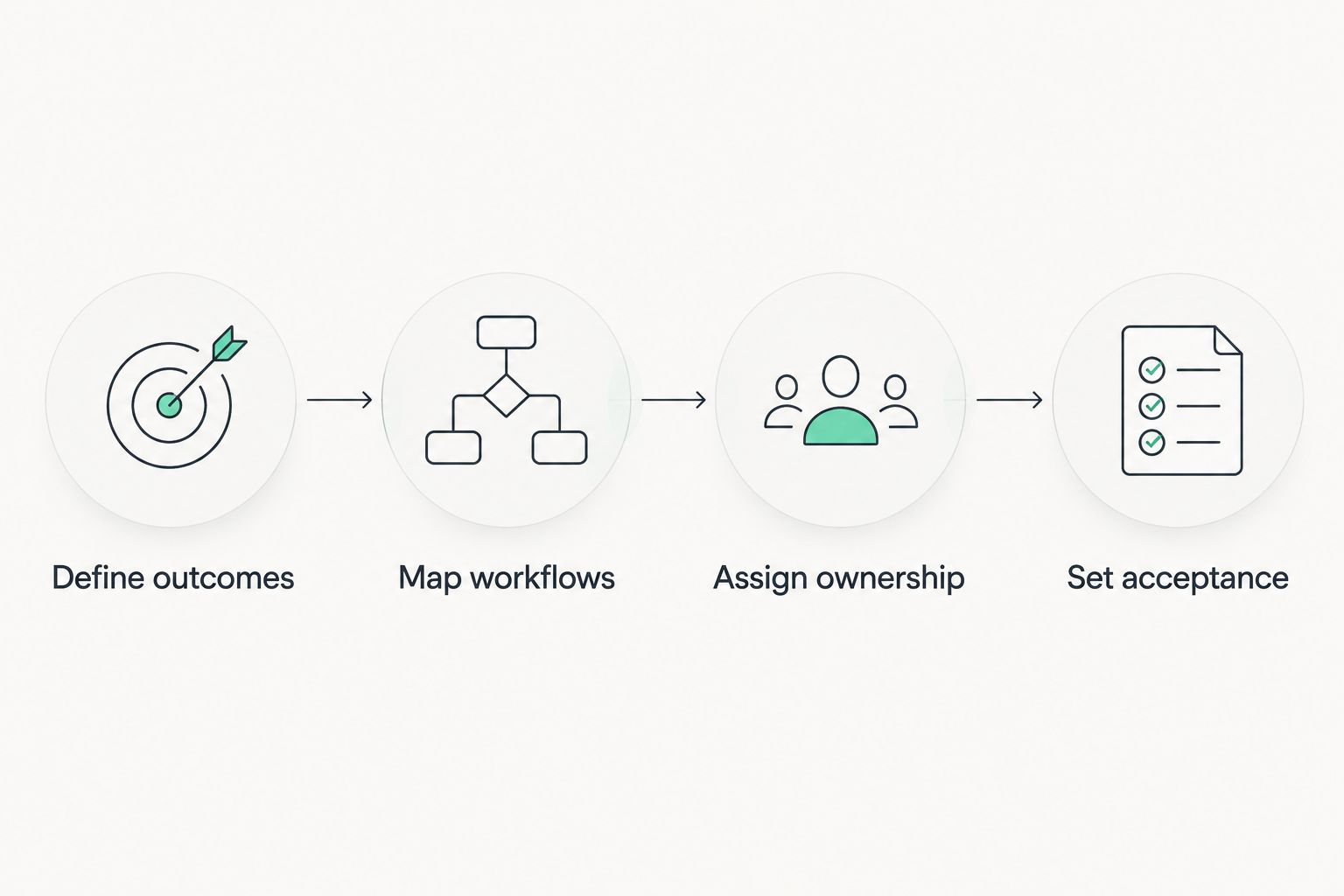
Build a scope that suppliers can estimate
A useful ERP brief describes the business result and the evidence needed to accept delivery. It does not need to prescribe every technical decision before discovery.
Define outcomes
Start with the operational problem: inconsistent inventory records, disconnected order processing or manual financial reporting. Name the process owner and explain what employees must be able to do differently.
Avoid requirements such as better visibility without specifying the decision the information supports. A finance leader needs to identify the reports, source transactions and reconciliation rules that make reporting usable.
Map workflows
Document the path from an initiating event to its business outcome. Include approvals, exceptions, reversals and handoffs between departments.
For example, an order workflow should describe what happens when an account is blocked or an order changes after approval. Those decisions define implementation work that a simple feature checklist misses.
Assign ownership
Assign an owner to each data set, integration, approval rule and acceptance decision. Distinguish supplier responsibilities from tasks your employees must complete.
Give those employees time to perform the work. A project plan that depends on finance validating migrated balances must explicitly include finance participation, not just a supplier delivery date.
Set acceptance
Write acceptance criteria before approving the final scope. Describe the transaction to execute, the expected result and the evidence required for sign-off.
Use business language. An integration is not accepted merely because it connects; it is accepted when the agreed transaction arrives correctly, exceptions are handled and the responsible team can operate it.
Make integration requirements explicit
An integration estimate needs business rules, not just a list of applications. Specify the source of each record, the direction of updates, the event that triggers an exchange and the response to failure.
For a 2026 ERP project involving B2B ordering, ERP credit limit integration belongs in the scope as an order-control requirement, not merely a data connection. Your requirements should define how ordering responds to a credit decision and what happens when current credit information cannot be retrieved.
That distinction changes what the team must build and test. Ask who can release a held order, how an override is recorded, and which system owns the final decision.
Apply the same discipline to reporting. A QuickBooks-to-automated-ERP-reporting workflow needs agreed account mappings, reconciliation rules and exception ownership; moving records alone does not establish that the resulting report is correct.
Include operating responsibilities in the integration scope:
- Name the team that receives failure notifications.
- Define how failed transactions are corrected and retried.
- Establish how duplicate records are detected and resolved.
- Document who approves changes to mappings or business rules.
- Specify the evidence required to reconcile source and destination records.
These requirements make integration proposals comparable. They also prevent a technical handover from leaving business users responsible for undocumented recovery work.
Compare proposals without hiding excluded work
Normalize the scope before you compare commercial terms. Ask every supplier to respond to the same requirements and identify whether each item is included, excluded or dependent on discovery.
Do not treat an exclusion as a saving until someone accepts responsibility for it. Data cleanup excluded from a proposal still needs an owner if the implementation depends on clean records.
Inspect assumptions
Read assumptions as conditions attached to the estimate. Examples include source data arriving in an agreed format, client users being available for testing, and existing systems supporting the required connection.
Ask what happens when an assumption proves false. The answer should explain the approval process for changed work rather than leaving your team to negotiate during delivery.
Connect payments to accepted work
Request milestones tied to clear deliverables and acceptance evidence. A calendar date alone does not establish that a migration, integration or business workflow is ready.
For your 2026 agreement, clarify who reviews each deliverable, how feedback is recorded and how unresolved defects affect acceptance. Keep these rules consistent with the responsibilities in the project scope.
Separate defects from changed requirements
A defect means the delivered work fails an agreed requirement. A change introduces or alters a requirement after the scope has been agreed.
Document that distinction before implementation begins. Both need a process, but they should not become interchangeable explanations for additional work.
What does an ERP implementation estimate exclude?
An ERP implementation estimate excludes whatever the agreement does not explicitly assign to the supplier. Common categories to check include software subscriptions, internal project time, data cleanup, infrastructure, ongoing support and future enhancements.
Treat an unassigned responsibility as unresolved scope, not as included work. Ask the supplier to identify exclusions directly rather than relying on a general statement that the project covers implementation.
Can a phased ERP rollout reduce the initial commitment?
A phased ERP rollout reduces the initial scope when later capabilities are genuinely deferred. It does not remove the eventual work required to deliver those capabilities.
Compare the full rollout plan as well as the opening phase. Include temporary integrations, parallel processes and repeated training wherever your proposed sequence requires them.
Should you budget separately for ERP training and support?
ERP training and support need explicit budget ownership, whether they sit inside the implementation agreement or in separate arrangements. Define the users covered, materials delivered, support responsibilities and handover conditions.
Role-specific preparation matters more than a generic demonstration. Ask employees to practice the tasks they will perform and the exceptions they will need to resolve.
FAQ
How do I get an accurate ERP implementation cost estimate?
Get an ERP implementation cost estimate from a written scope covering workflows, data, integrations, testing, training and launch support. Ask suppliers to state assumptions, exclusions and client responsibilities against the same requirements.
Does the ERP subscription include implementation?
Do not assume an ERP subscription includes implementation. Check the agreement for configuration, migration, integration, training and launch responsibilities, and separate recurring charges from project delivery.
Is standard ERP configuration better than customization?
Standard ERP configuration is the better starting point when it meets your documented business requirements. Customization is justified by a specific unmet requirement, with testing and maintenance responsibilities agreed before approval.
What should I ask before signing an ERP implementation contract?
Ask who owns each deliverable, what proves acceptance and how changed requirements are approved. Confirm data responsibilities, integration recovery, launch support and the handover to ongoing operations.
One last thing
Ask each supplier to walk through a failed transaction, not just a successful demonstration. A rejected order, mismatched balance or interrupted data transfer exposes ownership and recovery requirements that a normal demonstration leaves untested.
The strongest ERP scope explains what your team does when the process fails. Use that test before approving the implementation agreement.
Related guides
- How much does digital transformation consulting cost?
- How long does a digital transformation project take?
- How to connect Shopify to a custom ERP system
Schedule a consultation with Hexagon IT Solutions to discuss your ERP implementation scope, delivery responsibilities and acceptance criteria.


