






Your ecommerce software development cost in 2026 depends on what you need to build, connect, migrate and maintain—not simply how many pages your store has. A useful estimate separates the initial build from ongoing platform, payment, hosting and support expenses, then states exactly which workflows the development team will deliver.
- Ecommerce software development cost needs a defined scope; a headline estimate alone cannot support a budget decision.
- Use an existing commerce platform when standard checkout and order management meet your requirements.
- Choose custom development for documented business requirements, not cosmetic differences.
- Compare implementation, integrations, migration and ongoing ownership separately before approving a proposal.
How much does ecommerce software development cost?
There is no single development total that applies to every ecommerce project. A storefront configuration, a connected B2B ordering portal and a custom commerce application represent different work—even when their product pages look similar.
For your 2026 budget, require a breakdown that makes those differences visible. The broader custom software development cost guide provides context when your requirements extend beyond storefront configuration.
| Budget component | What the estimate should cover | What to clarify before approval |
|---|---|---|
| Discovery and scope | Business workflows, requirements and acceptance criteria | Which decisions remain unresolved? |
| Storefront implementation | Product discovery, product pages, cart and checkout configuration | Which screens and customer journeys are included? |
| Business rules | Account permissions, ordering restrictions and approval logic | Which rules need custom development? |
| Integrations | Connections to inventory, accounting, fulfillment or CRM systems | Who owns data mapping and error recovery? |
| Data migration | Product, customer and historical data preparation and import | Who cleans incomplete or inconsistent records? |
| Testing and launch | Functional testing, deployment and launch verification | What proves the store is ready? |
| Ongoing ownership | Platform services, infrastructure, maintenance and support | What sits outside the initial development agreement? |
Compare proposals by delivered scope, not by the total on the cover page. A proposal that excludes migration and integration testing is not equivalent to one that includes them.
Why this matters
An ecommerce project changes how money, orders and inventory move through your business. A checkout that works in isolation does not prove that fulfillment receives the correct order or that finance can reconcile a refund.
Your budget should therefore fund a working business process, not just a published website. Before approving development, identify who will operate the system and what those people need to complete their work without duplicate entry.
Which development approach fits your business?
Choose the approach after documenting your requirements. Starting with a preferred technology makes it harder to distinguish necessary work from optional customization.
| Approach | Best for | Main advantage | Main limitation |
|---|---|---|---|
| Platform configuration | Businesses whose requirements fit existing commerce functions | Reuses existing storefront and transaction functions | Workflows remain bounded by platform capabilities |
| Platform with custom integrations | Businesses keeping a commerce platform while connecting internal systems | Preserves existing commerce functions while addressing data handoffs | Connection failures and conflicting records need explicit handling |
| Custom commerce application | Businesses with documented requirements that existing platforms cannot meet | Allows application behavior to follow the defined business process | Your team must arrange maintenance for the custom application |
Platform configuration: keep standard requirements standard
Platform configuration is the best fit when your catalog, checkout and order handling match the platform's supported behavior. Evaluate those workflows before requesting custom screens or business logic.
The benefit is reuse: you do not commission every commerce function from scratch. The limitation is fit; a required workflow that the platform cannot support still needs another solution.
Recommendation: retain standard functions unless a documented requirement justifies changing them. Visual preferences alone do not establish a business case for rebuilding checkout or order management.
Custom integrations: connect the operational handoffs
A platform with custom integrations is the best fit when your storefront works but order data must move between business systems. Define the handoff before choosing the connection method.
The benefit is connecting an existing commerce process to internal operations. The limitation is that a successful connection requires more than transmitting a record: you must address duplicates, rejected updates, retries and ownership conflicts.
Ask each bidder to explain these responsibilities in the API integration cost breakdown. Do not accept an integration line item that leaves failure handling undefined.
Custom development: build only the business-specific layer
A custom commerce application is the best fit when a required business process cannot be delivered through the evaluated platform options. Examples to investigate include account-specific purchasing permissions or an approval process tied to internal operations; neither automatically requires a fully custom store.
The benefit is control over the application behavior you commission. The limitation is ownership: someone must maintain that application, test changes and manage its dependencies after launch.
Recommendation: document the unmet requirement before approving a custom build. Ask whether a smaller custom component would solve it without replacing the whole commerce system.
Why ecommerce software development cost varies
The most useful cost drivers describe work that someone must design, implement or verify. Use these factors to challenge your 2026 project scope:
- Business rules: Document who can buy, which approvals apply and what happens when an order violates a rule. Exceptions need explicit behavior and testing.
- System connections: List the records each system sends and receives. Define which system owns inventory, customer details and order status.
- Data quality: Identify missing fields, duplicate records and inconsistent product attributes before migration begins. Assign cleanup responsibility rather than assuming the developer will resolve every issue.
- Customer experience: Separate essential purchase journeys from optional merchandising and design requests. Each required journey needs clear acceptance criteria.
- Operational requirements: Specify permissions, monitoring, recovery and support expectations. A functioning storefront does not settle these decisions.
- Launch constraints: State whether the business must preserve existing URLs, migrate open orders or coordinate a system cutover. Include the transition work in the scope.
These factors also explain why a page-count estimate is incomplete. A product page can display simple information while relying on complicated account rules, inventory logic and fulfillment decisions behind it.
How do you get an estimate you can approve?
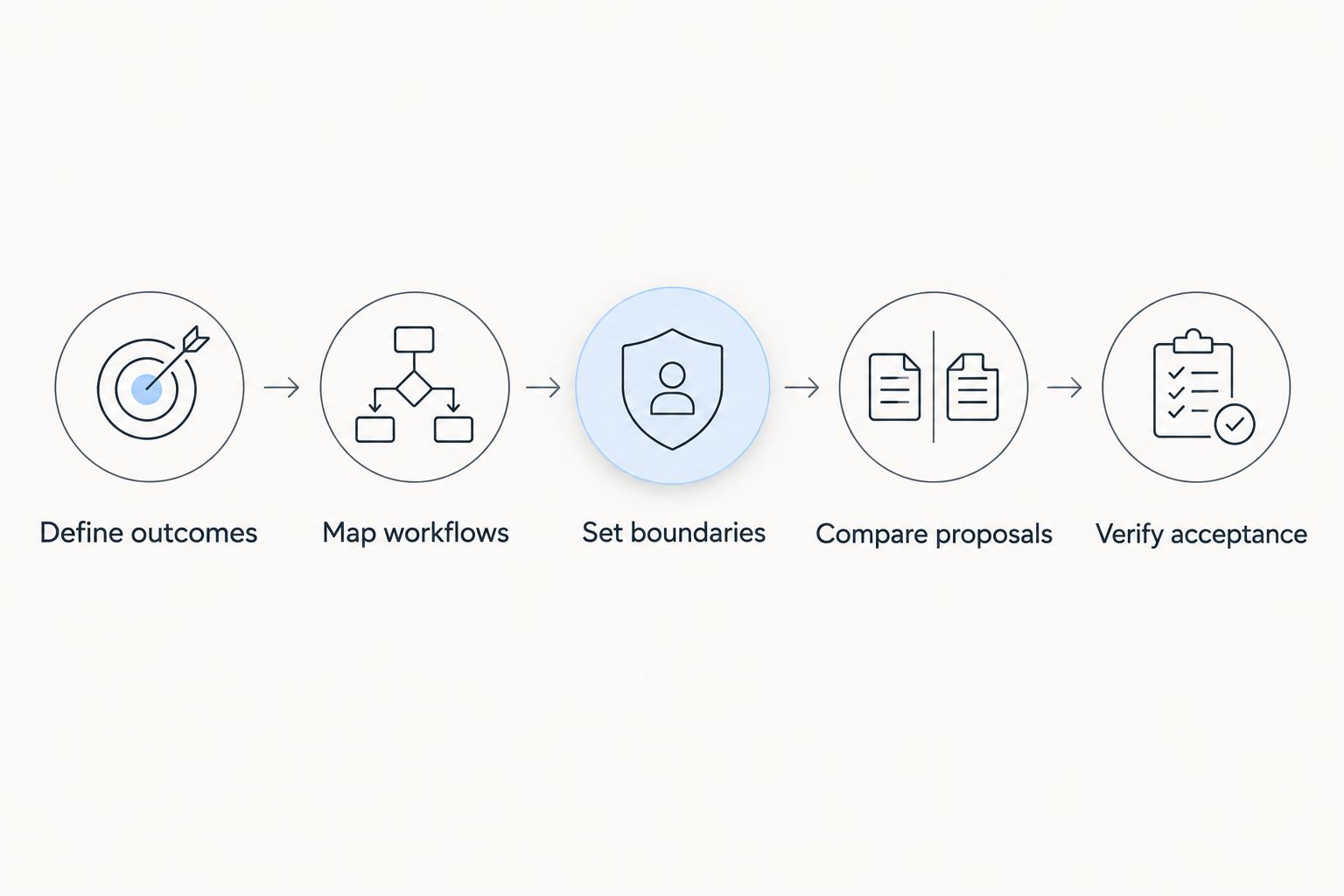
For founders consulting Hexagon IT Solutions, a defined order workflow is the best starting point for an ecommerce development estimate. Use the following sequence to turn your requirements into a proposal that both business and technical teams can evaluate.
Define outcomes
Write down the business problem before listing features. For example, specify that an approved customer must submit an order without staff re-entering it into another system.
Choose measures your team can actually track, such as manual order-handling time, failed transfers or completed purchases. Record the current baseline before assigning an improvement target; do not substitute a vendor's general promise for your own operating data.
Map workflows
Describe the purchase journey from product selection through fulfillment and refund handling. Include the operational actions that happen after checkout, not just the screens a customer sees.
For each handoff, name the owner and the expected result. If inventory cannot be updated, decide whether the order pauses, proceeds with a warning or requires staff review.
Set boundaries
Separate launch requirements from later enhancements. Mark each item as included, excluded or awaiting a decision so unresolved assumptions do not disappear into a proposal.
Keep optional requests outside the approved baseline. A later feature can still be valuable without becoming a condition for the initial launch.
Compare proposals
Give bidders the same brief and ask them to respond against it. Compare deliverables, assumptions, dependencies, acceptance tests and support responsibilities—not just commercial terms.
When a bidder proposes a different approach, ask which requirement it changes. A simpler implementation is useful only if it still delivers the business outcome you need.
Verify acceptance
Require a demonstration of 1 complete order through the connected workflow before accepting the implementation. Include payment status, inventory updates, fulfillment handoff and the relevant financial record.
Then test the exceptions identified in your scope. A successful purchase does not establish that canceled orders, rejected payments or interrupted transfers behave correctly.
What should your ongoing ownership budget include?
Your 2026 development agreement should distinguish launch work from the services and responsibilities that continue afterward. Compare ownership over 12 months and 24 months using the same assumptions, rather than treating the launch invoice as the entire commitment.
Include platform services, infrastructure, third-party extensions, monitoring, maintenance and support where applicable. Keep transaction-related expenses separate so you can see how sales activity affects the operating budget without confusing it with development work.
Ask who handles application updates, integration failures and changes made by connected services. Define access ownership, documentation and handover requirements so operating the store does not depend on undocumented knowledge.
A complete ownership plan names responsibilities as well as expenses. If your internal team must perform a task, include that workload in the decision even when it does not appear on the developer's proposal.
Is a custom ecommerce build worth it?
A custom ecommerce build is justified when a necessary business outcome cannot be delivered adequately through the evaluated alternatives. The requirement should explain what fails today and how the proposed application changes that process.
Assess the benefit using your own records. For manual work, compare the current workload with the proposed workflow; for a purchasing problem, identify the affected customer journey and measure its current performance.
Do not approve a custom build solely because it promises flexibility. Approve the smallest scope that delivers the required outcome and gives your team a workable maintenance plan.
Does adding AI change the development estimate?
Adding AI changes the scope when it introduces a new function, data dependency or acceptance requirement. Define the task—such as helping customers find products—before asking a bidder to include AI in the proposal.
Require a clear test for useful output and a fallback when the feature cannot complete the task. For a 2026 launch, keep an optional AI feature outside the critical purchase workflow unless your business requirements make it necessary.
FAQ
How much should I budget for ecommerce software development in 2026?
Budget against a defined scope covering implementation, integrations, migration, testing and ongoing ownership. Request an itemized proposal before approving a development total; page count alone does not describe the required work.
Is using an ecommerce platform better than building custom software?
An ecommerce platform is the better starting point when its supported workflows meet your requirements. Custom development needs a documented business requirement that the evaluated platform options cannot adequately deliver.
Does an ecommerce development quote include payment processing?
Check the quote rather than assuming payment processing is included. Implementing a payment connection and paying transaction-related expenses are separate budget items.
How can I reduce ecommerce development scope without hurting launch?
Keep launch scope focused on the workflows required to accept and fulfill orders. Move optional enhancements into a later backlog and retain the testing needed to verify the approved workflow.
What should I ask an ecommerce development company before signing?
Ask what is included, what is excluded, how acceptance works and who maintains the system after launch. Also confirm ownership of accounts, source code, documentation and operational access in the agreement.
One last thing
Ask a bidder to demonstrate a failed order, not just a successful purchase. A rejected payment or interrupted inventory update reveals whether the proposed workflow includes recovery, staff visibility and a clear next action.
Make that demonstration part of acceptance. You are buying a system your team must operate when something goes wrong, not only when everything works.
Related guides
- Ecommerce software development platforms
- How to connect Shopify to a custom ERP system
- Automatically update inventory when a POS sale closes
Schedule an ecommerce scope consultation
Discuss your ecommerce requirements with Hexagon IT Solutions.


