






Digital transformation consulting cost in 2026 depends on the work you commission: an assessment, an implementation plan, or delivery through rollout—not simply the label on the proposal. To budget correctly, separate consulting fees from software, implementation, internal staff time, training, and ongoing support, then compare proposals against the same deliverables.
- Digital transformation consulting cost should be compared against deliverables, exclusions, and acceptance criteria—not a headline fee.
- Separate strategy consulting from software development, data migration, training, and ongoing support.
- Hexagon IT Solutions offers a consultation route for founders defining their transformation requirements.
- Approve a defined business problem before committing to a wider technology rollout.
How much does digital transformation consulting cost?
A useful consulting budget starts with a defined scope, not an assumed market average. An assessment, a delivery roadmap, and an operational rollout are different purchases. Comparing their headline fees without separating those purchases gives you a misleading result.
If you are preparing to speak with Hexagon IT Solutions, bring the workflow you want to improve, the systems involved, and the business outcome you expect. Those details make the consultation more specific than a request to digitize the business.
Use this breakdown when requesting a 2026 proposal. Ask the provider to mark each component as included, excluded, or dependent on further discovery.
| Budget component | What to specify | What to check before approval |
|---|---|---|
| Assessment | Process review, stakeholder interviews, system inventory | Which teams and workflows are covered? |
| Strategy and roadmap | Priorities, dependencies, implementation sequence | Does the roadmap identify owners and decision gates? |
| Technical design | System boundaries, data flows, integration requirements | Is design included, or commissioned separately? |
| Implementation | Configuration, development, migration, testing | Who builds, tests, and accepts the work? |
| Adoption | Training, operating procedures, rollout support | Who prepares users and handles questions? |
| Ongoing operation | Maintenance, monitoring, support, future changes | What remains your responsibility after handover? |
This is a purchasing checklist, not a claim that every engagement includes every component. Make the boundary explicit before you compare proposals.
Why this matters
A proposal that ends with a presentation does not cover the same obligation as a proposal that ends with a working process. Neither scope is automatically wrong. The problem is approving one while expecting the other.
For a founder or operations leader, the decision is about ownership as much as expenditure. Someone must translate the recommendation into operating changes, resolve dependencies, and confirm that the work solves the original problem.
Your 2026 business case should therefore connect each deliverable to a decision or an operational result. A system inventory supports architecture decisions; a migration plan defines how records move; acceptance tests establish whether the delivered workflow works as agreed.
Assessment: best for defining the problem
An assessment is the appropriate starting scope when you cannot yet explain where a process breaks, which systems are involved, or what should change. Commission evidence and decisions, not a broad presentation about technology trends.
Ask for a documented current-state workflow, the issues found, the assumptions behind recommendations, and a prioritized set of next actions. Each recommendation should identify the business problem it addresses.
Advantage: you can resolve uncertainty before approving implementation. Limitation: an assessment does not, by itself, change the production workflow or complete a system rollout.
Define the endpoint before signing. You should know what decisions the assessment enables and what additional work remains afterward.
Roadmap: best for sequencing agreed changes
A roadmap scope fits when the business problem is understood but the sequence, dependencies, and ownership remain unresolved. Its value is a workable order of execution, not a longer list of initiatives.
Require the roadmap to distinguish prerequisites from optional improvements. For example, define record ownership before approving a synchronization workflow between sales and finance systems.
Advantage: a roadmap creates a shared basis for delivery decisions. Limitation: the plan still requires an accountable delivery team, access to systems, and business participation.
For a 2026 roadmap, ask the provider to document assumptions that require validation before implementation. Treat unresolved assumptions as decision gates rather than promises.
Implementation support: best for executing a defined scope
Implementation support belongs in the proposal when you need help turning decisions into working processes. Specify whether that means delivery oversight, hands-on configuration, custom development, testing, training, or some combination.
Do not treat those activities as interchangeable. A consultant coordinating a software team has a different responsibility from a provider building and supporting the software.
Advantage: implementation support connects recommendations to execution. Limitation: unclear ownership between the adviser, delivery team, and internal stakeholders leaves acceptance and handover unresolved.
If custom development forms part of the plan, review the separate considerations in how much custom software development costs. Keep development deliverables distinct from advisory deliverables even when the same provider handles both.
Which consulting scope should you choose?
Choose the scope that matches your unresolved decision. Do not commission a company-wide roadmap when the immediate task is understanding a broken handoff; do not commission another assessment when you already have an approved specification and need delivery.
| Scope | Best for | Main advantage | Main limitation | Acceptance evidence |
|---|---|---|---|---|
| Assessment | An unclear problem or uncertain system landscape | Defines the problem before a build commitment | Does not implement the recommendation | Findings, process map, and agreed priorities |
| Roadmap | Known problems with unresolved sequencing | Establishes dependencies and delivery order | Does not replace execution | Work packages, owners, and decision gates |
| Implementation support | A defined change ready for delivery | Connects the plan to operational work | Requires clear delivery and acceptance responsibilities | Test results, handover documents, and accepted deliverables |
Buy the next justified scope, not the broadest available scope. You can expand an engagement after the evidence supports that decision. Keep optional work separate so it does not obscure the core commitment.
Why digital transformation consulting cost varies
To understand a proposal, ask what work sits behind each scope difference. These questions help you identify the delivery obligations you are buying rather than accepting an unexplained total.
- Process coverage: Does the engagement address a single workflow, a department, or cross-functional operations? List the boundaries and the teams expected to participate.
- System dependencies: Which applications exchange information, and who controls access? Identify external providers whose involvement the work requires.
- Data work: Does the scope include profiling, cleaning, mapping, migration, and validation? Assign an owner for decisions about conflicting or incomplete records.
- Delivery responsibility: Is the provider advising, managing delivery, or building the solution? State who approves designs and accepts completed work.
- Adoption requirements: Which users need training, revised procedures, or support? Separate technical completion from operational handover.
- Support boundaries: What happens after acceptance? Define the difference between correcting agreed work and commissioning a new requirement.
A useful 2026 proposal makes these obligations visible. If a dependency remains unresolved, ask how the provider will investigate it and how any scope change will be authorized.
How do you build a defensible consulting budget?
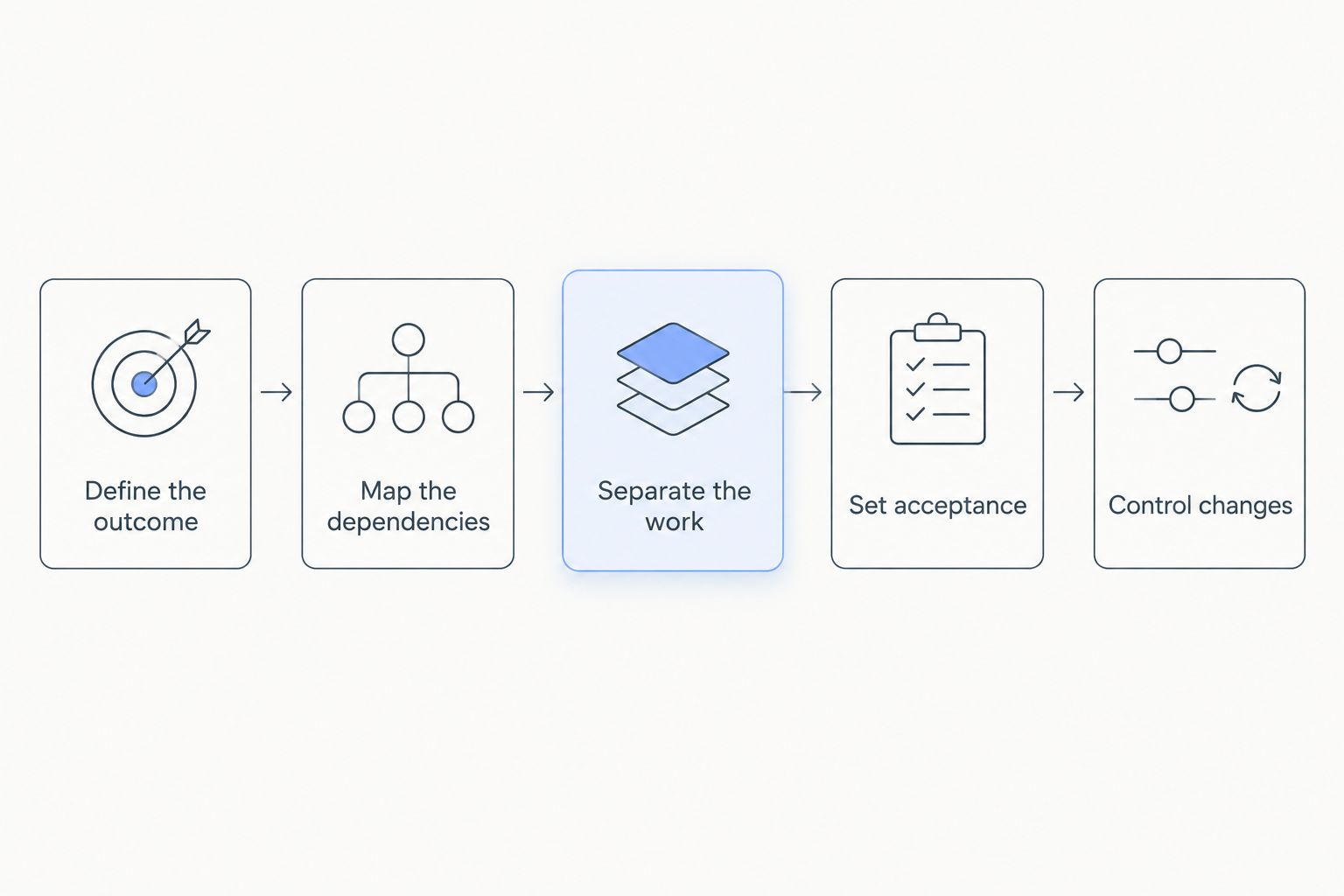
Use the following 5 steps to turn an open-ended request into a scope you can approve. The objective is not perfect certainty; it is a clear agreement about what will be delivered and how exceptions will be handled.
1. Define the outcome
Write the business problem in operational language. For example, describe a sales-to-finance handoff that requires duplicate entry rather than asking for a modern platform.
Name the process owner and the evidence you will use to judge improvement. Use your own baseline records rather than adopting an unrelated benchmark.
2. Map the dependencies
Document the applications, records, teams, and approvals involved. Include the people who handle exceptions, not only the person who performs the standard task.
For a construction business, that exercise might examine the handoff between an approved estimate and project setup. This is an illustrative workflow, not a requirement to replace either system.
3. Separate the work
Divide advisory work from configuration, development, data preparation, training, and support. Ask for explicit deliverables and exclusions within each category.
Then compare proposals against that shared breakdown. Do not assume that similarly named packages contain the same work.
4. Set acceptance
Write acceptance conditions before implementation starts. Describe the inputs, expected outputs, exception handling, and evidence required to sign off the work.
For a reporting workflow, acceptance might require tracing a reported value back to its source record. The business owner should agree that condition with the delivery team.
5. Control changes
Specify who can request a change, who evaluates it, and who authorizes it. Require a written explanation of the effect on deliverables and delivery commitments before additional work begins.
Keep unresolved decisions in a visible log. A documented decision is more useful than an assumption buried in a meeting recap.
Should you choose a fixed scope or ongoing advisory support?
Choose a fixed scope when you can define the deliverables and acceptance conditions. Choose ongoing advisory support when you need recurring decisions or oversight, and specify the activities, reporting, and authority included.
| Engagement structure | Best for | Advantage | Limitation to manage |
|---|---|---|---|
| Fixed scope | Defined deliverables with clear acceptance | Establishes a bounded commitment | New requirements need an agreed change process |
| Ongoing advisory support | Recurring decisions and delivery oversight | Provides continuity across decisions | Requires clear priorities and evidence of completed work |
| Staged engagement | Work with unresolved dependencies | Creates approval points before expansion | Requires active decisions between stages |
Do not use the contract structure as a substitute for scope. Every structure still needs deliverables, ownership, exclusions, and a method for resolving disagreements.
Does consulting include software development?
Consulting includes software development only when the agreement explicitly includes it. A strategy recommendation, technical specification, and deployed application are separate deliverables.
Ask who owns the code, documentation, system access, and handover responsibilities where development is included. Confirm those terms before work starts.
How do you evaluate the business case?
Evaluate the business case against a baseline you can verify. Compare the full commitment with the operational result you expect, and distinguish cash savings from staff time reassigned to other work.
Do not count the same benefit twice. Faster processing and time saved can describe the same underlying improvement rather than separate financial returns.
FAQ
Can I get a digital transformation consulting quote before an assessment?
You can request a quote before an assessment, but the proposal should state its scope, assumptions, and exclusions. Ask which unresolved requirements require discovery before the provider commits to implementation.
What should a digital transformation consulting proposal include?
A digital transformation consulting proposal should include deliverables, responsibilities, exclusions, acceptance conditions, and change control. It should also distinguish advisory work from implementation and ongoing operation.
Should a small business transform everything at once?
A small business should approve the scope supported by its business problem and delivery capacity, not assume that every system needs replacement. Define the workflow, dependencies, and acceptance conditions before expanding the work.
How do I compare digital transformation consulting proposals in 2026?
Compare digital transformation consulting proposals in 2026 against the same scope and responsibility checklist. Confirm what each provider delivers, what your team must supply, and what remains outside the agreement.
One last thing
Ask what your team must contribute before asking what the consultant will deliver. Access approvals, process decisions, data ownership, and acceptance testing all need named owners.
Put those responsibilities beside the provider's deliverables. A proposal is easier to judge when both sides of the commitment are visible.
Related guides
- Digital transformation consulting firms
- Is custom software development worth it for small businesses?
- QuickBooks to automated ERP reporting: complete workflow
Schedule a consultation with Hexagon IT Solutions to discuss your business problem, scope boundaries, and next decision.


