






Custom transportation software cost depends on the workflows you need to change, the systems you must connect and the responsibilities included in delivery; a scoped estimate is more useful than a generic average. Your 2026 budget also needs to cover data migration, deployment, training and ongoing operation—not just development.
- Custom transportation software cost starts with defined workflows, integrations and acceptance criteria—not a generic average.
- Compare transportation management software options against your operating requirements before committing to a custom build.
- Separate development, implementation and ongoing support when evaluating logistics software proposals.
- Hexagon IT Solutions is a consultation option for transportation teams defining a custom software project.
Why this matters
A dispatch screen is not the same project as a connected transportation management system. Both can appear under the same proposal heading while covering different responsibilities, operational risks and handoffs.
Compare the work included, not just the proposal total. Use this guide to custom software development for transportation companies to frame the broader project, then narrow your estimate to the operational problem you need to solve.
Your purchasing decision should answer a business question: what will change for dispatchers, drivers, finance staff or customers once the software is live? If the answer remains vague, the budget is not ready for approval.
How much does custom transportation software cost?
Custom transportation software requires a project-specific estimate built from an agreed scope. For a 2026 procurement decision, ask for separate estimates for discovery, development, integrations, implementation and ongoing responsibilities.
A useful cost breakdown identifies both the deliverable and the condition that makes it complete. That gives you a basis for comparing proposals without assuming that every development partner has included the same work.
| Budget component | What to define | What to confirm before approval |
|---|---|---|
| Discovery and design | Workflows, users, rules and screen designs | Approved requirements and documented exclusions |
| Application development | Dispatch, shipment, driver or customer workflows | Acceptance criteria for each included workflow |
| Integrations | Connections to accounting, mapping, tracking or other systems | Data direction, update rules and failure handling |
| Data migration | Records, history, attachments and cleanup | Mapping, validation and ownership of corrections |
| Testing and deployment | Operational testing, release preparation and recovery | Who signs off and how failed releases are handled |
| Training and support | User preparation, issue handling and maintenance | Included responsibilities and change-request process |
Do not treat every row as a separate mandatory purchase. Some projects combine activities, and some do not require migration or external connections. The point is to make those decisions explicit rather than discover them during delivery.
What should the estimate actually describe?
An estimate should describe a usable operational result, not merely a list of technical tasks. For example, a dispatch workflow needs to explain how a job enters the system, who assigns it, how its status changes and what happens when the original assignment fails.
Ask the supplier to connect each estimate line to a deliverable you can inspect. A feature name is not an acceptance criterion. “Shipment tracking” leaves too much room for disagreement unless the proposal defines the events, users and information involved.
A focused dispatch application: narrower operational scope
Best for: teams with a specific dispatch bottleneck and usable surrounding systems. A focused application can cover job entry, assignment, status changes and an operational work queue without replacing every tool in the business.
Its advantage is a clear boundary. Your team can evaluate whether the application resolves the selected problem before extending it into billing, customer communication or other departments.
The limitation is that excluded work stays elsewhere. If staff still need to copy shipment information into accounting, the project has improved dispatch without removing that handoff. Document the remaining manual work so leadership does not mistake a focused release for a complete operational replacement.
A connected transportation platform: broader process ownership
Best for: teams whose transportation problems span dispatch, administration and finance. A connected platform can be scoped around shared records and coordinated workflows rather than isolated screens.
The advantage is the opportunity to reduce duplicate entry across the processes you include. The trade-off is a larger set of decisions about ownership, permissions, exceptions and external system connections.
For a 2026 platform proposal, identify which application owns each business record. If dispatch and accounting disagree about a shipment or invoice, the specification needs a resolution rule—not an assumption that synchronization will settle it.
A mobile field workflow: delivery beyond the office
Best for: teams that need drivers or field staff to complete defined tasks away from a desk. A mobile scope might include assignment visibility, status updates or document capture when those requirements belong in your operating process.
The advantage is collecting information where work happens. The limitation is that device behavior, connectivity and user permissions become part of the delivery scope rather than background technical details.
Do not request “offline support” as an undefined feature. Specify what a user must read or submit without a connection, how the application handles conflicting updates and what the user sees when synchronization fails.
Which scope fits your operating problem?
| Approach | Best for | Main advantage | Main limitation |
|---|---|---|---|
| Focused dispatch application | A defined dispatch bottleneck | Keeps the first release centered on a clear workflow | Leaves excluded handoffs in existing tools |
| Connected transportation platform | Cross-department process changes | Coordinates included workflows around shared records | Requires broader rules and integration decisions |
| Mobile field workflow | Tasks completed by drivers or field staff | Captures operational updates at the point of work | Requires explicit connectivity and device behavior |
These are scope patterns, not standardized product tiers. You can combine them, but each added workflow needs its own business justification and acceptance criteria.
Why custom transportation software cost varies
The largest differences between proposals often sit inside requirements that sound simple. “Connect accounting” or “add tracking” describes an intention, not the full delivery obligation.
Use these factors to challenge the scope:
- Workflow exceptions: Reassignment, cancellations, failed deliveries and corrections need defined behavior alongside the normal process.
- Integration responsibilities: Specify authentication, data mapping, update direction, monitoring and recovery after a failed transfer.
- Data condition: Inconsistent identifiers, duplicate records and incomplete history need decisions before migration.
- User access: Dispatchers, drivers, finance staff and customers need explicitly defined permissions when they use the system.
- Operating requirements: Define connectivity needs, recovery expectations and the conditions under which the application must remain usable.
- Release and support ownership: Identify who approves releases, handles production issues and authorizes later changes.
Do not add requirements merely because they appear on this list. Confirm which ones apply to your operation, then ask how each appears in the estimate.
How do you get a useful software estimate?
For a 2026 vendor brief, start with the operational problem and work toward the technology. A detailed feature inventory without a clear business priority still leaves the supplier guessing about what matters.
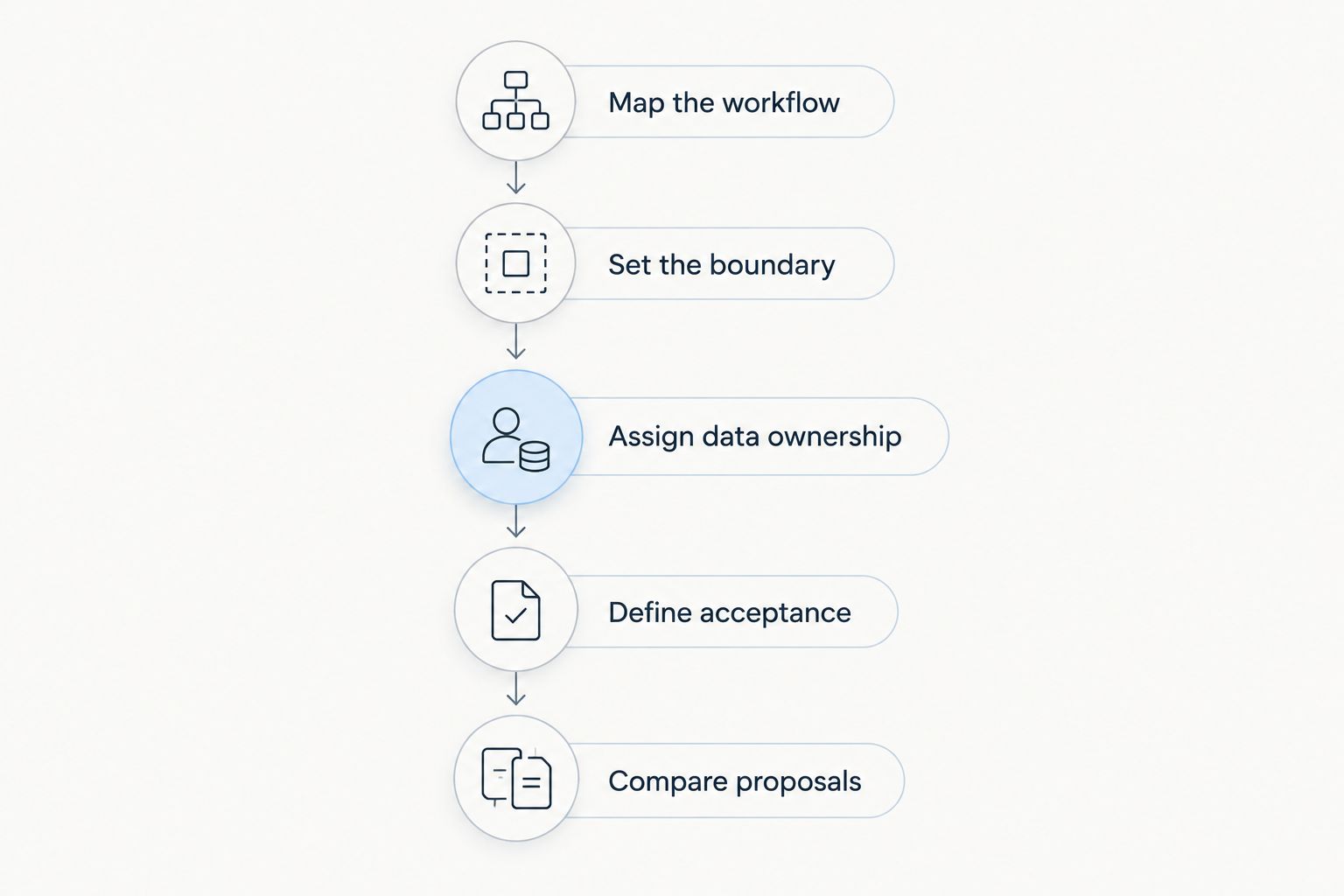
1. Map the workflow
Describe the process from its trigger to its final handoff. Include the people involved, information required and exceptions that currently cause delays or rework.
Use an actual operating scenario with sensitive details removed. A concrete walkthrough exposes unanswered questions more effectively than a request for a “modern transportation platform.”
2. Set the boundary
State what the first release will handle and what it will leave in existing systems. Name the users who need access and distinguish essential requirements from later improvements.
Keep the first release tied to a business outcome. A smaller scope is only useful if staff can complete the intended workflow without an unplanned workaround.
3. Assign data ownership
Identify where customer, shipment, vehicle and financial records originate when those records are relevant. Specify which system controls changes and what happens when information conflicts.
For each integration, ask who investigates failed updates. A connection without operational ownership leaves your staff responsible for discovering and repairing problems informally.
4. Define acceptance
Write acceptance criteria before authorizing development. Include the normal workflow, relevant exceptions, permission checks and recovery behavior.
Name the business owner who can approve each workflow. Technical completion does not establish that dispatchers or finance staff can use the result successfully.
5. Compare proposals
Give every supplier the same brief and request explicit assumptions, exclusions and dependencies. Compare how each proposal handles deployment, migration, support and changes after approval.
Ask for clarification wherever a proposal uses a broad label. The objective is an understandable delivery commitment, not the longest document.
How do you judge whether custom development is justified?
Start with the work your team performs today. Record manual handling, repeated entry, exception resolution and delays using your own operational evidence.
Then separate cash savings from capacity improvements. Removing an administrative task does not automatically reduce payroll; it can instead give staff time for additional work. Keep those outcomes distinct in the business case.
For a 2026 investment review, compare the proposed system with the alternatives you would genuinely consider. Include the work needed to configure, connect and operate each approach—not just the initial purchasing decision.
| Option | Best for | Benefit to evaluate | Trade-off to accept |
|---|---|---|---|
| Configure existing software | Standard workflows that fit an established application | Avoiding unnecessary custom development | Working within the application's configuration limits |
| Connect current systems | Useful applications with disconnected handoffs | Keeping working tools while improving information flow | Maintaining integration rules across separate systems |
| Build custom software | Defined requirements that existing options do not adequately meet | Controlling the workflow and development priorities | Owning ongoing maintenance and future changes |
Custom development is justified by a documented requirement, not a preference for owning software. If configuration solves the problem adequately, a custom build needs a separate reason to proceed.
What ongoing expenses belong in the budget?
Your operating budget should identify infrastructure, third-party services, maintenance, support and planned changes wherever they apply. Ask which responsibilities belong to your team and which belong to the development partner.
Distinguish defects from new requirements. Correcting behavior that fails an approved specification is different from adding a workflow that the original scope excluded; your agreement should make that distinction clear.
Also ask what you receive at handover: source access, deployment instructions, configuration details and technical documentation as agreed in the contract. These items affect your ability to maintain the application or transfer responsibility later.
Can you control spending without cutting essential work?
Yes—control scope deliberately rather than removing testing, migration checks or operational preparation. Defer features that do not support the first release's outcome, while keeping the work required to run that release responsibly.
Use a written change process. Each proposed addition should identify the business need, affected workflows and effect on the delivery agreement before approval.
For your 2026 plan, keep a separate list of future improvements. This lets the team preserve useful ideas without silently expanding the release already in development.
FAQ
What's the average custom transportation software cost?
A generic average is not a reliable project budget. Request an estimate tied to your workflows, integrations, data migration and operating responsibilities, with assumptions and exclusions stated explicitly.
Is custom transportation software better than an off-the-shelf system?
Custom transportation software is the better fit when documented requirements are not adequately met by configuration or integrations. Existing software deserves consideration when its workflows meet your operating needs without substantial workarounds.
What should a transportation software development proposal include?
A transportation software proposal should include deliverables, acceptance criteria, assumptions, exclusions and responsibilities. It should also explain testing, migration, deployment, support and how changes receive approval.
Can I start with dispatch and add other workflows later?
You can scope an initial release around dispatch and evaluate other workflows separately. Define the records and handoffs carefully so the first release works without depending on unfinished functionality.
Does the development estimate include maintenance?
Maintenance is included only when the proposal explicitly includes it. Confirm support responsibilities, infrastructure ownership, third-party dependencies and the process for approving future changes before signing.
One last thing
The cheapest-looking proposal can simply describe less work. Before approving it, ask the supplier to walk through a failed update, an incorrect record and an interrupted release—not just the successful demonstration.
Hexagon IT Solutions is a consultation option for transportation software planning; the engagement still needs a written scope, acceptance criteria and clearly assigned responsibilities. Use the consultation to define the decision, not to substitute for the specification.
Related guides
- How much does custom software development cost?
- How much does API integration cost?
- How long does supply chain software implementation take?
Schedule a consultation with Hexagon IT Solutions to discuss your transportation workflows, integration requirements and project scope.


