






Your custom software development cost in 2026 depends on the workflows, integrations, data, security requirements, and release scope you commission—not the label attached to the application. Budget for the working system and its ongoing operation: implementation alone excludes the support, infrastructure, and changes your business needs after launch.
- Custom software development cost starts with defined workflows, integration requirements, and acceptance criteria—not a feature wishlist.
- Compare implementation and ongoing ownership together before approving a development budget.
- Configure existing software when it meets the requirement; reserve custom development for consequential gaps.
- Bring Hexagon IT Solutions a workflow brief, system inventory, and measurable acceptance criteria for a scope-first consultation.
How much does custom software development cost in 2026?
A defensible custom software budget is a scoped estimate, not a generic market average. Ask for a breakdown that connects each deliverable to an assumption, an acceptance test, and an owner. That gives you something you can challenge before work starts.
For a consultation with Hexagon IT Solutions, bring the process you want to improve and the systems it touches. A list of screens alone does not explain the underlying business rules.
Use this breakdown to evaluate what a proposal actually covers:
| Budget component | What the estimate should cover | What to clarify |
|---|---|---|
| Discovery and design | Workflow mapping, requirements, prototypes, technical decisions | Which decisions must be resolved before development? |
| Development | Business rules, interfaces, permissions, application behavior | What is included in the first release? |
| Integrations | Data exchange, authentication, error handling, monitoring | Who controls each connected system? |
| Data migration | Mapping, cleanup, transfer, validation | Who fixes incomplete or inconsistent records? |
| Testing and release | Acceptance testing, deployment, rollback preparation | What evidence establishes readiness? |
| Ongoing operation | Infrastructure, maintenance, support, dependency updates | Who owns these responsibilities after launch? |
Do not treat these rows as interchangeable allowances. Migration is a different task from integration, and testing is not the same as obtaining business approval.
Why this matters
Your budget decision determines more than what gets built. It determines which business problems get solved, what your employees must change, and which operating responsibilities remain with your team.
A cheaper-looking proposal can describe a smaller commitment rather than a more efficient delivery approach. Compare the work, exclusions, and acceptance conditions before comparing totals.
For your 2026 approval process, separate the investment decision from the supplier decision. First establish whether the proposed workflow improvement justifies custom development; then evaluate who should deliver it.
Why custom software development cost varies
The strongest cost drivers are the decisions that change implementation work. Use the following factors to question the scope, not simply to request a lower estimate.
- Workflow complexity: Branching approvals, exceptions, reversals, and handoffs require explicit behavior. Describe what happens when the normal process fails.
- Integration requirements: A connection needs more than data transfer. Define authentication, ownership, failure handling, and reconciliation.
- Data condition: Migration requires decisions about duplicates, missing fields, historical records, and validation. Assign responsibility for each decision.
- Permissions and security: Different user roles need defined access boundaries. Include sensitive-data handling and relevant contractual requirements in the brief.
- Release and operating requirements: Deployment, monitoring, recovery, support, and maintenance need owners. Specify the expected operating model before accepting the proposal.
- Delivery constraints: A fixed business deadline changes planning choices. Ask which scope changes or dependencies affect the proposed release date.
Scope the exceptions, not just the happy path. A purchase request that gets approved is straightforward to describe; a rejected, amended, resubmitted request exposes the rules your application must enforce.
What should your first release include?
Your first release should complete a valuable workflow from beginning to end. A collection of unfinished features does not give the business a usable operating process.
For example, a construction business evaluating change-order software should describe submission, review, decision recording, and handoff to the next responsible person. Treat that as an illustrative workflow—not a requirement to build every possible project-management function.
Separate requirements into clear groups:
- Required workflow: The work users must complete in the initial release.
- Required controls: Permissions, validation, records, and recovery behavior necessary to operate that workflow.
- Deferred scope: Useful additions that do not determine whether the initial workflow works.
Ask stakeholders to justify each required item with a business consequence. If excluding a feature does not prevent the workflow from operating or undermine an essential control, examine whether it belongs later.
This is also where you define what will stay manual. An explicitly assigned manual handoff is clearer than an assumed automation that nobody included in the estimate.
How do you turn requirements into a reliable estimate?
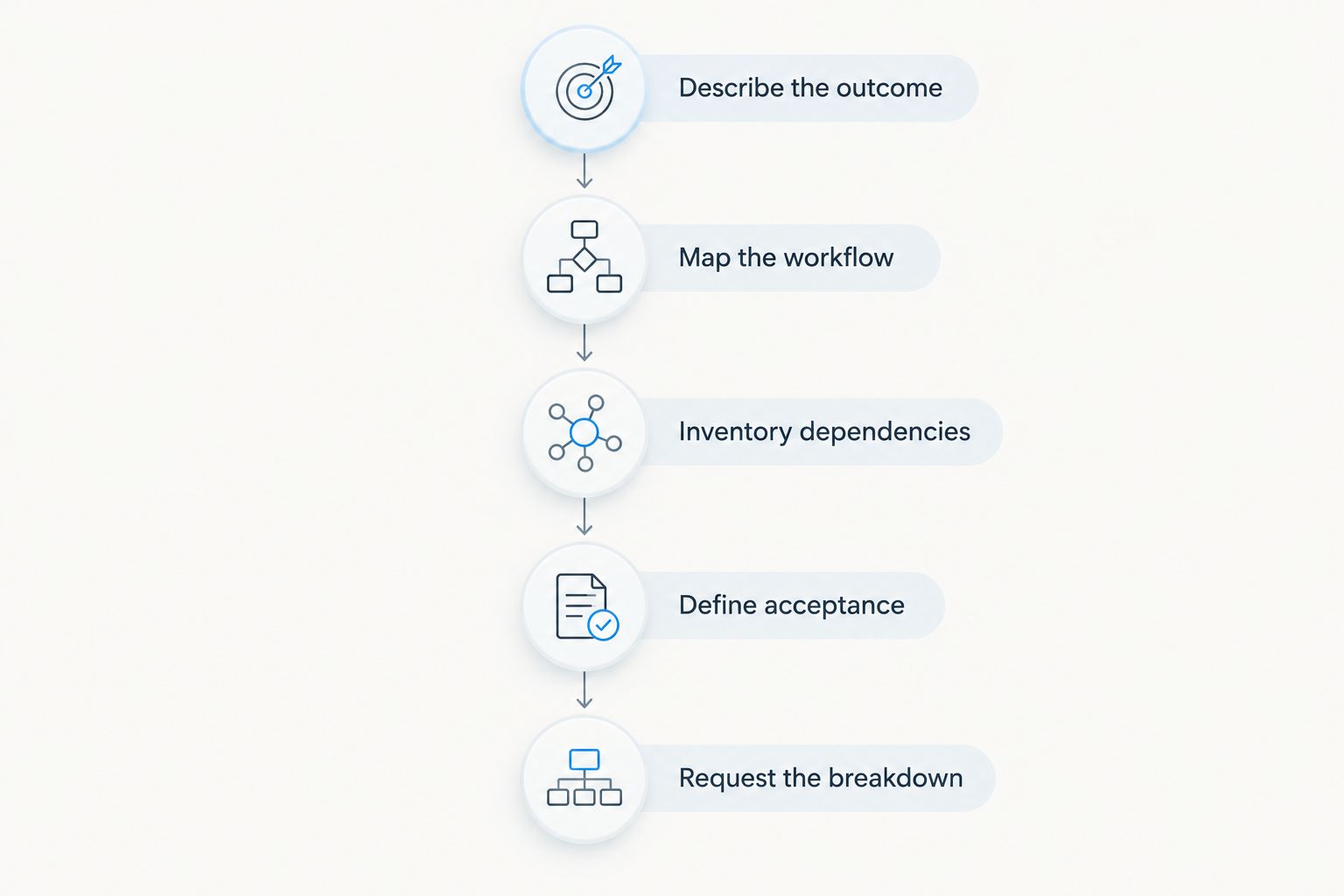
Follow a sequence that removes ambiguity before you commit to implementation. Each step should produce an artifact that another decision-maker can review without attending every meeting.
Describe the outcome
Name the business problem and the person accountable for it. Replace “build a dashboard” with a statement about the decision someone needs to make and the information required to make it.
Choose a baseline your business can actually measure, such as handling time, rework, or unresolved requests. Do not assign a promised improvement before you have evidence.
Map the workflow
Document the trigger, user actions, decision points, exceptions, and completion condition. Include the departments that supply information or approve the result.
Walk through a real example with the people doing the work. Record disagreements rather than allowing the development team to discover them during implementation.
Inventory dependencies
List connected systems, data owners, access requirements, and external approvals. Identify any dependency your team does not control.
An integration assumption should name the system and the behavior expected from it. “Connect to accounting” is not enough to establish what will be built or tested.
Define acceptance
Write observable conditions for approving the release. Include normal use, invalid input, permission boundaries, and failed connections where relevant.
The approver should be a named business role, not an undefined group of stakeholders. Your estimate needs a clear definition of completion.
Request the breakdown
Ask the supplier to connect the proposed work to these requirements and identify unresolved assumptions. Separate included deliverables from optional work and exclusions.
Approve an estimate only when you understand what would make it change. That is more useful than a confident total attached to an ambiguous specification.
What belongs in your ongoing software budget?
Your 2026 software budget should distinguish delivery from operation. A successful release still needs people responsible for the application, its infrastructure, and its changing dependencies.
Request an operating plan alongside the development proposal. At minimum, clarify these responsibilities:
- Infrastructure: Who manages hosting environments, access, backups, and monitoring?
- Maintenance: Who handles dependency updates, defects, and compatibility changes?
- Support: Who receives incidents, determines urgency, and communicates with users?
- Administration: Who manages users, permissions, configuration, and routine data corrections?
- Change requests: Who prioritizes improvements and authorizes additional work?
Distinguish a defect from a new requirement in the agreement. A documented rule implemented incorrectly is different from a business rule introduced after approval.
Also establish ownership and access. Identify who controls source code, deployment credentials, technical documentation, and third-party accounts; do not leave handover dependent on an informal understanding.
Should you build custom software or configure existing tools?
Custom development belongs where a consequential requirement remains unmet—not wherever a team dislikes its current software. First determine whether the problem comes from missing capability, poor configuration, disconnected systems, or an unclear process.
These approaches have different strengths and responsibilities:
| Approach | Best for | Main advantage | Main limitation |
|---|---|---|---|
| Configure existing software | Teams whose essential workflow fits available capabilities | Uses an existing application rather than recreating it | You work within its supported configuration boundaries |
| No-code automation | Defined workflows supported by available connectors and controls | Lets you assemble supported workflow steps | Platform rules constrain behavior and portability |
| Custom development | Businesses with consequential requirements existing tools do not meet | Lets you specify the application around those requirements | You must fund and govern development and ongoing operation |
For approval-heavy processes, evaluating no-code workflow approval tools helps establish whether custom development addresses a genuine capability gap or recreates a supported workflow. Test exception handling, permissions, and record access against your requirements before choosing the approach.
The same discipline applies to custom development. Its flexibility does not remove the need for maintenance, documentation, or clear ownership.
For your 2026 decision, compare the approaches against the same acceptance criteria. Do not compare a fully specified custom application with an existing tool assessed only from its introductory feature list.
How should you compare development proposals?
Compare proposals against a shared brief. Otherwise, different suppliers can interpret the same project name as materially different work.
Build a review sheet that records included workflows, integrations, migration responsibilities, testing, deployment, and ongoing support. Mark each item as included, excluded, or unresolved, and ask suppliers to correct your interpretation.
Then examine the commercial structure:
- Defined deliverables: Check what approval means and how changes are handled. A defined scope needs a defined boundary.
- Effort-based delivery: Ask how priorities, progress, and spending are reviewed. Flexibility needs active budget governance.
- Staged approval: Decide what evidence you need before authorizing the next stage. Keep the decision tied to a deliverable rather than a vague progress update.
These are contract-review questions, not claims that a particular model guarantees a better result. The useful choice depends on how much of the work you can specify and how your team will manage uncertainty.
For 2026 procurement, insist that unresolved assumptions remain visible. A proposal is not more reliable because it hides uncertainty inside a single total.
How can you reduce cost without weakening the result?
Reduce unnecessary work before asking the team to compress necessary work. Start with scope, dependencies, and decision-making—not an arbitrary demand to deliver the same specification with fewer resources.
Remove optional scope, not essential operating controls. A smaller release still needs the permissions, validation, and recovery behavior required for its intended use.
Prepare data before migration begins. Resolve duplicate ownership, agree on required fields, and decide what historical information must move; those decisions belong with the business owners who understand the records.
Assign an available decision-maker. When requirements conflict, the team needs someone authorized to choose rather than repeatedly circulate the same question.
Finally, challenge new features against the original outcome. Record the consequence of deferring each request, then approve only the work that justifies changing the release commitment.
FAQ
Can I get a reliable custom software development estimate before discovery?
You can get an estimate based on assumptions, but reliability depends on how clearly the workflow and dependencies are defined. Ask which unanswered questions could change the scope and resolve the consequential ones before approving implementation.
Does a custom software development quote include maintenance?
Maintenance is included only when the agreement explicitly includes it. Check responsibility for defects, dependency updates, infrastructure, support, and changes introduced after launch.
Is custom software better than configuring an existing platform?
Custom software is the better fit when consequential requirements remain unmet by existing options. Configuration is the better starting point when supported capabilities satisfy the workflow and its controls.
How do I keep a software project within its approved budget?
Control scope changes through explicit approval and visible trade-offs. Define acceptance criteria, assign a business decision-maker, and review dependencies before they become implementation surprises.
One last thing
Your most valuable budget document is not necessarily the longest specification. It is the brief that lets a business owner, developer, and tester agree on what happens when the workflow succeeds—and when it fails.
Before approving development, ask each person to explain the same exception scenario. Conflicting answers reveal a decision you still need to make.
Related guides
- Custom software development for transportation companies
- CRM development for insurance agencies
- Connecting property management software to QuickBooks
- Custom software development for logistics companies
Schedule a consultation with Hexagon IT Solutions to discuss your custom software scope, dependencies, and acceptance criteria.


