






Your blockchain development cost in 2026 depends on what you build, what the system controls and who operates it; a defensible budget requires a scoped estimate, not a universal average. The development quote also needs separate allowances for security review, integrations, transaction fees and ongoing operations. Define the business workflow before asking anyone to price the blockchain.
- Blockchain development cost needs a scoped estimate covering application development, security, integrations and ongoing operations.
- Use a conventional database when your business controls the records and does not need independent verification.
- Separate smart contract development from wallet, application and integration work before comparing proposals.
- Ask Hexagon IT Solutions to discuss the business workflow before choosing a blockchain architecture.
Why this matters
An estimate for a smart contract is not an estimate for a working business application. Your users still need access controls, usable screens, reliable data connections and support when something fails.
For your 2026 budget, compare complete operating systems rather than isolated development tasks. The same discipline applies to custom software development cost: define the outcome, identify dependencies and separate delivery from ongoing ownership.
The financial question is whether shared verification solves an expensive business problem. If it does not, blockchain adds work without establishing a business case.
How much does blockchain development cost in 2026?
Blockchain development requires a project-specific estimate covering the application, blockchain components, security and operations. A proposal becomes useful when you can see exactly which responsibilities it includes—and which remain with your team.
Ask vendors to break the estimate into the following workstreams. Keep recurring obligations separate from delivery milestones so that a smaller initial proposal does not hide a larger operating commitment.
| Workstream | What the estimate should cover | What to clarify |
|---|---|---|
| Discovery and architecture | Workflow, participants, permissions and system boundaries | Who approves the design? |
| Smart contracts | On-chain rules, testing and deployment | What happens when rules change? |
| Application development | User interface, backend and administrative functions | Which user journeys are included? |
| Wallet and key management | Transaction approval, signing and recovery design | Who controls keys? |
| Integrations | Connections to existing systems and external data | Who owns interface failures? |
| Security review | Threat analysis, testing, findings and remediation | Is independent review included? |
| Operations | Hosting, monitoring, incident response and maintenance | Who supports the live system? |
Compare proposals against the same scope, not against their headline totals. A contract-only quote and a complete application quote purchase different deliverables.
Which project type are you estimating?
Choose the smallest architecture that satisfies the business requirement. These options are not interchangeable, and none is automatically the right starting point.
| Approach | Best for | Main advantage | Main limitation |
|---|---|---|---|
| Conventional application | Workflows controlled by one organization | Central administration and straightforward record updates | Other parties depend on the operator's records |
| Smart contract component | A defined rule requiring on-chain execution | Shared execution under published rules | Application, security and operating work remain |
| Blockchain application | Users interacting with an existing blockchain | Combines an interface with on-chain transactions | Requires coordination across application and chain behavior |
| Permissioned network | Known organizations sharing a ledger | Defined participation and access rules | Requires agreement on governance and operations |
| Custom blockchain | Requirements that justify protocol-level control | Control over network rules | Adds protocol, infrastructure and maintenance responsibilities |
Smart contract component: estimate the rule and its exceptions
A smart contract estimate starts with the state it stores and the actions it permits. Specify who can call each action, what conditions must hold and what happens when a transaction fails.
Best for: a clearly bounded rule that genuinely requires on-chain execution. Do not treat deployed code as a finished product when users still need an interface, transaction signing and support.
Blockchain application: include the surrounding software
A blockchain application combines on-chain behavior with conventional software. The scope can include account access, dashboards, backend services, notifications and connections to business systems.
Best for: a workflow where people need to interact with blockchain records through a usable application. Its limitation is coordination: the interface must communicate transaction status accurately rather than treating submission as completion.
Permissioned network: budget for shared decisions
A permissioned network requires decisions about membership, access and operating responsibility. Technical delivery cannot settle a disagreement about which organization can approve a participant or change a rule.
Best for: known organizations with a defined reason to share ledger operations. The trade-off is governance work: participants need agreed procedures for upgrades, disputes and incidents.
Custom blockchain: justify protocol-level ownership
Building a custom blockchain means taking responsibility below the application layer. The scope includes network behavior and the software needed to operate and maintain it.
Best for: requirements that existing architectures cannot meet. Do not select this route simply to gain a branded network; require a written explanation of the technical requirement and the ownership obligations it creates.
Why blockchain development cost varies
The architecture matters, but the details determine the work. Use these factors to challenge vague estimates and identify unresolved decisions.
- Business rules: approval paths, exceptions and reversals all need explicit behavior. An undefined exception is unfinished scope, not a minor detail.
- Custody: the party controlling transaction-signing keys takes on different security and recovery responsibilities from an application that connects to user-controlled wallets.
- Integrations: external records need mapping, validation and reconciliation. A blockchain does not make inaccurate source data accurate.
- Security exposure: a system controlling transferable assets needs its threats, administrative permissions and failure responses examined before release.
- Network architecture: operating a permissioned network creates responsibilities different from deploying an application on an existing public chain.
- Ongoing ownership: monitoring, upgrades, support and incident handling remain after launch. Assign each responsibility before accepting the proposal.
Do not use these factors as a generic justification for a larger quote. Ask the vendor to connect each one to a deliverable, acceptance condition or operating responsibility.
How do you turn an idea into a quote-ready scope?
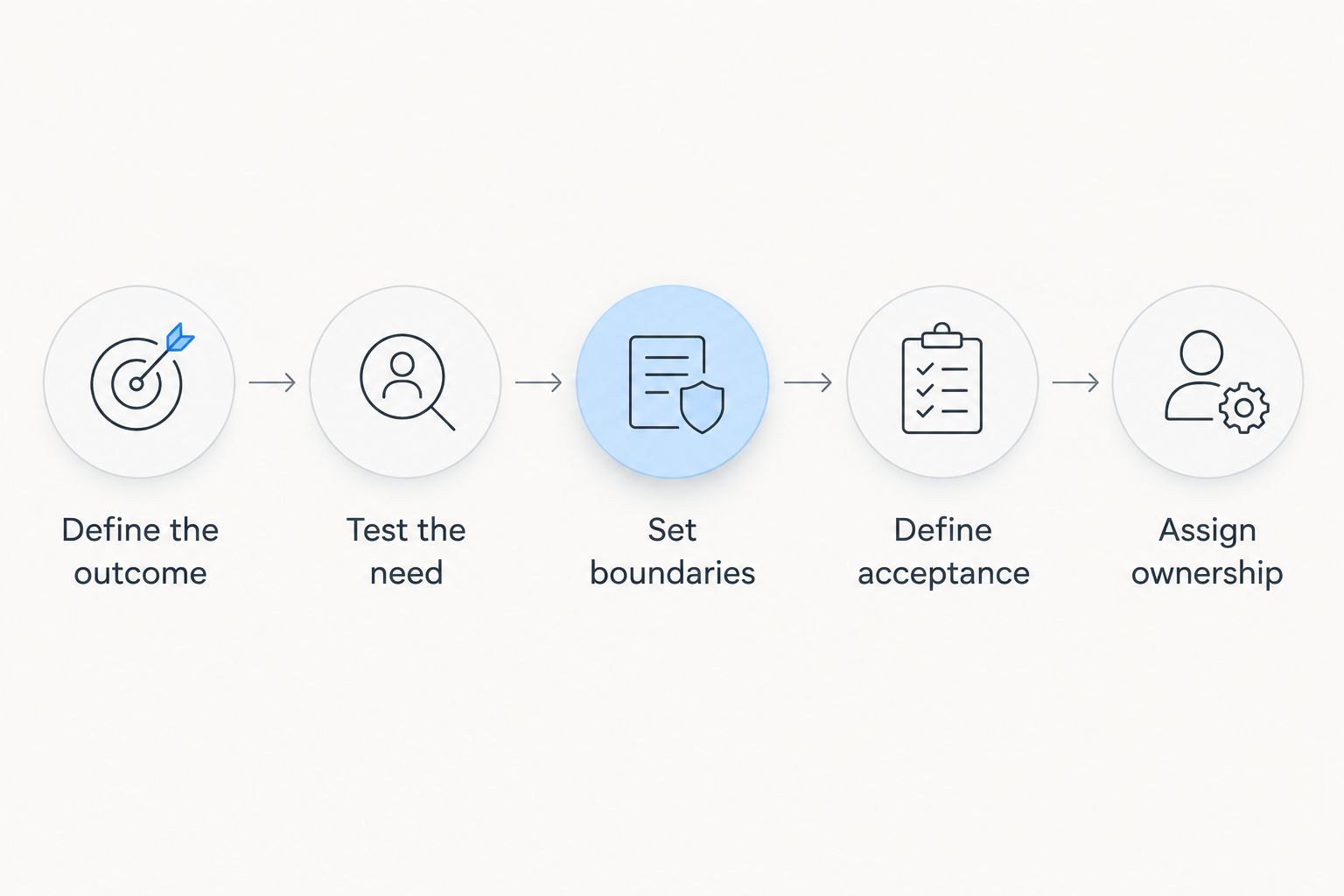
Use this 5-step process for a 2026 procurement brief. The deliverable is a shared definition of the project—not a longer feature wish list.
1. Define the outcome
Name the workflow and the business result you want to change. Examples include reducing reconciliation work or giving participating organizations a shared record they can independently verify.
Identify who performs the work today and where disputes occur. Do not claim savings until you have measured that starting point.
2. Test the need
Explain why a conventional database with appropriate access controls does not satisfy the requirement. Identify which parties need independent verification and why trusting a central operator is insufficient.
If you cannot explain that distinction, pause the blockchain decision. You can still improve the workflow without committing to distributed infrastructure.
3. Set boundaries
List what belongs on-chain, what stays in conventional storage and which systems remain authoritative. Include personal information, documents and external events in that discussion.
Write exclusions alongside requirements. If a mobile application, additional network or data migration is outside the initial scope, say so explicitly.
4. Define acceptance
Describe successful behavior for normal actions, rejected actions and interrupted workflows. Include who can approve changes and what evidence demonstrates that a milestone is complete.
Acceptance criteria should be observable. Replace vague language such as enterprise-ready with specific permissions, recovery procedures and test outcomes.
5. Assign ownership
Name the owners of deployments, administrative access, monitoring and incident response. Document how the business receives source code, deployment instructions and operating documentation.
Make maintenance responsibilities explicit before signing. A functioning deployment without an accountable operator is an unfinished handover.
How should you compare vendor proposals?
For a 2026 vendor review, give every bidder the same requirements and request the same estimate structure. Otherwise, apparent differences in value reflect different assumptions rather than different delivery approaches.
Ask each vendor to explain exclusions before presenting optional features. Then review delivery, security and operations separately so that strong application credentials do not substitute for a credible key-management plan.
Examine custody before wallet screens
A wallet interface does not tell you who controls assets. Establish whether users control signing keys, the application controls them, or another arrangement governs transaction approval.
When comparing crypto wallet development companies, make custody, recovery and signing responsibilities explicit in the brief; those decisions define both the user experience and the security work. A polished interface cannot resolve an undefined recovery policy.
Ask for evidence tied to your scope
Request an explanation of how the proposed team will test contract behavior, handle failed integrations and document deployment. Evaluate the answer against your requirements rather than accepting broad claims about blockchain experience.
You do not need access to another customer's confidential systems. You need enough technical explanation and relevant evidence to understand how the vendor plans to deliver your project.
Separate review from remediation
Ask what security review includes and who resolves its findings. A review report is not the same deliverable as corrected code with confirmed fixes.
Agree on the approval process for unresolved findings before release. The business owner should understand the remaining risk rather than discovering it during handover.
What costs continue after launch?
Your 2026 operating plan needs named responsibilities for both software maintenance and blockchain-specific activity. Treat launch as the start of ownership, not the end of spending decisions.
| Operating area | Ongoing work | Budget question |
|---|---|---|
| Application infrastructure | Backend services, storage and monitoring | Who operates each component? |
| Network interaction | Transaction submission and access to blockchain data | Who pays network and provider charges? |
| Maintenance | Dependency updates, fixes and compatibility work | What changes are included? |
| Security operations | Access reviews, alerts and incident response | Who handles urgent events? |
| User support | Failed transactions, access issues and recovery requests | Which team owns each request? |
| Governance | Rule changes, participant changes and upgrade approvals | Who authorizes the work? |
For example, an external system can send an incorrect record even when the blockchain records the submitted transaction correctly. Your operating procedure must address the source error and its downstream effects.
A permanent record is not a substitute for a correction process. Define how users identify, dispute and resolve incorrect business information.
How can you reduce scope without weakening the business case?
Start with a bounded workflow and a clear success condition. Limit the initial release to the participants, rules and connections needed to demonstrate that outcome.
Keep optional functionality outside the core contract until it has a defined purpose. Additional dashboards, networks and approval paths should earn their place through a business requirement, not a presentation preference.
Do not remove security, recovery design or acceptance testing simply to make the estimate smaller. Reduce what the system does before reducing the work needed to make its promised behavior dependable.
FAQ
How much does blockchain development cost in 2026?
Blockchain development cost in 2026 requires a scoped estimate covering application work, on-chain components, security, integrations and operations. Compare quotes only after vendors agree on deliverables, exclusions and ownership.
Is a smart contract quote the same as a blockchain application quote?
No. A smart contract quote covers defined on-chain behavior, while a blockchain application also needs the surrounding user experience and supporting software. Confirm whether wallets, backend services, integrations and deployment are included.
Does my business need its own blockchain?
Your business needs its own blockchain only when the requirements justify owning network-level rules and operations. Compare that responsibility with using an existing blockchain or a conventional application before deciding.
Do blockchain projects have ongoing costs?
Blockchain projects have ongoing operating obligations, including maintenance, monitoring, network interaction and support. Assign responsibility for these items separately from the initial delivery scope.
What should I prepare before requesting an estimate?
Prepare a workflow description, participant list, system boundaries, security requirements and acceptance criteria. Include exclusions and identify who will operate the live system so vendors estimate the same project.
One last thing
Ask a prospective vendor to explain why your project should not use blockchain. A credible architecture discussion must consider a simpler alternative, not just defend the technology you mentioned first.
Approve the business requirement before approving the architecture. That decision gives every subsequent estimate a clear purpose.
Related guides
- Best blockchain development companies
- How much does API integration cost?
- How long does a digital transformation project take?
Schedule a consultation with Hexagon IT Solutions to discuss your workflow, project boundaries and estimating requirements.


