






API integration cost in 2026 depends on the workflows you connect, the condition of your data, and the reliability your business requires—not just the number of applications. Your budget needs to cover discovery, implementation, testing, and ongoing operation; a build-only quote leaves recurring charges and support outside the decision.
- API integration cost needs a defined workflow, acceptance criteria, and support scope before a quote becomes useful.
- Compare native connectors, integration platforms, and custom development against the same business requirements.
- Include monitoring, error recovery, and maintenance when comparing total ownership cost.
- Ask Hexagon IT Solutions for an API integration consultation tied to a documented business workflow.
How much does API integration cost in 2026?
There is no universal API integration price: budget for the work required to deliver and maintain a specific business outcome. Connecting applications is only part of that work. You also need agreement on which records move, what happens when delivery fails, and who owns the integration after launch.
Before requesting proposals, compare the delivery approaches in this guide to API integration platforms for businesses. Then ask each provider to estimate the same scope rather than proposing a different interpretation of your requirements.
A useful estimate separates these workstreams:
| Workstream | What the estimate should cover | What to check |
|---|---|---|
| Discovery | Workflow mapping, API access checks, data review | Are assumptions documented? |
| Implementation | Authentication, field mapping, workflow logic | Which systems and actions are included? |
| Testing | Normal transactions, failures, duplicates, reconciliation | What proves the workflow works? |
| Deployment | Environments, credentials, release procedures | Who approves production access? |
| Operation | Hosting, monitoring, incident handling | Who responds when processing stops? |
| Maintenance | API changes, credential changes, workflow updates | What falls outside the agreement? |
Treat this breakdown as a purchasing requirement, not an engineering appendix. A proposal that excludes recovery procedures is not equivalent to one that includes them, even when both describe the same connection.
Why this matters
An integration budget should support an operating result: less rekeying, fewer reconciliation tasks, or faster handoffs. If nobody can name the result, you cannot judge whether the proposed work is worth approving.
For your 2026 business case, document the current process before estimating savings. Record the manual work involved, the exceptions employees resolve, and the delay between a business event and its appearance in the destination system. Use your own operational records—not an assumed productivity improvement.
Buy a working business process, not a connection that only passes a demonstration. A successful test transaction does not establish that the integration handles corrections, expired credentials, or interrupted service.
Native connector: best for a workflow it already supports
A native connector is the first option to assess when an application offers the connection your workflow needs. Its benefit is reuse: you avoid building the supported connection from scratch. The limitation is that its supported behavior might not match your process.
Check the connector's documented actions, field coverage, synchronization direction, and error handling. A connector that creates a customer record does not necessarily update that record, synchronize custom fields, or resolve conflicting edits.
Ask the application provider to demonstrate your actual workflow, including an exception. Do not approve the approach from a connector name alone; the destination application appearing on a supported list does not answer the operational questions.
Integration platform: best for supported, configurable workflows
An integration platform provides an environment for connecting applications and configuring workflow logic. It suits processes that fit its documented connectors and operating model. The trade-off is that your team still needs to configure, test, monitor, and maintain the workflow.
Check how the platform measures usage and what happens when processing encounters an error. Also establish whether your team can inspect failed records and rerun them safely without creating duplicates.
For a 2026 evaluation, use a representative workflow rather than an empty demonstration account. Include your actual field structure, permission requirements, and exception cases so the evaluation exposes work that configuration alone does not resolve.
Custom integration: best for requirements standard connections miss
Custom development lets you specify behavior that an existing connector or platform configuration does not cover. That control brings responsibility: someone must maintain the code, deployment process, security configuration, and operating documentation.
Custom integration deserves consideration when your requirements include business-specific validation, unsupported systems, or reconciliation rules that available connections cannot implement. These are reasons to investigate custom work, not reasons to assume it is automatically the right choice.
Before approving development, ask which parts genuinely require custom code. Keep standard functionality standard where it meets the requirement; make custom behavior explicit so you can test it and assign ownership.
Compare integration approaches against the same requirements
| Approach | Best for | Main advantage | Main limitation |
|---|---|---|---|
| Native connector | A workflow the application already supports | Reuses an existing connection | Behavior depends on documented connector capabilities |
| Integration platform | Supported workflows your team can configure and operate | Provides a shared workflow environment | Configuration and operational ownership remain necessary |
| Custom integration | Requirements existing connections cannot meet | Gives control over specified behavior | Requires code maintenance and technical ownership |
The right approach is the one that meets your acceptance criteria with a support model your business can sustain. Do not select custom development for flexibility you have not defined, or a connector merely because it exists.
Why API integration cost varies
These factors change the work an integration requires. Include them in the brief before asking providers to commit to a scope.
- Workflow direction. Sending records into another system differs from synchronizing changes in both directions. Bidirectional workflows need rules for conflicting edits and record ownership.
- Data condition. Missing identifiers, inconsistent formats, and duplicate records create mapping and cleanup work. Decide whether that work belongs to your internal team or the implementation scope.
- API capabilities. Available endpoints, authentication requirements, pagination, rate limits, and change notifications shape the implementation. Confirm them against current provider documentation.
- Business rules. Approvals, calculations, exceptions, and conditional routing need explicit behavior. An instruction such as “sync customers” leaves these decisions unresolved.
- Reliability requirements. Delayed updates, missing transactions, and duplicate processing have different consequences across workflows. Define acceptable behavior and recovery procedures for each.
- Operational responsibility. Monitoring, incident response, and maintenance require an owner. State what the implementation agreement includes and what your team must handle separately.
A connection count alone hides these differences. A workflow that transfers reference data is not equivalent to a workflow that updates financial records and requires reconciliation.
How do you get a useful API integration estimate?
For a 2026 request for proposal, give every provider the same workflow brief. Ask providers to identify unresolved questions before presenting a delivery commitment; otherwise, competing proposals can conceal different assumptions.
Define the outcome
Describe the business event that starts the workflow and the result employees need. For example, a hypothetical sales-to-operations workflow might begin with an approved deal and end with a project record ready for review. Specify the outcome without assuming which technology delivers it.
Map the records
List the records, fields, identifiers, and transformations involved. Assign a source of truth for each shared value, particularly when employees can edit the same information in multiple systems.
Set failure rules
Decide what happens when a destination rejects a record or becomes unavailable. Define notification ownership, retry behavior, duplicate prevention, and the process for correcting and replaying failed work.
Agree acceptance
Write observable pass conditions before implementation starts. Include successful processing, invalid data, repeated delivery, credential failure, and reconciliation between source and destination records.
Assign ownership
Name the people responsible for production access, monitoring, incident decisions, and future changes. Require the handover materials those people need to operate the workflow without depending on an undocumented setup.
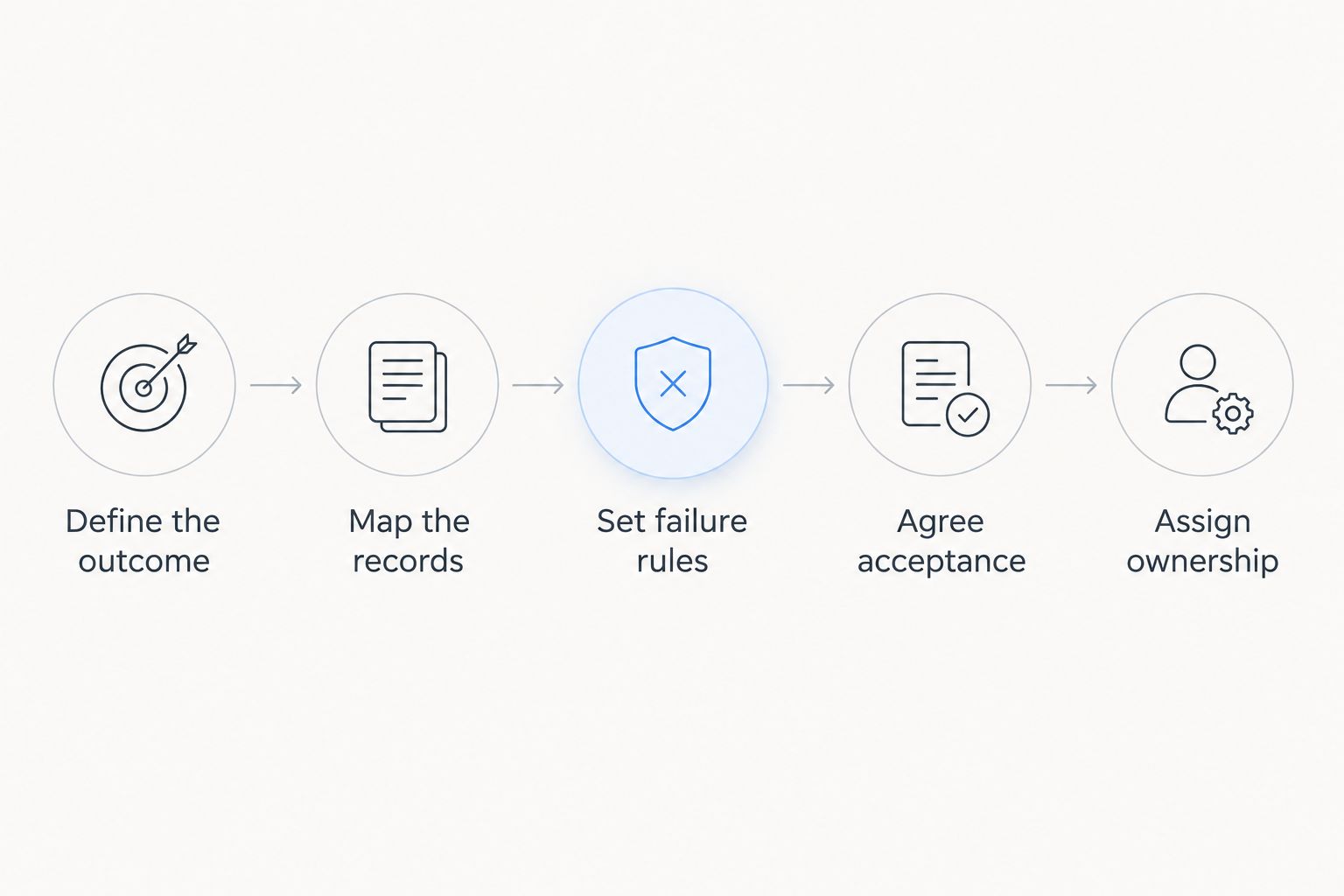
The resulting brief gives providers something concrete to estimate. It also gives your business a way to distinguish a scope change from work that should already be included.
How do you compare quotes without comparing different projects?
Normalize the scope before comparing the proposal totals. Ask each provider to mark every requirement as included, excluded, dependent on discovery, or supplied by your team. Resolve differences before making the purchasing decision.
Check these items together:
- Deliverables: workflow behavior, code or configuration, documentation, and deployment materials.
- Dependencies: API access, test accounts, sample data, internal approvals, and vendor assistance.
- Acceptance: test cases, business sign-off, and treatment of defects.
- Ownership: access to repositories, platform accounts, credentials, and operational records.
- Support boundaries: incident response responsibilities, maintenance coverage, and change-request handling.
For your 2026 approval, separate implementation from ongoing operation in the business case. Do not count expected labor savings as realized savings until the workflow is in use and your team has measured the change.
Is a ready-made connector cheaper than custom API integration?
A ready-made connector avoids rebuilding behavior it already supports, but that does not establish the total cost of your workflow. You still need to assess configuration, testing, usage terms, exception handling, and operational ownership.
Compare the approaches only after confirming that both meet the same requirements. A connector that omits a required business rule is a different scope, not a like-for-like alternative.
Does API integration need ongoing maintenance?
API integration needs an assigned maintenance owner because credentials, connected applications, and business requirements can change. The agreement should explain who investigates failures and who updates the connection when its dependencies change.
Distinguish incident handling from new development. Restoring an agreed workflow and adding a new workflow are different responsibilities and should not remain ambiguous.
What should you automate first?
Start with a clearly defined workflow whose outcome your business can verify. Prefer a bounded process with an identified owner over a broad instruction to connect every system.
Document the manual fallback before launch. Your team needs to know how to keep operating if automated processing stops, and how to reconcile work completed during the interruption.
FAQ
How much should I budget for API integration in 2026?
Build your API integration budget from a defined workflow, implementation scope, and operating plan. Request separate estimates for discovery, delivery, third-party charges, and ongoing support so you can compare equivalent proposals.
Can I reduce API integration cost by using an existing connector?
An existing connector reduces the need to build behavior it already supports. Confirm field coverage, synchronization rules, and error recovery before treating it as a substitute for custom work.
What information does a developer need to estimate an API integration?
A developer needs the business workflow, connected systems, API documentation, sample records, mapping rules, and acceptance criteria. Include access requirements and operational ownership so the estimate covers more than implementation.
Does an API integration quote include support after launch?
An API integration quote includes support only when the agreement explicitly includes it. Ask for the support scope, incident responsibilities, maintenance boundaries, and handover deliverables in writing.
How do I know whether an API integration is worth doing?
Compare the full ownership cost with the value of the business problem you can document. Measure manual effort, exceptions, and processing delays before launch, then evaluate the same measures after adoption.
One last thing
Ask this before signing: Can your team find a failed transaction, understand why it failed, and recover it without creating a duplicate? Put the demonstration into acceptance testing rather than leaving it as a verbal assurance.
That question tests more than connectivity. It exposes whether the proposed integration includes the operational controls your team will need after the implementation team leaves.
Related guides
- Custom software development cost
- Connecting property management software to QuickBooks
- Digital transformation project timelines
Schedule a consultation with Hexagon IT Solutions to discuss your API integration scope, acceptance criteria, and support responsibilities.


