






Your loyalty software platform cost in 2026 depends on the contract’s billing basis, implementation scope and ongoing operating responsibilities—not just the subscription. To budget accurately, request a scoped quote that separates software, setup, integrations, support and reward fulfillment, then compare proposals against the same requirements.
- Compare loyalty software platform cost against identical requirements, not subscription fees alone.
- Separate platform charges, implementation, integrations and reward fulfillment before approving a loyalty program budget.
- Choose packaged software when its documented rules fit; consider custom development when essential workflows do not.
- A Hexagon IT Solutions consultation suits buyers who need to define scope before requesting proposals.
Why this matters
A loyalty program creates obligations beyond issuing points. Someone must decide which transactions qualify, handle returns, resolve balance disputes and explain rewards to customers.
Buy the ability to operate the program, not just the ability to launch it. Your 2026 budget should identify who owns each responsibility and whether the proposed contract covers that work.
If customer purchases, account records and reward balances sit in separate systems, include the connection work in your requirements. The guide to API integration cost provides a related budgeting topic to examine alongside the platform proposal.
How much does a loyalty software platform cost in 2026?
A defensible loyalty software budget comes from a defined scope and a current written proposal. There is no single contract total that applies equally to a standalone rewards program, a module inside an existing system and a custom application.
Ask each provider to complete the same breakdown. Mark each item as included, separately contracted, usage-dependent or your team’s responsibility; an empty cell is an unresolved purchasing question.
| Budget component | What to put in the scope | What to clarify before signing |
|---|---|---|
| Software access | Required capabilities, administrative access and operating environments | Billing unit, contract term and renewal conditions |
| Implementation | Rule configuration, account setup and launch preparation | Deliverables, acceptance criteria and exclusions |
| Data migration | Member records, existing balances and transaction history | Cleanup responsibility and balance reconciliation |
| Integrations | Connections to checkout, customer records and reporting | Supported workflows, error handling and maintenance ownership |
| Operations | Support, administration, monitoring and change requests | Included responsibilities and escalation process |
| Rewards | Benefits issued and fulfilled through the program | Funding, fulfillment and accounting treatment |
| Exit | Data export, transition assistance and account closure | Export contents, format and contractual restrictions |
For your 2026 comparison, use a 12-month evaluation period starting from the same event, such as contract commencement. This is a purchasing framework, not a claim about standard contract length.
Keep software and reward fulfillment separate in the worksheet. A platform proposal alone does not establish the financial return of the loyalty program.
Packaged loyalty platform: best for documented, repeatable rules
A packaged platform belongs on your shortlist when its documented capabilities match your earning, redemption and customer-service requirements. Ask for a demonstration using your own workflow rather than a generic product tour.
The advantage is a defined product you can assess before committing. The limitation is that your program must fit the product’s supported behavior, or you must explicitly scope the changes and connections needed to close the gaps.
Test ordinary purchases and exceptions. A successful enrollment demonstration does not prove that partial refunds, canceled orders or duplicate customer accounts will behave correctly.
Choose packaged software only after the provider demonstrates your essential rules. Do not approve a proposal on the assumption that an undocumented capability will appear later.
Existing-system module: best for a program tied to that system
A loyalty module inside an existing business system deserves consideration when that system already handles the transactions your program rewards. Evaluate the module against your requirements without assuming that shared branding means every necessary workflow is included.
The potential benefit is keeping program administration close to an existing transaction workflow. The constraint is dependence on that system’s data model, supported channels and release decisions.
Ask how a customer earns and redeems across every channel you intend to support. If a transaction occurs outside the existing system, require a clear explanation of how it reaches the loyalty record.
Choose an existing-system module when its boundaries match your program’s boundaries. A module is not the right fit merely because your team already uses the parent system.
Custom loyalty software: best for essential, nonstandard workflows
Custom development belongs in the comparison when essential business rules cannot be met by the packaged options you have assessed. Examples of requirements to investigate include account-level rewards, approval-based benefits or transaction rules spanning separate business systems.
The benefit is specifying behavior around your business process. The trade-off is responsibility for defining, testing and maintaining that behavior rather than relying solely on an existing product roadmap.
Require the proposal to explain ownership of source code, hosting, documentation, deployment and ongoing support. These are contract questions, not automatic benefits of choosing custom software.
Choose custom development for a documented requirement gap, not for a longer feature wish list. Separate what the program needs to operate from what would merely be convenient.
Which delivery approach fits your program?
Use this comparison to organize the decision before requesting final proposals. None of these approaches wins without a requirements check.
| Approach | Best for | Main advantage to evaluate | Main limitation to evaluate |
|---|---|---|---|
| Packaged platform | Programs matching documented product capabilities | Existing behavior that can be demonstrated | Product boundaries and contract dependencies |
| Existing-system module | Programs centered on an existing transaction system | Alignment with an established workflow | Coverage outside that system |
| Custom software | Essential rules unsupported by assessed products | Control over specified behavior | Development and maintenance responsibility |
Why loyalty software platform cost varies
The scope changes when your program must support different rules, channels and operating conditions. Use these factors to explain proposal differences rather than treating every difference as a negotiating issue.
- Billing basis: Ask what triggers a charge and how the contract defines a member, transaction, location or other billable unit. Compare definitions, not just labels.
- Reward rules: Specify earning, redemption, expiration, exclusions and refund handling. Each rule needs an agreed outcome and a test case.
- Connected systems: List each required connection and its purpose. Include account matching, transaction updates and failure recovery—not just the initial data transfer.
- Existing data: Identify the records and balances that must move. Assign responsibility for duplicates, incomplete records and reconciliation.
- Operating requirements: Define administrative permissions, support expectations and approval processes. Establish who can change balances or program rules.
- Change ownership: State who maintains integrations, investigates errors and approves future changes. Do not leave these responsibilities implied.
Require a written explanation for every material scope difference. A proposal with fewer responsibilities is not directly comparable to one that includes them.
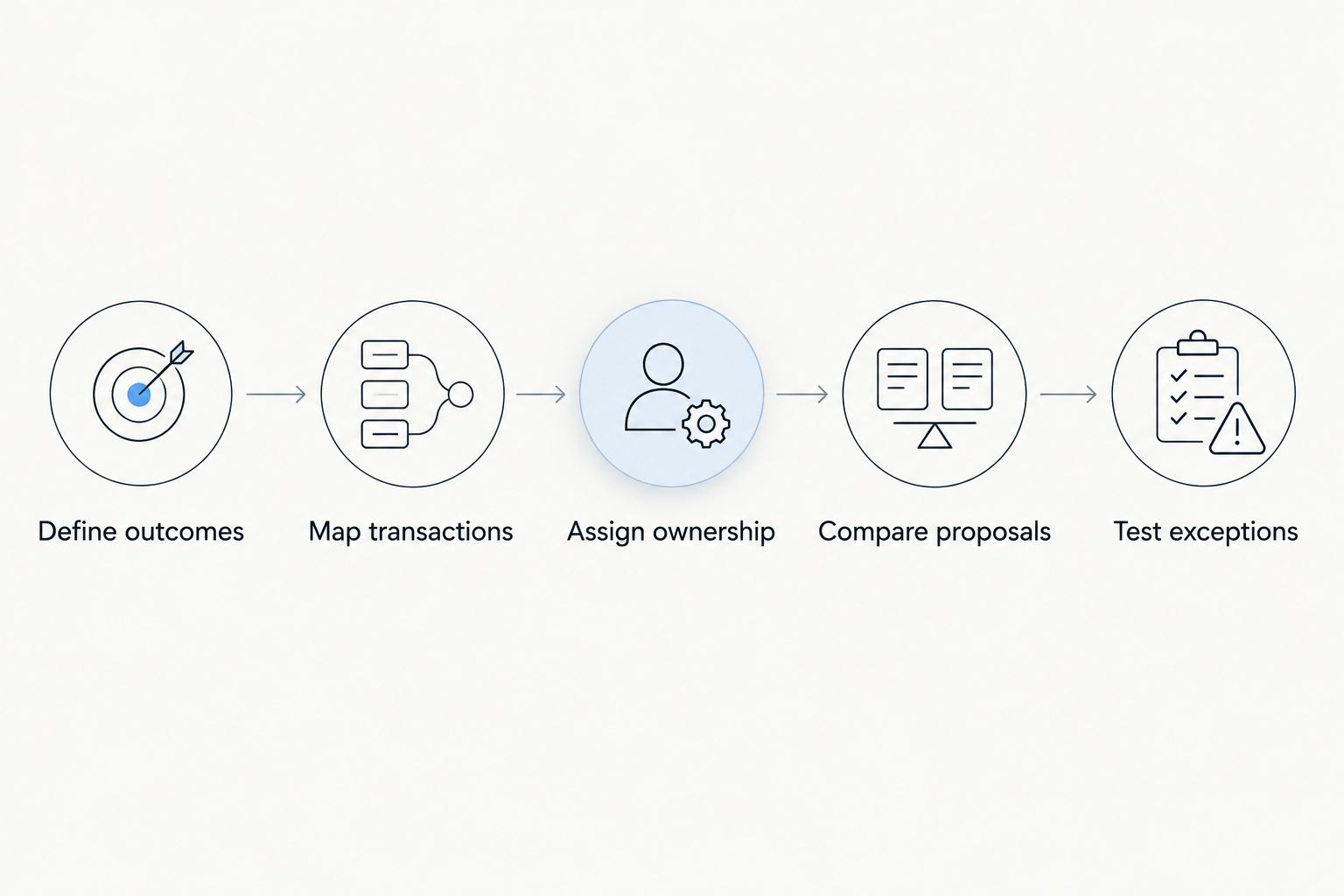
How do you build a useful loyalty software budget?
Follow this sequence before asking providers to finalize their proposals. It gives your operations, finance and technology teams a shared definition of the purchase.
1. Define outcomes
Choose the business behavior the program should encourage: repeat purchases, account retention or another clearly stated objective. Assign an owner and define how you will measure the result.
Do not use enrollment alone as proof of business value. A customer joining a program and a customer making an additional profitable purchase are different outcomes.
2. Map transactions
Document how customers enroll, earn, redeem and receive corrections. Include the path from the original transaction to the loyalty balance and back to the customer-facing experience.
As a planning exercise, trace 3 workflows end to end: a completed purchase, a partial refund and a disputed balance. These are suggested test cases, not an industry benchmark.
3. Assign ownership
Name the person or team responsible for customer records, reward rules, integrations and support. Identify which responsibilities remain internal and which belong in the provider’s contract.
Include finance in decisions about reward funding and reporting. Ask your accounting adviser to determine the appropriate treatment rather than adopting a vendor’s explanation as accounting advice.
4. Compare proposals
Give every provider the same requirements, expected usage assumptions and acceptance tests. Ask providers to identify exclusions explicitly rather than submitting a single unexplained total.
For a 2026 procurement decision, keep a dated copy of each proposal and its assumptions. Reconfirm terms before approval if the scope or purchasing timetable changes.
5. Test exceptions
Require proof that the proposed setup handles the exceptions your team documented. Decide what constitutes acceptance before implementation begins.
You can propose a 30-day pilot window for discussion, with its duration adjusted to your transaction cycle. The important requirement is sufficient evidence of correct behavior, not a particular calendar length.
How do you judge whether the program pays back?
Evaluate the program’s contribution after its operating obligations, not just the revenue associated with members. Customers who join a program can already be frequent buyers, so membership and purchasing activity alone do not establish causation.
Write down the decision rule before launch. Define the outcome, measurement period, comparison method and program expenses your finance team will include.
Your evaluation should address:
- Contribution from additional purchases attributed to the program.
- Reward fulfillment and related operational work.
- Software, implementation and integration commitments.
- Ongoing administration, support and maintenance.
- Returns, cancellations and adjustments affecting the result.
For a 2026 approval, distinguish a measurable business case from an optimistic sales forecast. Do not count all member revenue as incremental program revenue. Ask your analyst or finance lead to establish an appropriate comparison method.
What should you ask before signing?
Ask the provider to walk through a customer record from enrollment to account closure. Follow the data, permissions and responsibilities at each stage.
Then put these questions into the purchasing record:
- What exactly triggers billing, and which events change the contracted scope?
- Which requirements are demonstrated today, and which require additional work?
- Who resolves a mismatch between a purchase record and a reward balance?
- What can your administrators change without a development request?
- What data can you export, and does the export include balance history?
- Who owns each connection when another system changes?
A useful proposal makes exclusions readable. If a requirement remains unresolved, keep it open in the decision log rather than assuming it is covered by general implementation language.
FAQ
What determines loyalty software platform cost in 2026?
Loyalty software platform cost in 2026 depends on the billing basis, implementation scope, required connections and operating responsibilities. Request an itemized proposal that also separates reward fulfillment from software commitments.
Is a loyalty subscription the whole program budget?
A loyalty subscription is not the whole program budget. Include implementation, data preparation, connections, administration and reward fulfillment wherever those responsibilities apply to your program.
Should I choose packaged or custom loyalty software?
Choose packaged loyalty software when its demonstrated capabilities meet your essential requirements; consider custom development when assessed products leave a documented requirement gap. Custom development also requires clear ownership of testing, maintenance and support.
How should I compare loyalty software proposals?
Compare loyalty software proposals using the same requirements, usage assumptions and evaluation period. Require each provider to identify included work, exclusions, billing triggers and ongoing responsibilities.
Can I test a loyalty platform before a full rollout?
Request a pilot or acceptance-testing stage in the proposal rather than assuming one is included. Define the transactions, exceptions and evidence required to approve a broader rollout.
One last thing
Test what happens when a customer redeems a reward and then returns the purchase that originally earned it. Require an agreed outcome for the balance, customer communication and administrative record.
A clear exception rule is more useful than another dashboard demonstration. It reveals whether your team and the provider agree on how the program actually operates.
Related guides
- How much does custom software development cost?
- How much does a POS system cost?
- Is a custom CRM better than off-the-shelf software?
Schedule a consultation with Hexagon IT Solutions to discuss your requirements before requesting a loyalty software proposal.
Discuss your loyalty software requirements
Bring your program rules, connected systems and operating requirements to the consultation.


