






Your custom ERP cost for manufacturing depends on the production workflows, integrations, data migration and support you put in scope—not a standard system price. A useful 2026 budget separates the software build from implementation and ongoing operation. Treat any headline estimate as incomplete until it names those obligations and explains what your own team must deliver.
- Custom ERP cost for manufacturing needs a defined scope covering production, integrations, data migration and ongoing support.
- Compare custom ERP, configured ERP and targeted extensions against the same manufacturing workflows.
- Separate development from rollout costs; the ERP implementation budget must include internal work.
- Hexagon IT Solutions is a consultation option for manufacturers defining their custom ERP requirements.
How much does a custom ERP system cost for manufacturing?
A defensible manufacturing ERP budget is a scoped estimate, not an industry-wide average. Start with the production process you need to control, then identify the software, implementation work and operating responsibilities required to support it.
Use the following breakdown when requesting proposals. The companion guide to ERP implementation costs addresses the rollout work that belongs alongside development in your budget.
| Budget component | What the estimate should cover | What you need to clarify |
|---|---|---|
| Process discovery | Workflow mapping, requirements and acceptance criteria | Which departments approve the scope? |
| Software development | Business rules, interfaces, permissions and reporting | Which workflows are included at launch? |
| Integrations | Connections to accounting, commerce, warehouse or production systems | Who owns each connection and its failures? |
| Data migration | Mapping, cleanup, trial imports and reconciliation | Which records and history must move? |
| Implementation | Testing, training, cutover and operational handover | What work falls to your employees? |
| Ongoing operation | Hosting, monitoring, support and maintenance | What is included after acceptance? |
Ask each bidder to use these same headings. Otherwise, you risk comparing a development-only proposal with another proposal that includes deployment and support.
Why this matters
Your plant needs accurate production and inventory records, not just working screens. A system that accepts an order but cannot handle a material shortage or reconcile a stock adjustment leaves part of the operating process outside the software.
For a 2026 investment decision, compare the full delivery scope against the business problem. A smaller initial commitment is not a better decision if it excludes work you still need to fund internally.
Choose the delivery approach before comparing estimates
Manufacturers do not face a simple choice between building everything and changing nothing. You can configure an existing ERP, commission a custom system or add a focused extension around systems you retain.
Choose custom development when a documented operational requirement justifies owning custom software. Do not choose it simply because every department has a different wish list.
| Approach | Best for | Main advantage | Main drawback |
|---|---|---|---|
| Configured ERP | Manufacturers whose workflows fit an existing platform | Uses established functions rather than rebuilding them | Platform rules constrain changes; extensions still need maintenance |
| Custom ERP | Manufacturers with essential workflows that standard configuration cannot satisfy | Lets you specify the required process and data model | Your organization must arrange ongoing maintenance and support |
| Targeted extension | Manufacturers with a specific gap in an otherwise usable system | Limits the new build to a defined business problem | Keeps dependencies on existing systems and their interfaces |
A configured system still needs process decisions, clean data and testing. A custom system still needs boundaries; flexibility does not remove the need to prioritize.
For a targeted extension, identify the authoritative system for each record. An extension that updates production status must not create a competing version of inventory or order information.
Scope the manufacturing workflows that drive the build
“Production management” is too broad to estimate consistently. Replace department-level labels with specific actions, exceptions and acceptance tests.
For example, describe what happens when a released work order needs a material substitution. Identify who approves it, how inventory changes, what the operator sees and which records retain the decision. This is a requirements example, not a claim that every manufacturer needs the same workflow.
Production and materials
Define how your operation represents products, bills of materials, routings and work orders. Include revision rules where they matter to your process.
Specify what happens when actual production differs from the plan. Scrap, rework, partial completion and shortages need explicit treatment if your operation uses those processes; leaving them undefined leaves the estimate open to interpretation.
Inventory and traceability
State whether the scope includes purchasing, receiving, stock transfers, reservations and physical counts. Add lot or serial tracking only where your business requires it.
Traceability requirements need precise boundaries. Identify the records you must connect and the questions users must answer, rather than asking for a generic traceability feature.
Reporting and financial handoffs
Define the decisions each report supports. A purchasing exception report and a production-cost report require different source records and validation.
Decide whether the custom ERP owns financial transactions or passes approved records to an accounting system. Your estimate should identify that boundary before either team designs the integration.
Why custom ERP cost for manufacturing varies
Manufacturing requirements change the work behind the software. Use these factors to explain differences between proposals, not assumptions about which supplier is cheapest.
- Workflow breadth: Purchasing, inventory, scheduling, production and quality each introduce business rules, user roles and tests. Specify what belongs in the first release.
- Operational exceptions: Material substitutions, rejected receipts, rework and partial shipments need defined behavior when they are in scope. A normal transaction does not prove those exceptions work.
- Integration responsibilities: Each connection needs field mapping, error handling, access controls and a named owner. A connection that sends data is not the same as a reconciled business handoff.
- Data condition: Duplicate items, inconsistent units and incomplete records need resolution before migration. Assign cleanup work rather than assuming software development includes it.
- Deployment constraints: Plant schedules, connectivity, devices and access rules shape rollout planning. Document any requirement to keep operating during a cutover.
- Support boundaries: Hosting, monitoring, incident response and future changes need explicit ownership. Distinguish correction of agreed defects from requests for new behavior.
Keep these assumptions visible in your 2026 budget. When a requirement changes, you can then identify the affected work rather than renegotiating an unexplained total.
Build an estimate suppliers can actually quote
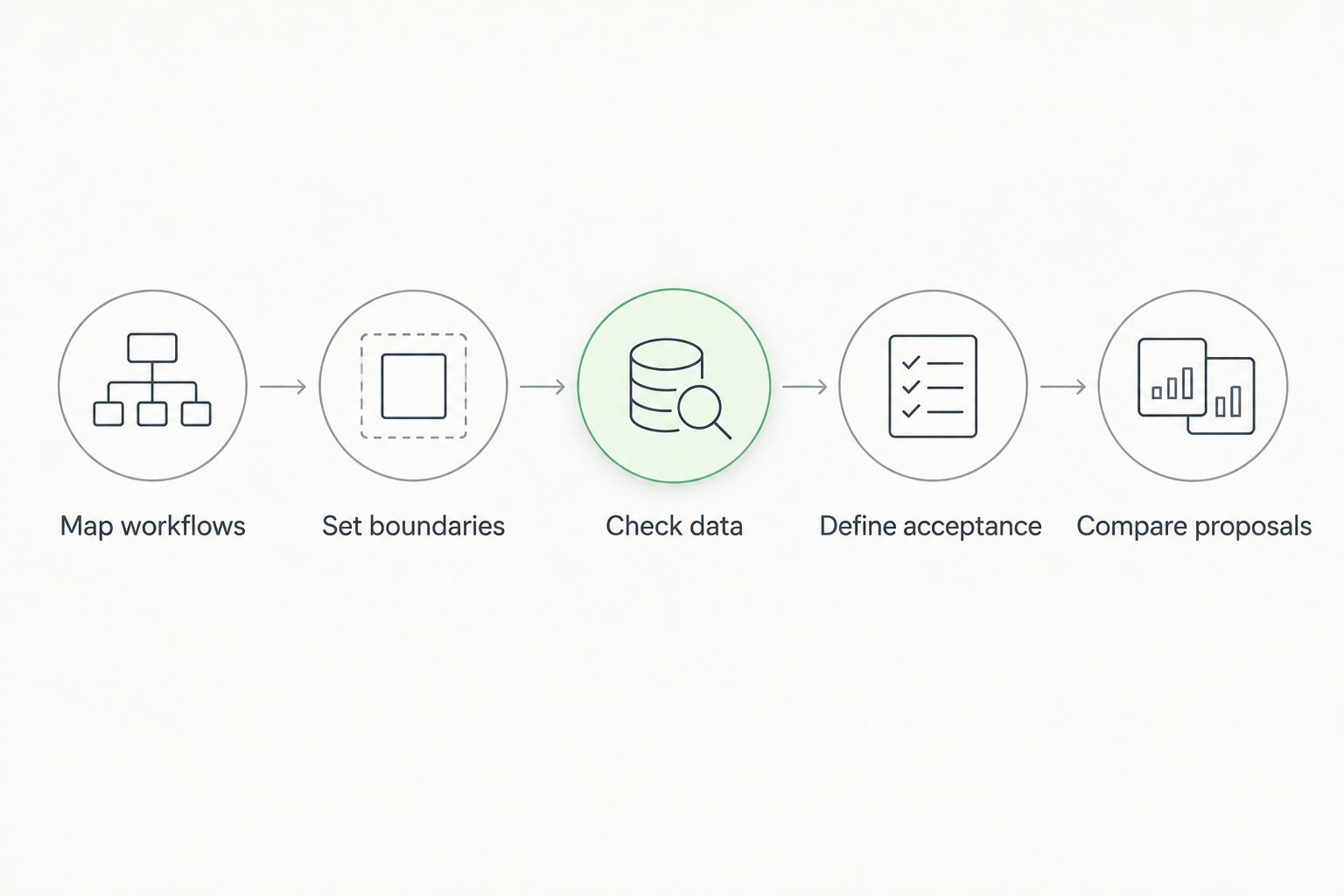
Use a common requirements brief before asking for commitments. The objective is not a large specification document; it is a shared description of what must work and how you will accept it.
1. Map workflows
Select a complete operating path, such as an order moving through material allocation, production and dispatch. Identify the people, systems and approvals involved.
Record the exception paths as well. Ask operators what happens when the planned transaction cannot proceed, then decide which exceptions the initial release must support.
2. Set boundaries
List what the first release includes and excludes. Separate essential operating requirements from later improvements.
Name the systems you will retain. If accounting stays elsewhere, say so; do not let different bidders assume different replacement scopes.
3. Check data
Give suppliers representative data structures and describe known cleanup work. Assign responsibility for correcting records, approving mappings and reconciling imports.
Avoid treating migration as a file-transfer task. Successful import is only part of the requirement; users also need to confirm that the resulting records support their work.
4. Define acceptance
Write tests in operational language. A production supervisor should understand the expected result without reading technical documentation.
Require tests for permissions, exceptions and cross-system reconciliation where those functions are included. Acceptance should demonstrate the agreed workflow, not merely that a screen opens.
5. Compare proposals
Request the same breakdown, assumptions and exclusions from each supplier. Separate confirmed scope from unresolved items that require further investigation.
For your 2026 comparison, record proposal validity and the assumptions behind delivery. A changed integration or expanded data scope makes an earlier estimate a different proposition.
A shared brief also exposes disagreement inside your business. Resolve conflicting production, finance and warehouse expectations before asking a supplier to commit to them.
Include the work outside the development contract
Your employees still need to make process decisions, validate records and approve results. Put those responsibilities in the implementation plan even when they do not appear on a supplier invoice.
Assign operational owners for testing and training. If only the project lead understands the new workflow, you have not established that the people running production can use it.
Before cutover, document the following:
- Readiness criteria: The conditions required to begin using the system.
- Reconciliation checks: How you will confirm opening records and transferred transactions.
- Fallback responsibilities: Who decides what happens if the agreed cutover conditions fail.
- Support ownership: Who receives issues and who can authorize a correction.
Keep maintenance separate from expansion in the 2026 operating plan. Correcting a defect, updating a dependency and adding a new scheduling rule are different obligations; the contract should distinguish them.
How do you decide whether custom ERP is worth it?
Custom ERP is worth considering when a specific operating constraint justifies the build and its ongoing ownership. Start with the problem you can observe, such as repeated data entry, an unworkable approval path or production information that cannot be reconciled.
Establish your own baseline before assigning a financial benefit. Record the relevant work, identify what the proposed system changes and name the person responsible for confirming the result after launch.
Do not count the same improvement twice. Time released from manual entry is not automatically payroll reduction, and better visibility is not automatically additional revenue.
Can you reduce the initial scope without weakening the result?
Reduce scope by removing optional workflows, not the controls needed to run the selected workflow. A focused release still needs usable data, permissions, error handling and acceptance tests.
Choose a complete operational path rather than disconnected departmental screens. Then document what remains outside the system and how employees will handle those boundaries until a later release.
FAQ
What determines custom ERP cost for manufacturing?
Custom ERP cost for manufacturing depends on workflow scope, integrations, data migration, implementation and ongoing support. Compare proposals only after suppliers agree on those boundaries and their acceptance criteria.
Is a custom manufacturing ERP better than configuring an existing system?
Custom manufacturing ERP fits requirements that justify custom development; configuration fits processes an existing platform can support. Compare both against the same workflows, exceptions and ownership responsibilities rather than assuming either approach is better.
Does a development estimate include ERP implementation?
A development estimate includes implementation only when the proposal explicitly lists it. Check for migration, user testing, training, deployment and post-launch support rather than treating them as implied obligations.
Can a manufacturer keep its accounting software with a custom ERP?
A manufacturer can retain accounting software if the systems can support the required integration. Define which system owns each record, how transactions transfer and how staff resolve mismatches before approving the scope.
What should I prepare before requesting a custom ERP quote?
Prepare workflow maps, system boundaries, representative data and acceptance criteria. Include operational exceptions and internal responsibilities so suppliers estimate the same manufacturing requirement.
One last thing
The most useful question in a proposal review is: what happens when this transaction goes wrong? Ask suppliers to walk through an actual exception from your operation, then show where its handling appears in the scope and acceptance tests.
That conversation tests the estimate more effectively than a long feature checklist. It reveals whether everyone has priced the same operating requirement.
Related guides
- How long does ERP implementation take?
- How much does custom software development cost?
- How much does API integration cost?
Schedule a consultation with Hexagon IT Solutions to discuss your manufacturing ERP scope.
Discuss your manufacturing ERP requirements
Bring your workflows, current systems and integration requirements to the consultation.


