






Your AI development services cost in 2026 depends on the workflow, data preparation, integrations and operating requirements you commission—not a standard project fee. Budget for development and ongoing operation separately: model usage, hosting, evaluation, maintenance and human review sit alongside the initial build.
- AI development services cost depends on project scope, data readiness, integrations and operating requirements.
- Compare workflow automation proposals against the same deliverables, acceptance tests and ongoing responsibilities.
- Existing AI models and custom-trained models solve different problems; choose based on evidence, not novelty.
- Hexagon IT Solutions is a consultation option for founders defining an AI development brief.
How much do AI development services cost in 2026?
Treat AI development as a scoped software investment, not a fixed-price category. A document assistant, a sales workflow and a custom prediction system require different data, testing and operational controls. A useful estimate explains those differences rather than attaching a headline figure to the word AI.
Separate the budget into the following workstreams. If your project also includes a new application, dashboard or customer portal, review the wider custom software development cost considerations alongside the AI scope.
| Budget component | What the proposal should cover | What to clarify before approval |
|---|---|---|
| Discovery | Workflow mapping, feasibility and acceptance criteria | Which decisions and deliverables end discovery? |
| Data preparation | Access, cleanup, labeling and permissions | Who supplies usable data and resolves gaps? |
| Development | Application logic, model connections and user controls | What works at the agreed delivery milestone? |
| Integration | Connections to business systems and authentication | Which systems, actions and failure paths are included? |
| Evaluation | Representative tests, error analysis and release checks | What evidence qualifies the system for use? |
| Operation | Hosting, model usage, monitoring and maintenance | Who owns usage charges, support and changes? |
The comparison becomes useful when each supplier estimates the same work. A proposal that excludes data cleanup or production support is not directly comparable with one that includes them.
Why this matters
An AI feature creates business value only when it improves a real workflow. Producing a summary is different from getting an accurate, approved summary into the system where your team works.
For your 2026 budget, define the intended outcome before choosing the technology. That outcome might be less time reviewing documents, faster preparation of sales follow-ups or fewer manual transfers between systems. Measure the existing process first so you can test whether the investment delivers the intended improvement.
Approve an outcome and its acceptance test before approving a build. Without those boundaries, a working demonstration can become an open-ended development project.
Choose the development approach before comparing estimates
Different approaches carry different responsibilities. Ask suppliers to explain why their proposed approach fits your workflow and what additional work it introduces.
| Approach | Best for | Main advantage | Main limitation |
|---|---|---|---|
| Existing-model integration | Adding language capabilities to a defined workflow | Uses an existing model rather than training one from scratch | Requires evaluation, usage management and handling of model errors |
| Retrieval-based application | Answering questions from an approved document collection | Supplies relevant source material to the model | Depends on document quality, access rules and retrieval accuracy |
| Model fine-tuning | Adapting behavior using representative examples | Can target a specific response pattern or task | Requires suitable examples and evidence that tuning improves results |
| Custom predictive model | Forecasting or classification using business data | Addresses a defined prediction problem | Requires suitable historical data and continued performance checks |
Existing-model integration: budget for the surrounding workflow
An existing-model integration sends instructions and permitted information to a model, then handles the response inside your application. The development brief still needs authentication, input validation, error handling and a usable interface.
For a sales follow-up assistant, decide whether the system only drafts text or also updates records and sends messages. Those actions create different integration and approval requirements. Choose this approach when an existing model meets the task; do not assume the model connection is the entire application.
Retrieval-based application: budget for information quality
A retrieval-based application finds relevant material and supplies it to the model when answering a question. This approach fits a document assistant that must work from an approved knowledge collection.
The scope includes document ingestion, access permissions, search behavior and source references. It also needs a defined response when the available material does not support an answer. Choose this approach when access to current source material matters; test retrieval separately from answer quality.
Model fine-tuning: require evidence before adding complexity
Fine-tuning adapts a model using task-specific examples. It does not replace the need to define the workflow, prepare data or evaluate the result.
Ask the supplier to compare fine-tuning with a simpler baseline using the same test cases. Approve the additional work only when the evaluation shows a useful improvement. Do not commission fine-tuning merely because the application uses specialized terminology.
Custom predictive model: start with the business decision
A predictive model estimates an outcome or assigns a category using data. Examples include identifying records for review or forecasting an operational measure.
Define what decision changes because of the prediction. Then establish whether the historical data contains a usable target and whether it represents the conditions the system will face. Choose this approach for a defined prediction problem, not as a substitute for documenting decision rules.
Why AI development services cost varies
The project label does not define the workload. These factors determine what your team and supplier must deliver:
- Workflow scope: Drafting an output differs from executing an action, updating records and managing exceptions.
- Data readiness: Inconsistent formats, missing labels and unclear ownership add preparation tasks before development can proceed.
- Integration depth: Reading approved information differs from writing to operational systems and recovering failed transactions.
- Access controls: User roles, confidential records and document-level permissions require explicit design and testing.
- Acceptance requirements: The team needs representative cases, failure criteria and a release decision—not just a successful demonstration.
- Operating responsibility: Usage monitoring, incident handling, updates and support need named owners after launch.
Use these factors to explain differences between proposals. If a supplier changes an assumption, ask which deliverable changes with it.
Build a budget brief that suppliers can estimate
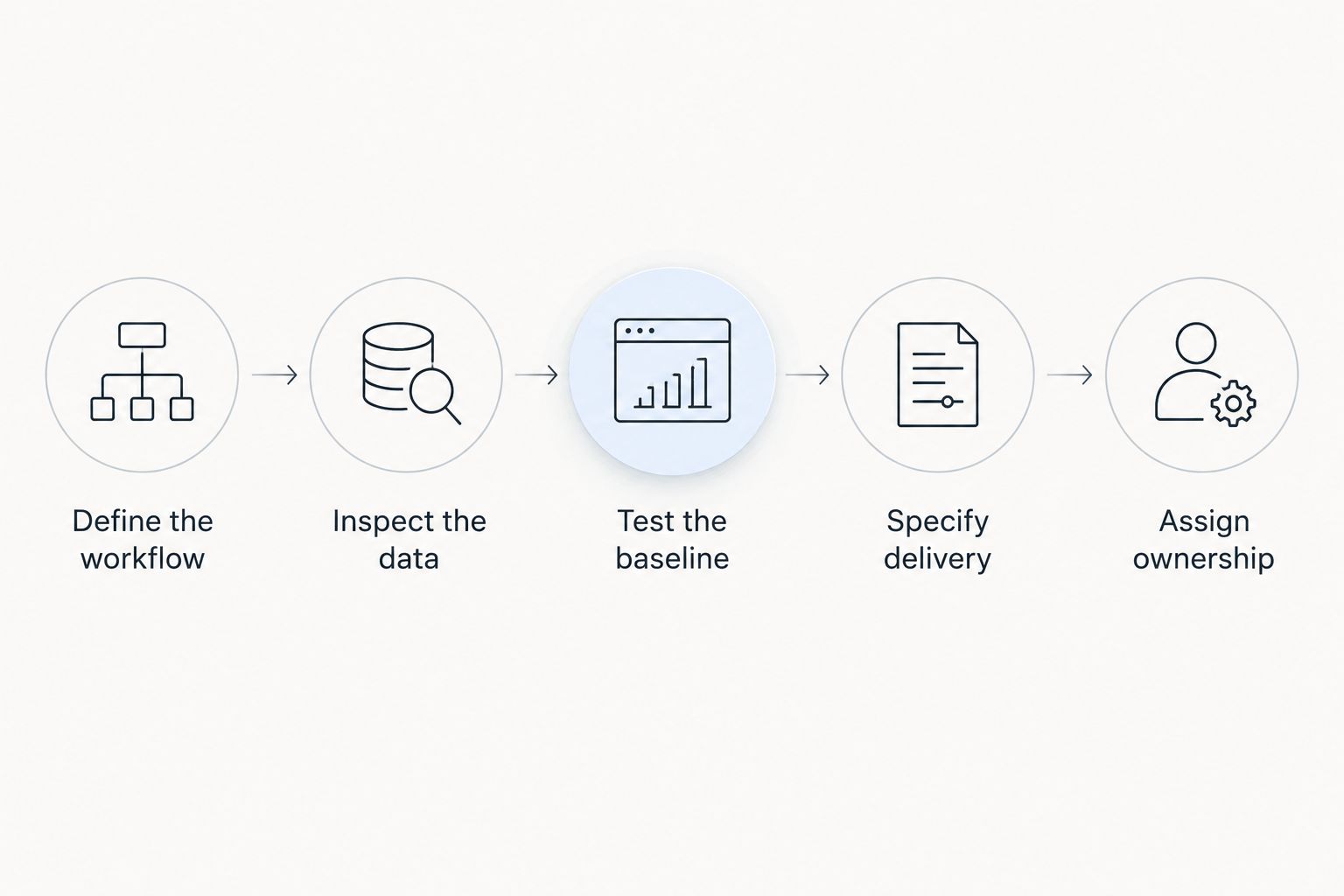
A useful brief makes the work observable. For a 2026 procurement decision, request a proposal against the following sequence rather than asking suppliers to interpret a broad ambition.
Define the workflow
Describe the trigger, input, expected output and person responsible for the result. State where the work begins and ends.
For example, a proposed document workflow could begin when an employee submits an approved file and end when a reviewer accepts extracted fields. Sending those fields into another system is a separate requirement unless you explicitly include it.
Inspect the data
Identify the source systems, data owners, formats and permission constraints. Provide representative examples that the supplier is authorized to inspect.
Include difficult cases, not only clean samples. Missing fields, conflicting documents and unreadable attachments belong in the feasibility discussion because they affect how the application handles real work.
Test the baseline
Compare the proposed AI approach with the current process and any suitable rules-based alternative. A deterministic validation rule does not need a language model merely because it sits inside an AI project.
Record what counts as an acceptable output. Test the difficult cases against that definition before expanding the build.
Specify delivery
List the included interfaces, integrations, environments and handover materials. Define who approves changes and how the supplier estimates work outside the agreed scope.
Separate a demonstration from a production release. Your release criteria should address permissions, error handling, monitoring and recovery as well as the main user journey.
Assign ownership
Name the people responsible for business acceptance, technical operation and incident response. Decide who maintains source content, reviews exceptions and approves model or workflow changes.
Require a handover that matches those responsibilities. Ownership is incomplete if your team receives code but lacks the access or instructions needed to operate it.
What should an AI development estimate include?
An estimate should connect each workstream to an assumption, deliverable and acceptance condition. Ask for explicit exclusions so that a lower initial commitment does not conceal work your team must complete.
Use this procurement checklist:
- Scope boundary: Included workflows, users, data sources and actions.
- Assumptions: Data access, internal expertise and decisions your team must provide.
- Deliverables: Working software, configuration, documentation and handover materials.
- Acceptance: Test cases, approval responsibility and treatment of unresolved defects.
- Dependencies: External systems, permissions and third-party services required for delivery.
- Change control: How new requirements receive approval before work begins.
- Ownership: Rights and access covering code, configurations, data and service accounts.
- Support: Responsibility for incidents, updates, monitoring and operational changes.
For 2026 proposals, request separate descriptions of implementation and ongoing operation. This makes it easier to see what ends at handover and what continues while the application remains in use.
Reject comparisons based only on the total estimate. Compare the included responsibilities first, then evaluate the commercial terms against that shared scope.
How do you evaluate the business return?
Start with measurements from your own workflow. Record handling time, workload volume, rework and the portion of the process that still needs human judgment.
For a time-saving case, estimate the handling effort removed, then subtract review, exception handling and maintenance effort. For a revenue case, define the measurable behavior the system should change, such as follow-up completion or response time. Do not count a drafted message as revenue.
Keep capacity and cash savings separate. Time returned to an employee creates capacity; it becomes a cash saving only when spending actually falls. This distinction keeps the business case honest.
In your 2026 approval document, name the measurement owner and the conditions for continuing, changing or stopping the project. A pilot without a decision rule tests software but does not settle the investment question.
Can you reduce AI development scope without weakening the outcome?
Reduce the workflow boundary before removing acceptance tests. Start with a defined task, an approved data source and an explicit human review point when the business process requires one.
Postpone unrelated interfaces and automation paths until the core task meets its acceptance criteria. This makes the first delivery easier to evaluate without treating untested output as reliable.
Do not remove permissions, failure handling or operating ownership merely to make a proposal smaller. Instead, narrow who uses the system, what information it can access and which actions it can perform. A constrained application has a clearer purpose than an unfinished broad platform.
FAQ
How much should I budget for AI development services in 2026?
Budget against a defined workflow, data requirements, integrations and operating responsibilities rather than a generic AI project label. Request separate implementation and ongoing-operation estimates, with assumptions and exclusions attached to each.
Is using an existing AI model enough for a business application?
An existing AI model can supply the core capability, but a business application also needs workflow logic, permissions, evaluation and error handling. Define those responsibilities before comparing proposals.
Do I need to train a custom model for my company?
Train a custom model only when the task and evaluation evidence justify it. Compare an existing-model or rules-based baseline first, using representative examples from the intended workflow.
What ongoing work should I plan for after an AI application launches?
Plan for usage monitoring, output evaluation, source-data changes, incident handling and software maintenance. Assign an owner to each responsibility before handover so the application remains an operated business system rather than an unsupported experiment.
One last thing
Put the fallback process in the brief before you approve development. Decide what happens when a source document is missing, a connected system is unavailable or the output fails review.
A demo shows the successful path. A purchasing decision also needs a workable failure path. Ask who receives the exception, what information they receive and how the task returns to normal operation.
Related guides
- Best AI development companies for enterprises
- AI development services for retail businesses
- AI development services for financial services firms
Schedule a consultation with Hexagon IT Solutions to discuss your workflow, scope and acceptance requirements.
Discuss your AI development scope
Bring your workflow, data requirements and intended business outcome to the conversation.


