






Custom CRM development takes as long as your team needs to define, build, test, and approve the workflows required for launch; a reliable schedule starts with that scope, not a generic month count. If your deadline covers a working sales operation, include data migration, integrations, user acceptance, and rollout—not just the date developers finish coding.
- How long does custom CRM development take? Scope, integrations, data migration, and acceptance criteria determine the schedule.
- Separate the first usable release from full rollout when planning custom CRM development.
- Require working demonstrations and acceptance gates before approving a launch date.
- Keep optional automation outside the launch scope unless the core workflow depends on it.
Why this matters
A CRM deadline is a business commitment. Sales leaders need to know when representatives can manage live opportunities, while operations teams need to know when handoffs and reporting will work without parallel spreadsheets.
For your 2026 plan, separate software delivery from operational readiness. A functioning application is not the same as a system your team can trust with customer records and daily work.
Before a consultation with Hexagon IT Solutions, document the sales process you need to support, the systems involved, and the deadline's business purpose. Those inputs make the scheduling discussion specific rather than speculative.
How long does it take to build a custom CRM system?
A credible custom CRM timeline is a sequence of accepted deliverables, not an unsupported promise of elapsed time. Ask for a schedule that identifies dependencies, responsible owners, and the evidence required to finish each phase.
Use this breakdown to distinguish progress from activity:
| Phase | Work that belongs in the schedule | Evidence required to move forward |
|---|---|---|
| Discovery | Define users, workflows, business rules, and launch boundaries | Approved scope and acceptance criteria |
| Design | Map records, permissions, screens, and handoffs | Reviewed prototype and data model |
| Development | Build the agreed workflows and system connections | Working demonstrations against requirements |
| Migration | Map, clean, import, and reconcile customer data | Verified records and exception handling |
| Acceptance | Test representative work with business users | Documented approval of required scenarios |
| Rollout | Prepare users, support, and the transition | Agreed cutover and recovery procedures |
These phases do not require a strictly sequential delivery plan. Teams can overlap work where dependencies allow, but they should not treat unfinished decisions as completed milestones.
For example, interface development can proceed while a migration sample is reviewed. Final migration approval still depends on agreed field mappings and reconciliation rules.
What should the delivery estimate include?
Require the proposal to state when its clock starts. Contract signature, approved requirements, access to source systems, and an assigned delivery team are different starting conditions.
Also define the endpoint. A prototype, a pilot with selected users, and a production rollout represent different commitments. An estimate that does not identify its endpoint cannot support your staffing or customer commitments.
Define the release before you estimate the work
For a 2026 CRM project, choose the smallest release that supports a complete business workflow. Removing essential handoffs creates a demonstration, not a usable first release.
The following options are scope choices, not duration benchmarks. Choose based on the work your business must perform at launch.
| Release approach | Best for | Advantage | Trade-off |
|---|---|---|---|
| Focused first release | Teams replacing a clearly bounded sales workflow | Limits the initial acceptance scope | Deferred capabilities still need a delivery plan |
| Department rollout | Teams whose daily work includes shared records and approvals | Tests a complete departmental process | Requires agreement across participating roles |
| Connected rollout | Businesses that need cross-system handoffs immediately | Includes essential data movement at launch | Adds external dependencies and integration testing |
Choose a focused first release when it can support real work without manual repairs to essential steps. Choose a broader release only when those additional workflows are necessary for a safe transition.
Focused first release
A focused release should let the selected users complete the agreed task from start to finish. For a sales workflow, that could mean receiving an inquiry, assigning ownership, updating an opportunity, and recording the outcome.
Treat that sequence as an example, not a mandatory feature list. Your actual release boundary should follow your operating process and the decisions users need to make.
Department rollout
A departmental release includes the interactions that make shared work possible. Assignment rules, manager visibility, permission boundaries, and exception handling belong in scope when the department depends on them.
The benefit is a more complete operational test. The limitation is coordination: unresolved disagreements between managers become unresolved requirements for the delivery team.
Connected rollout
A connected release includes the external systems required to complete the workflow. Define which application owns each record, what triggers an update, and what happens when an update fails.
A connection is not finished simply because a test request succeeds. The release also needs agreed behavior for duplicate records, rejected updates, access failures, and reconciliation.
Why custom CRM development timelines vary
The useful question is not whether a CRM is “simple” or “complex.” Ask which decisions, dependencies, and approval tasks sit between the current state and a usable release.
Use these factors to examine the proposed schedule:
- Workflow scope: Identify the actions, approvals, and exceptions users must complete. A screen count does not describe the underlying business rules.
- Decision readiness: Name the person authorized to approve requirements. Conflicting instructions leave development dependent on decisions outside the team's control.
- Data readiness: Identify source files, duplicate records, missing fields, and historical records that require migration.
- Integration access: Confirm access permissions, technical documentation, test environments, and the owner of each external connection.
- Acceptance requirements: Define the scenarios, access restrictions, and reporting checks that must pass before launch.
- Rollout constraints: Account for user availability, training, cutover restrictions, and support ownership.
For your 2026 schedule, put unresolved items beside the milestones they affect. A dependency register is more actionable than an unexplained allowance labeled contingency.
Do not confuse a larger team with a resolved dependency. Additional developers cannot approve a sales policy or obtain access that only your organization can authorize.
How do you get a defensible CRM development estimate?
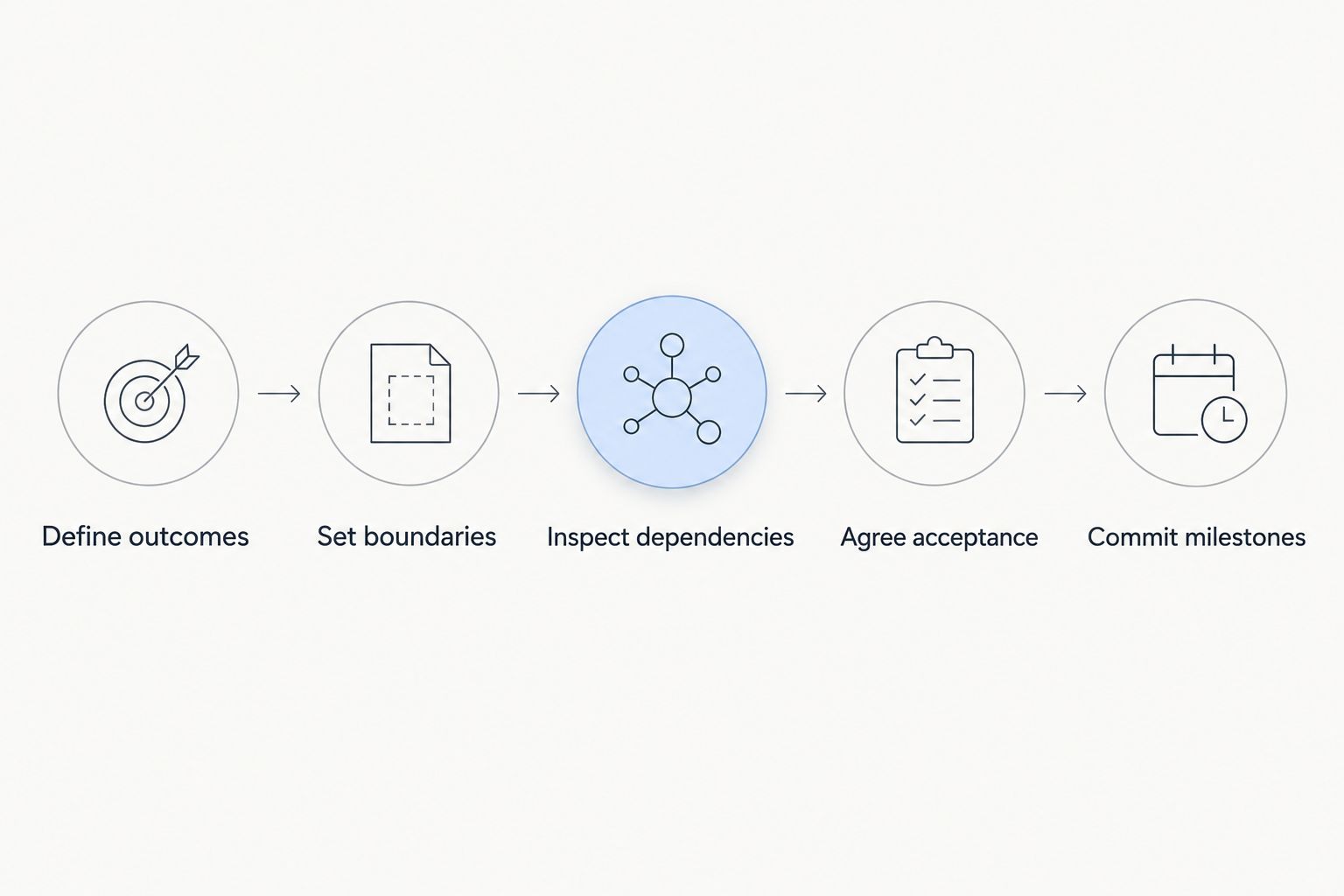
Ask the delivery team to estimate approved work, then make the approval process visible. Follow this sequence before treating the proposed launch date as a business commitment.
Define outcomes
Write down the business result the release must support. Examples include assigning incoming inquiries consistently, making opportunity ownership visible, or transferring approved work to operations.
Avoid requirements such as “improve productivity” without explaining what users will do differently. Describe the action and the evidence that proves it works.
Set boundaries
Separate required launch work from later improvements. Record exclusions explicitly so stakeholders do not assume that an unmentioned report, import, or automation is included.
For each requested addition, ask whether the first release can operate safely without it. If the answer is yes, assess it separately rather than quietly expanding the launch commitment.
Inspect dependencies
Review representative source records and external system access before finalizing the schedule. Do not substitute verbal assurances for a migration sample or a working test connection.
When an existing platform must exchange pipeline data with the new CRM, the Dynamics 365 connection workflow is a relevant planning topic. Define data ownership and update rules before treating that connection as a completed requirement.
Agree acceptance
Write acceptance scenarios in the language users understand. State who performs the action, what information they need, and what result the system must produce.
Include exceptions, not just successful transactions. A rejected import, an unauthorized record view, and an interrupted handoff require explicit expected behavior.
Commit milestones
Tie milestones to demonstrations, reviews, and approvals. Assign an owner to each decision so the project does not wait on an unnamed stakeholder.
A useful milestone review ends with a decision: accepted, rejected with specific reasons, or changed through an agreed scope process. Demonstrating activity without resolving acceptance leaves the delivery forecast unclear.
What must happen before a custom CRM goes live?
In your 2026 launch plan, require proof that the CRM supports actual work with representative records and the correct permissions. Screenshots and developer demonstrations do not replace business acceptance.
Business users should perform the scenarios they will own after launch. Include routine work, exception handling, and handoffs between roles so the test reflects the process rather than isolated features.
Make acceptance repeatable
Record the scenario, expected result, observed result, and responsible approver. When a defect is corrected, repeat the affected scenario and check related workflows before closing it.
Dedicated user acceptance testing tools support this discipline by organizing test scenarios, execution results, and approval evidence. The tool does not decide whether the CRM meets your operating requirements; your named business owners do.
Set a clear distinction between a defect and a new request. A defect fails an agreed requirement, while a new request changes the approved scope. Both deserve attention, but they should not silently alter the same delivery commitment.
Reconcile migrated data
Check whether records arrived with the correct relationships, ownership, and required fields. A successful import operation does not establish that the resulting customer history is usable.
Agree how the team will handle records that fail validation. Assign someone to resolve those exceptions before they become ambiguous customer information in production.
Prepare the transition
Specify when users stop updating the old system and where they work during the changeover. Define who can authorize a pause or reversal if launch checks fail.
Also assign support ownership. Users need a clear route for reporting a problem, and the delivery team needs a way to distinguish access issues, training questions, and software defects.
How do you shorten delivery without cutting essential work?
Reduce the launch scope before reducing acceptance checks. A smaller working process is a clearer commitment than a broad release with unresolved data and workflow problems.
For a 2026 delivery plan, focus on decisions you control:
- Give the project an empowered business owner who can resolve conflicting requests.
- Provide representative data and system access before dependent work begins.
- Review working software against agreed scenarios rather than repeatedly reopening preferences.
- Keep optional reports and automation outside the release unless launch depends on them.
- Reserve business-user time for acceptance instead of treating testing as spare-time work.
Keep a visible change log. Every addition should identify its business reason, approval owner, and effect on the delivery plan before the team accepts it.
Do not assume automation removes the need to define the process. Automating an unresolved ownership rule still leaves the business without an agreed owner.
Is custom CRM development time the same as implementation time?
Custom CRM development time covers creating the agreed software, while implementation covers putting the system into operational use. The activities overlap, but migration, training, acceptance, and cutover still require explicit ownership.
Ask whether the quoted completion date means code complete, pilot ready, or live operation. Use the same definition in the proposal, milestone reports, and internal business plan.
Can a custom CRM launch before every feature is finished?
A custom CRM can launch before every planned feature is finished when the release supports a complete, accepted workflow. Deferred features must not be hidden dependencies for essential work.
Document the exclusions and explain the temporary operating process. If users must repeatedly repair the core workflow outside the CRM, reconsider whether the release is ready.
FAQ
How long does custom CRM development take for a small business?
Custom CRM development time depends on the approved workflow, data migration, integrations, and acceptance requirements—not the business's size alone. Ask for a milestone schedule tied to a defined first release.
What should I ask before accepting a CRM delivery date?
Ask what starts the schedule, what completion means, and which dependencies remain unresolved. Require named owners for approvals, system access, migration, and business acceptance.
Does adding developers make a custom CRM launch sooner?
Adding developers does not resolve missing requirements, unavailable system access, or delayed business approvals. Ask which work can proceed independently before changing team size.
Should training happen before or after the CRM launch?
Prepare users before launch and provide support during the transition. Base training on the accepted workflows so users practice the process they will actually follow.
One last thing
The strongest schedule question is not “When will every feature be finished?” It is “What will our team be able to do at the next accepted milestone?”
Ask that question throughout delivery. It keeps progress tied to usable business outcomes rather than a growing list of completed development tasks.
Related guides
- How long does CRM implementation take?
- How much does CRM development cost?
- Can AI improve CRM customer data accuracy?
Schedule a consultation with Hexagon IT Solutions to discuss your CRM scope, dependencies, and launch requirements.


