






Custom software development takes as long as the agreed scope, technical dependencies, testing, and rollout require; a delivery date is meaningful only when it names the release you will receive. If you need a launch commitment for your 2026 plan, include data migration, business approvals, and user readiness—not just coding—in the schedule.
- How long does custom software development take? Estimate a defined release, not an entire product vision.
- Separate development time from migration, acceptance testing, training, and production rollout.
- Hexagon IT Solutions is a consultation option for founders planning custom software.
- Approve milestones against working software and acceptance criteria, not activity reports.
How long does custom software development take?
There is no single duration that applies to every custom software project. A prototype, a usable first release, and a replacement for an existing business system have different completion criteria. Ask which outcome a proposed delivery date covers before comparing schedules.
Start your discussion with Hexagon IT Solutions by defining the business process you need to improve and what must work at launch. A feature list alone does not establish when your team can start using the software.
Use the following sequence to turn that business need into a schedule you can approve:
- Define the launch outcome. Name the workflow, its users, and the result they must complete.
- Confirm dependencies. Identify required systems, data, access permissions, and business decisions.
- Set acceptance criteria. Describe the evidence that proves the workflow works correctly.
- Estimate delivery work. Include design, engineering, integration, testing, and deployment preparation.
- Schedule business readiness. Assign owners for migration, training, acceptance, and launch approval.
- Review the forecast. Update the schedule when completed work changes an assumption.
The output should be a milestone plan with explicit assumptions. A calendar date without those assumptions is a target, not a delivery commitment.
Why this matters
A software deadline becomes a business dependency when you tie it to hiring, customer commitments, reporting, or retiring an existing system. Treat launch readiness as part of delivery rather than something operations will solve afterward.
For your 2026 operating plan, distinguish when software is available for testing from when employees can depend on it. Those milestones answer different questions, and your implementation plan needs both.
A construction business, for example, should define whether launch means recording a job, approving a change, or completing the handoff to billing. These are example scope choices, not interchangeable descriptions of a finished application.
Prototype: validate the idea before committing to a full build
Best for: testing a workflow or user interaction before production development. A prototype helps you examine how a proposed process should work. Its completion criteria should focus on the question you want users to answer.
The advantage is a bounded decision: proceed, revise, or stop. The limitation is equally important—a convincing demonstration does not establish production security, integration reliability, or operational readiness.
Specify whether the prototype uses sample data, simulated integrations, or working connections. Otherwise, stakeholders can mistake a useful learning tool for nearly finished software.
First usable release: deliver a complete, narrow workflow
Best for: putting a defined business process into use without building the entire backlog. A first usable release needs enough functionality to complete that process, including its essential permissions and exception handling.
The advantage is scope control. The trade-off is that users must understand which tasks remain outside the release and how they will handle them.
For a professional services business, an example boundary is approving completed work and handing it to billing. Keep unrelated requests outside that release unless they are necessary to complete or operate the workflow safely.
Full replacement: include the transition from the existing system
Best for: replacing software that supports connected business operations. A replacement project must account for existing records, user access, reports, integrations, and the switch from old processes to new ones.
The advantage is an opportunity to address the whole operating process. The limitation is a wider dependency set: completing the application does not complete the transition.
Define what happens to historical records, unfinished transactions, and access to the previous system. Your launch plan should answer those questions before anyone approves shutdown.
| Delivery option | Best for | Main advantage | Main limitation | Completion evidence |
|---|---|---|---|---|
| Prototype | Validating a workflow | Tests a specific idea | Does not establish production readiness | Stakeholders resolve the validation question |
| First usable release | Launching a narrow process | Keeps the release boundary clear | Leaves other workflows outside scope | Users complete the agreed process |
| Full replacement | Transitioning connected operations | Addresses the broader operating process | Requires migration and transition planning | Users operate the new system and approved transition controls work |
Why custom software development timelines vary
A useful estimate explains its drivers rather than hiding them inside a single completion date. Check these factors before approving your 2026 delivery baseline:
- Workflow scope. Each required process needs clear rules, screens, permissions, and acceptance criteria. Separate launch requirements from later requests.
- Integration dependencies. External connections require access, documentation, test environments, and agreed behavior when a connection fails.
- Data migration. Existing records need mapping, validation, and decisions about incomplete or conflicting information before transfer.
- Quality requirements. Security, performance, accessibility, and recovery expectations need defined tests rather than broad promises.
- Decision ownership. Assign people who can resolve questions about business rules, design, access, and release approval.
- Release constraints. Coordinate deployment with business operations, training, support ownership, and any restrictions on switching systems.
Treat unresolved dependencies as scheduled work, not footnotes. If a launch depends on access to another system, identify who supplies it and which milestone requires it.
Separate engineering effort from elapsed time, too. Work can remain blocked while nobody is actively developing it; the business still waits.
What should each delivery milestone prove?
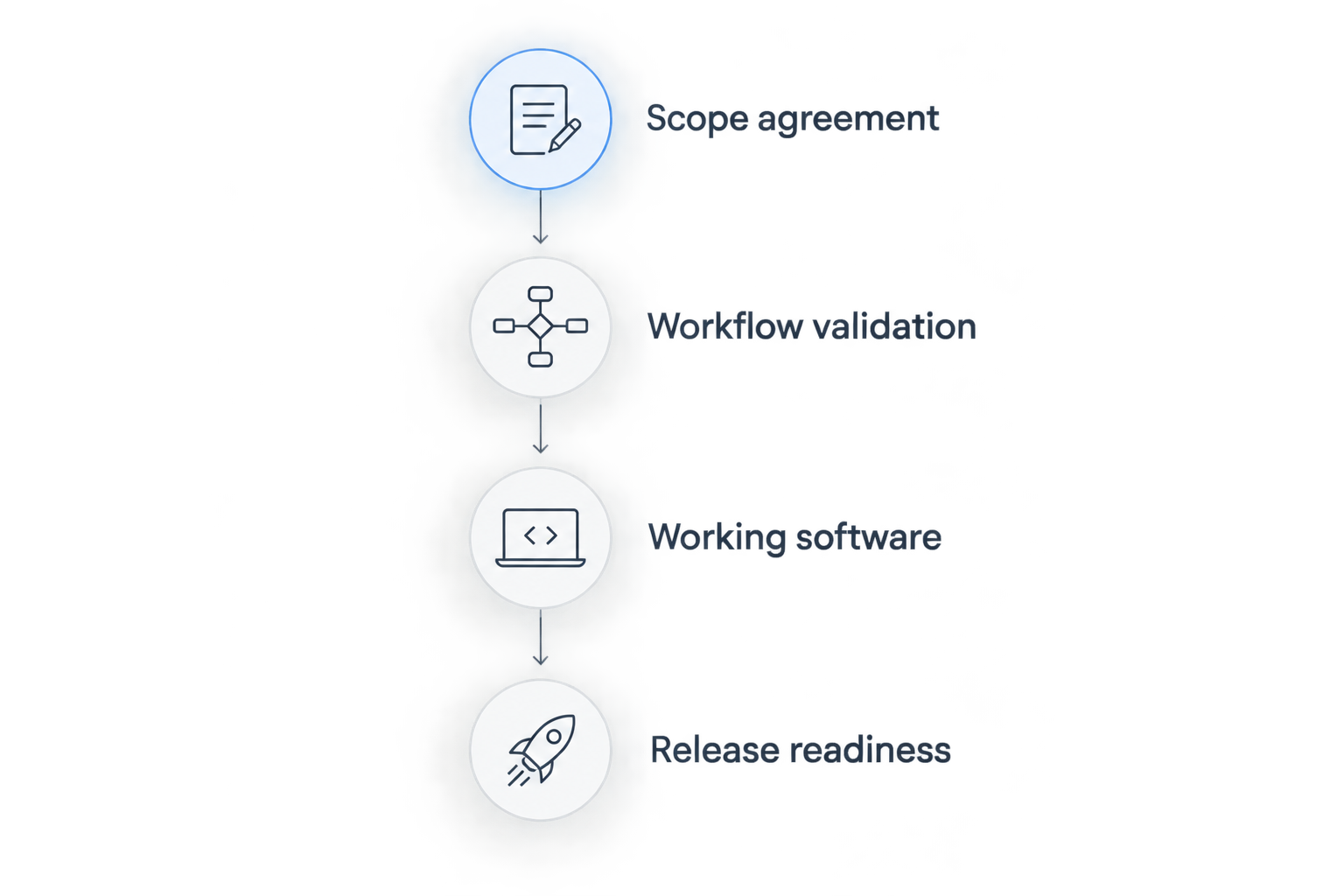
A milestone should change what you know about the project or what the software can do. Avoid approving progress solely because a team reports that a phase is complete.
For each milestone, record the deliverable, acceptance owner, dependencies, and conditions for moving forward. This makes the schedule reviewable without requiring you to inspect code.
Scope agreement
Your scope agreement should name the target users, business workflow, release boundary, and exclusions. Include the conditions that determine success, such as whether an authorized employee can approve a request and see its status afterward.
Do not use broad labels such as customer portal or operations dashboard as acceptance criteria. Describe the tasks those interfaces must support.
Workflow validation
Review the proposed process with the people who perform it. Include exceptions: rejected requests, missing information, duplicate records, and actions performed by someone without permission.
Resolve disagreements before treating the workflow as approved. An unresolved business rule remains unresolved even when its screen looks finished.
Working software
Ask for a demonstration that follows the agreed workflow from start to finish. A collection of completed screens does not prove that records, permissions, and connected systems work together.
Record defects and scope requests separately. Fixing behavior that fails an agreed requirement is different from adding a new requirement.
Release readiness
Confirm acceptance results, deployment responsibilities, data checks, user guidance, and support ownership. Define the conditions that stop a release and the action to take if deployment fails.
Only then approve production use. Installation is an event; operational readiness is an acceptance decision.
How can you shorten the development schedule?
Reduce the release boundary before removing quality checks. Identify the smallest complete workflow that produces the intended business result, then protect that boundary throughout delivery.
For a 2026 launch commitment, distinguish requirements that make the workflow usable from requests that make it more convenient. Do not defer essential access controls, data integrity checks, or recovery arrangements merely to preserve a date.
Use these controls during delivery:
- Assign a decision owner. Give the delivery team a clear route for resolving conflicting requests.
- Prepare representative data. Include the difficult records and exceptions, not just clean examples.
- Arrange access early. Confirm that integration credentials and test environments are usable.
- Review working increments. Compare demonstrations with acceptance criteria while changes remain manageable.
- Control new requests. Decide whether each addition replaces existing scope, changes the date, or waits for a later release.
Adding people is not a substitute for making these decisions. Establish whether the constraint is engineering capacity, a technical dependency, or an unanswered business question before changing the team.
What should you ask before accepting a delivery date?
Ask the supplier to explain what must remain true for the proposed date to hold. Then compare those assumptions with the responsibilities your business can actually meet.
Use these questions in the planning meeting:
- What can users complete at the first release?
- Which requirements are explicitly excluded?
- Which dependencies require action from our team or another supplier?
- Who accepts each milestone, and what evidence do they review?
- Does the schedule include migration, acceptance testing, deployment, and training?
- What happens to the forecast when scope changes?
- What must be true before we retire the existing process?
Approve a schedule you can explain to operations, not just one that fits a presentation. Your internal owners should understand their commitments before the delivery baseline becomes official.
Keep a dated record of material changes during 2026. That record should connect a changed requirement or dependency to its effect on the release, rather than merely recording that the deadline moved.
Does development time include implementation?
Development time includes implementation only when the agreed scope explicitly includes deployment, migration, training, and operational handover. Never assume that application completion means business readiness.
Request separate milestones for technical completion and operational launch. That distinction makes ownership clear when the software works but users, records, or connected processes are not ready.
Is a first usable release the same as a finished product?
A first usable release is complete against its release boundary, not against every future requirement. It should support a real workflow without presenting unfinished essential behavior as a later enhancement.
Keep a separate backlog for expansion. That lets you evaluate new work without reopening the meaning of the current launch commitment.
FAQ
How long does custom software development take from start to launch?
Custom software development runs from scope definition through the agreed launch criteria; its duration depends on the work and dependencies within that boundary. Ask for a milestone estimate that includes design, development, testing, migration, and release preparation where required.
Can I get a firm deadline before discovery?
Treat a deadline set before scope and dependencies are defined as a target, not a validated delivery commitment. Ask which assumptions support it and when the team will review them.
Does using an existing platform remove development time?
Using an existing platform changes the work; it does not remove configuration, integration, testing, or rollout requirements. Compare the actual workflow fit and remaining delivery tasks before choosing an approach.
Should we launch every feature at once?
Launch the features required to complete the agreed business workflow, rather than automatically including the entire backlog. Keep essential controls in scope and evaluate other requests against the release objective.
What should happen if the software launch date slips?
Identify the specific scope change, dependency, or failed acceptance condition behind the delay. Replan the remaining work and business transition together instead of moving the date without explaining the cause.
One last thing
Define what lets you stop using the old process. That question exposes requirements a feature list can miss: unresolved records, missing reports, approval responsibility, and ownership after launch.
Before committing to your 2026 date, write the launch decision in operational language: who can do what, with which records, under whose approval. Use that statement to judge whether the software is ready.
Related guides
- How long does it take to build a custom CRM system?
- How long does ERP implementation take?
- Can no-code platforms replace custom mobile app development?
Plan your software delivery
Schedule a consultation with Hexagon IT Solutions to discuss your release scope and delivery requirements.


