






You cannot set a reliable system integration deadline from the number of applications alone; the schedule depends on the workflows, data rules, access requirements and release conditions. Ask for a delivery date tied to validated scope—not a generic estimate in weeks or months. That date must include testing, business approval and production handover, not just the time needed to connect the systems.
- How long does a system integration project take? Scope, dependencies and acceptance criteria determine the delivery schedule.
- A working connection is not a finished integration; testing, reconciliation and production ownership belong in the plan.
- Separate the first usable workflow from the full rollout to make milestones easier to verify.
- Use a Hexagon IT Solutions consultation to discuss system integration scope before requesting a delivery commitment.
How long does a system integration project take?
A system integration project takes as long as its agreed delivery path requires: discovery, access, data mapping, development, testing and release approval. Some tasks overlap; others cannot start until a dependency clears. A credible estimate identifies that sequence and names the person responsible for each dependency.
For your 2026 project plan, distinguish integration from implementation. Connecting existing applications is a different scope from replacing an application, migrating its history and changing how teams work. The distinction also matters when reviewing how long ERP implementation takes.
Use the following milestones to assess whether an estimate covers the full job.
| Delivery stage | Work that belongs in the schedule | Evidence needed to finish |
|---|---|---|
| Discovery | Define the business event, systems and boundaries | Approved workflow and exclusions |
| Access | Obtain credentials, permissions and test environments | Verified access to required operations |
| Data mapping | Match fields, identifiers and business rules | Approved mapping and exception rules |
| Development | Build data movement and failure handling | Working workflow in a test environment |
| Validation | Check records, exceptions and business outcomes | Accepted test results and reconciliation |
| Release | Deploy, monitor and transfer ownership | Production approval and support handover |
This is a scoping checklist, not a duration benchmark. Ask your delivery partner to attach effort, dependencies and acceptance criteria to each applicable stage before committing to a launch date.
Why this matters
Your business needs an operational result, not a successful connection test. A signed contract that reaches project operations without its billing instructions still leaves work unfinished. An invoice that transfers twice creates a different problem.
For a 2026 business case, define the outcome before the integration method: remove duplicate entry, trigger an approved handoff or reconcile records between systems. Then specify how the business will confirm that outcome. This gives the delivery team a finish line and gives you a basis for accepting the work.
The distinction also prevents scope confusion. A request to connect sales and finance does not explain who owns customer records, which transactions move or how corrections travel back.
First workflow versus full rollout
Define separate milestones for the first usable workflow and the complete integration scope. They answer different questions: when the business can start using a connection, and when the agreed rollout is finished.
Neither approach is automatically right. Choose the release boundary around business dependencies and the ability to operate safely during the transition.
| Release approach | Best for | Advantage | Limitation |
|---|---|---|---|
| Bounded workflow release | A process that can operate independently | Creates a clear acceptance boundary | Other handoffs remain outside scope |
| Phased rollout | Workflows that can move in separate releases | Separates deployment decisions | Requires management of temporary mixed processes |
| Coordinated rollout | Processes that must change together | Keeps dependent changes within one release plan | Requires teams and systems to be ready together |
Bounded workflow release
A bounded workflow might send an approved job from sales into project operations. Define the trigger, required fields, receiving record and failure response before development begins.
Its strength is clarity. Its limitation is coverage: creating the job does not automatically include billing, document transfer or later amendments. Put those exclusions in the acceptance document.
Phased rollout
A phased rollout separates workflows that do not need to launch together. Customer records, project creation and financial transactions can have separate release decisions if their dependencies allow it.
The trade-off is transition work. Your team must know which system controls each process during every phase, including how to handle changes made before the next release.
Coordinated rollout
A coordinated rollout fits processes that cannot function correctly with only part of the change in place. Its schedule must include the readiness of every participating team.
Do not select this approach merely to produce a single launch announcement. Ask whether the business actually requires a shared cutover, and document what prevents independent releases.
Why system integration timelines vary
The integration method is only part of the schedule. These factors determine what the team must resolve before production approval:
- Workflow boundaries. Creating a customer record is a different requirement from synchronizing customers, contacts, projects and corrections.
- Interface access. Required operations need working credentials, permissions and a usable test environment. Track access requests as delivery dependencies.
- Data rules. Teams must agree on identifiers, required fields, duplicates and which system controls conflicting values.
- Synchronization behavior. Scheduled transfers, event-triggered updates and bidirectional changes require different handling and testing.
- Exception handling. Rejected records, expired credentials and interrupted transfers need defined recovery paths and owners.
- Approval and release constraints. Business validation, security review and operational restrictions belong in the calendar, not outside the estimate.
Ask which of these factors the estimate already resolves and which remain assumptions. An assumption with no owner or decision date is an unresolved scheduling dependency.
Avoid treating every requested field as equally important. Identify what the receiving team needs to complete the business task, then separate optional enrichment from required delivery scope.
How to get a delivery estimate you can use
A useful 2026 estimate connects technical work to business decisions. Follow this sequence before accepting a fixed completion date.
Define the outcome
Write the workflow in plain language: when an approved event happens in the source system, the destination receives the information needed for a named business task. Avoid starting with a list of software features.
Name the process owner as well. Someone must decide whether the resulting workflow actually supports the business.
Verify access
Confirm that the team can read and write the required records in a suitable test environment. Reviewing documentation is not the same as verifying access.
Record any outstanding permissions, account changes or third-party approvals. Keep their expected completion separate from development effort.
Agree data rules
Specify which system owns each shared field, how records match and what happens when values conflict. Include updates and deletions where they are part of the business requirement.
Use representative records rather than idealized examples alone. Include incomplete records, changed statuses and other conditions the workflow must handle.
Test exceptions
Define what happens when a transfer fails or the destination rejects a record. Decide who receives the alert, who corrects the issue and how the team safely resumes processing.
For example, retrying a request must not create an unintended duplicate transaction. Make that behavior an explicit acceptance test rather than an assumption.
Approve release
Agree on the production checklist, rollback conditions, monitoring and support ownership. Business acceptance must confirm the result in the destination, not merely confirm that the source sent a message.
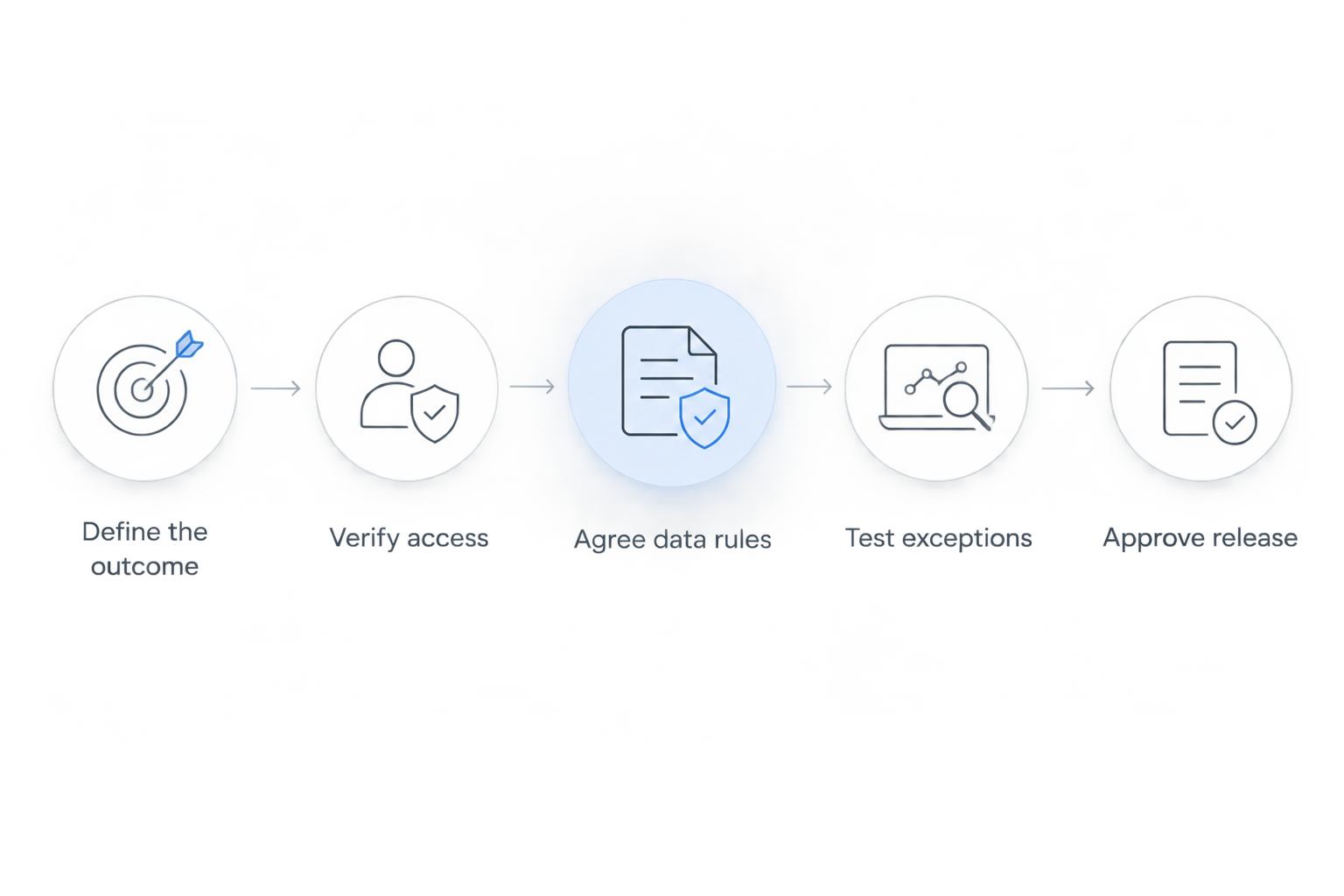
These checkpoints make an estimate reviewable. If access fails or a data rule changes, you can identify the affected work instead of debating the entire schedule again.
What should a written integration estimate include?
For a 2026 procurement decision, request a milestone plan rather than an isolated completion date. The document should make both the commitment and its conditions visible.
Include the following:
- Scope: named workflows, systems, record types and explicit exclusions.
- Dependencies: credentials, environments, sample data and external decisions.
- Responsibilities: delivery owner, business approver and source-system contacts.
- Acceptance: expected outcomes, reconciliation checks and exception tests.
- Release conditions: deployment approval, rollback criteria and monitoring ownership.
- Change control: how new requirements affect effort and completion dates.
Ask the team to distinguish working time from elapsed time. Development effort does not include every day spent waiting for access, answers or business approval unless the estimate explicitly accounts for those waits.
Request an explanation of parallel work, too. Mapping different records can proceed independently only when the relevant decisions and resources allow it; adding people does not remove a blocked dependency.
Hexagon IT Solutions is a consultation option for founders and IT buyers defining system integration scope. Use that conversation to establish boundaries and acceptance conditions; assess the proposed schedule against the written plan rather than treating the consultation as a delivery commitment.
Can a connector make the project faster?
A connector can remove the need to build a supported connection from scratch, but it does not define your business rules. Verify the required objects, fields, triggers and error behavior before assuming that the connector covers the workflow.
Choose the approach that fits the workflow, not the approach with the shortest setup demonstration. A successful demonstration does not establish how production exceptions, corrections or ownership will work.
| Approach | Best for | Advantage | Limitation |
|---|---|---|---|
| Existing connector | Workflows covered by its supported behavior | Reuses an existing connection mechanism | Business requirements must fit its capabilities |
| Custom integration | Requirements needing specific logic or control | Supports a deliberately defined workflow | Your plan must include development and ongoing ownership |
If the process crosses into project billing, review the workflow from PSA software to automated project billing when defining the handoff. Keep application setup, integration logic and financial acceptance distinct in your scope.
Does integration finish when data starts moving?
No. Data movement proves that a connection works under the conditions tested; production acceptance also requires correct records, recoverable failures and accountable ownership.
Check the destination against the source using the business rules you approved. Confirm that records have not disappeared, duplicated or landed with the wrong status. Test how the team investigates a mismatch without relying on the original developer to explain every step.
Then complete the handover. Support staff need access to logs, a recovery procedure and a clear escalation route. Without those, the business owns a live dependency without a usable operating process.
FAQ
How long does a system integration project take from kickoff to launch?
The schedule depends on validated scope, access, data rules, testing and release approvals. Request a milestone plan that includes business acceptance and handover, not just development.
Can we get an integration deadline before discovery?
Treat a pre-discovery deadline as conditional until the team verifies the workflow and its dependencies. Ask the estimate to list its assumptions and the decisions needed to confirm them.
Is connecting applications the same as implementing a new system?
No. Integration connects workflows or data between systems; implementation also concerns putting a system into business use. Define migration, configuration and process changes separately when they are required.
What should we prepare before an integration project starts?
Prepare a workflow description, process owners, representative records, interface documentation and an access plan. Agree on the business result and acceptance criteria before requesting a delivery commitment.
How do we shorten the schedule without skipping testing?
Reduce the initial scope to an independently usable workflow and resolve access and ownership decisions before development. Keep exception testing, reconciliation and release approval inside that smaller scope.
One last thing
For your 2026 launch decision, ask the team to demonstrate recovery—not just success. Have the team show what happens when a transfer fails, how someone finds the affected record and how processing resumes without an unintended duplicate.
A workflow is not ready for business ownership until someone can operate it when something goes wrong. Make that demonstration part of acceptance before signing off on production release.
Related guides
- How long does CRM implementation take?
- How long does supply chain software implementation take?
- How to connect Microsoft 365 to your custom ERP system
Schedule a consultation with Hexagon IT Solutions to discuss your integration scope, dependencies and release criteria.
Define your integration scope
Discuss workflows, dependencies and acceptance criteria before committing to a delivery date.


