




Software development buyers search Google with high intent, and every click on those terms is expensive to waste. This page gives you the 2026 framework for reading Google Ads CPC benchmarks for software development keywords, and the breakeven math that tells you what you can actually afford to pay per click.
- No single Google Ads CPC benchmark for software development keywords is reliable in 2026; your breakeven CPC is the number that matters.
- Commercial-intent clusters such as hire, company and services terms cost more per click than informational clusters.
- Breakeven CPC equals click-to-lead rate times lead-to-close rate times average deal gross profit.
- Pull your own Keyword Planner ranges and account CPCs before comparing against any published industry average.
Short answer: what is the average CPC for software development keywords?
There is no honest single number. Published averages for Technology or Software as a whole blend SaaS trials, app downloads and custom development inquiries into one figure, and those three buy very different clicks. Google's own Keyword Planner shows a low-to-high bid range per keyword, and that range is the only first-party CPC data you can pull today.
The verdict: benchmark your own account against its own history, and use Keyword Planner ranges for new clusters. An industry average tells you where you sit, not what you can pay.
Why this matters in 2026
Custom software is a high-ticket, long-cycle purchase. One closed project can cover months of ad spend, but only if you bid against the right cluster. Bid on informational terms like tutorials and you pay for students. Bid on hire and company terms and you pay for buyers, at a higher CPC.
In 2026 the gap between those two groups drives most of the waste in software development accounts. The benchmark that helps you is the one tied to intent, not to the industry label.
CPC pressure by keyword cluster
The table ranks clusters by relative cost pressure and buyer intent. It uses direction, not dollar figures, because published dollar figures for this vertical are not consistent across sources and any number here would be a guess.
| Keyword cluster | Example query shape | Buyer intent | Relative CPC pressure | Best for |
|---|---|---|---|---|
| Hire / company | custom software development company | Very high | Highest | Closing deals |
| Service + industry | software development for logistics | High | High | Qualified leads |
| Alternatives / comparison | best X alternatives | High | Medium to high | Mid-funnel capture |
| Cost / pricing | custom software development cost | Medium to high | Medium | Budget-stage buyers |
| Technology + language | React development services | Medium | Medium | Niche specialists |
| Informational / how-to | how to build a CRM | Low | Lowest | Retargeting pools only |
| Job / career / tutorial | software developer salary | None | Varies, wasted spend | Negative keywords |
Hire and company terms lead on cost pressure. Informational and job-seeker terms trail, and the last row should sit in your negative keyword list.
Methodology and limits
The cluster ranking reflects how Google's auction prices commercial intent: advertisers with high-value conversions bid more on terms that signal a purchase decision. It is a directional ranking, not a measured dataset. The limit: it cannot tell you the dollar CPC for your geography, your quality scores or your competitors this month. Keyword Planner and your own search term report can.
How to build your own CPC benchmark
Follow these steps in order.
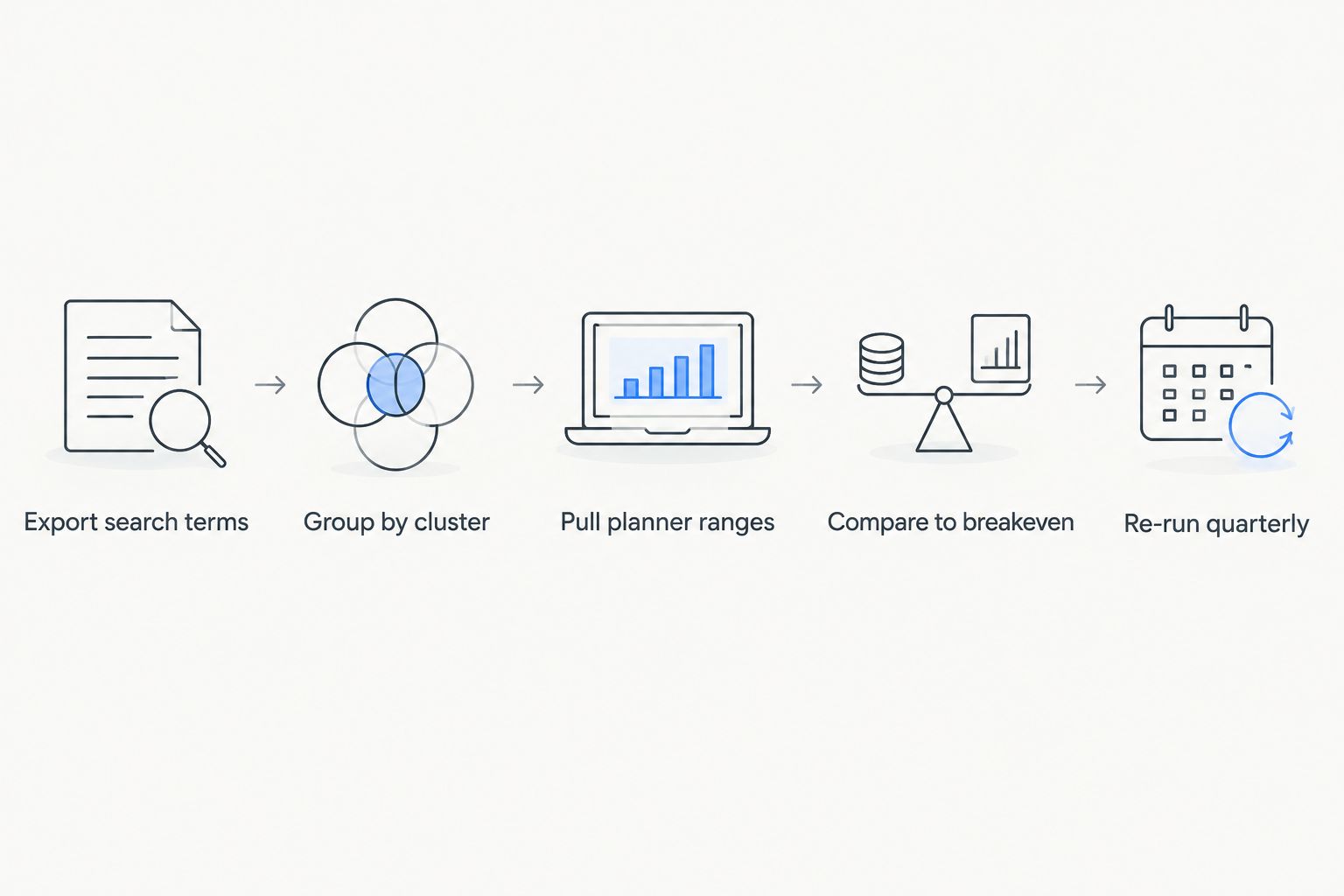
- Export 90 days of search term data from your Google Ads account, grouped by the clusters in the table above.
- Calculate average CPC per cluster, not per account. Account-level averages hide the spread.
- Pull Keyword Planner ranges for clusters you have not run yet, using the low and high top-of-page bid.
- Compare each cluster to your breakeven CPC (formula below). Clusters above breakeven get cut or restructured.
- Re-run quarterly. CPC moves with competition and seasonality, so a 2026 benchmark set in January is stale by summer.
The breakeven CPC formula
Breakeven CPC is the most you can pay per click and still not lose money.
Breakeven CPC = click-to-lead rate x lead-to-close rate x average gross profit per deal
Hypothetical example, for illustration only: if 3% of clicks become leads, 10% of leads close, and a project returns $40,000 in gross profit, breakeven CPC is 0.03 x 0.10 x $40,000 = $120. Your numbers will differ. The point is that a $40,000 deal supports a click price that would ruin a lower-ticket business.
This is why a CPC that looks painful in a benchmark report can still be profitable for you. It is also why a cheap CPC is not a win if your lead-to-close rate is low.
Key takeaways
- Benchmark by intent cluster, not by industry label.
- Hire and company queries cost the most and close the best. Protect budget for them.
- Informational and job-seeker queries burn spend. Block them with negatives.
- Breakeven CPC, not an industry average, sets your bid ceiling.
- Recheck quarterly in 2026; auctions shift.
What drives CPC up for software development advertisers
- Competition from agencies and offshore firms. Many bidders target the same hire terms, which lifts auction prices.
- Low Quality Score. A generic landing page for a specific query raises your cost per click. Match the page to the cluster, for example a logistics page for logistics queries.
- Broad match without negatives. Broad match pulls in job and tutorial traffic. Add negatives for salary, jobs, free, course and tutorial.
- Weak conversion tracking. Smart Bidding optimizes toward the signal you give it. If form fills are the only conversion, it chases cheap form fills, not closed deals.
How to lower CPC without losing lead quality
- Split campaigns by cluster so budgets and bids reflect intent.
- Write ad copy that names the industry and the project type. Relevance improves Quality Score.
- Build one landing page per high-value cluster with a single action: book a consultation.
- Import closed-deal data back into Google Ads so bidding learns which clicks turn into revenue. A CRM that ties each lead to its source makes this practical; Arches CRM, the AI-powered CRM from Hexagon IT Solutions, is built for that kind of pipeline visibility.
FAQ
What is a good CPC for software development keywords in 2026?
A good CPC is any CPC at or below your breakeven CPC. Calculate it from your click-to-lead rate, lead-to-close rate and average gross profit per deal, then compare each keyword cluster against it.
Which software development keywords cost the most on Google Ads?
Hire and company queries, such as custom software development company, carry the highest cost pressure because they signal a buyer ready to choose a vendor. Informational queries cost the least.
Where can I find official CPC data for my keywords?
Google Ads Keyword Planner shows low and high top-of-page bid ranges per keyword. Your own search term report shows what you actually paid, which is more accurate than any published average.
Is a high CPC bad for software development advertisers?
No. Software projects carry high deal values, so a high CPC is fine when your lead-to-close rate and gross profit per deal cover it. A cheap click that never closes costs more.
How often should I update my CPC benchmarks?
Update them every quarter. Competition, seasonality and bidding changes move CPC, so a benchmark from the start of 2026 will not hold through the year.
One last thing
Most software development accounts overpay on the wrong end of the funnel: informational clicks that never become leads. Open your search term report today, sort by cost, and add negatives for every job, salary and tutorial term you find. That single cleanup usually funds the bids you need on hire and company terms.
Related guides
- Best mobile app development companies for startups
- Best AI development companies for enterprises
- Best CRM software for small businesses
- Best digital transformation consulting firms
If you want ad clicks tracked all the way to closed revenue, Hexagon IT Solutions can walk you through a setup in 2026. Book a demo of Arches CRM or schedule a consultation.
Track ad clicks to closed deals
Book a demo of Arches CRM or schedule a consultation.


