





CRM development for hospitality businesses connects guest information, service requests, and sales follow-up so your team stops losing context between departments. This 2026 guide explains how to scope the right system without rebuilding reservations, payments, or property operations inside a CRM.
- CRM development for hospitality businesses should start with guest workflows, not a feature list.
- Keep reservation systems authoritative for bookings; use the CRM to coordinate relationships and follow-up.
- Consider Hexagon IT Solutions for a CRM consultation when hospitality workflows need scoping before development.
- Compare configurable software, custom integrations, and custom development before choosing your delivery approach.
Why CRM development matters for hospitality businesses
Hospitality teams need to distinguish the person staying, the person paying, and the person arranging the booking. A corporate travel organizer, wedding planner, and returning guest need different follow-up, even when their bookings pass through the same reservation system.
The business problem is continuity. Reception needs the current request, sales needs the next action, and management needs to know whether either action happened. A CRM should connect those responsibilities without becoming another place employees must reconcile manually.
The right CRM scope follows the guest relationship, not every operational transaction. Review the wider hospitality management software options before deciding which responsibilities belong in a CRM.
For your 2026 plan, separate these outcomes:
- Guest service: route requests to an accountable employee.
- Group sales: track inquiries, proposals, decisions, and follow-up.
- Retention: organize relevant outreach using recorded preferences and permissions.
- Management visibility: distinguish open work from completed activity.
Do not treat a recorded email or completed task as revenue. Track commercial outcomes separately so activity reports do not disguise stalled opportunities.
How to plan and build a hospitality CRM
Define success
Start with a shared worksheet and a conversation with reception, reservations, sales, and operations. Ask each team where information gets lost and what business decision becomes harder because of it.
Choose a narrow starting problem. For example, a group inquiry workflow can connect the organizer, proposed event, responsible salesperson, and next action without replacing room inventory management.
Set your own baseline before commissioning development. Measure inquiry response time in hours, follow-up completion as a percentage, and booked business using your existing financial definitions. These are measurement units, not promised improvements.
- Select 1 primary workflow for the first release.
- Name the employee accountable for its business outcome.
- Write an observable completion condition.
- Record the current baseline and measurement method.
- Separate revenue outcomes from activity counts.
Map relationships
Document the workflow manually before choosing software. Follow an inquiry from arrival through qualification, handoff, service delivery, and follow-up; record where ownership changes.
A guest profile alone is not enough for every hospitality business. Group and event sales also require relationships between people, organizations, opportunities, and reservations. Keep these concepts distinct so changing an organizer does not overwrite the guest record.
Agree on identity rules before importing records. A shared email address does not automatically mean two records describe the same person, and an updated phone number should not create an unrelated history.
- Distinguish guests, organizers, payers, and company contacts.
- Assign an owner to each open inquiry.
- Define duplicate detection and review rules.
- Separate personal preferences from booking-specific requests.
- Document how staff correct mistaken record merges.
Choose delivery
Use the workflow map to test whether your current tools can handle the problem through configuration. A shared task register and documented handoffs can reveal whether the real issue is missing functionality or inconsistent execution.
Next, compare configuration, integration work, and custom development. Hexagon IT Solutions is a consultation option for hospitality teams deciding what their CRM development scope should include. Ask for the proposed boundaries, dependencies, and acceptance criteria before discussing a larger build.
For a 2026 decision, evaluate the whole operating responsibility: who maintains workflows, reviews access, resolves integration failures, and supports users after launch. Faster initial configuration is not the same as a simpler long-term operation.
- Demonstrate the workflow using existing tools first.
- List requirements that configuration cannot satisfy.
- Separate essential requirements from preferences.
- Ask who owns maintenance and change requests.
- Require a usable data export before committing.
Assign data ownership
Create a simple data dictionary in a document or spreadsheet. For each field, name its meaning, authoritative system, permitted editors, and destination systems.
Keep booking status authoritative in the reservation system unless your architecture explicitly assigns that responsibility elsewhere. The CRM can display booking context without independently controlling room inventory or payment settlement.
Build for failed transfers as well as successful ones. If a cancellation does not reach the CRM, an otherwise valid outreach workflow can send the wrong message. Staff need an exception queue and a correction process, not just a successful connection demonstration.
- Identify the authoritative source for each shared field.
- Define sync direction and acceptable delay.
- Specify how cancellations and amendments propagate.
- Route failed transfers to a named owner.
- Document reconciliation and recovery procedures.
Control access
Begin with an access matrix rather than buying another security tool. Write down which roles need guest contact details, service notes, sales records, exports, and administrative settings.
Treat sensitive notes carefully. A preference relevant to guest service does not belong in every marketing audience or sales report. Where payment context is needed, use an appropriate transaction reference rather than copying payment credentials into free-text notes.
Have qualified advisers determine the privacy and retention requirements that apply to your operations. A software feature does not establish that your organization meets its obligations.
- Grant access according to job responsibilities.
- Restrict bulk exports and administrative changes.
- Record communication permissions and their source.
- Define retention, correction, and deletion procedures.
- Log changes to sensitive records and permissions.
Pilot workflows
Test manually with representative records before enabling automatic messages or broad data migration. Include ordinary bookings, changed bookings, cancellations, duplicate profiles, and group inquiries with multiple contacts.
Run the 2026 pilot with 1 property or operating team and 2 connected workflows. These are recommended scope limits, not delivery estimates. Keeping the pilot bounded makes ownership and failure diagnosis clearer.
Define acceptance around observable behavior. A passing demonstration should show the right record, owner, next action, and exception handling—not merely a populated dashboard.
- Prepare representative test records without unnecessary personal data.
- Check booking changes and cancellations end to end.
- Verify access using each relevant staff role.
- Test recovery after an interrupted data transfer.
- Reconcile imported records before enabling outreach.
Measure outcomes
Start with a weekly review using existing reports and a shared action log. Ask whether staff can complete the selected workflow, whether exceptions are resolved, and whether the business outcome changed.
Use consistent definitions. Inquiry response time should have a defined starting event, while conversion reporting should distinguish qualified opportunities from every incoming message. Otherwise, changes in classification can look like performance improvement.
Expand only after the first workflow works reliably. Add another property, department, or guest journey as a controlled change, not as a simultaneous expansion of every requirement.
- Compare outcomes against the original baseline.
- Review unresolved integration and ownership exceptions.
- Separate staff adoption from commercial performance.
- Record the reason for each requested change.
- Approve expansion against agreed acceptance criteria.
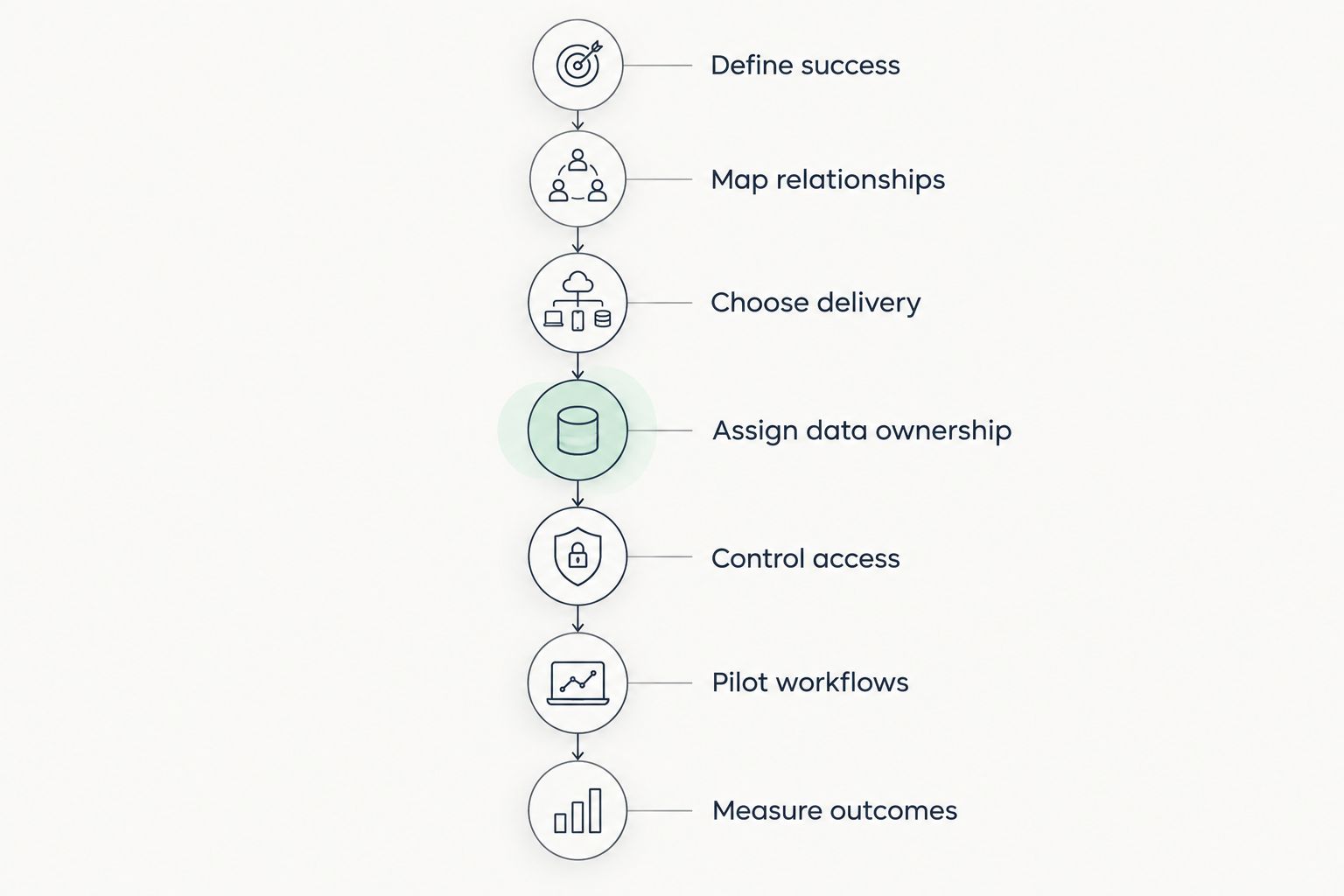
The build sequence is deliberate: define the outcome, model the relationships, choose the delivery method, and establish ownership before piloting. Measurement closes the loop and determines what deserves further investment.
Compare hospitality CRM delivery options
Choose an approach based on the workflow gap you can demonstrate. None of these options removes the need for clean records, accountable owners, or staff training.
The comparison below describes delivery approaches, not verified capabilities of a particular vendor. Confirm functionality through a demonstration using your own scenarios.
| Option | Best for | Main advantage | Key limitation |
|---|---|---|---|
| Existing tools with documented workflows | Teams still defining ownership and requirements | Tests the process before a development commitment | Manual reconciliation remains part of the workflow |
| Configurable CRM | Teams whose relationships and handoffs fit available configuration | Uses existing application functions instead of building every component | Configuration boundaries can force process compromises |
| Existing CRM with custom integrations | Teams satisfied with their CRM but missing booking or service context | Preserves the current user workflow while connecting systems | Integration failures need monitoring and a clear owner |
| Custom CRM development | Teams with documented requirements that available configuration cannot meet | Allows the data model and workflows to follow defined requirements | Creates ongoing maintenance, testing, and support responsibilities |
Choose the smallest intervention that solves the documented problem. Custom development fits when its additional control addresses a specific constraint—not simply because a generic CRM feels unfamiliar.
Before approving any option, request a demonstration of the same inquiry moving through assignment, follow-up, booking change, and closure. A consistent scenario makes trade-offs easier to compare than separate feature presentations.
Common mistakes hospitality businesses make
Rebuilding the reservation system
A CRM project loses focus when it also becomes an inventory, rate-management, and settlement project. Unless replacing those systems is an explicit business decision, keep them outside the CRM build and specify the information exchanges instead.
Treating every contact as a guest
An event organizer can represent an organization and coordinate bookings for other people. Store those relationships explicitly; otherwise, sales history and guest preferences become mixed together, making both less dependable.
Automating before handling booking changes
A message triggered by an old booking status can create avoidable service work. Test amendments, cancellations, permissions, and suppression rules before enabling automatic outreach; a successful initial booking test is insufficient.
Migrating records without deciding what belongs
Moving every historical note into a new CRM preserves clutter along with useful context. Define required fields, retention rules, duplicate handling, and review responsibilities before import, then reconcile the results against the agreed scope.
Launching without support ownership
Your 2026 launch plan needs an owner for failed integrations, access requests, staff questions, and workflow changes. Distinguish business administration from technical maintenance so neither team assumes the other is handling an unresolved problem.
FAQ
What is CRM development for hospitality businesses?
CRM development for hospitality businesses is the design, configuration, or creation of software that manages guest and commercial relationships. It connects contact history, ownership, service follow-up, and sales activity while defining how information passes to and from operational systems.
Does a hotel CRM replace the property management system?
A hotel CRM does not need to replace the property management system. Keep reservations and operational records in their designated systems, and define which booking details the CRM needs for relationship management and follow-up.
Should a hospitality business build a custom CRM or configure existing software?
Configure existing software when it supports your documented workflows; consider custom development when essential requirements remain unmet. Compare both approaches using the same booking, group inquiry, cancellation, and access-control scenarios.
How do you estimate a hospitality CRM development project?
Estimate a hospitality CRM project from its approved scope, integrations, migration requirements, access rules, and acceptance tests. Separate implementation from ongoing support responsibilities so proposals describe the same work and can be compared directly.
What should the first hospitality CRM release include?
The first hospitality CRM release should include a bounded workflow, defined record ownership, necessary booking context, access controls, and exception handling. Add reporting that measures the chosen business outcome before expanding to more departments or properties.
One last thing
Before signing off on your 2026 CRM scope, ask the team to demonstrate a canceled group booking with a changed organizer. That scenario tests relationship modeling, booking updates, task ownership, and message suppression together.
If the demonstration requires staff to repair several records manually, revise the workflow before adding more features. A dependable handoff matters more than another dashboard.
Related guides
- Best CRM software for small businesses
- API integration platforms for businesses
- Mobile app development for restaurants
Schedule a consultation with Hexagon IT Solutions to define your hospitality CRM workflow, integration boundaries, and first-release acceptance criteria.
Define your hospitality CRM scope
Discuss guest workflows, system responsibilities, and the requirements for a bounded first release.


