






No—AI cannot replace the full role of a custom software developer in 2026, even when it produces working code. If you are deciding whether to hire developers or build with AI alone, separate code generation from responsibility for requirements, security, integrations and production failures.
- Can AI replace software developers? Not across the full custom software development lifecycle.
- AI-assisted development suits bounded tasks with clear requirements and independent review.
- AI-only prototypes demonstrate ideas; working screens do not establish production readiness.
- Keep a named engineer responsible for architecture, permissions, testing and releases.
Why this matters
Your business needs a dependable workflow, not just an application that opens. A construction approval tool, for example, must handle rejected requests, changed permissions and incomplete records—not only the successful submission shown in a demo.
The wrong comparison is developer headcount versus generated code. Compare the effort required to deliver, verify, operate and change the software. Use the same scope when reviewing custom software development costs; otherwise, you compare a prototype with an operating system your business depends on.
AI can take over coding tasks; that does not make it accountable for a software product. Your buying decision should preserve that distinction.
Can AI replace custom software developers?
AI can generate functions, suggest tests, explain unfamiliar code and draft changes. Those capabilities overlap with development work, but custom software development also includes deciding what to build, resolving conflicting requirements and accepting responsibility for how the application behaves.
A generated implementation can satisfy a prompt while missing the actual business rule. A request to let managers approve expenses, for example, leaves unanswered which managers qualify, whether they can approve their own expenses and what happens after an approval changes.
For a 2026 development decision, compare delivery approaches against the work you need completed—not against the amount of code they produce.
| Approach | Best for | Main advantage | Main limitation | Decision |
|---|---|---|---|---|
| Developer-led work without generated code | Tasks requiring deliberate investigation or tight control over every change | Keeps reasoning and implementation directly connected | Requires manual drafting even for repetitive code | Use where the task justifies it |
| Developer-led, AI-assisted work | Clearly scoped changes with tests and accountable review | Provides drafts that engineers can inspect and revise | Generated output still needs verification | Use with explicit review gates |
| AI-only building | Disposable experiments using non-sensitive data | Lets you explore a workflow before committing to production | Leaves business decisions and operational responsibility with you | Keep outside critical production workflows |
These are workflow choices, not guarantees of quality. A developer can make mistakes, and an AI-assisted team can release defective software. What matters is whether your process exposes mistakes before they affect customers, staff or financial records.
What would count as replacement?
Replacing a developer means transferring the role's responsibilities, not merely completing a coding exercise. Someone must establish acceptance criteria, evaluate design choices, control access, approve releases and respond when the system fails.
Before removing an engineering role, identify who takes over each responsibility. If the answer remains your founder, operations manager or outside contractor, the work has moved rather than disappeared. Include that transferred workload in your decision.
AI-assisted development: keep engineering ownership
AI-assisted development is best for defined tasks whose output an engineer can independently check. Examples include drafting a data transformation, explaining a legacy function or proposing tests for a documented rule.
Start with the business result. If your sales team needs a reliable handoff to operations, define the required information, ownership changes and failure handling before asking for an implementation. Generating a form does not settle those decisions.
The advantage is practical: an engineer receives material to review instead of beginning every task with a blank file. The limitation is equally practical: plausible code can contain incorrect assumptions, and reviewing unfamiliar output is work.
For your 2026 delivery plan, require the team to identify where AI contributes and where a person approves the result. Do not accept an unspecified productivity claim as a delivery commitment.
Useful tasks to delegate include:
- Drafting: Generate an initial implementation from an approved specification.
- Explanation: Summarize code so an engineer can investigate it.
- Test suggestions: Propose normal, boundary and failure cases for review.
- Documentation: Draft instructions that the team checks against actual behavior.
None of these tasks removes the need to verify the result. A test that repeats the implementation's mistaken assumption is not independent evidence that the business rule is correct.
AI-only building: keep experiments separate from production
AI-only building is best for exploring an idea you can discard without disrupting the business. Use fictional records and a restricted environment to test whether a proposed workflow makes sense.
Imagine a professional services firm exploring a project intake form. A prototype can help staff discuss the questions, approval sequence and information they need. That is useful before commissioning a production application.
The limitation appears when the prototype starts handling real client records or making operational decisions. You now need answers about access, backups, error handling and support—regardless of how the interface was built.
Before promoting an experiment into production, require an engineering review. Treat the prototype as evidence about the desired workflow, not proof that the underlying implementation is safe to operate.
Do not confuse a convincing demonstration with a completed delivery. A successful demonstration shows one path through the system; production responsibility includes the paths that fail.
Why the answer varies by project
The replacement question becomes more useful when you ask which responsibilities a particular project contains. These factors determine what your review process must cover:
- Requirement clarity: Written rules give reviewers something concrete to test. Unresolved exceptions require business decisions, not additional code generation.
- Data sensitivity: Customer, employee and financial records require deliberate decisions about access, handling and tool use.
- Integration behavior: Connected systems introduce authentication, record mapping, retries and conflicting updates.
- Failure consequences: A broken demonstration and a failed payment workflow demand different release controls.
- Existing system constraints: Legacy code, undocumented behavior and shared databases require investigation before changes.
- Maintenance ownership: Every production application needs someone responsible for updates, incidents and future modifications.
In a 2026 project brief, describe these factors before choosing the development approach. The relevant distinction is not whether AI can write the code; it is whether the team can verify the whole result.
A small application can still carry serious risk. An internal approval form that changes payment authorization deserves more scrutiny than a larger informational website with no sensitive transactions.
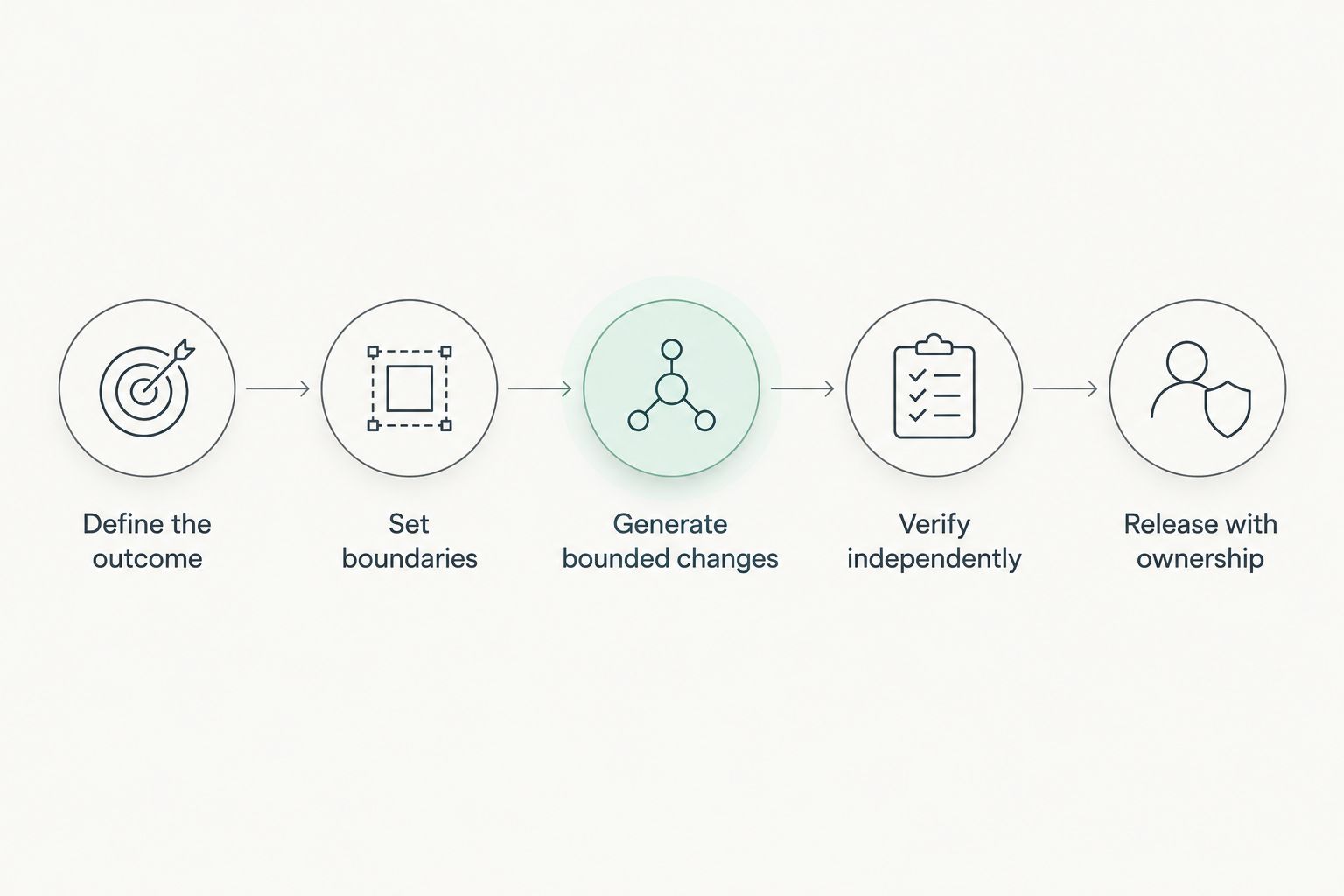
How should you use AI without losing control?
Use a repeatable sequence that connects each generated change to a business requirement. Keep approval authority with people who understand the workflow and the technical consequences.
1. Define the outcome
Write the operational result before listing features. For a construction change-order workflow, specify who submits a request, who approves it and which event permits downstream work.
Name the business owner who resolves disagreements. Developers and AI systems should not silently decide your approval policy.
2. Set boundaries
Identify permitted data, connected systems and actions the application can perform. Keep credentials and sensitive records out of unapproved tools.
Document prohibited actions as clearly as permitted ones. For example, a user who can view an estimate should not automatically receive permission to approve it.
3. Generate bounded changes
Break implementation into changes small enough for meaningful review. Ask for the assumptions behind each change and check those assumptions against the approved requirements.
Do not treat a large generated patch as evidence of progress by itself. Reviewable work is more useful than a growing volume of unexplained code.
4. Verify independently
Test the business rule separately from the generated implementation. Include rejected actions, missing information, duplicate submissions and unavailable integrations.
Assign 3 review gates: business acceptance, technical review and release approval. These are recommended controls, not a promise that any process eliminates defects.
5. Release with ownership
Name the person who approves deployment and the person who responds to incidents. Confirm how to observe failures and reverse a faulty release before it reaches users.
A release is not complete because deployment succeeds. Your team also needs usable documentation and a clear route for reporting problems.
How do you judge whether AI actually helps?
Measure the complete delivery process rather than accepting a claim about faster typing. Use your own project records and keep the definition of completed work consistent.
Track 3 measures: delivery time in days, review effort in hours and production defects per release. These are measurement choices, not industry benchmarks. Establish your baseline before making a staffing decision.
Include correction work in the comparison. If a change takes less time to draft but more time to inspect and repair, the initial saving does not describe the full result.
Also check whether completed work passes business acceptance. A technically functioning feature that fails the approved workflow still requires correction.
For a 2026 sourcing decision, request evidence tied to a defined scope: what changed, how it was checked and who accepted it. Avoid judging teams by generated lines of code or the number of prompts they use.
Can a nontechnical founder build an app with AI?
Yes—a nontechnical founder can use AI to develop a prototype and clarify a proposed workflow. That does not establish that the application is ready to handle sensitive data, customer commitments or business-critical operations.
Use the prototype to make requirements concrete, then obtain technical review before production use. Keep the freedom to experiment separate from the authority to release.
Do you still need developers for integrations?
Yes—production integrations need someone responsible for data mapping, authentication, failure handling and changes in connected systems. AI can draft integration code, but a successful connection does not prove that records remain correct during failures.
Ask what happens when a request times out after the destination has already accepted it. The answer should explain how the application avoids duplicate actions and establishes the final state.
What should you ask a development partner?
When discussing custom software with Hexagon IT Solutions, ask for a delivery plan that separates generated work from accountable engineering. Request the same clarity from any provider you assess.
Your evaluation should establish:
- Who approves requirements and resolves business-rule questions.
- Who reviews generated code and checks dependencies.
- How the team tests permissions and failure scenarios.
- What evidence supports release approval.
- Who owns maintenance and incident response after launch.
Treat unclear answers as unresolved delivery risks. A proposal should make ownership explicit, whether the team uses AI extensively, selectively or not at all.
FAQ
Can AI replace software developers completely?
No—AI does not replace the full responsibility of software developers. Generating code is different from deciding requirements, verifying security, managing releases and maintaining a production system.
Is AI-generated code safe for a business application?
AI-generated code requires review and testing before business use. Check permissions, data handling, dependencies and failure behavior against the application's requirements rather than assuming safety from a successful demonstration.
Should I hire developers or use AI to build my MVP?
Use AI to explore a disposable prototype; assign engineering ownership when the MVP serves real users or handles sensitive data. The decision depends on what the application does and the consequences of failure, not the MVP label.
Will AI reduce my custom software development budget?
AI does not guarantee a smaller total development budget. Compare drafting effort, review, corrections, testing and maintenance across the same agreed scope.
What should I ask a developer who uses AI?
Ask which tasks use AI, what data enters those tools and who approves the output. Require a clear explanation of testing, release approval and support ownership.
One last thing
Ask a developer to demonstrate a failed operation, not just a successful one. A rejected approval, interrupted synchronization or unauthorized request reveals whether the team has designed the boundaries of the workflow.
Before replacing a role, write down who inherits its responsibilities. If that list has gaps, code generation has not solved your delivery problem.
Related guides
- Custom software development for transportation companies
- Connecting property management software to QuickBooks
- AI development services for financial services firms
Schedule a consultation with Hexagon IT Solutions to discuss your workflow, technical risks and engineering ownership.
Discuss your software development plan
Bring your workflow and requirements to a consultation about scope, risk and delivery ownership.


