






Yes—AI-powered CRM tools can predict customer churn by learning patterns associated with customers leaving, then scoring current accounts for risk. The prediction is a probability, not a confirmed cancellation or an explanation of its cause. For your 2026 retention plan, the real test is whether those scores identify customers early enough for your team to take a useful action.
- Can AI CRM predict customer churn? Yes, but historical validation must show that its risk scores are useful.
- CRM churn prediction needs consistent customer records, dated activity, and a clear definition of a lost customer.
- Compare predictive scoring with simple rules before adding model complexity.
- A churn alert needs an accountable owner, a relevant response, and a measurable retention outcome.
Why this matters
A customer leaving is a business outcome. A warning score is only an input to a decision. If your sales or service team cannot explain what to do after an alert, prediction adds another queue rather than a retention process.
Start with the customer record. The relationship between AI and CRM customer data accuracy matters because duplicate accounts, missing renewal dates, and inconsistent cancellation records undermine both reporting and prediction.
Your 2026 buying decision should depend on validated warnings and workable follow-up—not an AI label.
Can AI CRM predict customer churn?
Yes. A predictive model can use historical customer behavior and known outcomes to estimate which current customers are at risk of leaving. The CRM can present that estimate alongside account information, provided the implementation supports the required data connections and scoring workflow.
The process has distinct steps:
- Define churn. Specify the event you want to predict, such as cancellation, nonrenewal, or the end of an ongoing service relationship.
- Set the prediction horizon. Decide how far ahead your team needs a warning to intervene.
- Assemble historical records. Connect account activity to the outcome that followed it.
- Train and validate. Learn patterns from earlier records and test predictions on later, unseen outcomes.
- Route the warning. Assign a next action to someone who can investigate and respond.
- Measure the result. Track predictive performance separately from the effect of the retention action.
These steps distinguish prediction from a summary. A generated account summary can describe recent complaints; that alone does not establish that the system can estimate future churn accurately.
Define the customer outcome before selecting technology
Your definition of churn determines what the model learns. In a subscription business, a cancellation event and a failed renewal payment represent different problems. For professional services, a completed project is not automatically a lost customer.
Write the outcome in business language before translating it into a database field. Specify which accounts qualify, when the event occurs, and how you handle customers who return.
Include these decisions in your 2026 requirements:
- Account boundary: Decide whether churn applies to a customer, contract, subscription, or business location.
- Outcome date: Use the date that matches the business event, not whichever timestamp is easiest to export.
- Observation period: Define which historical activity the prediction can use.
- Action window: Leave enough time between the warning and the predicted event for a response.
- Exclusions: Separate planned project completion, duplicate records, and administrative account closures from genuine customer loss.
Without a consistent definition, a technically correct model can answer the wrong business question. Your operations and finance teams should agree on the definition before model development starts.
Which approach fits your retention process?
Predictive scoring is not the only way to identify an account that needs attention. Compare it with simpler approaches using the same customer outcomes and the same follow-up capacity.
| Approach | Best for | Main advantage | Main limitation |
|---|---|---|---|
| Rules-based alerts | Teams with clear, observable warning signs | Easy to inspect and connect to a specific action | Misses patterns outside the rules you define |
| Predictive churn scoring | Teams with usable historical outcomes and connected account data | Evaluates combinations of signals rather than isolated triggers | Requires validation, monitoring, and reliable data |
| Account-owner review | Complex relationships with important context outside systems | Captures commercial details that records do not explain | Depends on consistent documentation and human judgment |
Use rules as a baseline, not as an obstacle to AI. If a simple renewal reminder identifies the same actionable accounts as a model, the model needs to demonstrate additional value.
Human review also has a defined role. An account owner can distinguish a planned seasonal pause from unexpected disengagement, but that judgment needs to be recorded so the wider team can use it.
Why churn-prediction reliability varies
There is no universal accuracy figure for AI CRM churn prediction. Reliability depends on the customer population, the event being predicted, the available history, and the evaluation method.
The main drivers are:
- Outcome consistency: Mixed definitions of cancellation and inactivity create conflicting training examples.
- Historical coverage: The model needs examples of the outcomes it is expected to distinguish.
- Signal timing: Information recorded after cancellation cannot support an honest advance warning.
- Connected records: Usage, support, billing, and relationship activity need a dependable link to the correct account.
- Business change: New contracts, onboarding processes, or customer segments can change the relationship between behavior and churn.
- Operational capacity: A useful alert must arrive while someone has time and authority to respond.
More fields do not automatically produce better predictions. An irrelevant or incorrectly dated field can add noise, while a reliable renewal date can support a straightforward retention action.
What data should you connect?
Start with records that describe the customer relationship and its outcome. Add a data source because it answers a specific business question—not because it is available.
Commercial history establishes what the customer purchased, whether the relationship continues, and which renewal or termination terms apply. Contract changes also help distinguish customer loss from a change in scope.
Engagement history shows observable participation, such as product activity, onboarding completion, or attendance at agreed account reviews. Interpret inactivity in context: a product designed for occasional use should not be judged like a daily workflow.
Service history captures unresolved issues and the progress toward resolution. A high ticket count alone does not explain whether the relationship is deteriorating or the customer is actively adopting the service.
Billing history helps separate commercial dissatisfaction from payment processing problems. Keep sensitive information restricted, and use only the fields needed for the retention purpose.
For your 2026 data review, assign an owner to each source and document its refresh timing. A score based on stale inputs should not appear current merely because the CRM displays it today.
How do you test whether the predictions work?
Test the system against future outcomes it could not see during development. A chronological split is important because a retention team makes decisions using information available at that moment—not records added afterward.
Prevent information leakage
Information leakage occurs when a model receives clues that would not exist at prediction time. Cancellation processing notes, closed-account statuses, and refund records entered after departure can make a model look accurate without making it useful.
Ask for a timestamp-level explanation of the evaluation. Every input should have been available before the prediction was supposed to occur.
Use metrics that match the decision
Do not accept a headline accuracy claim without its definition. A model that mostly predicts customers will stay can appear accurate when departures are uncommon while failing to identify the accounts you need to contact.
Review these measures together:
- Precision: Of the accounts flagged, how many actually experienced the defined churn event?
- Recall: Of the accounts that churned, how many received a warning?
- Calibration: Do predicted probabilities match observed outcomes for comparable scored groups?
- Lead time: Did the warning arrive before the team lost its opportunity to act?
- Alert workload: Can the account team investigate the flagged accounts without neglecting existing responsibilities?
There is a trade-off between catching more at-risk accounts and generating more false alarms. Choose the operating threshold around your follow-up capacity and the consequences of a missed warning.
Separate prediction from retention impact
A correct prediction does not prove that an intervention prevents churn. Some flagged customers will stay without outreach; others will leave despite a well-executed response.
Where practical, compare eligible accounts receiving the intervention with a suitable control group. Define the outcome before the comparison starts, and distinguish renewed revenue from activity measures such as calls completed.
Match the warning to the reason for risk
A risk score tells your team where to investigate. It does not establish why a customer is leaving or which response will change the outcome.
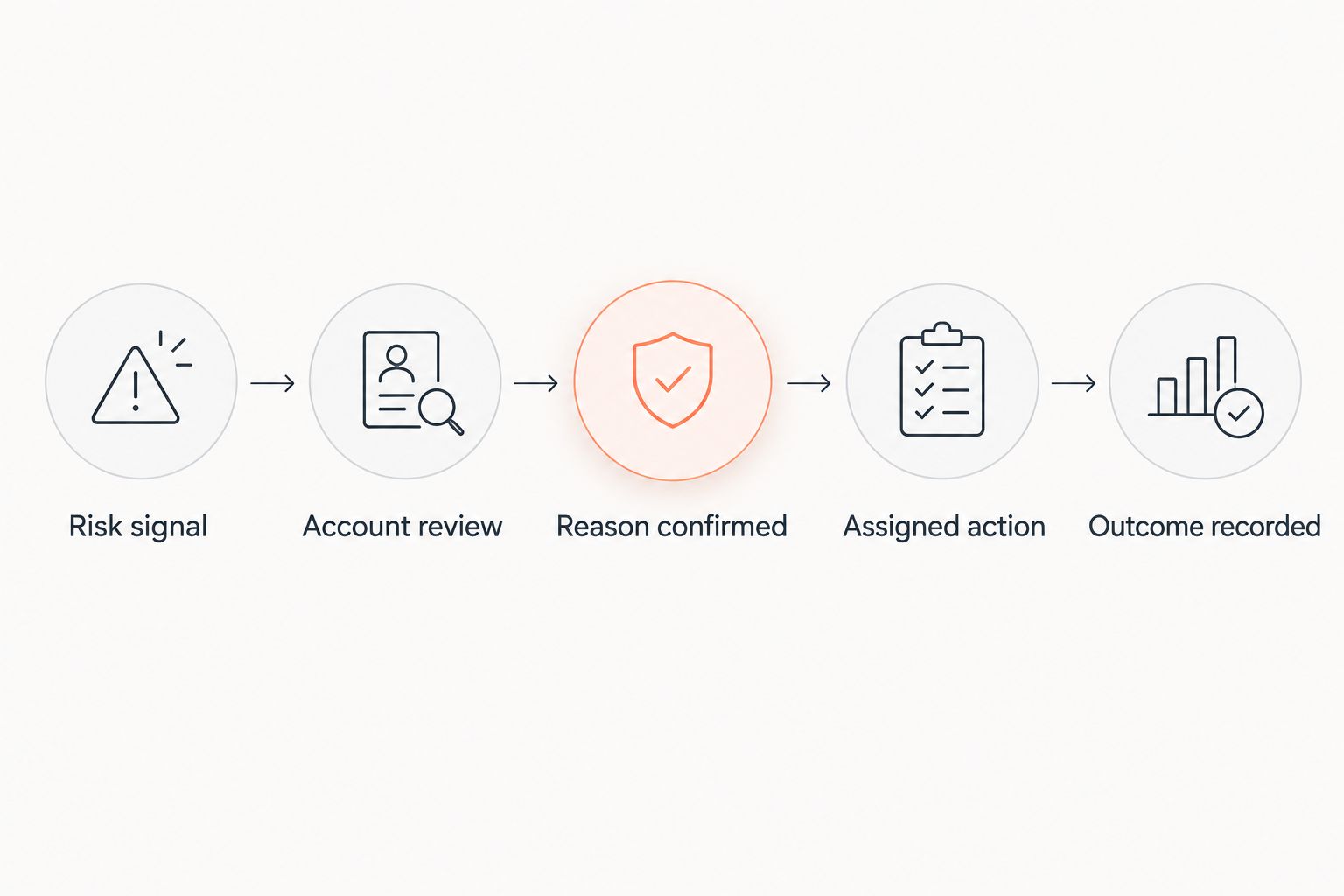
Use an investigation path that separates the warning from the diagnosis and the action:
- Risk signal: Identify the behavior or record that triggered review.
- Account review: Check the context and confirm that the underlying data is current.
- Reason confirmed: Record the issue supported by the conversation or operational evidence.
- Assigned action: Give a named owner responsibility for the next step.
- Outcome recorded: Capture what happened without assuming the intervention caused it.
For example, a payment failure calls for a different response from an unresolved service complaint. Treating failed subscription payments as confirmed customer dissatisfaction would confuse a billing problem with an intent to leave.
The same distinction applies to declining engagement. Your team should establish whether the customer is blocked, has changed its workflow, or no longer needs the service before selecting an intervention.
A churn score prioritizes attention; it does not diagnose the relationship. Avoid sending an automated retention message solely because a probability crossed a threshold.
Put ownership and safeguards around the workflow
For a 2026 rollout, begin with a controlled operating process rather than an unattended automation. Let account owners inspect the warning, confirm the context, and record whether the recommended action fits.
Define who owns each decision:
- The business owner approves the churn definition and retention objective.
- The data owner resolves missing records and identity mismatches.
- The account owner investigates the warning and chooses the response.
- The technical owner monitors scoring failures and changes in model performance.
Give staff a way to challenge a score without deleting the evidence. An override should capture a reason so you can distinguish a data problem from an exception or a flawed assumption.
Access controls matter too. A retention workflow should not expose sensitive billing or support information to everyone who can view an account. Confirm permissions, permitted uses, and record handling before connecting sources.
Can you start without a predictive model?
Yes. Start with rules when your warning signs are clear or your historical churn records are incomplete. Renewal follow-up, unresolved onboarding issues, and overdue account reviews can support useful workflows without a probability score.
Keep the outcomes. Consistent records of warnings, actions, and customer decisions create a better foundation for evaluating predictive scoring later.
Does a high churn score mean you should offer a discount?
No. A high churn score is not evidence that the customer objects to the commercial terms. Investigate the reason first; a service issue, missing capability, or payment failure requires a response matched to that problem.
FAQ
Can AI CRM predict customer churn accurately?
AI CRM can estimate churn risk, but accuracy must be demonstrated on your own defined outcomes and unseen historical periods. Review precision, recall, calibration, and warning lead time rather than accepting a single headline score.
What customer data does AI need to predict churn?
Churn prediction needs dated customer records linked to a consistent churn outcome. Relevant inputs can include contract history, engagement, support activity, and billing events, subject to appropriate permissions.
Is an AI churn score the same as a customer health score?
No. A churn score estimates the probability of a defined future event, while a customer health score can combine selected indicators without estimating that probability. Ask how each score is built and validated.
Can a small business use AI for customer retention?
A small business can use predictive retention tools when its records and outcomes support a meaningful evaluation. When that foundation is missing, rules-based follow-up and consistent account records are a more practical starting point.
Will AI automatically prevent customers from leaving?
No. AI can prioritize accounts for attention, but retention depends on diagnosing the issue and delivering an effective response. Measure the effect of the intervention separately from the quality of the prediction.
One last thing
A successful intervention creates a measurement problem: the customer who stayed might have left without help. Do not automatically label every retained, high-risk customer a false alarm; evaluate the warning and the intervention separately.
Hexagon IT Solutions is a consultation option for business leaders scoping CRM and integration requirements. Bring a written churn definition, a sample of dated account records, and the retention workflow you want to improve—not just a request for an AI feature.
Related guides
- Is a custom CRM better than off-the-shelf software?
- How long does CRM implementation take?
- Can AI handle enterprise business intelligence tasks?
Schedule a consultation with Hexagon IT Solutions to discuss your CRM requirements and retention workflow.


