






Disconnected systems leave your team re-entering data, chasing failed handoffs and questioning reports; Accenture is the default enterprise shortlist pick, IBM Consulting fits hybrid environments, and Deloitte fits integration tied to operating-model change. This 2026 guide compares the best system integration companies by project fit and shows you what to require before signing.
- The best system integration companies match your architecture, business workflow and support requirements—not just your software brands.
- Accenture is the enterprise shortlist default; IBM Consulting fits hybrid environments; Deloitte fits process-led transformation.
- Capgemini suits application modernization discussions; Cognizant suits integration connected to ongoing application services.
- Require a working pilot, named delivery owners and documented failure recovery before approving a wider rollout.
Why this matters
A connection that transfers data is not necessarily a working business process. Your sales order still needs the correct customer, approval status, accounting treatment and exception owner when it reaches the next system.
For an SMB or mid-market buyer, the first decision is scope—not vendor size. A Hexagon IT Solutions consultation is an option for defining that system integration brief before you compare proposals.
The 2026 shortlist below separates different buying situations. The ranking is a fit-based starting point, not a claim that one company wins every integration project.
What makes the best system integration companies?
Use these criteria before comparing presentations or proposed technology:
- Business ownership: The proposal identifies the workflow, its accountable owner and the business result it must produce.
- Architecture fit: The design addresses your actual applications, interfaces, identity controls and data locations.
- Data integrity: Mapping rules explain identifiers, duplicates, conflicting updates and which application owns each field.
- Failure recovery: The delivery plan covers rejected records, retries, alerts and safe replay without duplicate transactions.
- Delivery accountability: Named people own design decisions, testing, cutover and acceptance—not just account management.
- Operational handover: Your team receives access, documentation and a clear support boundary after launch.
The best integration partner makes exceptions visible and ownership explicit. A polished demonstration without those controls does not establish production readiness.
System integration companies at a glance
These companies have established technology consulting or application-services practices. The table identifies the buying conversation each belongs in; it does not promise a particular project team, contract scope or outcome.
| Company | Best for | Relevant practice area | Contract boundary to clarify |
|---|---|---|---|
| Accenture | Enterprise-wide integration programs | Technology transformation and systems integration | Responsibility across applications and delivery teams |
| IBM Consulting | Hybrid environments | Hybrid cloud and application transformation | Existing-system dependencies and platform ownership |
| Deloitte | Process-led transformation | Technology implementation and business consulting | Process redesign versus technical delivery |
| Capgemini | Application modernization | Application services and cloud transformation | Migration, coexistence and integration sequencing |
| Cognizant | Integration with ongoing application services | Enterprise applications and application management | Build-to-support handover and service ownership |
There is no universal budget winner. Compare proposals against the same workflow and acceptance requirements rather than treating a company name as a cost category.
1. Accenture: best for enterprise-wide system integration
Accenture combines technology consulting, systems integration and transformation services. Put Accenture on the shortlist when your integration work crosses business units and requires coordination beyond an individual application.
Best for: Enterprise programs with multiple application owners and a central transformation sponsor.
The useful evaluation question is whether the proposed team can turn a broad transformation objective into an executable release plan. Ask Accenture to separate business dependencies, application changes and integration work so you can see what determines the schedule.
Accenture pros to evaluate:
- Broad technology and business consulting scope.
- Relevance to programs spanning several enterprise functions.
- A suitable starting point for discussing cross-system delivery accountability.
Accenture engagement considerations:
- Specify whether the contract covers integration delivery alone or a broader transformation program.
- Identify the people responsible for your architecture and acceptance decisions before approving the engagement.
For a 2026 selection, request a walkthrough of your actual order-to-cash or service-delivery workflow. The walkthrough should explain what happens when an upstream application sends incomplete data—not just show a successful transfer.
Verdict: Hold until the proposed delivery team demonstrates end-to-end ownership.
2. IBM Consulting: best for hybrid-environment integration
IBM Consulting provides technology consulting, hybrid cloud and application transformation services. Include IBM Consulting when your project must connect existing enterprise systems with newer applications or cloud environments.
Best for: Buyers whose integration decisions depend on legacy-system continuity and hybrid architecture.
Begin with the systems you cannot replace. Ask the proposed team to explain how those systems expose data, how access is controlled and how operations continue during a connection failure.
IBM Consulting pros to evaluate:
- An established focus on hybrid cloud consulting.
- Application transformation services relevant to mixed environments.
- A useful candidate for architecture-led integration discussions.
IBM Consulting engagement considerations:
- Require a clear separation between consulting services, software decisions and operational responsibility.
- Document which existing dependencies remain after implementation and who maintains them.
Keep the discussion anchored to your business workflow. For example, a finance integration needs reconciliation and error ownership as well as a transport mechanism between systems.
Verdict: Hold until the architecture review demonstrates how existing systems stay operational.
3. Deloitte: best for process-led system integration
Deloitte combines business consulting with technology implementation services. Shortlist Deloitte when connecting applications is part of a wider change to finance, operations, reporting or management processes.
Best for: Organizations changing how work gets approved, measured and governed alongside the technology.
A process-led project needs agreement on the future workflow before developers encode it. Ask Deloitte to distinguish decisions your business must make from configuration and engineering tasks the delivery team will perform.
Deloitte pros to evaluate:
- Business consulting alongside technology implementation.
- Relevance to projects involving operating-model decisions.
- A useful option when functional leaders need to participate in system design.
Deloitte engagement considerations:
- Make technical acceptance criteria explicit alongside business-process deliverables.
- Assign an internal decision-maker for unresolved workflow and policy questions.
In a 2026 procurement, do not accept a process diagram as proof that the integration works. Require a demonstration that follows the data through approvals, posting, rejection and correction.
Verdict: Hold until process responsibilities and technical acceptance are both documented.
4. Capgemini: best for integration during application modernization
Capgemini provides consulting, application services and cloud transformation services. Include Capgemini when integration must support a transition between existing applications and their replacements.
Best for: Modernization programs that need old and new systems to coexist during delivery.
The central question is sequencing. Your integration design must explain which system owns each business record before, during and after migration; otherwise, a temporary connection can become a permanent source of conflicting data.
Capgemini pros to evaluate:
- Application services relevant to modernization work.
- Cloud transformation services alongside consulting.
- A suitable candidate for discussing migration and integration together.
Capgemini engagement considerations:
- Separate temporary migration connections from integrations intended to remain in production.
- Require retirement criteria for interfaces that should disappear after migration.
Ask for a cutover plan that names the authoritative application at every stage. Include the conditions that trigger rollback and the procedure for reconciling records created during the transition.
Verdict: Hold until coexistence, cutover and interface retirement are defined.
5. Cognizant: best for integration with ongoing application services
Cognizant provides technology consulting, enterprise application services and application management. Consider Cognizant when your buying decision includes both implementation and the operation of connected applications.
Best for: Organizations evaluating a continuing application-services relationship rather than a build-only engagement.
Treat support as part of the design discussion. Ask how incidents move between application support, integration support and your internal business owners when a transaction fails across systems.
Cognizant pros to evaluate:
- Enterprise application services relevant to connected workflows.
- Application management alongside implementation services.
- A useful candidate for discussing build-to-support continuity.
Cognizant engagement considerations:
- Define the exact boundary between fixing an interface and correcting source data.
- Keep access rights, configuration records and operational documentation available to your organization.
Your acceptance process should include a support handover exercise. Have the proposed support team diagnose a rejected transaction using the documentation and monitoring that will exist after launch.
Verdict: Hold until the support team can explain incident ownership without gaps.
How this shortlist is ranked
The order follows distinct procurement needs: enterprise coordination, hybrid architecture, process change, modernization and ongoing application services. Each company belongs to a different primary use case rather than competing for an identical “best overall” label.
These are established service categories, not findings from hands-on testing or a scored vendor benchmark. For your 2026 decision, score the proposed delivery team against the criteria above and ask each bidder for references relevant to your application environment.
How to validate a system integration proposal
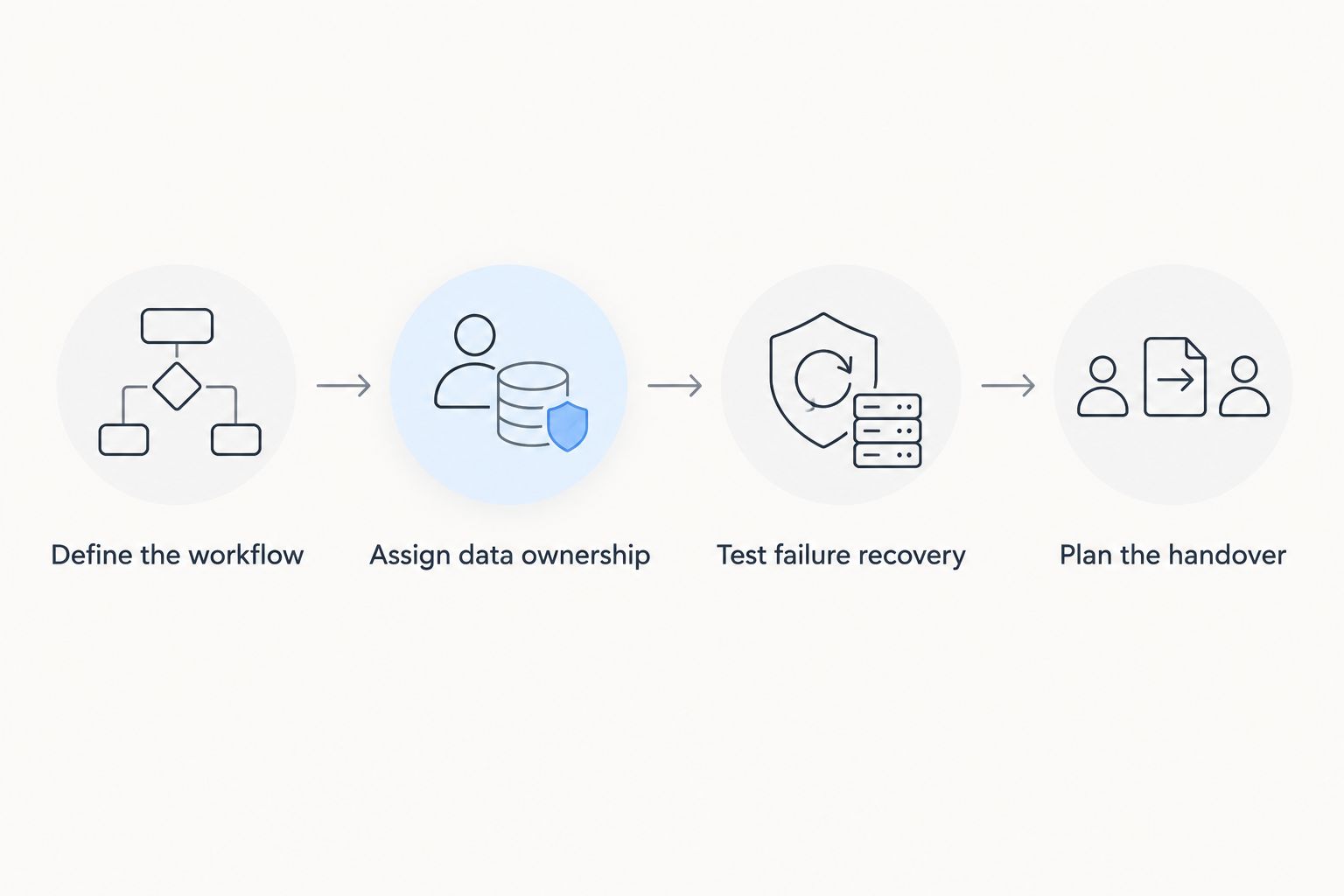
A proposal becomes useful when it describes observable behavior. Use the following sequence to turn a broad promise into a decision you can defend.
Define the workflow
Start with 1 workflow, such as converting an approved sales order into an accounting record. Specify its trigger, required fields, destination and business owner before adding adjacent processes.
Assign data ownership
Name the authoritative application for each shared field. Customer identity, payment status and delivery status do not automatically belong to the same system; write down how conflicting updates are resolved.
Test failure recovery
Require 3 test scenarios: successful processing, rejected data and replay after interruption. These are proposed acceptance tests, not claims about vendor performance. Confirm that replay does not create duplicate business records.
Plan the handover
Assign 2 owners: a business owner for transaction correctness and a technical owner for service operation. Both should approve the monitoring, escalation process and recovery instructions before launch.
Keep commercial comparisons aligned with that same scope. The API integration cost guide is a related planning resource; your proposal still needs to identify its assumptions, exclusions and change-control process.
Which system integration company should you choose?
Start with Accenture for a broad enterprise program, then change the shortlist when your dominant requirement points elsewhere. IBM Consulting belongs in hybrid-architecture discussions; Deloitte fits process-led change; Capgemini fits modernization; Cognizant fits ongoing application-services evaluation.
For an SMB with a narrow workflow, first establish whether you need a large transformation engagement at all. A tightly defined implementation brief gives you a better comparison than asking every bidder to redesign your entire operating environment.
The deciding evidence is a relevant team, an explicit scope and a working acceptance demonstration. Company reputation does not replace those checks.
FAQ
What's the best system integration company for my business?
The best system integration company is the one whose proposed team fits your workflow, architecture and support requirements. Accenture is a starting point for broad enterprise programs; compare other firms according to hybrid architecture, process change, modernization or application support needs.
Should a small business hire a large system integrator?
A small business should define the integration scope before choosing the size of its delivery partner. Compare a narrow implementation with a broader transformation engagement using the same workflow, acceptance tests and support requirements.
What's the difference between a system integrator and an integration platform?
A system integrator is a service provider; an integration platform is software used to connect applications and manage data flows. Buying the platform does not assign business ownership, resolve conflicting data definitions or establish a support process.
What should I ask a system integration company to demonstrate?
Ask the system integration company to demonstrate successful processing, rejected data and recovery after an interruption. Require evidence that replay avoids duplicate records and that support staff can identify the failed transaction.
How should I compare system integration proposals in 2026?
Compare 2026 proposals against an identical workflow and acceptance brief. Check delivery ownership, data mapping, failure recovery, handover, exclusions and change control before making the final selection.
One last thing
Ask who can safely replay a failed transaction after the project team leaves. That question connects architecture, documentation, access and support ownership in a way a successful demo does not.
If nobody has a clear answer, keep the project in evaluation. An integration is not finished when data moves; it is ready when your team can detect and resolve a failed business transaction.
Related guides
- How long does ERP implementation take?
- Connect Dynamics 365 to a custom CRM pipeline
- QuickBooks to automated ERP reporting workflow
Schedule a consultation with Hexagon IT Solutions to discuss your system integration requirements.
Discuss your integration requirements
Bring your application list, business workflow and ownership questions to the consultation.


