





You need to decide whether growth calls for a different ERP or a clearer operating model; NetSuite already brings financial management, inventory and order management into a cloud ERP. Among NetSuite alternatives in 2026, Hexagon IT Solutions is the best fit for a consultation before choosing software; Microsoft Dynamics 365 Business Central is the strongest shortlist candidate if you need an ERP connected to Microsoft's business applications.
- Compare NetSuite alternatives by accounting, operational and integration requirements, not feature counts.
- Microsoft Dynamics 365 Business Central fits an ERP shortlist built around Microsoft's business applications.
- Odoo suits businesses evaluating connected applications across sales, accounting and operations.
- Sage Intacct belongs on finance-led shortlists; a CRM alone does not replace an ERP.
Why this matters
An ERP decision changes how your business records revenue, fulfills orders and reports performance. Start with those outcomes. A product comparison becomes useful only after you identify which processes the replacement must own and which existing systems should remain.
Separate a whole-system replacement from a narrower improvement. A sales follow-up problem calls for a different evaluation than inventory valuation or multi-entity financial reporting. Construction businesses should also distinguish project delivery requirements from general accounting and purchasing requirements.
If production is central to your business, use the ERP software for manufacturing businesses guide alongside this shortlist. Manufacturing requirements deserve their own evaluation rather than a passing mention in a general ERP demo.
The right replacement solves your required workflows without creating an unclear boundary between systems. That is the decision standard for this 2026 shortlist, not a promise that one platform fits every growing business.
NetSuite alternatives at a glance
The options below are not interchangeable. One is a consultation route, two are broader business-system candidates, and one centers on financial management. NetSuite remains in the table so you can compare each route against the system you are considering replacing.
| Option | Best for | Standout capability or role | Relationship to NetSuite |
|---|---|---|---|
| NetSuite | Businesses seeking a cloud ERP across finance and operations | Financial management, inventory and order management | The ERP benchmark for this comparison |
| Hexagon consultation route | Leaders who need to define the replacement scope first | A consultation before committing to software | A decision-support route, not an ERP product |
| Microsoft Dynamics 365 Business Central | SMBs evaluating ERP within the Microsoft application ecosystem | Finance, purchasing, sales and inventory management | Another ERP candidate to evaluate against the same workflows |
| Odoo | Businesses evaluating connected applications across departments | Applications spanning CRM, accounting, inventory and other functions | An application-suite approach to business management |
| Sage Intacct | Finance-led teams prioritizing accounting and reporting | Cloud financial management and multi-entity consolidation | A finance-focused candidate rather than an equivalent operational scope |
Treat this as a selection map, not a substitute for a demonstration. The product capabilities described here are established categories; your required workflows, configuration and integration boundaries still need direct validation.
1. Hexagon IT Solutions: best for scoping the decision
A consultation is the first route to consider when your team has not agreed on what needs replacing. Before comparing software, identify whether you need a new ERP, changes to surrounding systems or a clearer division of responsibilities between applications.
Hexagon IT Solutions is best for business-systems consultation before you choose an ERP replacement. This recommendation concerns the decision process, not a claim that the company supplies a packaged equivalent to NetSuite.
Where the consultation route shines
- You can bring the business problem to the discussion before committing to a product category.
- You can make accounting, sales and operational requirements part of the same decision.
- You can ask which workflows should remain unchanged rather than assuming everything must move.
Where the consultation route falls short
- A consultation is not an ERP license or an operational system.
- You still need product demonstrations and a documented implementation plan.
- Advice does not replace internal ownership of requirements, approvals and acceptance testing.
| Decision dimension | Consultation route | NetSuite |
|---|---|---|
| What you are evaluating | A discussion about requirements and direction | A cloud ERP product |
| Immediate purpose | Define the problem and selection criteria | Assess software against those criteria |
| Accounting system | Not an accounting application | Includes financial management |
| Operational use | Planning rather than transaction processing | Supports business transactions |
Best for: Founders and operations leaders who need agreement on scope before selecting software.
Bring examples of an order, an invoice and a management report to the consultation. Concrete records make the discussion about business work rather than a list of desirable features. Verdict: Hold the software purchase until the replacement scope is clear.
2. Microsoft Dynamics 365 Business Central: best for Microsoft-centered ERP
Microsoft Dynamics 365 Business Central combines financial management with purchasing, sales and inventory capabilities. It belongs on your shortlist when you want an ERP and your application strategy already includes Microsoft business tools.
Evaluate the business workflow first. Familiar software names do not establish whether approvals, reporting or operational processes will work as your team requires.
Where Microsoft Dynamics 365 Business Central shines
- It covers accounting and operational functions within an ERP product.
- It has connections to Microsoft's business application ecosystem, including Microsoft 365.
- Its scope supports a comparison that extends beyond the finance department.
Where Microsoft Dynamics 365 Business Central falls short
- A Microsoft-centered application strategy is not a deciding advantage if your requirements lie elsewhere.
- Standard capabilities do not establish a fit for specialized construction or industry workflows.
- Connections between applications still need validation against your actual data and permissions.
| Decision dimension | Microsoft Dynamics 365 Business Central | NetSuite |
|---|---|---|
| Product category | ERP for small and midsize businesses | Cloud ERP |
| Finance | Financial management | Financial management |
| Operations | Purchasing, sales and inventory | Inventory and order management |
| Ecosystem emphasis | Microsoft business applications | NetSuite application ecosystem |
Best for: Growing businesses evaluating accounting and operations together within a Microsoft-centered application strategy.
For your 2026 evaluation, ask the demonstrator to process an actual purchasing or sales scenario and produce the resulting accounting entries. Then check who can approve, amend and report on that transaction. Verdict: Hold until the operational demonstration passes your acceptance criteria.
3. Odoo: best for an application-suite approach
Odoo provides business applications spanning CRM, accounting, sales, inventory and manufacturing. It belongs on the shortlist when your decision starts with which departmental applications to bring together, rather than an ERP name alone.
That breadth makes boundaries important. Decide which applications you will use, what information they share and which existing tools will remain authoritative.
Where Odoo shines
- Its application range supports evaluation across sales, finance and operations.
- Manufacturing and inventory applications make it relevant to an operational shortlist.
- Its application-suite structure gives you a clear basis for discussing departmental scope.
Where Odoo falls short
- A long application list does not prove that your end-to-end workflow is covered.
- Selecting applications creates decisions about configuration, shared records and ownership.
- You must confirm the edition, application combination and integrations used in the proposed solution.
| Decision dimension | Odoo | NetSuite |
|---|---|---|
| Product approach | Suite of business applications | Cloud ERP suite |
| Sales | CRM and sales applications | Customer and order-management capabilities |
| Finance | Accounting applications | Financial management |
| Operational evaluation | Application selection across inventory and manufacturing | ERP configuration and operational requirements |
Best for: Businesses that want to evaluate connected departmental applications and can define the scope clearly.
Ask for a demonstration that follows the same customer and order through every proposed application. Do not accept separate module demonstrations as proof that the complete process works. Verdict: Hold until the selected applications complete your workflow together.
4. Sage Intacct: best for a finance-led shortlist
Sage Intacct focuses on cloud financial management, including accounting, reporting and multi-entity consolidation. It is relevant when the replacement decision centers on finance and you have a defined plan for operational systems.
Where Sage Intacct shines
- Financial management is the central product focus.
- Multi-entity consolidation belongs in its finance evaluation.
- Its scope supports a focused discussion about accounting and reporting requirements.
Where Sage Intacct falls short
- A finance-led selection does not resolve every operational requirement.
- Inventory, fulfillment and project-delivery boundaries still need explicit decisions.
- You must validate the proposed connections to systems that remain outside finance.
| Decision dimension | Sage Intacct | NetSuite |
|---|---|---|
| Primary evaluation | Financial management | Finance and operational ERP |
| Accounting | Core focus | Part of the ERP suite |
| Multi-entity requirements | Consolidation evaluation | Consolidation evaluation |
| Operational boundary | Define surrounding systems | Assess ERP operational scope |
Best for: Finance leaders whose accounting and reporting requirements drive the selection.
Verdict: Hold until finance requirements and operational handoffs are both demonstrated.
Why businesses consider switching from NetSuite
Consider switching when a documented requirement points to a different system boundary or application strategy. That is a specific reason to evaluate alternatives; a general preference for newer software is not.
Use these decision triggers without assuming any platform has failed:
- Finance-led scope: You want to select financial management independently of operational applications.
- Microsoft alignment: Your business wants to evaluate ERP alongside its Microsoft application strategy.
- Application consolidation: You want to assess connected applications across departments.
- Workflow redesign: Your business processes have changed, and the proposed system must reflect them.
For each trigger, write down the required outcome and the demonstration that would prove it. For example, a consolidation requirement needs a reporting demonstration, while application consolidation needs proof that shared records remain consistent.
Do not confuse switching with improving. Your 2026 review should compare a replacement against a defined improvement plan for the existing environment. Both paths need accountable owners and acceptance criteria.
How to evaluate an ERP replacement without guessing
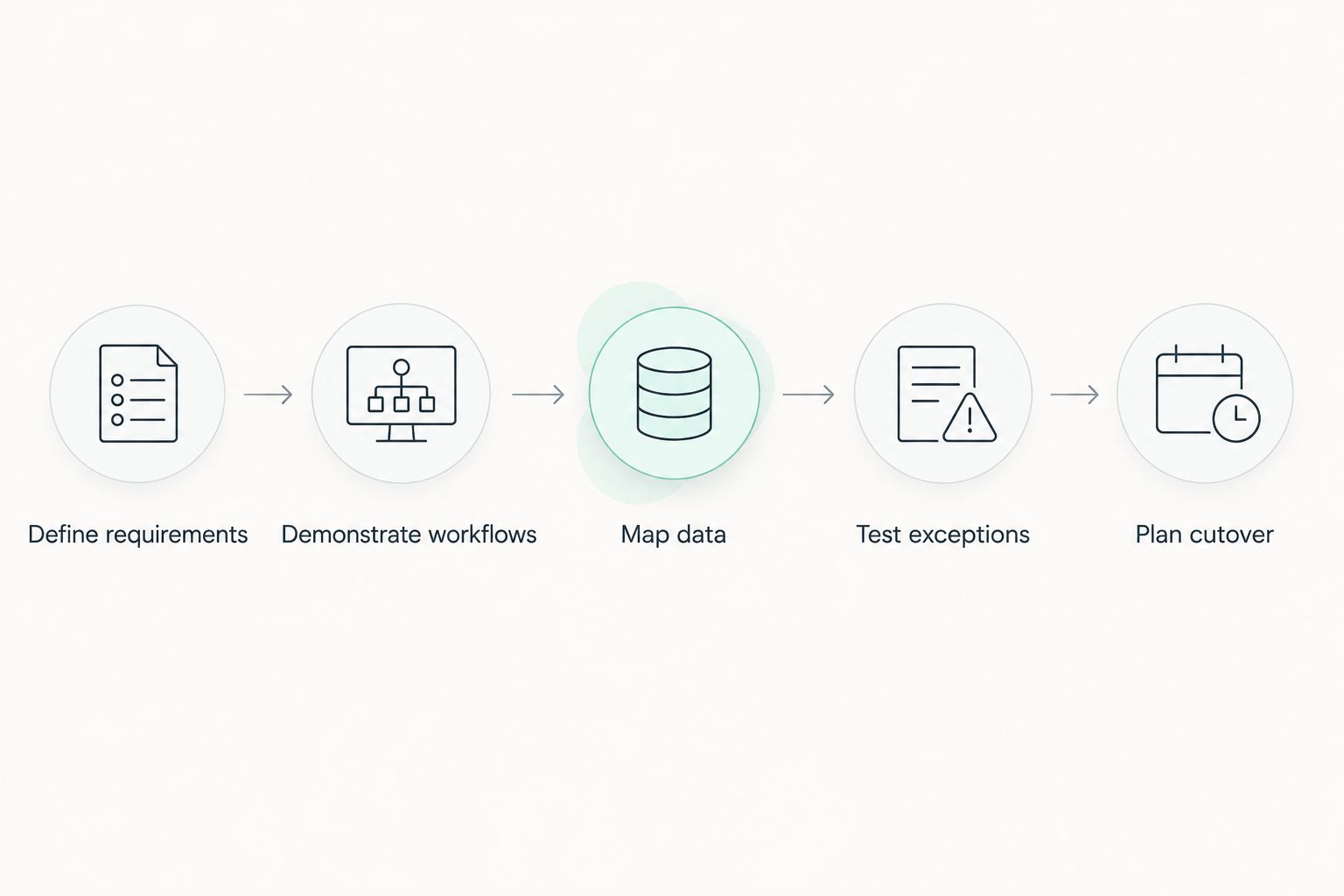
Use 3 business workflows as a recommended starting point: an order, a purchase and a period-end reporting process. These are evaluation exercises, not a claimed benchmark. Add industry-specific workflows where your business requires them.
Define requirements
Name the owner, inputs, approvals and required output for each workflow. Distinguish requirements from preferences. A requirement needs an acceptance test; a preference helps compare options that already pass.
Demonstrate workflows
Give each candidate the same scenarios. Ask the demonstrator to show transactions, exceptions and reports rather than explain them. Record unresolved questions separately from demonstrated capabilities.
Map data
Identify where customers, suppliers, accounts and open transactions live. Assign an owner to each record type. Agree which system becomes authoritative after migration.
Test exceptions
Include corrections, cancellations and approval changes in the demonstration. Use 5 acceptance checks: record accuracy, approval ownership, accounting impact, report visibility and exception handling. These checks make the decision observable rather than subjective.
Plan cutover
Define how you will reconcile migrated records and approve the transition. Consider 2 reporting cycles during testing to examine continuity between periods; adjust the plan to your accounting calendar and business requirements. Set the rollback decision before the production move.
For a 2026 migration plan, assign responsibility for every unresolved question. A feature marked as available is not the same as a workflow accepted by your business owner.
When staying with NetSuite is the right call
Stay with NetSuite when it meets your required workflows and the replacement case does not establish a better fit. Its cloud ERP scope remains relevant when you want financial management, inventory and order management within the same platform.
Separate product selection from configuration and process decisions. If the required outcome can be demonstrated in the existing environment, compare that path with migration before approving a replacement. Your business needs a working operating model, not a change of software for its own sake.
FAQ
What's the best NetSuite alternative for a growing business in 2026?
Microsoft Dynamics 365 Business Central is a strong shortlist choice when you need an ERP connected to Microsoft's business applications. Odoo fits an application-suite evaluation, while Sage Intacct fits a finance-led evaluation. Choose through demonstrated workflows rather than a universal ranking.
Is a CRM a replacement for NetSuite?
A CRM alone is not a replacement for NetSuite's ERP scope. Sales relationship management does not establish coverage for accounting, inventory or order processing. Decide whether your problem concerns sales execution or the broader operating system.
Should I compare Odoo with NetSuite?
Compare Odoo with NetSuite when you are evaluating connected applications across finance and operations. Define the Odoo applications in scope and demonstrate the same workflow in both proposed solutions.
When should I consider Sage Intacct instead of a broader ERP?
Consider Sage Intacct when financial management and reporting drive your selection. Define how operational systems will exchange information with finance before approving the architecture.
How do I know whether to stay with NetSuite?
Stay with NetSuite when it meets your documented requirements and the replacement case does not demonstrate a better fit. Compare an improvement plan for the current environment with the full replacement plan, including data migration and acceptance testing.
One last thing
The most useful demo is not the smoothest one. Ask the demonstrator to correct a transaction after approval and show what changes in the accounts and reports. That exercise makes responsibility, permissions and record integrity visible before you commit.
Related guides
- Business intelligence tools for enterprises
- API integration platforms for businesses
- CRM software for small businesses
Define your ERP replacement scope
Discuss your business workflows and requirements before choosing a replacement.


