





Your enterprise app needs to work with existing systems, protect business data, and remain maintainable after launch—not just pass a demo. Best overall for engineering-led delivery in 2026: Thoughtworks; best for transformation-wide programs: Accenture; best for product engineering: EPAM; best for IBM-centered estates: IBM Consulting; best for experience-led applications: Globant.
- Thoughtworks leads this best mobile app development companies for enterprises shortlist for engineering-led delivery.
- Accenture fits transformation-wide programs; IBM Consulting fits IBM-centered enterprise estates.
- EPAM fits product engineering; Globant fits experience-led mobile applications.
- Choose enterprise mobile app development partners using integration evidence, named teams, testing, and operational ownership.
Why this matters
A mobile app does not replace your operating model. If approvals, customer records, and inventory data remain disconnected, a better interface still leaves employees moving information manually.
Your 2026 selection should therefore start with the business workflow, not a preferred framework. Before scheduling vendor presentations, define what must improve: fewer duplicate entries, faster approvals, clearer customer handoffs, or better field access. You can bring that workflow to a consultation with Hexagon IT Solutions rather than beginning with a feature wishlist.
The shortlist below separates different buying situations. The right partner for a company-wide transformation is not automatically the right partner for a focused employee application.
What makes the best enterprise mobile app development company?
Judge enterprise mobile development partners against these six criteria before comparing proposals:
- Workflow fit: The proposed team understands the transaction you need to complete, who owns it, and what happens when it fails.
- Integration depth: The architecture identifies systems of record, authentication, data ownership, and dependencies—not simply a list of APIs.
- Security ownership: Responsibilities cover access controls, local storage, secrets, testing, and incident handling. A certification does not replace application-specific evidence.
- Delivery accountability: Named people own architecture, implementation, testing, and acceptance. Escalation paths remain clear when several suppliers participate.
- Operational continuity: Your organization controls repositories, release accounts, documentation, and production access arrangements from the outset.
- Commercial clarity: Discovery, implementation, change requests, support, and handover have explicit boundaries and acceptance conditions.
Require evidence for each criterion, not a presentation slide. A relevant architecture walkthrough and a conversation with the proposed delivery lead tell you more than an unrelated portfolio highlight.
Enterprise mobile development companies at a glance: 2026
| Company | Best for | Relevant capability | Scope question to resolve |
|---|---|---|---|
| Thoughtworks | Engineering-led modernization | Software engineering and technology consulting | How will the engagement transfer engineering ownership? |
| Accenture | Transformation-wide programs | Consulting, technology, and operations services | Which workstreams belong inside the mobile engagement? |
| EPAM | Product engineering | Digital engineering and product development | Who owns product priorities and acceptance? |
| IBM Consulting | IBM-centered enterprise estates | Technology consulting and systems integration | Which platform dependencies need specialist ownership? |
| Globant | Experience-led applications | Digital product engineering and experience services | How will design decisions connect to backend delivery? |
These are fit-based recommendations, not measured performance rankings. Apply the scope questions to every bidder; none is a substitute for project-specific diligence.
1. Thoughtworks: best for engineering-led enterprise mobile development
Thoughtworks combines technology consulting with software engineering. It belongs on your shortlist when the mobile application forms part of a wider effort to improve architecture, delivery practices, and internal engineering capability.
Thoughtworks is best for enterprises that want mobile delivery tied to engineering modernization. Give the proposed team a difficult workflow, including backend dependencies, and ask how it would divide responsibility between your engineers and the delivery partner.
Thoughtworks pros
- Software engineering and technology strategy can sit within the same engagement.
- Its engineering focus aligns with buyers evaluating maintainability alongside delivery.
- A consulting-led engagement creates room to examine architecture before implementation.
Engagement trade-offs
- Architecture work needs a defined boundary to keep discovery connected to delivery.
- Knowledge transfer requires participation from your internal engineering owners.
Best for: Enterprises building long-term engineering ownership alongside a mobile application.
Verdict: Buy when maintainability and internal capability are explicit acceptance criteria; keep the initial workflow tightly defined.
2. Accenture: best for transformation-wide enterprise mobile programs
Accenture provides consulting, technology, and operations services. That breadth makes it a relevant candidate when mobile delivery depends on changes across business processes, enterprise platforms, and organizational responsibilities.
Frame the engagement around a business transaction rather than an isolated app. For example, an employee approval application needs agreement on permissions, exception handling, and the underlying approval policy before interface development settles those questions by accident.
Accenture pros
- Business consulting and technology delivery fit within its service scope.
- Its broad services portfolio suits evaluation across multiple connected workstreams.
- Operations services make post-launch responsibilities a relevant procurement discussion.
Engagement trade-offs
- A multi-workstream program needs clear decision rights between business and technology owners.
- Mobile acceptance criteria must remain visible within the wider transformation scope.
Best for: Enterprises procuring mobile delivery as part of a broader operating or technology change.
Verdict: Buy when the application is one component of an approved transformation; define the mobile workstream separately.
3. EPAM: best for product-engineering-led mobile applications
EPAM provides digital engineering and product development services. It fits a shortlist where your organization needs a delivery partner to help turn an established product direction into software that connects with enterprise systems.
Bring a prioritized workflow and an accountable product owner. Ask the proposed team to explain how mobile, backend, design, and testing responsibilities will work together rather than assessing those disciplines as separate purchases.
EPAM pros
- Product development and engineering sit within its service offering.
- Digital engineering provides a relevant basis for discussing mobile and backend delivery together.
- A product-oriented engagement supports evaluation beyond the initial release.
Engagement trade-offs
- Your organization still needs authority over priorities and acceptance decisions.
- Ongoing product development needs a different governance model from a fixed handover project.
Best for: Enterprises with product leadership that needs an engineering delivery partner.
Verdict: Buy when you can provide product ownership and want engineering capacity organized around an evolving application.
4. IBM Consulting: best for mobile programs in IBM-centered estates
IBM Consulting provides technology consulting and systems integration services. Include it when the mobile application's dependencies make IBM platform knowledge a central part of delivery—not merely because your organization already buys IBM products.
Start with the systems the app must read from or update. Ask the proposed architects to identify authentication boundaries, transaction ownership, and the specialists required for each integration.
IBM Consulting pros
- Systems integration is part of its consulting service scope.
- Its relationship to IBM's technology portfolio is relevant to IBM-centered architecture discussions.
- Consulting services support evaluation of the application within a wider enterprise environment.
Engagement trade-offs
- Existing supplier relationships do not establish mobile-team suitability.
- Platform and application responsibilities need separate acceptance conditions.
Best for: Enterprises whose mobile delivery depends materially on IBM-centered systems.
Verdict: Buy when those dependencies justify the fit and the proposed mobile team demonstrates relevant delivery experience.
5. Globant: best for experience-led enterprise mobile applications
Globant provides digital product engineering and experience services. Include it when user journeys and adoption sit at the center of the business case, especially for customer-facing applications.
An experience-led project still needs operational discipline. Ask how the proposed team connects interface decisions to business rules, backend behavior, accessibility, and release acceptance.
Globant pros
- Experience services and engineering sit within its service scope.
- Digital product work provides a relevant basis for evaluating customer journeys.
- The service mix supports discussion of design and implementation together.
Engagement trade-offs
- User-experience approval cannot replace technical acceptance.
- Design decisions need access to people who understand operational exceptions.
Best for: Enterprises prioritizing customer journeys while commissioning the supporting application engineering.
Verdict: Buy when experience quality drives the business case and backend responsibilities are explicit.
How to evaluate the proposed team before signing
Shortlist 3 vendors, then give each the same brief. Comparing different scopes produces a comparison of proposals, not a reliable choice of delivery partner.
Use the following sequence to make the decision concrete. Each stage should produce an artifact your business and technical owners can inspect.
Define the workflow
Choose 1 workflow for the evaluation: submitting a site inspection, approving a purchase, or updating a customer record. Document the current process, its exceptions, and the outcome you want.
Keep the initial scope narrow enough to trace from user action to final system update. Include rejected transactions and interrupted sessions, not just the successful path.
Inspect the architecture
Require a diagram showing the mobile application, identity provider, integration layer, and systems of record. Ask which system owns each business decision and how the application handles unavailable dependencies.
Native development, cross-platform development, and configurable platforms are implementation choices—not business outcomes. Establish device requirements and integration constraints before choosing between them.
Test the release
Make testing evidence part of acceptance, not an activity described only in the project plan. Specify the supported device and operating-system matrix, critical user journeys, permission checks, and integration failure scenarios.
Your choice of enterprise mobile app testing tools belongs inside the release-governance discussion: agree who maintains tests, investigates failures, and blocks a release when a critical workflow breaks. A tool selection alone does not establish those responsibilities.
Prove the handover
Ask the proposed team to show how your organization will build, release, monitor, and support the application. Repository access and documentation matter, but so does demonstrating the release process without relying on undocumented individual knowledge.
Require a written 30-day post-launch ownership plan as a procurement deliverable. This is a recommended planning window, not a promised delivery timeline or support entitlement.
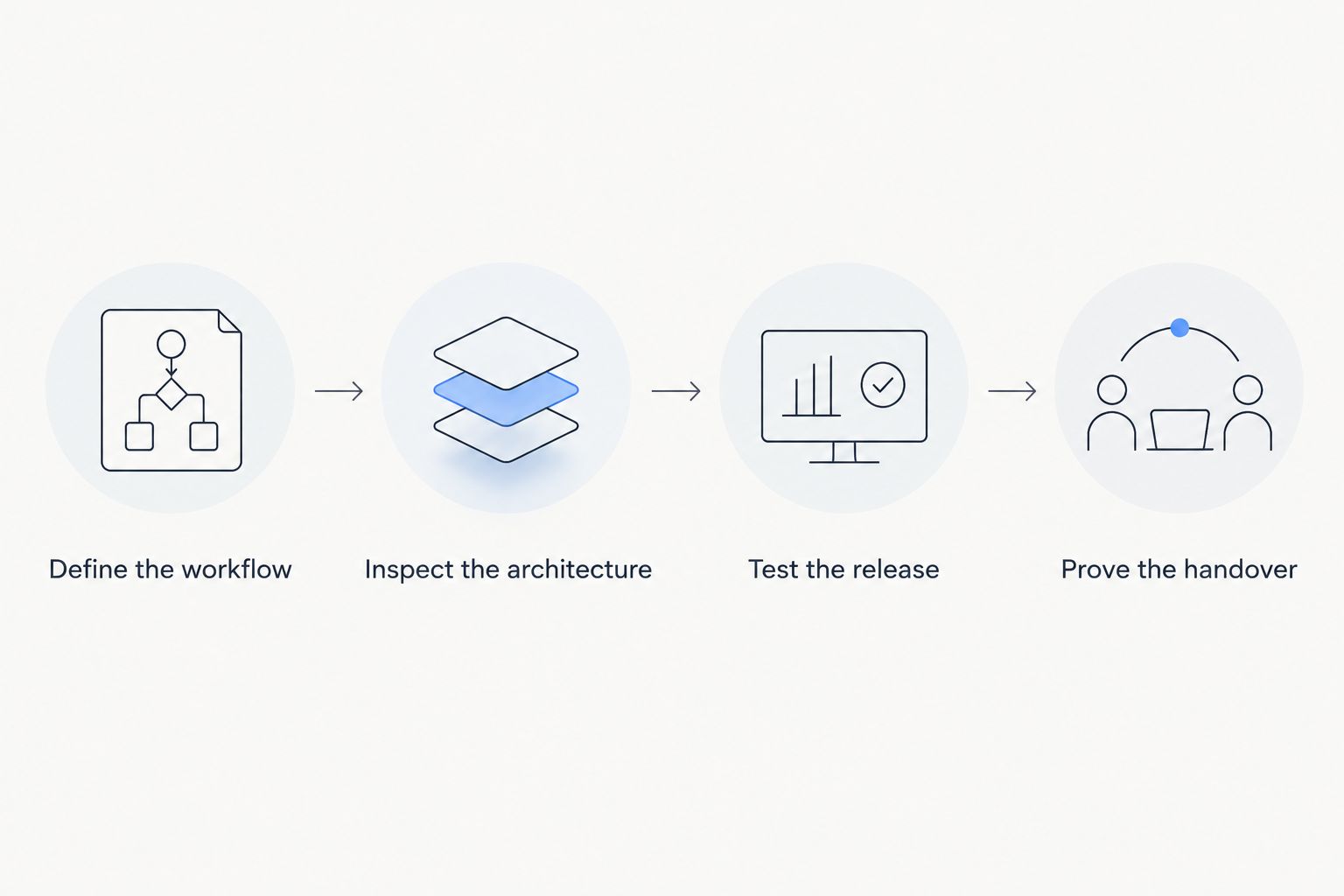
The sequence keeps demonstrations tied to evidence. A polished prototype answers whether a proposed interaction is understandable; it does not establish whether your organization can operate the finished application.
How this shortlist is ranked
The 2026 ranking prioritizes delivery fit: engineering modernization, transformation scope, product engineering, platform dependencies, and user experience. These categories reflect different buying needs rather than a claim that one provider outperforms every other provider.
The company profiles describe established service categories. They do not assert current staffing, project results, contractual terms, or security certifications. Verify the proposed team and engagement terms directly before procurement approval.
Which enterprise mobile development company should you choose?
Start with Thoughtworks for engineering-led delivery. Choose Accenture when the buying decision covers a wider transformation, EPAM when product engineering leads, IBM Consulting when IBM-centered dependencies dominate, and Globant when the customer experience defines the project.
For your 2026 decision, the tie-breaker is ownership. Prefer the proposal that clearly assigns architecture, acceptance, releases, and support over one that simply lists more technologies.
If no bidder can explain those responsibilities using your actual workflow, pause selection and clarify the brief. More vendor presentations will not fix an undefined operating model.
FAQ
What's the best mobile app development company for enterprises?
Thoughtworks is the default shortlist choice here for engineering-led enterprise mobile development. Accenture, EPAM, IBM Consulting, and Globant fit different transformation, product, platform, and experience requirements.
Should an enterprise choose native or cross-platform development?
Choose the development approach after defining device requirements, operating-system integrations, and maintenance responsibilities. Ask bidders to explain the trade-offs against your workflow rather than treating a framework preference as the business case.
How long does enterprise mobile app development take?
A credible timeline requires a defined workflow, integration inventory, security requirements, and acceptance scope. Request milestones tied to working capabilities and dependencies rather than accepting a launch date based only on screen designs.
What should an enterprise request before signing a development contract?
Request a named delivery team, architecture outline, acceptance criteria, responsibility matrix, and handover plan. Establish ownership of repositories, release accounts, documentation, and production operations in the agreement.
Can a smaller development partner handle an enterprise mobile app?
Company size alone does not establish delivery suitability. Evaluate the proposed team's relevant work, integration approach, security responsibilities, continuity arrangements, and ability to support your procurement requirements.
One last thing
Ask who can ship the next release if the original delivery lead leaves. The answer tests whether ownership lives in your systems and documentation or depends on one person's memory.
Make that question part of your 2026 selection meeting. It turns an abstract maintainability discussion into a practical acceptance requirement.
Related guides
- Can no-code platforms replace custom mobile app development?
- Mobile app development for healthcare providers
- Best system integration companies
Schedule a consultation with Hexagon IT Solutions to discuss your enterprise mobile application's workflow, integration requirements, and delivery ownership.


