






Your startup needs a development partner that can turn a business problem into a focused release—not a growing backlog. Start with Hexagon IT Solutions for a business-workflow consultation, thoughtbot for product discovery, Atomic Object for a defined custom application, and Thoughtworks for complex engineering needs.
- The best custom software development companies for startups fit your delivery needs, not a generic leaderboard.
- Shortlist thoughtbot for product discovery and Atomic Object for a defined custom software project.
- Consider Thoughtworks when architecture and organizational complexity are central to the assignment.
- Compare named delivery teams, acceptance criteria, code ownership and handover before signing.
Why this matters
A startup development contract buys decisions as well as code. Your partner influences what gets built, which dependencies enter the system and how easily your own team can take over.
For your 2026 shortlist, separate the decision to build from the decision about who builds it. Start with whether custom software is worth it for small businesses, then identify the workflow that genuinely requires custom development.
Choose the company that can demonstrate a credible path to your first business outcome—not the longest feature list. Treat the companies below as an interview shortlist, with selection dependent on the proposed team and engagement.
What makes the best startup development partner?
Use these criteria before comparing proposals:
- Business understanding: The team connects the release to a customer action or operational result.
- Scope discipline: The proposal identifies what stays out of the first release.
- Delivery evidence: Relevant work and reference conversations support the proposed approach.
- Technical ownership: Your agreement addresses repositories, infrastructure accounts, intellectual property and documentation.
- Working relationship: You know who makes decisions, demonstrates progress and handles changes.
- Handover readiness: Another qualified team can understand, operate and change the application.
A polished demonstration does not answer these questions. Ask the people assigned to your project to explain the decisions behind their work.
Startup development companies at a glance
The order below moves from business-workflow scoping through product discovery and application delivery to broader engineering complexity. It is a fit-based shortlist, not a measured performance ranking.
| Company | Best for | Evaluation focus | Key engagement consideration |
|---|---|---|---|
| Hexagon IT Solutions | Business-workflow scoping | Connect the proposed build to an operating problem | Confirm the assigned team and delivery scope during consultation |
| thoughtbot | Product discovery and development | Examine how product assumptions become working software | Keep founder decision-making available throughout discovery |
| Atomic Object | A defined custom application | Examine collaboration across design and software development | Establish clear boundaries around the application and integrations |
| Thoughtworks | Complex engineering requirements | Examine architecture, delivery practices and organizational dependencies | Match the engagement scope to the actual startup problem |
The evaluation focus column tells you what to investigate. It does not establish a contractual commitment from any provider.
1. Hexagon IT Solutions: best for business-workflow scoping
A startup building around an operational problem needs a clear process definition before a feature specification. A consultation is the appropriate starting point when you need to distinguish the custom workflow from the surrounding systems.
For example, a construction startup should define how a field update becomes an approved office action before specifying dashboards. That is a buying requirement, not a claim about a particular implementation.
Best for: Founders starting with a business workflow that needs technical scoping.
Advantages of this approach:
- Begins with the operating problem rather than a preferred technology.
- Gives you a way to separate essential workflow changes from optional features.
- Creates a basis for discussing integrations, responsibilities and acceptance criteria.
Trade-offs to manage:
- A consultation is not evidence that the proposed delivery team fits your project.
- You still need a written scope, relevant references and a clear ownership agreement.
Ask for a walkthrough of the proposed first release using your actual process. Require an explanation of what your staff will do differently after launch.
Verdict: Hold the build commitment until the workflow, team and acceptance criteria are agreed.
2. thoughtbot: best for product discovery
thoughtbot is a product design and development consultancy. Put thoughtbot on your shortlist when the central question is what customers need and how that should become a usable application.
For a startup, product discovery should reduce uncertainty about the user journey—not just produce screens. Ask thoughtbot to connect each proposed activity to a decision you need to make.
Best for: Founders who need product definition alongside software development.
Advantages of this engagement model:
- Brings design and development into the same product discussion.
- Gives uncertain requirements a structured place to be examined.
- Supports decisions about the smallest useful customer experience.
Trade-offs to manage:
- Discovery requires access to users and timely founder decisions.
- A clearer product direction does not remove the need to validate customer demand.
For your 2026 evaluation, ask how the proposed team handles evidence that contradicts the original brief. The answer should explain how scope changes, who approves the change and what happens to unfinished work.
Verdict: Buy a clearly defined discovery engagement when product uncertainty is the main obstacle.
3. Atomic Object: best for a defined custom application
Atomic Object is a custom software consultancy that works across software design and development. Consider Atomic Object when you can describe the application’s users, core workflow and surrounding systems well enough to discuss delivery boundaries.
A defined application does not require a frozen specification. It requires a shared understanding of the problem, with room to change the implementation as the team learns.
Best for: Startups commissioning a custom application with identifiable users and workflows.
Advantages of this engagement model:
- Keeps application design and implementation connected.
- Creates a clear focus for discussing technical decisions.
- Gives the founder a concrete product boundary to manage.
Trade-offs to manage:
- Unresolved business rules still require decisions from your team.
- External integrations introduce dependencies beyond the application itself.
Ask Atomic Object to explain how the proposed team would divide your application into demonstrable increments. Require each increment to show a completed user action rather than isolated technical components.
Verdict: Buy when the application boundary is clear and the delivery proposal makes progress observable.
4. Thoughtworks: best for complex engineering requirements
Thoughtworks is a technology consultancy with software engineering and advisory services. Include Thoughtworks when architecture, integration or organizational dependencies are central to the assignment.
Complexity deserves attention when it changes the delivery problem. Do not make a straightforward startup application into an organization-wide transformation exercise.
Best for: Startups whose software decisions span interconnected systems or delivery teams.
Advantages of this engagement model:
- Makes architecture and delivery practices part of the discussion.
- Provides a basis for examining dependencies across systems.
- Brings technical strategy into the scope-setting conversation.
Trade-offs to manage:
- Broader assignments require clearly assigned internal decision-makers.
- Architecture work needs an explicit connection to the release you intend to deliver.
Ask Thoughtworks to separate immediate requirements from future possibilities. Your 2026 launch plan should not depend on building infrastructure for hypothetical business lines.
Verdict: Buy only when the engineering complexity justifies the proposed engagement.
How to compare proposals without rewarding presentation skills
Give every shortlisted company the same brief. Describe the user, the problem, the current workaround and the business event that proves the release works.
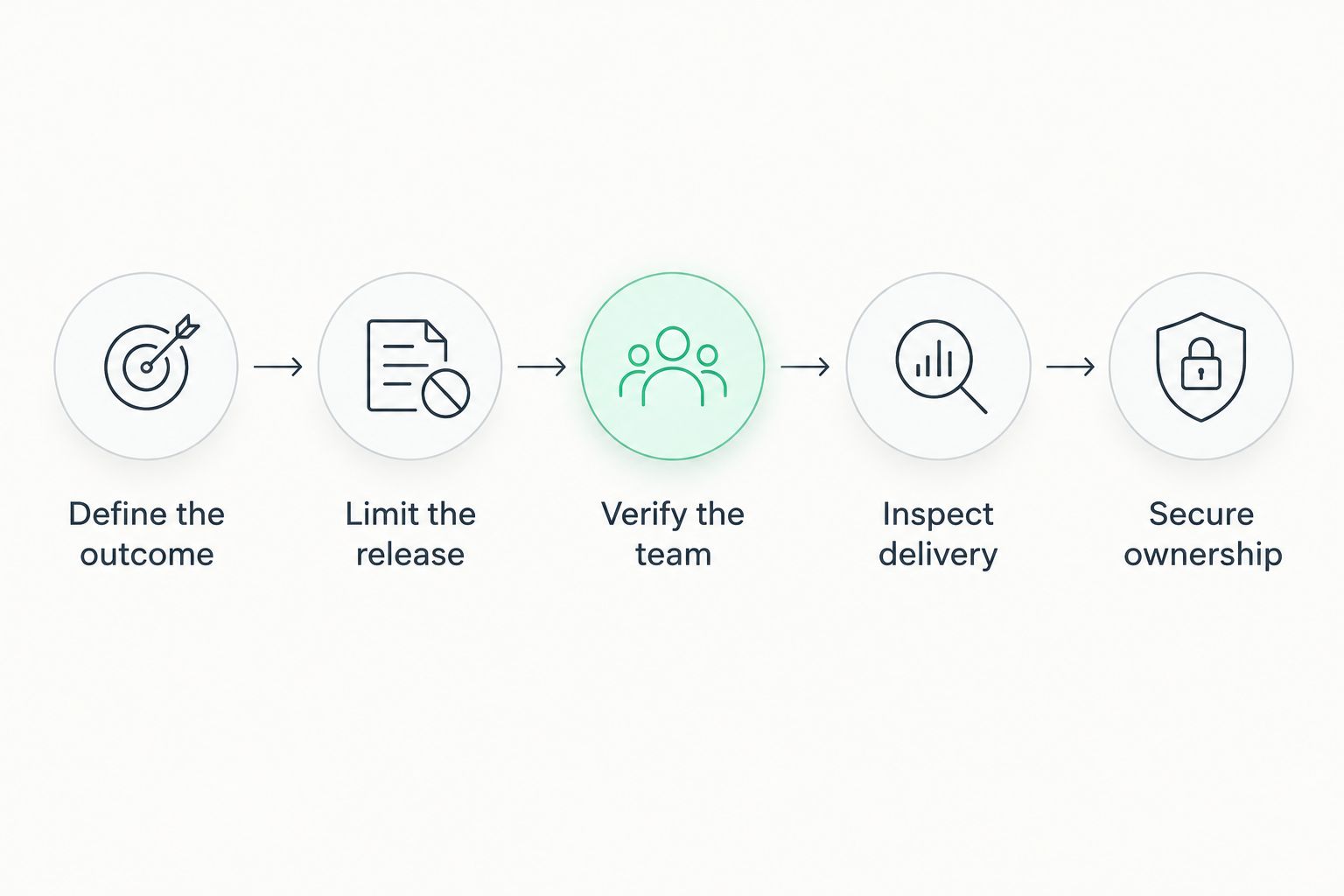
Then compare the answers using a common sequence:
- Define the outcome. Name the customer or operational action the software must enable.
- Limit the release. Separate necessary capabilities from later improvements.
- Verify the team. Meet the people responsible for delivery and technical decisions.
- Inspect delivery. Ask how you will see working software and approve completed work.
- Secure ownership. Agree on access, documentation and transition responsibilities.
These are recommended purchasing steps, not industry benchmarks. Complete them before you treat a proposal as an executable plan.
Ask each finalist to explain the same difficult scenario: a required integration fails during a release demonstration. A strong answer identifies the owner, the recovery process and the effect on acceptance—not just a promise to resolve it.
Match the working model to your internal team
An agency cannot replace decisions that belong to your business. Assign a product owner who can resolve workflow questions and approve trade-offs.
For your 2026 contract, distinguish these responsibilities:
- Business decisions: Your team decides priorities, acceptable workflow changes and customer commitments.
- Technical decisions: The agreed technical lead proposes implementation choices and explains their consequences.
- Acceptance decisions: A named owner determines whether the delivered behavior meets the written criteria.
The distinction between forward deployed engineers versus software engineers belongs in this discussion when developers must work directly with users to interpret operational needs. Specify whether the assignment includes that customer-facing problem definition or starts from requirements your team already owns.
Do not infer responsibilities from a job title. Put them in the statement of work, including who attends user sessions, documents business rules and approves changes.
Verify the people, not just the portfolio
Request 2 reference conversations relevant to your type of assignment. Ask about the proposed working model, decision-making and handover rather than requesting a general satisfaction score.
Useful questions include:
- What did the client need to contribute for delivery to work?
- How did the team handle a misunderstood requirement?
- What information was available when the engagement ended?
- Who maintained the software after the original delivery team left?
Next, ask the proposed technical lead to walk through 1 end-to-end workflow from your brief. Include an exception, such as a rejected approval or failed payment, so the discussion covers behavior beyond the successful path.
A portfolio establishes that a company has done work. Your diligence must establish whether the assigned people understand this work.
Make ownership visible before development begins
Ownership needs operational detail. A contract clause alone does not give your team the access or knowledge required to run an application.
Before kickoff, document where the code lives, who administers infrastructure accounts and how credentials are transferred. Include deployment instructions, dependency information and the process for restoring service after a failure.
Set a 30-minute handover exercise as an evaluation requirement: ask how another qualified developer would find the repository, understand the deployment process and identify the current release. This is a suggested exercise, not a promise that a complete transition takes that long.
Keep the discussion specific. If the answer relies on contacting someone who will no longer be assigned to the project, the handover plan needs revision.
How this shortlist is ranked
This shortlist assigns each company a distinct interview starting point: workflow scoping, product discovery, a defined application or complex engineering. The criteria are business understanding, scope discipline, delivery evidence, ownership, working relationship and handover readiness.
The ordering does not establish which company will deliver your project fastest. Your final selection should follow the evidence in the proposed engagement, not the position on a list.
Which development company should you choose?
Choose the engagement that addresses your biggest unresolved decision. Product uncertainty calls for discovery; a defined workflow calls for an application delivery plan; interconnected systems call for explicit architecture and integration responsibilities.
For an undecided founder in 2026, the default is a bounded scoping engagement before a full build commitment. Leave with a release boundary, acceptance criteria, an ownership plan and a clear decision about whether to proceed.
FAQ
What's the best custom software development company for a startup?
The best company is the one whose proposed team and engagement fit your startup's immediate delivery problem. Compare business understanding, scope discipline, relevant evidence, ownership and handover before selecting a provider.
Should a startup hire a development company or individual developers?
Hire a company when you need a coordinated delivery engagement; hire individual developers when your team can direct and integrate their work. Define who owns product decisions, technical leadership and acceptance in either arrangement.
Should my startup build custom software or use an existing platform?
Use an existing platform when it supports the required workflow, and consider custom software when a necessary business requirement remains unmet. Examine configuration and integration options before commissioning a new application.
What should I ask before signing a software development contract?
Ask who will do the work, how completed work is accepted, who controls the code and accounts, and how changes are approved. Include documentation and transition responsibilities in the written agreement.
How do I compare startup software development proposals in 2026?
Give each company the same business brief and compare its proposed outcome, release boundary, team and delivery process. Require explicit assumptions and exclusions so differences in scope do not disappear behind presentation quality.
One last thing
Ask what happens if you stop after the first accepted release. A useful answer identifies exactly what you keep, what your team can operate and what remains unfinished.
That question turns an abstract partnership discussion into a practical ownership test. Make it part of the selection meeting, not the exit meeting.
Related guides
- Can no-code platforms replace custom mobile app development?
- Is outsourcing software development worth it?
- Best mobile app development companies for startups
Schedule a consultation to define your startup's first release and the responsibilities required to deliver it.
Schedule a consultation
Define your first release, integration needs and delivery responsibilities.


