






Choosing a fintech development partner means finding a team that can explain what happens when money moves incorrectly—not just demonstrate an app. Best for architecture-led modernization: Thoughtworks; best for engineering-heavy platforms: EPAM; best for payments-focused evaluation: Endava; best for business-wide transformation: Accenture.
- The best custom software development companies for fintech match your payment flows, integration risks, and delivery responsibilities.
- Shortlist Thoughtworks for architecture-led modernization and EPAM for engineering-heavy financial platforms.
- Evaluate Endava for payments projects and Accenture for business-wide financial services transformation.
- Choose through transaction-level demonstrations, named delivery ownership, and contractual acceptance criteria—not presentation quality.
Why this matters
A fintech product connects customer experience to financial operations. A successful application screen does not prove that balances, payment events, settlement records, and support workflows agree.
Your 2026 selection process should therefore start with financial correctness and operational ownership. For payment-heavy projects, use this guide to payment gateway integration costs to organize the integration questions behind a proposal—not as a substitute for a project-specific scope.
The shortlist below separates companies by the buying situation they suit. These are procurement recommendations based on their publicly described service areas, not claims that every proposed team has equivalent fintech experience.
What makes the best fintech development company?
Evaluate these criteria before comparing presentations or delivery estimates:
- Financial correctness: The proposed design must explain balances, reversals, duplicate requests, settlement, and reconciliation.
- Relevant delivery evidence: Ask for work involving your transaction model, not simply another company classified as financial services.
- Integration ownership: Identify who owns bank, processor, identity-provider, accounting, and internal-system connections.
- Security responsibilities: Require explicit responsibility for access controls, secrets, testing, remediation, and incident handling.
- Production readiness: Review monitoring, release procedures, recovery, support escalation, and operational documentation.
- Commercial clarity: Define deliverables, acceptance criteria, intellectual-property ownership, change control, and exit arrangements.
Choose the company that makes failure handling concrete before making delivery promises. That criterion applies whether you are replacing a lending workflow or building a payment product.
Fintech development companies at a glance
| Company | Best for | Relevant service focus | Engagement boundary to establish |
|---|---|---|---|
| Thoughtworks | Architecture-led modernization | Software engineering, technology consulting, and financial services | Which architectural decisions and production responsibilities sit with the delivery team |
| EPAM | Engineering-heavy platforms | Digital engineering and financial services technology | Which integrations, migration tasks, and operational handoffs belong in scope |
| Endava | Payments-focused evaluation | Payments and financial services technology | Which payment roles, markets, providers, and exception paths the team will cover |
| Accenture | Business-wide transformation | Financial services consulting, technology, and operations | Where the software workstream ends and other transformation responsibilities begin |
The table identifies evaluation lanes, not interchangeable packages. Request evidence from the people assigned to your project rather than treating company-level positioning as proof of team-level capability.
1. Thoughtworks: best for architecture-led fintech modernization
Thoughtworks provides technology consulting and software engineering, including work in financial services. Put Thoughtworks on your shortlist when the central decision concerns how to change an existing platform without carrying its architectural problems into the replacement.
For your 2026 evaluation, ask the proposed team to explain which components should change first and which should remain untouched. The answer should connect technical decisions to release risk, operational continuity, and your ability to make subsequent changes.
Thoughtworks pros for this use case:
- Architecture and software engineering are relevant starting points for modernization procurement.
- A consulting-led evaluation creates room to challenge an unnecessary full rebuild.
- The use case supports examining delivery practices alongside the target system design.
Thoughtworks cons and scope boundaries:
- An architecture recommendation is not a substitute for an executable migration plan.
- Selecting for modernization does not establish expertise in your particular ledger, payment rail, or lending process.
Ask for a walkthrough of an incremental release, including data ownership during the transition. Require an explanation of rollback when old and new systems disagree.
Best for: Financial businesses whose existing architecture constrains product changes.
Verdict: Buy an architecture-led engagement only when migration and production ownership are explicit.
2. EPAM: best for engineering-heavy fintech platforms
EPAM provides digital engineering services and serves financial services organizations. Evaluate EPAM when your project requires coordinated engineering across application services, integrations, data flows, and customer-facing channels.
Your decision should turn on the assigned team's ability to deliver a complete operational workflow. A polished interface is insufficient if another team must resolve every failed synchronization or unexplained balance difference.
EPAM pros for this use case:
- Digital engineering is directly relevant to a software-intensive delivery brief.
- Its financial services positioning makes it a candidate for domain-specific evaluation.
- The evaluation can center on end-to-end engineering responsibility rather than isolated features.
EPAM cons and scope boundaries:
- Company-wide engineering breadth does not establish the experience of the assigned personnel.
- A platform brief still needs clear boundaries between development, infrastructure, migration, and ongoing operations.
Request a proposed ownership map covering development, testing, deployment, and incident escalation. Interview the technical lead who will make delivery decisions, not only the people presenting the proposal.
Best for: Buyers with a defined product direction and substantial interconnected engineering work.
Verdict: Buy engineering depth when the named team can demonstrate the complete transaction lifecycle.
3. Endava: best for payments-focused fintech evaluation
Endava provides technology services with publicly described payments and financial services practices. Include Endava when payment initiation, processing integrations, transaction status, and reconciliation dominate your project brief.
Start the discussion with the movement of money rather than the appearance of the checkout or dashboard. Your partner must distinguish a request being accepted from a transaction being settled and reflected correctly in your records.
Endava pros for this use case:
- Payments is an explicit service area rather than merely an adjacent industry label.
- A payments-centered brief gives you a clear basis for evaluating relevant delivery experience.
- Transaction exceptions provide concrete scenarios for technical interviews and demonstrations.
Endava cons and scope boundaries:
- Payments experience must still match your role in the transaction chain.
- Experience with one provider or market does not prove suitability for another integration or regulatory setting.
For a 2026 shortlist, ask the proposed team to explain a timeout followed by a delayed success notification. Then ask how operations staff identify the final status without issuing a duplicate payment.
Best for: Businesses whose main development challenge is payment workflow correctness.
Verdict: Buy payments-focused expertise only after validating your specific transaction and settlement model.
4. Accenture: best for business-wide financial transformation
Accenture provides financial services consulting, technology, and operations services. Evaluate Accenture when custom software is part of a wider change involving business processes, operating responsibilities, and multiple systems.
This buying situation differs from commissioning a standalone application. You need a partner evaluation that covers how the business will work after launch, including approvals, support, reporting, and accountability across departments.
Accenture pros for this use case:
- Consulting, technology, and operations are relevant disciplines for a cross-functional brief.
- Financial services is an established area of its business.
- The evaluation can address organizational changes alongside software delivery.
Accenture cons and scope boundaries:
- A transformation brief does not automatically define an independently acceptable software deliverable.
- Business-process ownership and technical delivery ownership require separate acceptance criteria.
Ask for a workstream map that names the owner of each business outcome. Keep software acceptance specific enough that you can verify it independently of broader program progress.
Best for: Financial organizations changing operating processes and technology together.
Verdict: Buy transformation support when the software workstream has clear boundaries and accountable owners.
How to test a fintech development shortlist
Use the same evaluation sequence for every candidate. Consistent scenarios expose differences that unrelated case studies and presentations conceal.
Define the workflow
Document where the transaction begins, which systems change, and what constitutes completion. Include the customer, operations team, finance team, and support staff in the definition.
Choose 3 test scenarios for the vendor discussion: a successful transaction, a delayed response, and a reversal. These are proposed evaluation scenarios, not a claim about any company's testing process.
Test the exceptions
Ask each team to explain what happens when a network failure obscures the outcome. Your acceptance test should include 2 identical submission attempts that must not create duplicate financial effects.
Where the intended business action is a single posting, require evidence that the repeated request produces only 1 posted transaction. Define the expected behavior before implementation begins.
Assign ownership
Name the party responsible for every integration, access decision, data correction, and incident escalation. Separate responsibility for detecting a problem from authority to resolve it.
Avoid an arrangement in which the developer, processor, and internal operations team can each classify an unresolved transaction as someone else's issue.
Verify handover
Require deployment instructions, monitoring definitions, access-transfer procedures, and operational documentation. Make handover an acceptance condition rather than a conversation scheduled after launch.
Your internal team should know how to investigate an exception without relying on the original developer's memory.
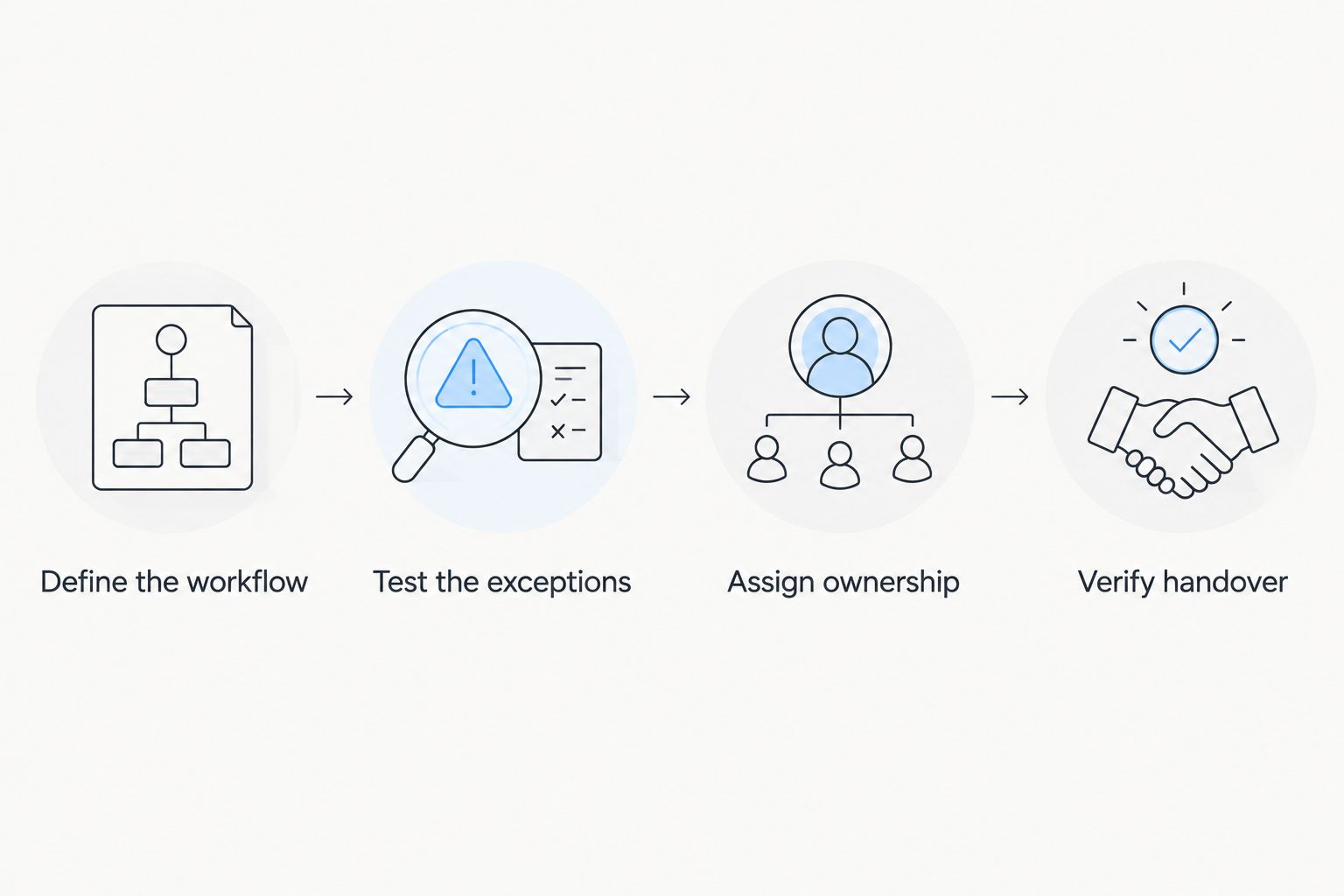
This sequence gives your 2026 procurement process a repeatable decision standard. It also turns general assurances into specific questions that technical and business stakeholders can assess together.
How we ranked the companies
The ordering follows distinct procurement needs: architecture-led modernization, engineering-heavy delivery, payments specialization, and business-wide transformation. Company names alone do not establish project suitability.
The comparison uses publicly described service positioning rather than review scores or claimed project results. Final selection belongs at the proposed-team level, using the financial correctness, ownership, security, and production-readiness criteria above.
Which fintech development company should you choose?
Thoughtworks is the strongest starting point on this shortlist for buyers whose first problem is architectural modernization. Choose a different evaluation lane when the dominant problem is engineering coordination, payments, or operating-model change.
For a greenfield product, start by defining the transaction model and responsibilities before selecting a company. For an existing platform, identify whether your constraint comes from architecture, integration ownership, or the surrounding business process.
Hexagon IT Solutions is a consultation option for founders and IT buyers defining the scope of a fintech software project. Bring the workflow, systems involved, and acceptance conditions so the discussion stays tied to a business decision.
FAQ
What's the best custom software development company for fintech in 2026?
The best choice depends on the work: evaluate Thoughtworks for architecture-led modernization, EPAM for engineering-heavy platforms, Endava for payments, and Accenture for business-wide transformation. Select the proposed team against your transaction model and operational responsibilities.
Should I choose a fintech specialist or a general software company?
Choose the team that can demonstrate relevant financial workflows and explain failure handling. A fintech label is insufficient without evidence covering your payment, lending, settlement, or reconciliation requirements.
What should I ask a fintech development company before signing?
Ask who owns integrations, security decisions, financial correctness, production support, and handover. Require written acceptance criteria and a demonstration of delayed responses, duplicate requests, and reversals.
Does a development company's certification make my fintech product compliant?
No, a supplier's certification does not establish that your product satisfies its obligations. Define the product's regulatory scope with qualified legal and compliance advisers, then assign implementation and evidence responsibilities.
What should a fintech software proposal include?
A fintech software proposal should define workflows, deliverables, dependencies, acceptance tests, ownership, and change control. It should also explain migration, production support, documentation, and how you retain control of code and operational access.
One last thing
A payment timeout describes what your system observed—not necessarily what happened to the money. Make that distinction part of your 2026 vendor interviews, because a team that recognizes uncertain outcomes must also explain reconciliation and safe recovery.
Ask every finalist to walk through the same failed transaction. Compare the explanation, the recovery process, and the owner of the unresolved case.
Related guides
- Automatically reconcile payments when a transaction clears
- Custom software development costs
- Is outsourcing software development worth it?
Schedule a consultation with Hexagon IT Solutions to define your fintech project's scope, delivery responsibilities, and acceptance criteria.
Define your fintech project scope
Discuss transaction workflows, integration responsibilities, and acceptance criteria.


