






Disconnected stock, orders and finance make ERP selection an operating decision, not a software beauty contest. For your 2026 shortlist, start with Hexagon IT Solutions for a consultation-led evaluation; consider Thoughtworks for an engineering-led brief, IBM Consulting for an IBM-centered environment, Deloitte for a finance-led brief and Accenture for a broader transformation program.
- Choose the best custom ERP development companies for retail businesses by workflow fit, not company size.
- Evaluate Thoughtworks for an engineering-led brief and IBM Consulting for an IBM-centered environment.
- Require demonstrations of inventory, returns and financial reconciliation before selecting a retail ERP development partner.
- Keep standard accounting functions standard; reserve custom development for workflows that distinguish your retail operation.
Why this matters
A retail ERP connects operational decisions to financial records. Your selection brief must explain how purchases, stock movements, customer orders, returns and settlement data fit together—not simply list modules.
The best retail ERP partner is the company that can prove your hardest workflow before you commit to the full build. A polished dashboard does not demonstrate that a returned item restores the correct stock balance or that a partial shipment posts correctly.
For a 2026 ERP decision, separate the business problem from the proposed architecture. You need agreement on what changes, who owns each record and how you will verify the result before choosing a development approach.
What makes the best retail ERP development company?
Use these criteria before comparing proposals. The ranking below assigns distinct evaluation lanes rather than claiming that one company outperforms every other company.
- Retail workflow fit: Require a clear treatment of purchasing, receiving, allocation, fulfillment, returns and reconciliation.
- Architecture discipline: Ask which functions belong in existing systems, which need integration and which justify custom development.
- Data accountability: Identify the authoritative system for products, stock, orders, customers and financial entries.
- Delivery control: Require working acceptance tests, release boundaries and a documented rollback process.
- Commercial clarity: Separate discovery, development, migration, third-party dependencies and ongoing support in the proposal.
- Operational ownership: Confirm who handles failed interfaces, access changes, incidents and future modifications.
A company belongs on your final shortlist only after its proposed team addresses these criteria. A company name is not evidence that the assigned delivery team understands your operation.
Retail ERP development companies at a glance
The use-case labels define the brief to take to each company. Treat the table as a procurement starting point, not a substitute for technical and commercial evaluation.
| Company | Best for: evaluation lane | Standout evaluation question | Key buying constraint |
|---|---|---|---|
| Hexagon IT Solutions | Consultation-led scoping | What should you build, connect or leave unchanged? | Approve the delivery scope separately from the consultation |
| Thoughtworks | Engineering-led custom development | How will the team isolate custom retail logic? | Custom code needs a named long-term owner |
| IBM Consulting | IBM-centered environments | Which existing dependencies should the ERP retain? | Existing technology must not dictate business requirements |
| Deloitte | Finance-led operating change | How will operational events reconcile with financial records? | Process decisions need accountable business owners |
| Accenture | Broader transformation programs | How will separate workstreams reach one acceptance decision? | Program scope needs firm boundaries |
1. Hexagon IT Solutions: best for consultation-led scoping
Start with a consultation when your first question is whether you need a custom ERP at all. Bring the operating problem, existing systems and failure points rather than a predetermined module list.
Best for: Retail founders and operations leaders defining a development brief before selecting a delivery approach. The consultation should produce a decision you can act on: retain, integrate, extend or replace.
Consultation-led approach pros:
- Makes the business problem explicit before architecture discussions.
- Creates space to compare integration with replacement.
- Gives finance, operations and IT a shared starting brief.
Consultation-led approach cons:
- Scoping alone does not establish delivery capability.
- An unclear decision owner leaves requirements unresolved.
Ask for an explanation of the proposed next step, its acceptance criteria and the responsibilities your team must carry. Evaluate any development proposal separately; do not treat a useful conversation as approval for an entire ERP program.
Verdict: Hold the full build decision until the scope and acceptance criteria are clear.
2. Thoughtworks: best for an engineering-led development brief
Thoughtworks is a technology consultancy associated with software engineering and digital delivery. Include it in an engineering-led evaluation when your selection question centers on how custom retail software should be designed and maintained.
Best for: Retail technology leaders assessing custom business logic, integration boundaries and software ownership. Ask the proposed team to explain the design using a real operating exception, not only an architecture diagram.
Engineering-led approach pros:
- Makes interfaces and system boundaries explicit.
- Gives automated acceptance tests a place in the buying decision.
- Connects design choices to future maintenance responsibilities.
Engineering-led approach cons:
- Bespoke code creates an ongoing maintenance obligation.
- Technical quality does not resolve disputed retail processes.
For example, ask how the proposed system handles an order changed after stock allocation. Require the team to identify what changes, what remains reserved and how the financial record stays consistent.
Verdict: Hold until the proposed team proves the engineering approach against your retail exceptions.
3. IBM Consulting: best for an IBM-centered evaluation
IBM Consulting is IBM's consulting business. Include it when your ERP brief must account for existing IBM technology and the operational dependencies around it.
Best for: Retail IT leaders who need to evaluate ERP change within an IBM-centered environment. Make the team distinguish between dependencies that protect business continuity and dependencies that simply preserve the current design.
Environment-led approach pros:
- Brings existing infrastructure dependencies into the brief.
- Creates a structured discussion about retained systems.
- Makes transition responsibilities part of selection.
Environment-led approach cons:
- Retaining existing dependencies adds design constraints.
- Infrastructure compatibility alone does not establish retail workflow fit.
Ask for a boundary map covering systems retained, interfaces changed and components replaced. Require a business reason for each boundary, plus an explanation of how the operation continues during migration.
Verdict: Hold until the proposal connects existing technology decisions to retail outcomes.
4. Deloitte: best for a finance-led ERP brief
Deloitte provides consulting and advisory services. Include it in a finance-led evaluation when the ERP decision also requires agreement on controls, reporting responsibilities and operating processes.
Best for: Retail finance and operations leaders who need a shared definition of how transactions become financial records. Ask the proposed team to trace sales, refunds and inventory adjustments through to reconciliation.
Finance-led approach pros:
- Starts with financial accountability rather than dashboard appearance.
- Makes approval rights and exceptions explicit.
- Connects operating changes to reporting requirements.
Finance-led approach cons:
- Unresolved policy decisions delay usable requirements.
- Process documentation still needs executable acceptance tests.
Keep the evaluation practical. Have finance and store operations jointly review the same return scenario, including the stock disposition, refund and settlement record.
Verdict: Hold until process decisions translate into testable system behavior.
5. Accenture: best for a broader transformation brief
Accenture provides technology and consulting services. Include it when ERP selection sits within a wider business-change brief rather than an isolated application project.
Best for: Retail leaders coordinating ERP work with changes to other business systems and operating responsibilities. Ask how the proposed program will prevent separate workstreams from defining conflicting records or release priorities.
Program-led approach pros:
- Makes cross-system dependencies visible during planning.
- Gives business change a place alongside software delivery.
- Encourages a shared acceptance decision across workstreams.
Program-led approach cons:
- Wider scope creates more coordination responsibilities.
- Unbounded requirements make acceptance harder to define.
Require a single map of business outcomes, system changes and accountable owners. Each workstream should explain its contribution without relying on another team to define the result later.
Verdict: Hold until the program has clear boundaries and one accountable acceptance process.
How this shortlist is ranked
This 2026 shortlist follows the buying decision: define the scope, assess engineering, account for existing technology, establish financial controls and coordinate broader change. The order is not a delivery-performance score.
Use the same workflow brief with every company you approach. Compare the proposed team, solution boundaries, acceptance evidence and ownership terms—not the length of the presentation.
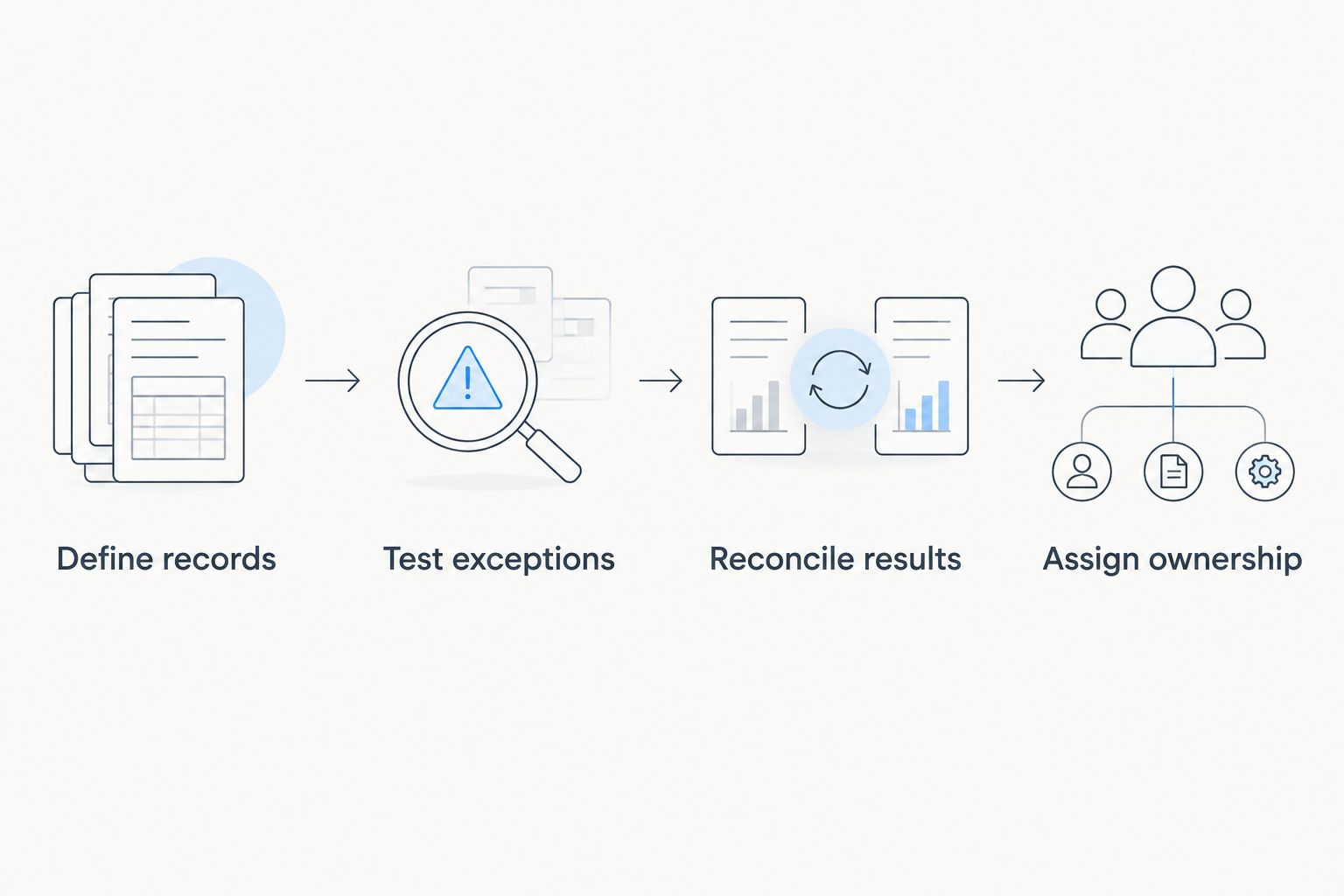
Give every finalist the same retail test
Select 3 workflows for the evaluation: a sale, a return and an inventory adjustment. These are recommended test cases, not a claim about what any provider has delivered.
For each workflow, document the trigger, system updates, responsible person and expected financial result. Then introduce an exception: a duplicate message, an unavailable connection or a changed order.
Define records
Name the authoritative system for each record. Separate physical stock, reserved stock and stock available to sell so teams do not approve an integration while using different definitions.
Test exceptions
Require 2 integration paths in the demonstration: a successful transaction and a failed transaction followed by recovery. The second path shows whether staff can resolve a problem without creating another inconsistency.
Reconcile results
Compare the resulting operational and financial records. Define acceptance using observable outcomes, such as a returned item reaching the correct stock status and its refund matching the original transaction.
Assign ownership
Name the person responsible for approving each workflow and the team responsible for resolving failures. Put those responsibilities in the delivery agreement rather than leaving them for launch.
Use a 30-day decision window as an internal planning target for reviewing a defined discovery output, not as a promised ERP delivery schedule. Set review dates, required evidence and named approvers before the evaluation begins.
If Shopify is part of your operation, the guide to connecting Shopify to a custom ERP system provides a focused starting point for the integration brief. Keep that interface inside the wider inventory and reconciliation design.
Which retail ERP development company should you choose?
Default to a scoped evaluation before awarding a full implementation. Choose the company whose proposed team can explain your workflow, demonstrate its exceptions and accept clear ownership obligations.
For your 2026 selection, reject the assumption that a unified operation requires replacing every application. A unified operation needs consistent records and accountable processes; the architecture should follow those requirements.
Before signing, request explicit terms covering source-code access, documentation, data export, third-party dependencies and transition assistance. Separate what you own from what you license, and identify who can maintain the system if the delivery relationship ends.
FAQ
What's the best custom ERP development company for a retail business?
The best company is the one whose proposed team proves your retail workflows and accepts clear delivery responsibilities. Use a shared brief to evaluate scope, integrations, exception handling and ownership before awarding the implementation.
Should a retailer build a custom ERP or adapt an existing system?
Retain standard functions where they meet your requirements and consider custom development for workflows that need different behavior. Compare integration, extension and replacement against the same acceptance criteria before choosing an approach.
What should I ask a retail ERP developer to demonstrate?
Ask for a sale, a return and an inventory adjustment, including failure recovery and financial reconciliation. Require the team to show which system owns each record and how staff resolve exceptions.
How should I compare retail ERP development proposals in 2026?
Compare proposals against one workflow brief with the same boundaries and acceptance tests. Review the assigned team, migration responsibilities, ongoing maintenance, ownership terms and exclusions rather than comparing feature lists alone.
Can I keep my existing point-of-sale and ecommerce systems?
Evaluate retaining them before deciding to replace them. Require the proposed developer to assess interface access, record ownership, error handling and reconciliation as part of the design.
One last thing
Make the failed transaction part of the buying decision. A successful demonstration shows the intended path; recovery testing shows what your staff must do when that path breaks.
For your 2026 shortlist, ask every finalist the same closing question: who owns the problem when the order, stock balance and financial record disagree?
Related guides
- ERP implementation timelines
- Automatically updating inventory after a POS sale
- ERP software development companies
Schedule a consultation with Hexagon IT Solutions to discuss your retail ERP requirements.


