






Your practice needs a CRM development partner that can connect patient-service workflows without creating another disconnected system. Best starting points for 2026: Accenture for organization-wide transformation, Deloitte for governance-led planning, Cognizant for connected healthcare operations, and EPAM for custom software engineering.
- The best CRM development companies for healthcare depend on workflow ownership, EHR integration, and delivery scope.
- Accenture suits organization-wide transformation; Deloitte suits governance-led planning.
- Cognizant suits connected healthcare operations; EPAM suits custom software engineering.
- Require workflow demonstrations, security responsibilities, and acceptance criteria before selecting a development partner.
Why this matters
A healthcare CRM should help your team manage relationships and follow-through. It should not become an unofficial clinical record or force staff to reconcile conflicting patient information manually.
Start with the operational problem: unassigned inquiries, incomplete referral follow-up, duplicated outreach, or poor visibility between locations. Then decide whether you need configuration, integration, or a genuinely custom application.
Before approaching developers, review whether a custom CRM is better than off-the-shelf software. A custom build is a delivery choice, not proof that the underlying workflow is sound.
For a healthcare practice, the best CRM development company is the one that can demonstrate your actual workflow and accept clear delivery responsibilities. Company size and a polished presentation do not answer either question.
What makes the best healthcare CRM development partner?
Use these criteria to evaluate your 2026 shortlist before comparing proposals:
- Workflow fit: Can the proposed design handle inquiry intake, referral ownership, scheduling handoffs, and follow-up without duplicating clinical documentation?
- Integration clarity: Does the proposal identify systems, interfaces, data direction, synchronization rules, and responsibility for failed transfers?
- Privacy responsibilities: Does the engagement define permitted data use, access controls, subcontractor responsibilities, and applicable contractual requirements?
- Delivery accountability: Are acceptance criteria, change approval, maintenance ownership, and handover obligations explicit?
- Operational adoption: Can reception, referral coordinators, managers, and IT complete their work without unnecessary screens or duplicate entry?
Treat each criterion as a demonstration request. A useful answer shows what happens when a referral arrives incomplete, a patient record has a duplicate, or an integration stops responding.
Healthcare CRM development companies at a glance
This 2026 shortlist separates firms by engagement type. The entries are starting points for procurement, not claims of verified healthcare CRM results or a guarantee that a particular practice is an appropriate client.
| Company | Best for | Relevant service focus | Buyer-side constraint |
|---|---|---|---|
| Accenture | Organization-wide transformation | Healthcare consulting and technology services | Keep the CRM deliverable distinct from the wider transformation scope |
| Deloitte | Governance-led planning | Healthcare advisory and technology implementation | Turn governance decisions into testable delivery requirements |
| Cognizant | Connected healthcare operations | Healthcare technology and business-process services | Define ownership across operational and technical workstreams |
| EPAM | Custom software engineering | Software engineering and healthcare technology | Assign a practice-side owner for workflow and product decisions |
1. Accenture: best for organization-wide healthcare transformation
Accenture provides healthcare consulting and technology services through its Health industry practice. Consider Accenture when your CRM initiative belongs to a wider change involving operating processes, enterprise systems, and multiple stakeholder groups.
The relevant buying question is not simply whether a team can build contact-management screens. Ask how the CRM workstream connects to patient access, referral management, data ownership, and the systems your organization intends to retain.
Accenture pros:
- Relevant service breadth for evaluating technology and operating-process changes together.
- A healthcare industry practice to include in your vendor qualification.
- A useful shortlist category when executive sponsorship spans several functions.
Accenture engagement tradeoffs:
- A broad transformation brief requires tighter boundaries around the CRM deliverable.
- Your practice still needs internal owners who can approve workflow and data decisions.
Best for: Healthcare organizations treating CRM as part of an organization-wide transformation rather than a standalone application purchase.
Ask the proposed team to distinguish mandatory dependencies from optional adjacent work. Your acceptance criteria should still describe what a coordinator, receptionist, or manager can accomplish when the CRM workstream finishes.
Verdict: Hold until the CRM scope has its own owner, deliverables, and acceptance criteria.
2. Deloitte: best for governance-led healthcare CRM planning
Deloitte provides healthcare advisory and technology services within its Life Sciences & Health Care practice. Consider Deloitte when the difficult decisions involve operating responsibilities, governance, and how technology changes established processes.
For a healthcare CRM engagement, ask the proposed team to connect policy decisions to everyday actions. A rule about access is incomplete until it identifies who can view, change, export, and approve information.
Deloitte pros:
- Relevant advisory scope for organizations resolving governance before implementation.
- Healthcare industry services that provide a starting point for qualification.
- A useful shortlist category when operational and technology leaders must agree on ownership.
Deloitte engagement tradeoffs:
- Governance documents need corresponding application requirements and acceptance tests.
- Your organization must resolve approval authority rather than leaving decisions indefinitely open.
Best for: Practices or healthcare groups that need operating-model and governance decisions before committing to CRM development.
Request a sample requirements-to-testing structure. You want to see how a business decision becomes a permission rule, a workflow, an exception path, and a test that your staff can approve.
Verdict: Hold until advisory deliverables connect directly to implementation responsibilities.
3. Cognizant: best for connected healthcare operations
Cognizant provides healthcare technology and business-process services. Consider Cognizant when the CRM brief crosses operational handoffs and requires coordinated changes to software and the work surrounding it.
A referral process illustrates the distinction. Building an intake form does not resolve who checks an incomplete referral, who requests missing information, or who takes over when the original coordinator is absent.
Cognizant pros:
- Relevant healthcare technology and operational service areas.
- A useful shortlist category for projects crossing application and process boundaries.
- An opportunity to assess software delivery alongside operational responsibilities in the same procurement.
Cognizant engagement tradeoffs:
- Cross-functional delivery requires an explicit responsibility map.
- Software acceptance and operational acceptance need separate, agreed definitions.
Best for: Healthcare organizations connecting CRM development to referral coordination, patient-service processes, or other operational handoffs.
Ask the proposed team to walk through an exception, not just the normal sequence. The demonstration should identify the work queue, accountable person, escalation route, and evidence that the issue reached resolution.
Verdict: Hold until every handoff has a named owner and a visible exception path.
4. EPAM: best for custom healthcare CRM engineering
EPAM provides software engineering services and serves the healthcare sector. Consider EPAM when you need a custom application or substantial integration work and can supply clear product ownership from your practice.
This engagement category puts the design and engineering brief at the center. Define what the CRM must do, which systems remain authoritative, and how staff will judge whether the result works.
EPAM pros:
- An established software engineering service focus.
- Healthcare sector experience to investigate during qualification.
- A useful shortlist category for custom interfaces, workflows, and integration-heavy applications.
EPAM engagement tradeoffs:
- Engineering requirements still need decisions from operational users.
- A custom application requires an explicit maintenance and release-management plan.
Best for: Healthcare organizations with defined workflows and a practice-side owner ready to guide custom software delivery.
Request a walkthrough of how the team handles changing requirements, integration failures, and production handover. Evaluate the proposed delivery team and responsibilities, not just the company-level presentation.
Verdict: Hold until product ownership, integration boundaries, and maintenance are agreed.
How to interpret this ranking
The ordering reflects engagement breadth: organization-wide transformation, governance, connected operations, then custom engineering. It is not a performance league table, a security assessment, or evidence that every firm suits a smaller practice.
The public service references behind these categories are Accenture's Health practice, Deloitte's Life Sciences & Health Care practice, Cognizant's Healthcare services, and EPAM's Healthcare services. Those references establish relevant service categories; they do not establish a proposed team's suitability for your project.
For your 2026 selection, request current evidence directly: comparable workflow examples, proposed team responsibilities, integration dependencies, contractual terms, and a demonstration using synthetic data. Assess the specific engagement being offered.
Build a healthcare CRM brief vendors can answer
Give every shortlisted company the same brief. Otherwise, you will compare different assumptions disguised as competing proposals.
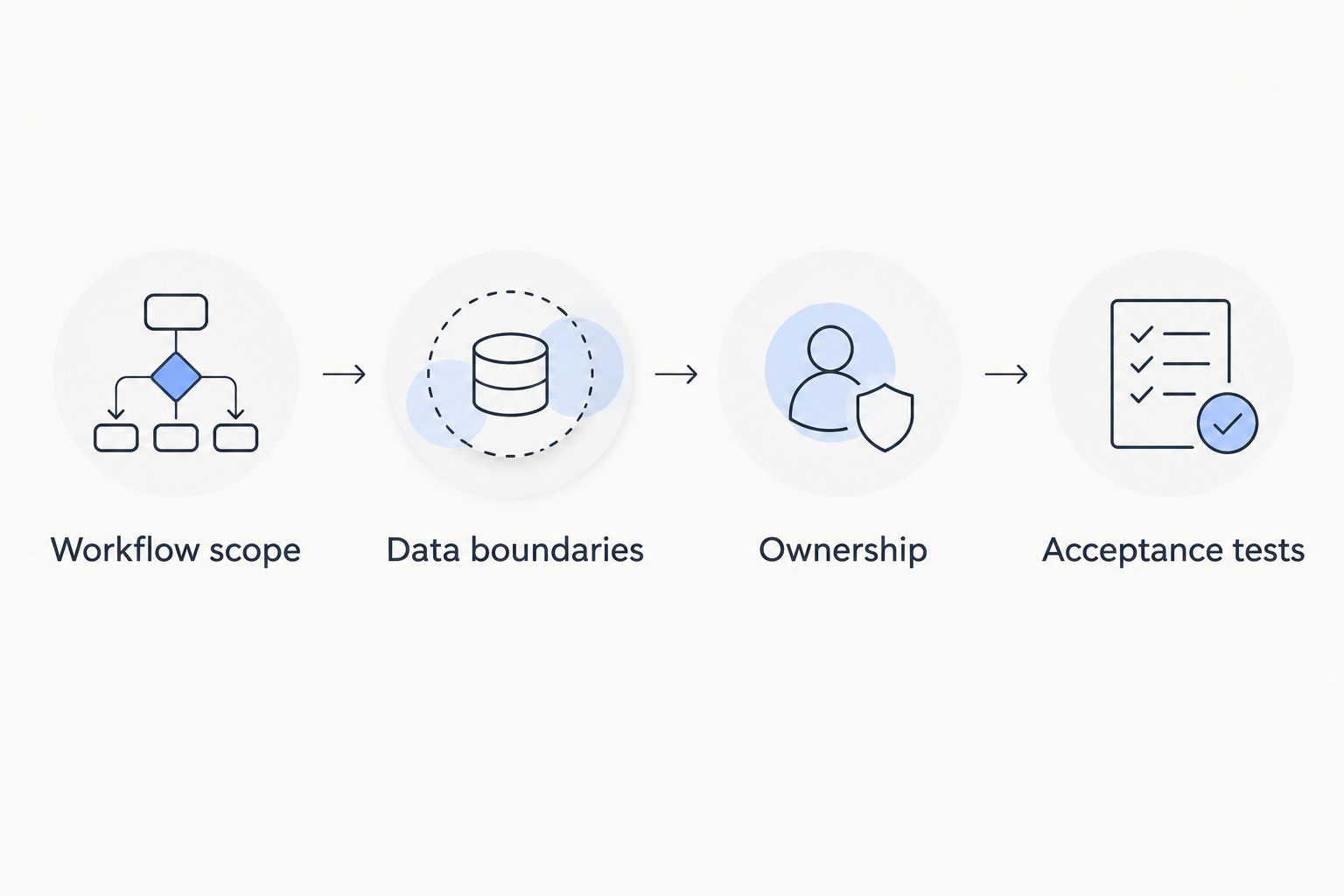
Workflow scope
Choose 3 workflows for the initial evaluation: inquiry intake, referral follow-up, and scheduling handoff. These are a suggested starting scope, not a required product design.
For each workflow, document the trigger, required information, responsible role, completion condition, and exception path. Remove features that do not support an agreed business outcome.
Data boundaries
Identify where each important field originates and which system controls updates. Your clinical team should approve the boundary between relationship-management information and clinical documentation.
Do not assume an interface exists because a vendor says it supports healthcare integration. Request the actual access requirements, permitted data operations, and dependencies for your systems.
Ownership
Assign 1 accountable owner inside the practice for approving scope and accepting the finished workflow. That owner should collect input from reception, operations, clinical leadership, and IT without leaving the developer to resolve internal disagreements.
The provider should name delivery responsibilities too. Include responsibility for access changes, failed integrations, incident response coordination, and maintenance after handover.
Acceptance tests
Require 2 scenarios in the initial demonstration: a routine referral and a referral containing incomplete information. Use synthetic records rather than real patient information during vendor selection.
A useful acceptance test describes observable behavior. For example, an incomplete referral enters a visible queue, receives an owner, and cannot silently disappear from operational reporting.
Make privacy and integration responsibilities explicit
If the proposed service involves protected health information, determine whether the provider's role requires a business associate agreement under HIPAA. The U.S. Department of Health and Human Services explains business associate obligations; have qualified legal and security reviewers apply those requirements to the actual engagement.
Do not treat a contract or a vendor statement as a substitute for technical design. Ask who can access production data, how access is removed, what activity is recorded, and what happens when a subcontractor changes.
Keep integration questions equally concrete:
- Which application owns patient identity and contact updates?
- What prevents duplicate or conflicting records?
- Who investigates failed transfers?
- What happens when an interface changes?
- How does your practice retrieve its information when the engagement ends?
Request these answers in the statement of work. A verbal assurance is not an acceptance criterion.
Which healthcare CRM development company should you choose?
Choose the engagement type before choosing the company. Accenture fits the organization-wide transformation shortlist; Deloitte fits governance-led planning; Cognizant fits connected operational change; EPAM fits custom engineering.
For an undecided practice, start with workflow definition rather than a full-build commitment. A clear brief lets you compare a smaller specialist, a configuration partner, and a larger development firm against the same requirements.
Hexagon IT Solutions is a consultation option for practices defining a CRM development brief. Keep that conversation focused on workflow scope, system boundaries, and delivery responsibilities rather than assuming a particular product or implementation is already the answer.
FAQ
What are the best CRM development companies for healthcare in 2026?
Accenture, Deloitte, Cognizant, and EPAM are starting points for different healthcare CRM engagement types. Compare organization-wide transformation, governance-led planning, connected operations, and custom engineering against your actual project requirements.
Should a small healthcare practice hire a large development company?
A small healthcare practice should select a development partner by scope and delivery fit, not company size. Confirm that the proposed engagement supports your workflows, internal resources, and ongoing maintenance needs before committing.
Does a healthcare CRM replace an EHR?
A relationship-management CRM does not replace an EHR's clinical-record function. Define which information belongs in each system and which system controls updates before designing integrations.
Do healthcare CRM developers need a business associate agreement?
A developer acting as a business associate under HIPAA generally needs a business associate agreement with the covered entity. Have qualified reviewers assess the developer's access to protected health information and the services actually being provided.
What should a practice request before signing a CRM development contract?
Request a workflow demonstration, integration boundaries, security responsibilities, acceptance criteria, and a maintenance plan. Use synthetic records and include an exception scenario so the evaluation covers more than the ideal workflow.
One last thing
Ask every finalist to demonstrate what happens when the workflow fails. An incomplete referral, conflicting contact update, or unavailable interface exposes ownership gaps that a polished dashboard does not address.
For your 2026 decision, make that exception walkthrough part of acceptance, not an optional presentation. It tests whether the proposal describes usable operations rather than screens alone.
Related guides
- Healthcare software development companies
- How long CRM implementation takes
- Mobile app development for healthcare providers
Schedule a consultation with Hexagon IT Solutions to discuss your healthcare CRM development brief.
Discuss your CRM development brief
Focus the consultation on workflows, integration boundaries, and delivery responsibilities.


