





Your blockchain shortlist needs to separate business-process consulting, application development and contract security. Best overall for enterprise coordination: IBM Consulting. Best for custom business applications: ScienceSoft. Best for protocol engineering: ChainSafe. Best for smart-contract security: OpenZeppelin. These are distinct buying decisions, not interchangeable positions on a 2026 leaderboard.
- The best blockchain development companies fit different jobs; choose by delivery responsibility, not brand recognition.
- IBM Consulting is the enterprise-coordination pick; ScienceSoft fits custom business-application shortlists.
- ChainSafe fits protocol engineering; OpenZeppelin fits smart-contract security and contract libraries.
- Require named deliverables, independent security review and operational ownership before approving development.
Why this matters
A blockchain project does not end when a contract deploys. Your business still needs usable screens, reliable integrations, access controls, incident procedures and someone accountable for production.
The wrong supplier category leaves a gap between those responsibilities. A security specialist does not automatically replace an application team, and an enterprise consultancy does not automatically replace a specialist contract reviewer.
For broader technology planning, schedule a consultation with Hexagon IT Solutions. Start with the business process and the systems it touches before deciding whether blockchain belongs in the architecture.
For a 2026 purchase, define the job before comparing the companies. A shared ledger is relevant when independent participants need an agreed record and cannot simply delegate control to one organization. If one business controls the entire process, assess a conventional database first.
What makes the best blockchain development companies?
Use these criteria before accepting a proposal. Each criterion should produce a document, demonstration or contractual commitment—not an adjective in a presentation.
- Business fit: Explain which reconciliation, ownership or coordination problem requires a shared ledger.
- Delivery scope: Identify who owns contracts, applications, integrations, deployment and support.
- Security discipline: Separate implementation from independent review, and define how findings get resolved.
- Operational control: Document key custody, permissions, upgrades, monitoring and incident response.
- Interoperability: Show how the proposed system exchanges data with your existing business applications.
- Exit ownership: Specify source-code access, documentation, administrator rights and handover responsibilities.
Ask each bidder to walk through the same business scenario. For example, a contractor submits a payment claim, another party approves it, and accounting needs the approved record. The useful comparison is how each team handles authority, exceptions and integration—not how many blockchain terms appear in its proposal.
Blockchain development companies at a glance
This 2026 shortlist ranks companies by their relevance to separate delivery needs. The scope checks below are procurement requirements, not claims that a company lacks a capability.
| Company | Best for | Publicly documented focus | Key scope check |
|---|---|---|---|
| IBM Consulting | Enterprise coordination | Enterprise consulting and blockchain work associated with Hyperledger Fabric | Separate consulting, implementation and ongoing operating responsibilities |
| ScienceSoft | Custom business applications | Custom blockchain development services | Confirm the exact application, integration and security-review deliverables |
| ChainSafe | Protocol engineering | Blockchain engineering, including the Lodestar Ethereum consensus client | Confirm business-application and operational scope alongside protocol work |
| OpenZeppelin | Smart-contract security | OpenZeppelin Contracts and security audit services | Treat contract security as a distinct workstream, not the entire application |
No single row covers every project requirement automatically. Your statement of work determines what you are buying.
1. IBM Consulting: best for enterprise blockchain coordination
IBM Consulting belongs on the shortlist when a blockchain initiative also involves enterprise processes, governance and systems integration. IBM's published enterprise blockchain material includes Hyperledger Fabric, a permissioned distributed-ledger framework.
That makes IBM Consulting relevant to projects involving multiple organizations and established operating procedures. The buying question is whether you need enterprise coordination alongside software delivery, rather than contract development alone.
IBM Consulting pros
- Enterprise consulting gives you a route to discuss process change alongside implementation.
- Hyperledger Fabric provides a concrete permissioned-ledger reference for technical discussions.
- A consulting-led engagement lets you examine responsibilities across business and IT teams.
IBM Consulting cons and scope checks
- Enterprise coordination is a broader assignment than a narrowly defined contract build; keep the engagement boundary explicit.
- A ledger design still requires separate decisions about participant governance, identity and operational ownership.
- Confirm the named delivery team and exact platform responsibilities in the proposal.
Best for: Organizations coordinating a shared business process across departments or independent participants.
Ask IBM Consulting to explain what happens when participants disagree, when an administrator leaves and when a transaction needs correction. Those answers matter more than an architecture diagram alone.
Verdict: Buy enterprise coordination when governance and integration are part of the problem; skip that scope for a contract-only assignment.
2. ScienceSoft: best for custom blockchain business applications
ScienceSoft publishes custom blockchain development services. It is a relevant candidate when your requirement is an application with business workflows, rather than participation in an existing protocol project.
Frame the engagement around what users must accomplish. A useful proposal connects the ledger to interfaces, business rules, external systems and support responsibilities.
ScienceSoft pros
- Custom blockchain development is an explicitly published service category.
- An application-focused brief lets you evaluate contracts and user workflows together.
- A defined software-delivery scope gives you concrete acceptance criteria for integrations and handover.
ScienceSoft cons and scope checks
- A published service category does not establish the suitability of a particular proposed team.
- Application development does not remove the need for independent contract review.
- Chain selection and upgrade authority still need written decisions before implementation.
Best for: Businesses commissioning a custom application that must connect blockchain records with existing operational systems.
Give ScienceSoft a workflow brief, not a request to build a blockchain platform. Include the actors, permissions, exceptions and information that accounting or operations must receive.
Verdict: Buy against an application-specific statement of work; hold approval until integration, security and handover responsibilities are explicit.
3. ChainSafe: best for blockchain protocol engineering
ChainSafe is a blockchain engineering company associated with infrastructure and open-source development. Lodestar, its Ethereum consensus client, provides a specific public reference for protocol-level work.
That focus is relevant when your technical requirement concerns blockchain infrastructure, interoperability or protocol behavior. It is a different starting point from commissioning a back-office application.
ChainSafe pros
- Public protocol work gives technical buyers concrete implementation material to examine.
- Lodestar provides a named reference for Ethereum consensus engineering.
- An infrastructure-focused discussion can address behavior below the application interface.
ChainSafe cons and scope checks
- Protocol work is not a substitute for defining your users' business workflows.
- Confirm whether the engagement includes interfaces, integrations and production operations.
- Your internal team still needs to identify the business acceptance criteria for technical deliverables.
Best for: Technical buyers whose project depends on protocol or blockchain-infrastructure engineering.
Ask ChainSafe to distinguish protocol dependencies from application responsibilities. Your proposal should explain who investigates a failure when the ledger works but the business application does not.
Verdict: Buy for a defined infrastructure requirement; hold a business-application engagement until the full delivery boundary is agreed.
4. OpenZeppelin: best for smart-contract security
OpenZeppelin publishes contract libraries and provides security audit services. OpenZeppelin Contracts supplies reusable smart-contract components; an audit examines the implementation within an agreed scope.
OpenZeppelin belongs in this guide as a security specialist, not as an interchangeable substitute for every full-service development company. Its role is especially relevant when contracts control assets, permissions or upgrade behavior.
OpenZeppelin pros
- Published contract libraries provide concrete components for developers to evaluate.
- Security audit services create a distinct review workstream.
- A contract-focused brief makes code scope and security assumptions explicit.
OpenZeppelin cons and scope checks
- A contract audit is not an audit of your entire business application by default.
- Reusable libraries do not establish that your implementation is safe.
- Changes after review need a defined process for assessing whether further review is required.
Best for: Teams that already have, or are selecting, developers and need specialist contract-security work.
Specify the code version, dependencies, deployment assumptions and remediation process. Keep user interfaces, key-management procedures and integrations visible as separate responsibilities.
Verdict: Buy a defined security workstream; skip treating an audit as a complete development engagement.
How we ranked: fit before reputation
The order follows delivery scope: enterprise coordination, custom applications, protocol engineering and contract security. It is not a measured performance ranking or a claim that the first company is better at every job.
The public reference points are IBM's Hyperledger Fabric material, ScienceSoft's blockchain development service descriptions, ChainSafe's Lodestar documentation and OpenZeppelin's Contracts documentation and audit-service descriptions. These establish the categories used in this 2026 guide, not guaranteed project outcomes.
Use public documentation to form a shortlist. Use the actual proposal, named team, contract terms and relevant work evidence to make the purchase.
Turn the shortlist into an executable brief
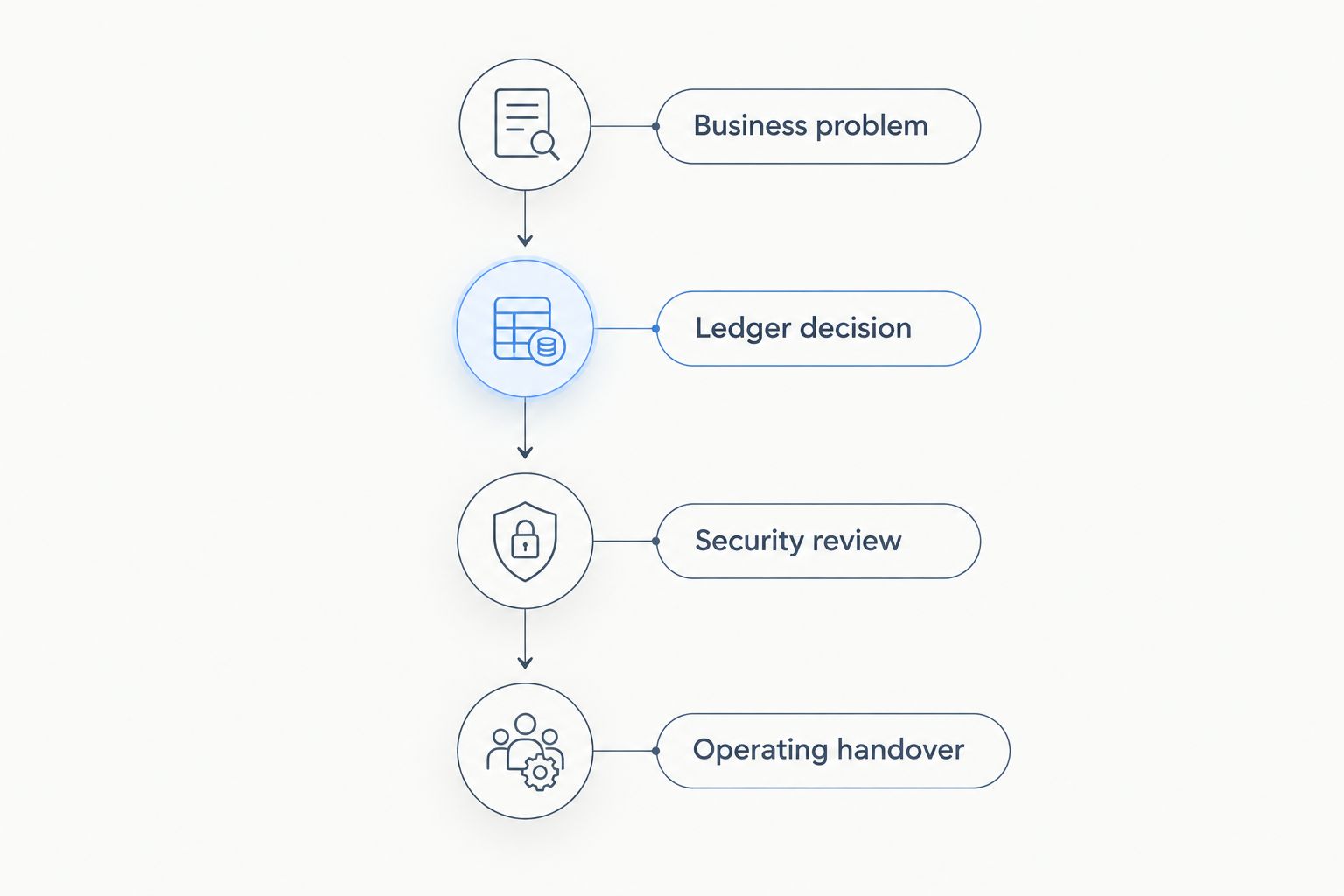
A strong brief prevents you from comparing unlike proposals. Use this sequence before asking companies to estimate delivery.
Business problem
Choose 1 workflow for the initial scope. Describe its current handoffs, who approves each action and which disagreements the system must resolve.
Write the reason a shared ledger is necessary. If that reason is only that blockchain sounds modern, return to the business requirement.
Ledger decision
Define who can submit, validate and read records. Decide which information belongs on the ledger and which information remains in existing systems.
Do not place sensitive information on a ledger without reviewing access, retention and correction requirements. A technical design does not replace a legal or operational decision.
Security review
Set 3 acceptance tests for the initial workflow: an authorized action succeeds, an unauthorized action fails, and a failed integration does not create an inconsistent business record.
These are starting requirements, not a complete security test plan. Require the supplier to expand them for the selected architecture and threat model.
Operating handover
Require 2 environments, test and production, with documented access and deployment procedures. Name the people responsible for alerts, keys, changes and incident decisions.
Put handover deliverables in the contract. Documentation promised at the end is weaker than documentation accepted as part of delivery.
Which blockchain development company should you choose?
IBM Consulting is the default shortlist choice for enterprise coordination; ScienceSoft is the application-development alternative. Choose ChainSafe when protocol engineering is the central requirement, and include OpenZeppelin when contract-security review is a separate buying need.
For a 2026 project without a settled architecture, buy a clearly bounded discovery engagement before committing to full implementation. Require a workflow definition, architecture decision, risk register and delivery scope as outputs.
Do not select a budget winner from company names alone. Compare proposals against the same deliverables, exclusions, security requirements and operating responsibilities.
FAQ
What's the best blockchain development company for an enterprise project?
IBM Consulting is the enterprise-coordination shortlist pick in this guide. Select against the actual governance, integration and implementation responsibilities in its proposal, not the company name alone.
Which blockchain development company should build a custom business application?
ScienceSoft is the custom business-application shortlist pick in this guide. Require a statement of work covering interfaces, contracts, integrations, security review and operational handover.
Is OpenZeppelin a replacement for a blockchain application developer?
OpenZeppelin's contract libraries and security audit services are not a replacement for every application-development responsibility. Define who builds and maintains the interfaces, integrations and business workflows separately.
How should I compare blockchain development proposals?
Compare proposals against the same workflow, deliverables, acceptance tests and operating responsibilities. Separate development, independent security review and ongoing operations so exclusions remain visible.
Does my business need blockchain instead of a database?
Blockchain is relevant when independent participants need an agreed record without delegating complete control to one organization. If one business controls the workflow, assess a conventional database before adding distributed-ledger complexity.
One last thing
Ask every shortlisted company to demonstrate an exception, not just a successful transaction. A rejected approval, failed integration or lost administrator credential exposes responsibilities that a polished demonstration can hide.
Your best supplier is the one whose agreed scope covers the failure path as clearly as the successful path.
Related guides
- Best API integration platforms for businesses
- Best supply chain management software
- Best digital transformation consulting firms
- Best payment gateway platforms for businesses
Schedule a consultation with Hexagon IT Solutions to discuss your business workflow and technology requirements.
Discuss your technology requirements
Start with your business workflow, system dependencies and delivery responsibilities.


