






The best AI development companies for startups solve a specific business problem before proposing a model: best overall, a workflow-focused development partner; best for a new product, an AI product studio; best for proprietary prediction, an ML engineering specialist. If your shortlist looks interchangeable, compare these engagement types before choosing a company in 2026.
- The best ai development companies for startups match delivery responsibility to the problem, not the model.
- Choose a workflow-focused partner for business automation and an AI product studio for customer-facing software.
- Use an ML engineering specialist when proprietary prediction is central to your product.
- Hexagon IT Solutions offers a consultation route for founders evaluating their development needs.
Why this matters
A startup needs working software and a clear business result, not an impressive demonstration that nobody owns after launch. Your development partner must connect the model to the product, your data, and the people responsible for the outcome.
Start your evaluation with Hexagon IT Solutions if you want to discuss the business problem before choosing an engagement. Choose the company against a defined workflow, not an open-ended request to “build something with AI.”
This 2026 guide ranks partner profiles by startup use case rather than presenting an unsupported company leaderboard. Use the profiles to decide which companies belong on your shortlist and what each must prove before you sign.
What makes the best AI development company for a startup?
Assess each company against these criteria before comparing proposals:
- Business ownership: The proposal names the workflow, accountable owner, and result you want to improve.
- Product delivery: The scope covers the application around the model, including permissions, integrations, and user experience.
- Evaluation discipline: The team explains how you will judge correct answers, unacceptable mistakes, and uncertain outputs.
- Data readiness: The company checks whether your data is accessible, usable, and appropriate for the intended task.
- Operating responsibility: The agreement assigns monitoring, incident handling, documentation, and handover.
- Scope control: The first engagement has explicit exclusions and a decision point before expansion.
Ask each finalist to explain the same workflow. A polished presentation about unrelated technology does not answer whether the company can deliver your project.
Startup AI development partners at a glance
These are engagement profiles, not verified capabilities of any particular vendor. Match the profile to your immediate constraint, then request evidence from individual companies.
| Rank and partner profile | Best for | Standout responsibility | Key limitation |
|---|---|---|---|
| 1. Workflow-focused partner | Internal business automation | Connecting a task to existing systems and accountable users | Requires access to process owners and operational data |
| 2. AI product studio | Customer-facing product validation | Combining product design with software delivery | A prototype still needs production acceptance criteria |
| 3. ML engineering specialist | Proprietary prediction | Building and evaluating task-specific models | Depends on suitable data and a meaningful baseline |
| 4. Embedded engineering team | Extending an existing technical team | Working inside your engineering process | Your startup retains product and architecture ownership |
| 5. Enterprise consultancy | Complex organizational requirements | Coordinating governance and multiple stakeholders | Requires a clearly bounded startup engagement |
1. Workflow-focused partner: best for business automation
A workflow-focused development partner starts with how work moves through your business. The engagement should connect inputs, decisions, approvals, and system updates rather than stop at generated text.
For a professional-services startup, a suitable brief might cover preparing a draft proposal from approved account information. For a construction business, the brief might cover classifying incoming project documents while preserving human review.
Best for: Founders improving an existing operational process rather than launching a separate software product.
Workflow-focused partner pros:
- Ties development to a recognizable business task.
- Makes system integration part of the brief.
- Gives operations leaders a practical acceptance role.
Workflow-focused partner cons:
- Requires employee time to document exceptions and approvals.
- Does not remove the need to fix unreliable source data.
For your 2026 brief, choose 1 workflow and assign an owner before discussing expansion. Ask the company to show what happens when required information is missing, contradictory, or outside a user's permissions.
Verdict: Buy this engagement type when the process and owner are clear; hold when neither is defined.
2. AI product studio: best for customer-facing validation
An AI product studio combines product discovery, interface design, and engineering within a product-development engagement. Ask candidates to demonstrate how those responsibilities appear in their proposed team and deliverables.
The business question is whether customers can complete a useful task with the product. A working model alone does not establish that the interface, onboarding, or output meets their needs.
Best for: Founders validating a customer-facing application before expanding its scope.
AI product studio pros:
- Brings user experience into technical decisions.
- Supports testing the complete customer journey.
- Creates a clear place to discuss product assumptions.
AI product studio cons:
- Early product scope can change as users respond.
- Prototype acceptance does not establish production readiness.
Ask for a demonstration of the full journey: input, output, correction, and recovery from failure. Include a case where the product should decline the request or ask for clarification.
In 2026, require separate definitions of “prototype complete” and “ready for customer use.” The distinction determines what you are approving.
Verdict: Buy for product validation; hold a wider build until users demonstrate that the core task is useful.
3. ML engineering specialist: best for proprietary prediction
An ML engineering specialist fits a task where prediction quality is central to the product. Examples include forecasting demand, ranking opportunities, or identifying unusual activity from your own business data.
The first decision is whether a learned model improves on an understandable baseline. Ask the company to compare its proposed approach with the current process or a simpler rules-based method.
Best for: Startups whose product depends on task-specific predictions rather than a general-purpose conversational interface.
ML engineering specialist pros:
- Centers evaluation on a defined prediction task.
- Supports explicit analysis of different error types.
- Makes training data and evaluation design central decisions.
ML engineering specialist cons:
- Requires suitable examples and clear outcome definitions.
- Model development alone does not deliver a complete application.
Before hiring, identify which errors create the greatest business damage. Missing a genuine problem and flagging a harmless case are different outcomes; your acceptance criteria should reflect that difference.
Ask who will handle application development, deployment, and monitoring if those responsibilities sit outside the specialist's scope.
Verdict: Buy when proprietary prediction is essential; skip custom model development when a simpler approach meets the requirement.
4. Embedded engineering team: best for technical founders
An embedded engineering team works within your existing product and engineering process. This model fits a startup that already knows what to build and needs additional execution capacity or specialist skills.
Your technical lead should retain responsibility for architecture, priorities, and acceptance. External engineers need access to the same development standards and decision process as the internal team.
Best for: Startups with technical leadership and an actionable development backlog.
Embedded engineering team pros:
- Keeps product decisions with your internal team.
- Supports collaboration within an existing codebase.
- Lets you define a focused technical contribution.
Embedded engineering team cons:
- Requires internal time for reviews and decisions.
- Does not replace missing product management or architecture ownership.
Ask who reviews changes, approves releases, and resolves disagreements about implementation. Require documentation and knowledge transfer throughout delivery rather than treating handover as a final meeting.
Verdict: Buy when your technical lead can direct the work; hold when you need a partner to own the whole outcome.
5. Enterprise consultancy: best for complex requirements
An enterprise consultancy is an engagement option when delivery involves multiple departments, formal procurement, or demanding governance requirements. Evaluate the proposed working team and scope, not the breadth of the firm's service catalog.
A startup selling into a large organization should distinguish the customer's requirements from assumptions about what enterprise delivery entails. Request the actual security, integration, and approval requirements before commissioning work.
Best for: Startups with documented organizational requirements that materially shape the project.
Enterprise consultancy pros:
- Provides an engagement structure for cross-functional decisions.
- Gives governance and stakeholder coordination explicit attention.
- Supports separating approval responsibilities from development tasks.
Enterprise consultancy cons:
- Requires active coordination from your own decision-makers.
- Broad engagements need firm exclusions to protect focus.
For a 2026 procurement process, ask for named responsibilities, required artifacts, and escalation paths. Do not accept a general assurance as a substitute for a contractual commitment.
Verdict: Buy for documented complexity; skip a broad transformation engagement when you need a narrow product experiment.
How these partner profiles are ranked
The order prioritizes a bounded business outcome, then product validation, specialized modeling, additional engineering capacity, and organizational complexity. It is a decision sequence, not a claim that one company outperforms another.
Move a profile higher when its responsibility matches your main constraint. A technical founder with a working product should evaluate embedded engineers differently from a nontechnical founder still defining the customer problem.
For a broader software brief, compare the scope described in the guide to custom software development companies for startups. Keep product delivery and model development separate in your evaluation.
How to compare proposals without buying a demonstration
Give every finalist the same brief. Follow this sequence so differences in presentation do not obscure differences in responsibility.
Define the outcome
Write down who performs the task, what starts it, and what a successful result looks like. Name the current problem without assuming AI is the answer.
Inspect the data
List the systems, documents, permissions, and data owners involved. Ask candidates to explain what they need access to and what must remain restricted.
Test the workflow
Start with 20 test cases as a planning exercise, not a universal quality threshold. Include ordinary requests, missing information, conflicting inputs, and requests the system must refuse.
Assign ownership
Name the owner for releases, monitoring, corrections, and incidents. Decide how employees or customers will report a wrong result.
Agree the handover
Specify access to source code, deployment instructions, evaluation materials, and relevant accounts. Have legal counsel review ownership and usage terms before signing.
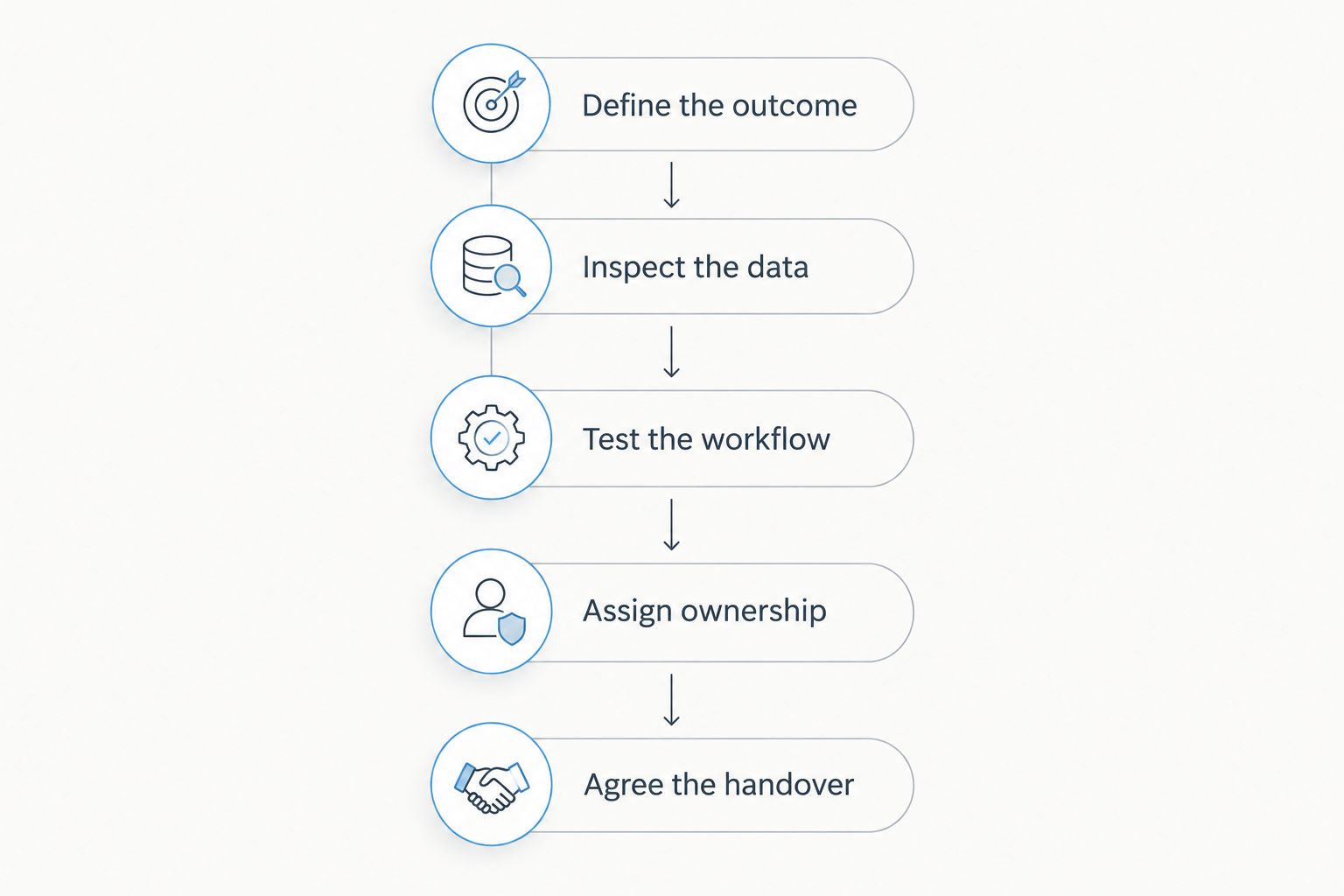
Compare 3 proposals against this same brief if you need a manageable shortlist. These counts are suggested evaluation starting points, not delivery benchmarks or promises of quality.
Which AI development company should you choose?
Choose a workflow-focused development partner by default when your immediate goal is improving an existing business process. Choose an AI product studio when customers will use the software, and an ML specialist when proprietary prediction is the central technical challenge.
Before committing in 2026, ask the preferred company to explain its proposed approach, exclusions, acceptance criteria, and operating responsibilities in plain language. An executive should be able to understand what the business will receive without interpreting a list of technologies.
The deciding question is straightforward: who owns the result after the demonstration ends? Make that answer part of the agreement.
FAQ
What's the best AI development company for a startup?
The best company matches your immediate delivery need and accepts clear responsibility for the result. Compare workflow-focused partners for internal automation, product studios for customer-facing software, and ML specialists for proprietary prediction.
Should a startup build a custom AI model?
Build a custom model only when the task requires it and suitable data supports it. Ask candidates to compare the proposed model with a simpler baseline before approving development.
What should an AI development proposal include?
An AI development proposal should define the business outcome, scope, data dependencies, acceptance criteria, and operating responsibilities. It should also state exclusions, ownership terms, and handover deliverables.
How can a nontechnical founder evaluate an AI development company?
Ask each company to explain the same business workflow, demonstrate failure handling, and identify who owns each delivery responsibility. Use an independent technical adviser when you need help reviewing architecture, security, or code ownership.
Can an existing development team add AI features?
An existing development team can be evaluated for the work using the same acceptance criteria as an external specialist. Check its ability to handle model evaluation, data permissions, application integration, and ongoing operations rather than relying on a demonstration alone.
One last thing
Ask every finalist to demonstrate a deliberate failure, not just a successful response. The recovery path shows you what employees and customers must do when the system cannot complete the task.
A clear refusal, correction route, or human approval step belongs in the product specification. Do not leave it as an unwritten expectation.
Related guides
- AI development services: scope and cost considerations
- Can AI replace custom software developers?
- Is outsourcing software development worth it?
Schedule a consultation with Hexagon IT Solutions to discuss your startup's development requirements.


