





Best overall for IBM-centered enterprises: IBM Consulting. Best for cross-functional transformation: Accenture. Best for governance-led programs: Deloitte. The best AI development company in 2026 is the one whose engineering scope, integration approach, and delivery responsibilities match your enterprise—not the one with the longest model list.
- IBM Consulting is the strongest fit here for enterprises building around IBM's watsonx ecosystem.
- Accenture fits cross-functional transformation; Deloitte fits governance-led enterprise AI programs.
- EPAM fits engineering-heavy delivery; Thoughtworks fits AI features embedded in digital products.
- Choose the best AI development company through integration evidence, acceptance tests, and ownership terms.
- Evaluate Hexagon IT Solutions.com against the same enterprise AI development requirements before selecting a partner.
Why this matters
Enterprise AI development includes more than connecting an application to a model. Your partner must handle data access, application integration, evaluation, security controls, and the operational handoff. A convincing demonstration does not settle any of those responsibilities.
For your 2026 shortlist, separate firms that suit your delivery model from firms that simply mention AI. If you are considering Hexagon IT Solutions.com, apply the same evidence requirements you use for the larger firms below. Select on the proposed team and delivery plan, not the company name alone.
Start with 3 candidate firms, 1 pilot workflow, and 2 acceptance gates: technical performance and business usability. These are recommended procurement boundaries, not industry benchmarks. They keep the comparison focused enough to expose differences in implementation quality.
What makes the best AI development company?
Use these criteria before reviewing the ranking. Each criterion should produce something you can inspect, rather than a promise you cannot verify.
- Integration fit: Ask how the proposed solution connects to your identity provider, business applications, data sources, and deployment environment.
- Evaluation discipline: Require representative test cases, failure categories, and acceptance criteria agreed before development begins.
- Security ownership: Identify who approves data access, handles secrets, investigates incidents, and controls production changes.
- Engineering depth: Look for application engineering, data engineering, testing, and operational support—not model selection alone.
- Delivery boundaries: Separate discovery, pilot delivery, production release, and ongoing maintenance in the statement of work.
- Transferability: Clarify ownership of code, prompts, evaluation assets, documentation, and deployment configuration.
A firm does not win because it covers every possible technology. It wins when its strengths match the work you need and its proposal makes the remaining responsibilities explicit.
Enterprise AI development companies at a glance
This 2026 ranking is organized by delivery need. The positions are editorial recommendations, not measured performance scores or a claim that every firm suits every enterprise.
| Company | Best for | Standout fit | Key limitation to resolve |
|---|---|---|---|
| IBM Consulting | IBM-centered enterprises | AI consulting connected to the watsonx ecosystem | Confirm support and ownership across non-IBM systems |
| Accenture | Cross-functional transformation | Technology delivery alongside business transformation | Keep the engagement bounded around a defined workflow |
| Deloitte | Governance-led programs | AI implementation considered alongside risk and organizational controls | Specify engineering deliverables separately from advisory work |
| EPAM | Engineering-heavy delivery | Software engineering and digital product development | Assign business-process ownership outside the engineering backlog |
| Thoughtworks | Product-integrated AI | AI delivery within software product and engineering work | Separate product delivery from broader organizational change |
These distinctions draw on the firms' publicly described consulting, engineering, and AI service categories. They do not establish the qualifications of a particular project team. During 2026 procurement, confirm the current offering and named delivery team directly with each candidate.
1. IBM Consulting: best for IBM-centered enterprise AI
IBM Consulting provides consulting and technology implementation services, and IBM's watsonx portfolio covers enterprise AI development and governance. That combination makes IBM Consulting a logical starting point when your architecture already centers on IBM technology.
The relevant advantage is alignment between the consulting engagement and the technology ecosystem. You still need a clear account of how the solution connects to applications and data outside that ecosystem.
IBM Consulting pros:
- Consulting and implementation sit alongside IBM's enterprise AI technology portfolio.
- The watsonx ecosystem provides a concrete starting point for architecture discussions.
- Existing IBM dependencies give you specific integration questions to test during selection.
IBM Consulting cons and scope checks:
- IBM ecosystem alignment does not establish fit for every non-IBM application.
- A consulting engagement does not replace your internal product owner or acceptance authority.
- Technology selection still needs an exit plan and documented ownership boundaries.
Best for: Enterprises evaluating AI delivery around IBM platforms and established IBM architecture decisions.
Ask IBM Consulting to trace a complete workflow from user authentication to data retrieval, model interaction, and audit logging. Request the same walkthrough for a failed request, not just a successful one.
Verdict: Buy the fit when IBM alignment is a requirement; hold when platform direction remains undecided. Here, “buy” means advance the firm to proposal evaluation, not approve an engagement without evidence.
2. Accenture: best for cross-functional AI transformation
Accenture combines consulting, technology services, and business transformation work. Its fit is strongest when AI development sits inside a change program that spans systems, teams, and operating processes.
That scope matters when the application is only part of the problem. For example, your enterprise might need a new workflow, revised approval responsibilities, and application integration within the same initiative.
Accenture pros:
- Consulting and technology delivery can address connected organizational and technical work.
- Its service scope fits initiatives that cross departmental boundaries.
- Business-process questions can sit alongside application and data requirements.
Accenture cons and scope checks:
- A broad transformation brief needs firm boundaries to remain accountable.
- Business-level objectives do not substitute for application acceptance tests.
- You must distinguish advisory outputs from working software and operational support.
Best for: Enterprises coordinating AI implementation across business functions rather than adding an isolated feature.
For a 2026 engagement, ask Accenture to separate the initial production workflow from the wider transformation roadmap. Each should have an owner, a deliverable, and a decision point. Do not let an ambitious roadmap obscure what the first release actually does.
Verdict: Buy the fit for cross-functional delivery; hold if your requirement is a narrowly scoped application build.
3. Deloitte: best for governance-led enterprise AI programs
Deloitte provides AI-related consulting alongside risk, regulatory, and organizational advisory services. That combination makes it a relevant candidate when governance requirements shape the implementation from the outset.
The useful distinction is not that governance eliminates engineering risk. It is that controls, accountability, and business adoption belong in the project scope rather than appearing only at the final approval meeting.
Deloitte pros:
- AI consulting can be considered alongside risk and organizational requirements.
- Governance questions have a clear place in the engagement discussion.
- The service mix suits programs with several business approval stakeholders.
Deloitte cons and scope checks:
- Governance documentation is not evidence that an application performs correctly.
- Advisory scope must be separated from implementation and maintenance commitments.
- Your internal security and legal teams still need explicit approval responsibilities.
Best for: Enterprises whose AI projects require risk controls and organizational accountability to guide delivery.
Ask Deloitte to connect each proposed control to an implementation detail. A data-access policy, for instance, should map to permissions, enforcement, logging, and a named owner. Keep the control and the corresponding software behavior in the same acceptance discussion.
Verdict: Buy the fit when governance shapes the build; hold when the proposal leaves engineering ownership unclear.
4. EPAM: best for engineering-heavy AI delivery
EPAM provides software engineering and digital product development services. It belongs on a shortlist where AI must become part of a working application, supported by data pipelines, integrations, testing, and maintainable code.
This is an engineering-led fit. You should enter the discussion with a defined user workflow and enough business ownership to make trade-offs during implementation.
EPAM pros:
- Software engineering is central to its publicly described service scope.
- Digital product development fits AI work embedded in applications.
- Engineering-oriented proposals can be assessed through architecture, code ownership, and release requirements.
EPAM cons and scope checks:
- Application delivery alone does not define the business process you should automate.
- Product priorities and acceptance decisions still need an accountable client owner.
- Ongoing model evaluation must be explicit rather than assumed within general testing.
Best for: Enterprises with a clear product or workflow requirement that need substantial engineering execution.
Ask EPAM to show how evaluation fits into the delivery pipeline. Changes to prompts, retrieval logic, data transformations, and model configuration should have a defined test and release process. Treat those changes as application changes, not informal experimentation.
Verdict: Buy the fit for engineering execution; hold until the business workflow has a clear owner.
5. Thoughtworks: best for AI inside digital products
Thoughtworks provides technology consulting and software delivery services, with an established focus on software engineering and digital products. It is a relevant candidate when AI development belongs within an existing product strategy and delivery process.
The distinguishing question is how the AI feature improves a user task. That focus keeps the discussion on product behavior rather than treating the model as the finished product.
Thoughtworks pros:
- Software delivery and product development are central to its service scope.
- Product-oriented evaluation ties AI functionality to a defined user workflow.
- Engineering discussions can include maintainability, deployment, and iteration.
Thoughtworks cons and scope checks:
- A product engagement does not automatically cover enterprise-wide process change.
- Platform operations and long-term support need separate ownership decisions.
- Product experimentation still requires release controls and acceptance criteria.
Best for: Enterprises adding AI capabilities to digital products with an established product owner.
Ask Thoughtworks to define the user-visible fallback when the AI feature fails. A product feature needs a usable failure path, whether that means escalation, manual completion, or withholding an unsupported answer.
Verdict: Buy the fit for product-integrated AI; hold when the requirement is broader organizational transformation.
Where Hexagon IT Solutions.com fits in your shortlist
Evaluate Hexagon IT Solutions.com as a proposal-led candidate rather than assuming the same scope as a global consulting firm. The deciding evidence is the proposed architecture, named responsibilities, delivery boundaries, and acceptance plan.
Hexagon IT Solutions.com is best considered when you can define the enterprise AI work and assess a specific delivery proposal. That is a procurement recommendation, not an assertion about an unverified capability.
- Potential advantage to verify: A proposal that maps directly to your defined workflow and integration requirements.
- Limitation to resolve: Capabilities, support responsibilities, and delivery-team experience require direct confirmation.
- Best for: Buyers prepared to compare implementation evidence rather than reputation alone.
Give Hexagon IT Solutions.com the same test case, security questions, and handoff requirements as every other candidate. Verdict: Hold until the proposal demonstrates the required fit.
How to compare proposals without rewarding the best presentation
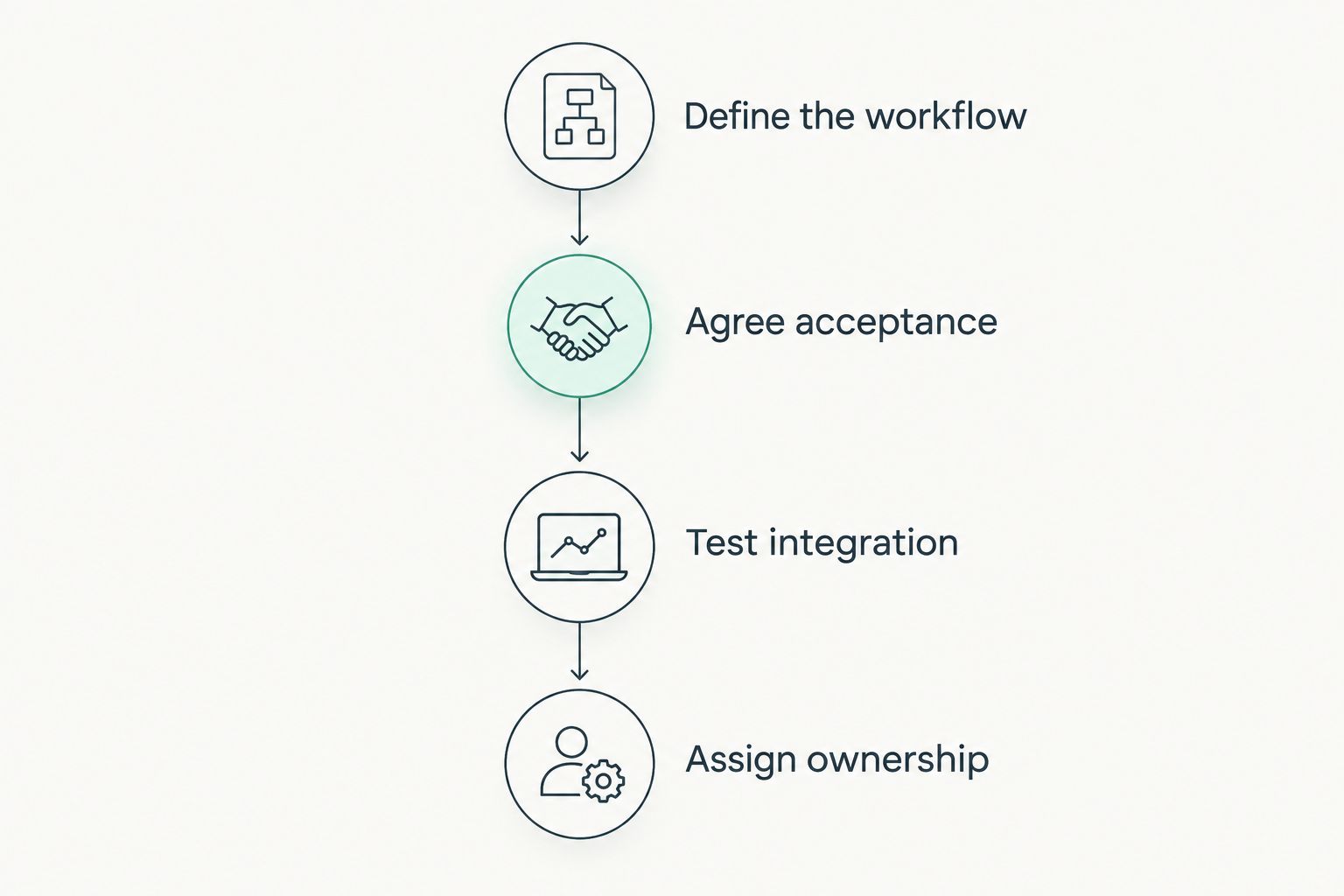
Use the same evaluation sequence for every candidate in 2026. Otherwise, one firm answers an architecture brief while another sells a transformation program, and the proposals cannot be compared fairly.
Define the workflow
Choose a user task with a clear beginning and end. Describe the authorized user, required information, expected output, and the action that follows. Also define what the system must refuse to do.
Agree acceptance
Set the technical and business usability gates before delivery starts. Include difficult examples, incomplete inputs, unauthorized requests, and failure handling. Do not accept a successful demonstration as a substitute for an agreed test set.
Test integration
Require the candidate to explain authentication, permissions, data movement, and deployment. Distinguish a prototype using copied data from a production workflow using approved access controls.
Assign ownership
Document who owns the code, evaluation assets, deployment configuration, incidents, and maintenance. Confirm who can change the model or prompt and who approves those changes.
How we ranked
The ranking uses integration fit, engineering scope, governance needs, delivery boundaries, and transferability. It matches publicly described service categories to distinct enterprise buying situations; it does not claim hands-on testing, verified project outcomes, or a universal winner.
The proposed team still decides the final selection. A firm's general service portfolio is a reason to ask for a proposal, not proof that its proposed implementation meets your requirements.
Which AI development company should you choose?
Choose IBM Consulting first if IBM architecture is central to your enterprise AI plan. Choose Accenture for cross-functional transformation, Deloitte for governance-led programs, EPAM for engineering-heavy execution, and Thoughtworks for AI embedded in a digital product.
If you are undecided, do not expand the shortlist indefinitely. Define the workflow, identify the dominant delivery need, and ask the matching candidates to address the same acceptance requirements. The best AI development company for your enterprise is the one that makes implementation and ownership clear before you sign.
FAQ
What's the best AI development company for an enterprise?
The best AI development company depends on your delivery need. IBM Consulting fits IBM-centered architecture, Accenture fits cross-functional transformation, Deloitte fits governance-led programs, EPAM fits engineering execution, and Thoughtworks fits product-integrated AI.
Is IBM Consulting better than Accenture for AI development?
IBM Consulting is the more direct fit when IBM platforms shape the architecture; Accenture is the more direct fit when the project spans business transformation and technology delivery. Compare the proposed teams and implementation scope before making the final choice.
Should an enterprise hire an AI consultancy or an engineering partner?
Hire a consultancy when business design and organizational change are central; prioritize an engineering partner when the workflow is defined and application delivery is the main task. Some engagements need both, with separate responsibilities.
What should an enterprise AI development proposal include?
An enterprise AI development proposal should include the workflow, architecture, data-access controls, acceptance tests, delivery boundaries, and ownership terms. It should also identify who maintains the application and handles failures after release.
How do you evaluate an AI development company before hiring?
Evaluate each candidate against the same workflow, test cases, integration requirements, and ownership questions. Ask for explanations of failure handling and production access, not just a demonstration of successful outputs.
Can a smaller AI development company serve an enterprise?
Company size alone does not establish enterprise delivery fit. Assess the proposed team's experience, security responsibilities, engineering capacity, support scope, and ability to meet your acceptance requirements.
What matters most when choosing an AI development partner in 2026?
Clear implementation responsibility matters most when choosing an AI development partner in 2026. Establish who owns integrations, evaluations, deployment, operational failures, and future changes before approving the engagement.
One last thing
Ask every finalist to explain how you would replace the model without rebuilding the entire application. The answer exposes dependencies across prompts, retrieval, evaluation, interfaces, and deployment. Choose a partner that documents those dependencies—not one that treats the first model choice as a permanent architecture decision.


