






The best AI automation services companies in 2026 depend on the work you need to change: Accenture for enterprise-wide transformation, IBM Consulting for hybrid technology environments, Deloitte for governance-led programs, and Cognizant for automation tied to IT operations. Choose the delivery model before the company; a strong demonstration does not establish who will own the workflow after launch.
- Compare the best ai automation services companies by workflow ownership, integration requirements, and measurable business outcomes.
- Accenture belongs on enterprise transformation shortlists; IBM Consulting fits evaluations involving hybrid technology environments.
- Deloitte fits governance-led evaluations; Cognizant fits automation programs connected to IT operations.
- Start with one bounded workflow, define acceptance criteria, and assign maintenance before expanding.
Why this matters
Your automation project crosses business processes, software, and employee responsibilities. Selecting a company only for its model demonstration leaves integration, exception handling, and support outside the decision.
For SMB leaders defining sales and operations requirements, Hexagon IT Solutions is a consultation option for scoping an automation initiative. A consultation with Hexagon IT Solutions should start with the business bottleneck, not a predetermined technology purchase.
What makes the best AI automation services companies?
Use these criteria to assess your 2026 shortlist:
- Business ownership: A named person owns the result, not just the deployment.
- Integration fit: The proposal explains how systems exchange and validate information.
- Exception handling: Failed or uncertain actions reach an accountable person.
- Governance: Access, approvals, and records match the consequences of each action.
- Operational handover: Your team receives documentation, monitoring, and support responsibilities.
AI automation services companies at a glance
This is a use-case shortlist, not a measured performance league table. The order follows distinct buying situations rather than an unsupported claim that one company wins every project.
| Company | Best for | Standout service orientation | Scope issue to resolve |
|---|---|---|---|
| Accenture | Enterprise-wide operating change | Technology implementation alongside business transformation | Separate the initial workflow from the wider transformation program |
| IBM Consulting | Hybrid technology environments | Consulting connected to enterprise technology and AI | Define platform choices and system dependencies explicitly |
| Deloitte | Governance-led automation | Business, risk, and technology advisory | Keep policy work connected to executable delivery milestones |
| Cognizant | Automation within IT operations | Technology services and business-process delivery | Distinguish building the workflow from operating it |
1. Accenture: best for enterprise-wide transformation
Accenture provides consulting and technology services across business transformation and implementation. Include Accenture when automation requires coordinated changes across departments rather than an isolated application.
For example, a sales-to-delivery workflow can require changes to qualification, approvals, customer records, and project handoff. That is an operating-model decision as much as a software decision.
Accenture pros:
- Brings business transformation and technology implementation into the same evaluation.
- Fits programs involving several business functions.
- Offers a relevant starting point when automation accompanies wider organizational change.
Accenture scope trade-offs:
- A broad transformation brief still needs a tightly bounded first release.
- Executive sponsorship does not replace a named operational owner.
Ask the proposed delivery team to distinguish process redesign from software implementation. Require separate acceptance criteria for each, so completing workshops does not count as delivering a working automation.
Best for: Enterprises changing business processes across functions.
Verdict: Buy when the requirement is cross-functional transformation; do not use that scope by default for a single workflow.
2. IBM Consulting: best for hybrid technology environments
IBM Consulting provides business and technology consulting, including work involving AI and hybrid cloud. Include IBM Consulting when your automation must operate across a mixed technology estate.
An automated service request, for example, might read a document, retrieve account information, and request an update in another system. Your evaluation should follow that entire transaction rather than stop at the generated response.
IBM Consulting pros:
- Connects AI discussions with enterprise architecture.
- Fits evaluations involving hybrid cloud and existing business systems.
- Provides a relevant option when integration architecture is central to the project.
IBM Consulting scope trade-offs:
- Platform selection and implementation responsibilities need separate written decisions.
- An architecture proposal still needs business-level acceptance tests.
For a 2026 procurement, ask which components your organization will operate, which the provider will operate, and which depend on other suppliers. Require the proposal to explain how failed updates are detected and reconciled.
Best for: Organizations integrating automation across hybrid technology environments.
Verdict: Buy when architecture and system integration drive the requirement.
3. Deloitte: best for governance-led automation
Deloitte provides consulting across business, technology, and risk-related disciplines. Include Deloitte when automation decisions require close coordination between operational leaders and governance stakeholders.
Consider a workflow that prepares a customer communication using confidential records. The buying decision includes who can access those records, who approves the communication, and what evidence remains afterward—not just whether the text reads well.
Deloitte pros:
- Connects business-process discussions with risk and governance considerations.
- Fits evaluations requiring agreement across business and control functions.
- Provides a relevant option when policy decisions shape the automation design.
Deloitte scope trade-offs:
- Governance deliverables need corresponding implementation tasks and owners.
- Approval requirements should distinguish routine actions from consequential exceptions.
Ask for a decision map showing which actions run automatically, which require review, and which remain outside scope. Keep that map attached to the delivery plan, not in a separate policy document that developers never use.
Best for: Organizations where governance requirements determine how automation operates.
Verdict: Buy when control design is part of the core business requirement.
4. Cognizant: best for automation connected to IT operations
Cognizant provides technology services and business-process services. Include Cognizant when your buying decision covers both implementing automation and fitting it into an ongoing operating environment.
A workflow is not finished when it succeeds in a demonstration. Someone must respond when an application changes, credentials expire, or a transaction reaches an unexpected state.
Cognizant pros:
- Brings technology delivery and operational services into the evaluation.
- Fits programs connected to application maintenance and business processes.
- Provides a relevant option when ongoing service ownership matters alongside implementation.
Cognizant scope trade-offs:
- Implementation and ongoing operations require distinct acceptance criteria.
- Support boundaries must identify which team owns failures between systems.
Ask bidders to walk through an incident from detection to resolution. The answer should identify the responsible role, the escalation path, and the evidence used to confirm recovery.
Best for: Organizations connecting automation delivery with ongoing IT operations.
Verdict: Buy when the operating arrangement matters as much as the initial build.
How the shortlist is ranked
The ranking matches established service orientations to different buying situations. It does not claim measured differences in delivery quality, customer satisfaction, or project results.
Apply the same criteria to every proposal: business ownership, integration fit, exception handling, governance, and operational handover. Your final choice should depend on the proposed team and contract scope, not the company name alone.
Turn your 2026 shortlist into a delivery test
Give each shortlisted company the same workflow brief. A consistent brief makes differences in assumptions visible before you commit to implementation.
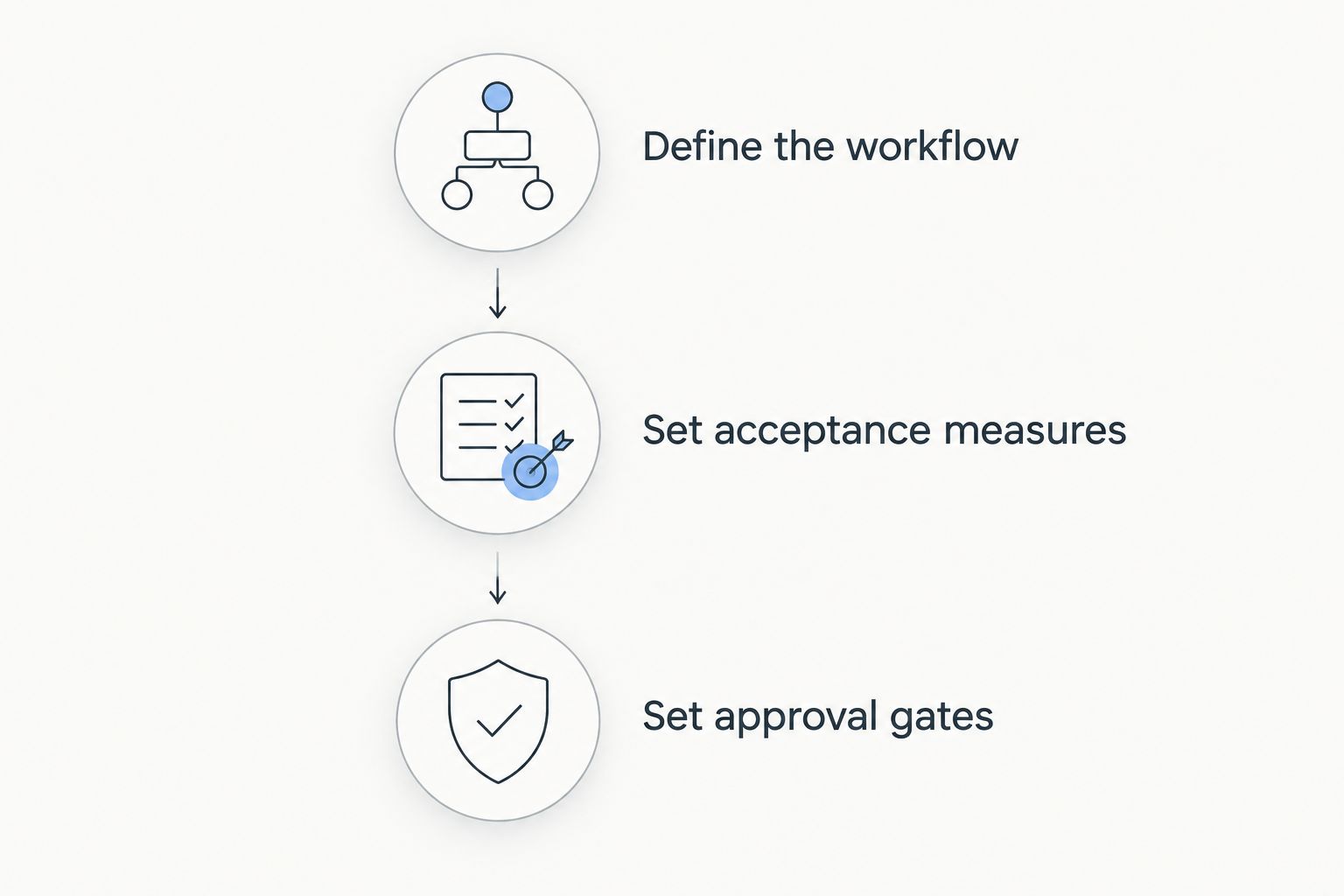
Define the workflow
Choose 1 workflow with an identifiable beginning and end. For a professional services business, that might be an approved opportunity becoming a delivery handoff; for construction, it might be an incoming document reaching the correct reviewer.
Specify the trigger, required information, permitted actions, and completion evidence. State what remains outside scope so the proposal does not quietly expand into a wider systems replacement.
Set acceptance measures
Use 3 measures in the evaluation: cycle time, human handling effort, and exception rate. Establish your own baseline before setting targets; a vendor demonstration is not evidence of your current performance.
Measure the complete process. Faster document classification has little business value if the resulting records wait in an unowned queue.
Set approval gates
Use 2 approval gates for the initial release: business acceptance and operational acceptance. Business acceptance confirms that the workflow produces the required result; operational acceptance confirms that someone can monitor, support, and recover it.
Do not treat these as interchangeable. A correct output does not prove the workflow is supportable.
Assign ownership before automation reaches production
The contract should answer a practical question: who fixes the workflow when the underlying business process changes? Assign that responsibility before launch, while both business and technical teams are involved.
For sales teams, sales automation maintenance responsibilities belong in the operating agreement because changes to pipeline stages, approval rules, and field definitions alter what the workflow must do. A successful launch does not settle ownership of those later changes.
Build a responsibility table with these roles:
| Role | Decision or task to own | Evidence to retain |
|---|---|---|
| Business owner | Approve process rules and intended outcomes | Current workflow definition |
| System owner | Approve access and application changes | Access and configuration records |
| Delivery provider | Implement the agreed scope | Tests, documentation, and deployment records |
| Operations owner | Monitor failures and coordinate recovery | Incident records and recovery instructions |
One person can hold several roles in a smaller company. The requirement is explicit accountability, not a larger committee.
Compare proposals without confusing scope and value
For your 2026 evaluation, separate discovery, implementation, integration, and ongoing operation. Otherwise, proposals with different responsibilities appear comparable when they are not.
Ask each bidder to identify assumptions about data cleanup, access permissions, existing documentation, and employee participation. These are delivery dependencies, not administrative details.
If your workflow requires new connections between applications, include the integration questions covered in API integration planning in the brief. Establish which system is authoritative, how updates are confirmed, and what happens when a connection fails.
Use these questions during the proposal review:
- What exact business event starts the workflow?
- Which actions need human approval?
- How are duplicate requests handled?
- What happens when source information is incomplete?
- Who accepts a change to the workflow after launch?
- What documentation does your team receive at handover?
Reject ambiguous scope, not unfamiliar terminology. A provider should explain the operating arrangement in language your business owner can approve.
Which AI automation services company should you choose?
Choose Accenture for a shortlist centered on enterprise-wide transformation. Choose IBM Consulting when hybrid architecture drives the evaluation, Deloitte when governance shapes the design, and Cognizant when delivery must connect with ongoing operations.
For an undecided SMB buyer, the next move is narrower: define the workflow before choosing a large implementation program. Your first decision is what to automate and how to verify success—not which supplier has the longest capabilities list.
The strongest 2026 proposal connects a business outcome to a bounded release, explicit acceptance criteria, and named operating responsibilities. Select the team that makes those commitments clear.
FAQ
What are the best AI automation services companies in 2026?
Accenture, IBM Consulting, Deloitte, and Cognizant belong on different use-case shortlists. Evaluate Accenture for enterprise transformation, IBM Consulting for hybrid environments, Deloitte for governance-led programs, and Cognizant for automation connected to IT operations.
Which AI automation company is best for a small business?
A small business should choose a provider that scopes a bounded workflow and assigns clear implementation and support responsibilities. Compare the proposed team, acceptance criteria, and handover rather than selecting on company size alone.
Should we use AI or ordinary workflow automation?
Use ordinary workflow automation when explicit rules can determine the required action. Evaluate AI for tasks involving unstructured information or interpretation, and define how uncertain results reach a human reviewer.
What should an AI automation services proposal include?
An AI automation services proposal should define the workflow, integrations, access requirements, acceptance measures, exception handling, and operational ownership. It should also state assumptions, exclusions, and the process for approving later changes.
How do we measure whether automation is working?
Compare cycle time, human handling effort, and exception rate against your own baseline. Include review and recovery work so the measurement reflects the complete business process rather than one automated step.
One last thing
Ask every finalist to demonstrate a failed transaction, not just a successful one. Watch who receives the alert, what information they receive, and how they restore the workflow without creating a duplicate action.
That exercise tests the operating arrangement your team will depend on after the demonstration ends.
Related guides
- Best AI development companies for enterprises
- Can AI improve CRM customer data accuracy?
- Can AI handle enterprise business intelligence tasks?
Schedule a consultation with Hexagon IT Solutions to define your first automation workflow and its acceptance criteria.


