





Retail AI development services build and integrate software that helps you make decisions about demand, inventory, merchandising, and customer service without relying on disconnected spreadsheets. If your sales, stock, and support systems disagree, fix that foundation before asking a model to automate decisions.
- AI development services for retail businesses should start with one measurable workflow, not a company-wide technology rollout.
- Hexagon IT Solutions offers a consultation route for retail leaders evaluating software development.
- Demand forecasting needs stockout and promotion context; sales history alone does not explain demand.
- Keep inventory adjustments, refunds, and customer-facing promises behind explicit approval rules.
Why AI development matters for retail businesses
Retail decisions connect across departments. A promotion changes demand, replenishment affects availability, and a service response can create a promise your fulfillment team must keep. Your 2026 development brief should describe those connections before listing features.
The objective is not to add a chatbot everywhere. It is to improve a defined business decision while protecting margin, customer trust, and operational control. Start with the decision that currently causes avoidable work or inconsistent execution.
Your point-of-sale system is part of that foundation. Review the POS systems for retail businesses guide when mapping where sales, returns, and product records originate; assess data access before considering an AI integration.
Retail also requires separating observed sales from underlying demand. An item cannot record a sale while unavailable, and returns can change the meaning of apparent revenue. A useful retail model needs business context, not just transaction volume.
Build your retail AI plan in 6 steps
1. Choose one decision to improve
Start manually. Ask store managers, ecommerce operators, buyers, and support leads where they repeatedly reconcile information or override system recommendations. Record the trigger, decision, owner, and consequence in a shared document.
Choose 1 workflow for the first release. This is a scope recommendation, not an implementation benchmark: a narrow pilot makes it easier to identify whether the software changes an outcome.
For example, replenishment recommendations and customer-service drafting solve different problems. Replenishment requires product-location history and purchasing constraints; service drafting requires approved policy information and conversation context. Combining them immediately makes evaluation harder.
Write the outcome as a decision, not a feature. “Help buyers identify replenishment exceptions” gives a development team clearer boundaries than “build an intelligent retail platform.”
- Name the employee who makes the decision today.
- Document the existing manual process and its exceptions.
- Select one primary outcome, such as handling time or forecast error.
- Define which actions remain outside the pilot.
- Record the condition that would stop the project.
2. Map the data and establish a baseline
Use exports and a spreadsheet before commissioning a new data pipeline. Match product identifiers across sales, inventory, ecommerce, and purchasing records. Document where quantities, timestamps, and return statuses disagree.
For a 2026 demand-forecasting pilot, distinguish sales from availability. Include relevant promotions, stockouts, returns, and assortment changes when those records exist. Without that context, a system can mistake a supply constraint for weak demand.
Establish the current result before evaluating an alternative. For forecasting, compare predictions with later outcomes using a chronological holdout period; do not train on information that would have been unavailable when the decision occurred.
Keep the baseline simple enough for an operator to explain. Existing replenishment rules or a seasonal comparison provide a useful challenge: the proposed model must demonstrate value beyond the process you already understand.
- Identify the source of truth for each required field.
- Reconcile product, location, and order identifiers.
- Flag missing records rather than silently filling them.
- Save a baseline result using the current process.
- Reserve later observations for evaluation.
3. Select the smallest suitable development approach
Test the workflow with existing reports and documented rules first. If a dashboard answers the question, do not commission a prediction model. If the task requires drafting language, evaluate generated responses separately from the factual records supporting them.
A Hexagon IT Solutions consultation is best for retail leaders who need to define a development brief before selecting technology. Bring the workflow map and baseline to Hexagon IT Solutions; ask for a proposed scope rather than assuming a packaged retail product or particular integration exists.
A development partner can become the faster path when your team lacks the capacity to build and maintain the chosen workflow. That choice still creates responsibilities: someone must own requirements, acceptance testing, access permissions, and ongoing operation.
Ask every candidate to explain why the proposed method fits the decision. A recommendation that cannot be compared with a simpler alternative is not ready for approval.
- Compare existing features, rules, predictive models, and generated text.
- Request an architecture showing data movement and access.
- Ask who owns source code, configuration, and documentation.
- Require an evaluation plan before approving development.
- Assign responsibility for maintenance and model changes.
4. Connect systems with controlled permissions
Begin with read-only exports or access wherever practical. Prove that the workflow produces useful recommendations before allowing it to change inventory, send messages, or modify orders. Reading a record and changing a record require different approval decisions.
Design the integration around explicit business actions. A support assistant that drafts an answer does not automatically need permission to issue a refund. A replenishment model does not automatically need permission to place a purchase order.
Set 3 guardrails before enabling write access: approval rules, action logs, and rollback procedures. These are recommended controls, not a claim that every retail system supports the same implementation.
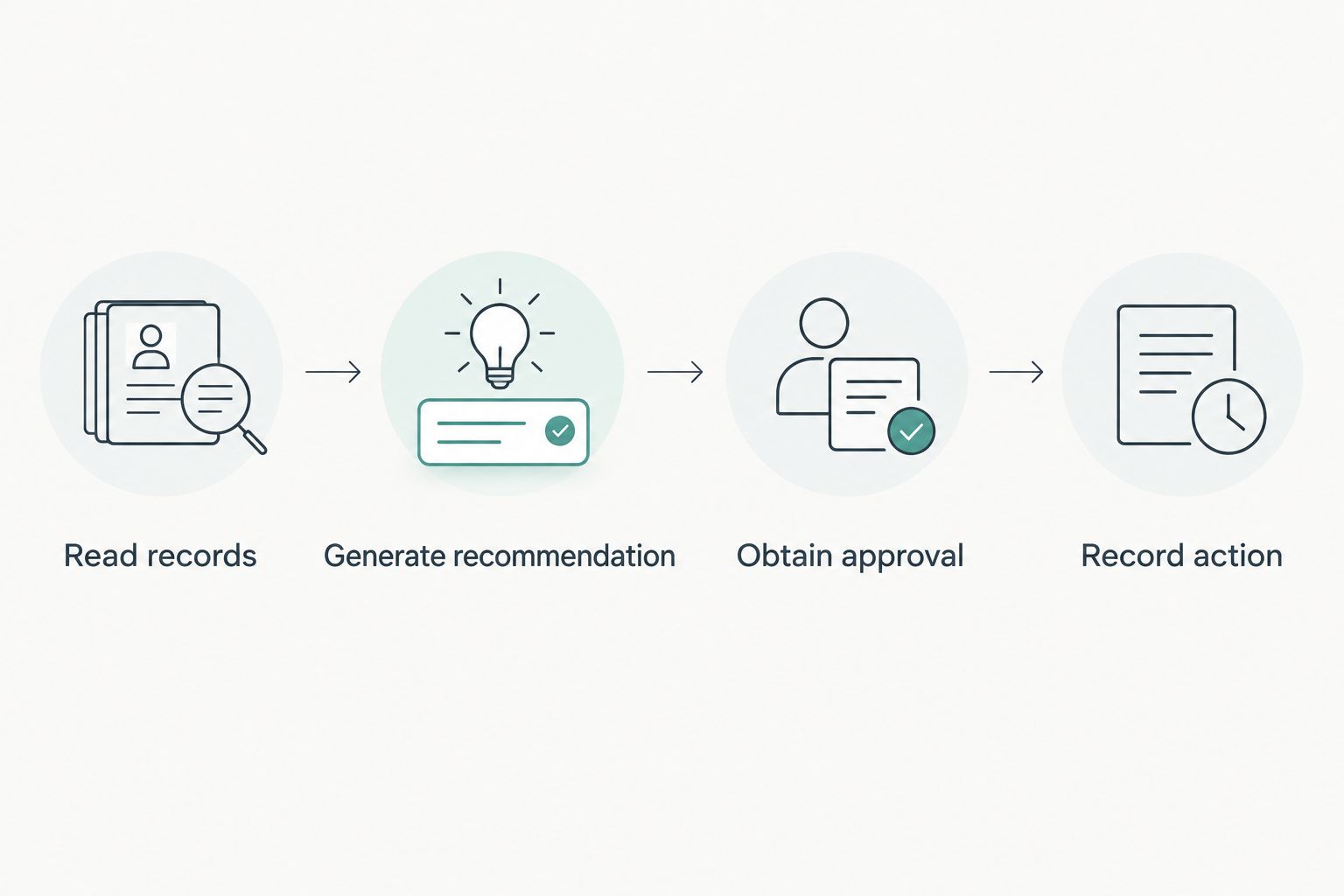
Keep the operational path clear: read approved records, generate a recommendation, obtain approval, and record the action. That separation makes failures easier to investigate.
- Limit access to the records each workflow needs.
- Require approval for consequential changes.
- Log the recommendation, approver, and resulting action.
- Define how to reverse an incorrect update.
- Specify behavior when a source system is unavailable.
5. Evaluate business outcomes and failure cases
Run the proposed workflow alongside the existing process before replacing it. Have employees assess recommendations without requiring them to act on every output. Record disagreements and their reasons; those exceptions reveal missing requirements.
For your 2026 evaluation, use 2 evaluation tracks: business results and failure behavior. Better average performance does not compensate for an unacceptable action, such as promising unavailable stock or exposing another customer's information.
Match the measurement to the job. A service assistant needs factual accuracy and escalation testing, while replenishment recommendations need evaluation against purchasing constraints and later demand. Do not reduce both to a generic accuracy score.
Account for review work as well. Faster drafting is not a net improvement when employees spend the saved time correcting unsupported answers or reconciling records.
- Compare results against the documented baseline.
- Test unavailable items, returns, and conflicting records.
- Measure employee review and correction effort.
- Check answers against approved policy sources.
- Require a named owner to approve release.
6. Roll out gradually and assign ongoing ownership
Start with a bounded product group, location, or support queue. Keep the previous process available until the new workflow passes its acceptance criteria. Expansion should follow evidence, not an arbitrary rollout date.
Your 2026 operating plan needs an owner after launch. Product assortments, promotions, policies, and system connections change; evaluation must continue when those inputs change.
Document what happens when quality drops. Employees need a clear route to flag a bad recommendation, stop an automated action, and return to the approved fallback. An incident plan that exists only in a developer's inbox is not an operating process.
Treat expansion as another approval decision. A workflow tested on one category has not automatically passed evaluation for a different category with different return patterns or purchasing rules.
- Name the business owner and technical owner.
- Publish instructions for exceptions and escalation.
- Monitor data freshness and integration failures.
- Re-evaluate after material policy or assortment changes.
- Expand only after reviewing the pilot evidence.
Compare retail AI development options
Choose the approach that fits your data, operating capacity, and decision risk. For a 2026 selection, request evidence using your workflow rather than a general demonstration. The table separates each option's main advantage from the responsibility it leaves with you.
| Option | Best for | Main advantage | Key limitation |
|---|---|---|---|
| Manual analysis and business rules | Defining a workflow before development | Makes assumptions and exceptions visible | Requires continued employee effort and consistent execution |
| Existing platform features | Requirements already supported by your current systems | Keeps work within an established operating environment | Coverage, data access, and controls depend on the platform |
| Packaged retail application | A standardized workflow with a close functional fit | Provides an existing application to evaluate | Configuration and integration boundaries can restrict fit |
| Custom AI integration partner | A defined workflow spanning multiple systems | Allows requirements to shape the proposed solution | Requires clear scope, acceptance criteria, and maintenance ownership |
| In-house development team | An ongoing development program with internal technical capacity | Keeps implementation knowledge within your organization | Your team owns delivery, monitoring, security, and upkeep |
Custom development is not the default winner. Choose it when existing options cannot satisfy a documented requirement and your organization can support the resulting software. Otherwise, improve the current process or use an existing capability.
Separate purchasing from evaluation. A polished demonstration establishes neither integration fit nor operational value; both require testing against your records, permissions, and exceptions.
Common mistakes retail businesses make
Treating sales as a complete demand signal
Sales records describe completed transactions, not every purchase customers wanted to make. Ignoring stockouts, promotions, or discontinued products weakens the interpretation. Ask what each record means before deciding what it can predict.
Automating product claims without approved sources
Generated product copy and support answers need verified specifications and current policies. Do not let a model invent compatibility, materials, delivery promises, or return terms. Keep factual claims tied to approved records and review ambiguous answers.
Measuring speed without correction effort
A faster first draft is only part of the workflow. Include review, rework, escalation, and downstream reconciliation when judging time saved. Otherwise, work moves between teams while the reported result looks better.
Giving a pilot production-level authority
A promising recommendation does not justify unrestricted access to purchasing, refunds, or customer messaging. Increase permissions only after testing the relevant action and failure path. Keep approval boundaries visible to the people responsible for the outcome.
Buying separate tools without a shared data plan
Independent applications can create conflicting product records and unclear ownership. Define shared identifiers, approved sources, and integration responsibilities before adding another tool. A unified operating process matters more than presenting unrelated applications under one interface.
FAQ
What do AI development services for retail businesses include?
AI development services for retail businesses cover defining a workflow, preparing data, building or configuring software, integrating systems, and evaluating results. Your agreement should specify which activities are included and who owns ongoing operation.
What's the best first AI project for a small retailer?
The best first project addresses one recurring decision with usable data and a measurable baseline. Start with a bounded workflow, such as support drafting or replenishment review, and keep consequential actions subject to approval.
Is custom retail AI better than an existing application?
Custom retail AI fits when a documented requirement cannot be met by an existing application. Existing software is the simpler choice when its functionality, integrations, and controls already match the workflow.
Can a retailer start without replacing its POS system?
A retailer can start without replacing its POS system when the required records are accessible through suitable exports or integrations. Check identifiers, permissions, and data freshness before approving the development scope.
How do I measure whether a retail AI project works?
Compare the workflow with its baseline using a business outcome and explicit failure criteria. Include employee review effort, correction work, and operational exceptions rather than judging only the model's output.
One last thing
Write the stop condition before approving the build. If your team cannot explain when to reject a recommendation or return to the previous process, the workflow is not ready for automation. That decision protects the business more than another feature in the demonstration.
Related guides
- AI development companies for enterprises
- API integration platforms for businesses
- Supply chain management software
Schedule a consultation with Hexagon IT Solutions to scope your first retail AI workflow.


