





Financial services AI development turns document review, case preparation and other data-heavy workflows into assisted processes so your team spends less time on repeat work. If your 2026 plan involves sensitive customer records or decisions affecting access to credit, define the review controls before choosing the technology.
- AI development services for financial services firms should start with one measurable workflow, not an autonomous decision system.
- For firms evaluating Hexagon IT Solutions, the best starting point is a scoped workflow with clear acceptance criteria.
- Compare custom development, packaged software and rules-based automation against the same business requirements.
- Keep customer-data permissions, human review and ongoing ownership inside the delivery scope.
Use a consultation with Hexagon IT Solutions to discuss the workflow, its constraints and the evidence a proposed solution must produce. Keep vendor selection separate from approval to use customer data or influence financial decisions.
Why AI development matters for financial services firms
A financial workflow rarely ends with producing an answer. Your team also needs to establish which records supported it, who reviewed it, what changed and which action followed. Those requirements distinguish an operational system from a convincing demonstration.
Consider a lending document review. Extracting an income figure is only part of the task; the reviewer also needs the source document, the relevant passage and a way to resolve conflicting information. Faster extraction has little business value when staff must reconstruct that context afterward.
For your 2026 investment decision, separate assistance from authority. Summarizing a case for a qualified reviewer is a different scope from recommending a credit outcome or sending customer-facing advice. Choose the business process first, then determine whether AI belongs in it.
That distinction also improves procurement. Instead of comparing demonstrations, you can compare how each delivery option handles the same records, exceptions and review requirements.
How to scope and deliver financial services AI development
Define the workflow
Start manually. Walk through a completed case with the employee responsible for it, and record each handoff, lookup and correction. Use existing process documents and a spreadsheet before commissioning software.
Choose a bounded task such as preparing a customer-service case summary or extracting fields for review. Describe the output precisely: a draft summary with source references is a clearer requirement than an assistant that understands customer needs.
Record the current effort and rework using your own operating data. Do not treat a vendor demonstration as evidence of time savings, and do not select a target simply because another firm uses it.
Set a clear exclusion as well. A case-preparation pilot, for example, should not quietly expand into approving requests or changing account records. Scope expansion changes the risks and invalidates an evaluation designed for a narrower task.
- Name the employee who receives the output.
- Define the event that starts the workflow.
- Specify the output and its required source references.
- List actions the system must never take.
- Document the current manual fallback.
Inspect the data
Review representative records before selecting a model or platform. Check whether documents are readable, account identifiers match across systems and staff can establish which version is authoritative. Model choice cannot resolve unclear record ownership.
For a 2026 pilot, define the evaluation period and record which policies and document versions apply. A result that was correct under an older policy is not automatically correct under the current one.
Use synthetic or appropriately approved records for early development. Masking visible names alone does not establish that a dataset is safe to share; transaction details and document contents can still identify someone.
Bring the relevant privacy, security and legal owners into decisions about permitted use, retention and processing locations. Document those decisions before transferring records to a development environment.
- Inventory source systems and document types.
- Identify sensitive fields and access restrictions.
- Assign an authoritative source for each required field.
- Record permitted storage, processing and retention arrangements.
- Reserve evaluation cases separately from development examples.
Set review controls
Write the review procedure manually before asking a supplier to implement it. Specify who checks the output, what evidence the reviewer sees and which exceptions stop the workflow. This makes the control testable rather than aspirational.
At this stage, ask Hexagon IT Solutions to frame a proposed development scope around those requirements. Request an explanation of how the proposed design would handle permissions, unsupported answers and failed integrations; treat each point as a requirement to verify, not an assumed capability.
Human review only counts when the reviewer has the evidence and authority to reject the output. A confirmation button without source context does not establish meaningful oversight.
Use 2 review gates for the initial release: business acceptance of the output and security approval of the operating design. Keep responsibility for financial decisions with the roles authorized to make them.
- Define which outputs require approval before use.
- Require source references for extracted or summarized information.
- Route missing or conflicting evidence to an exception queue.
- Record reviewer corrections and final decisions.
- Establish a stop procedure and manual fallback.
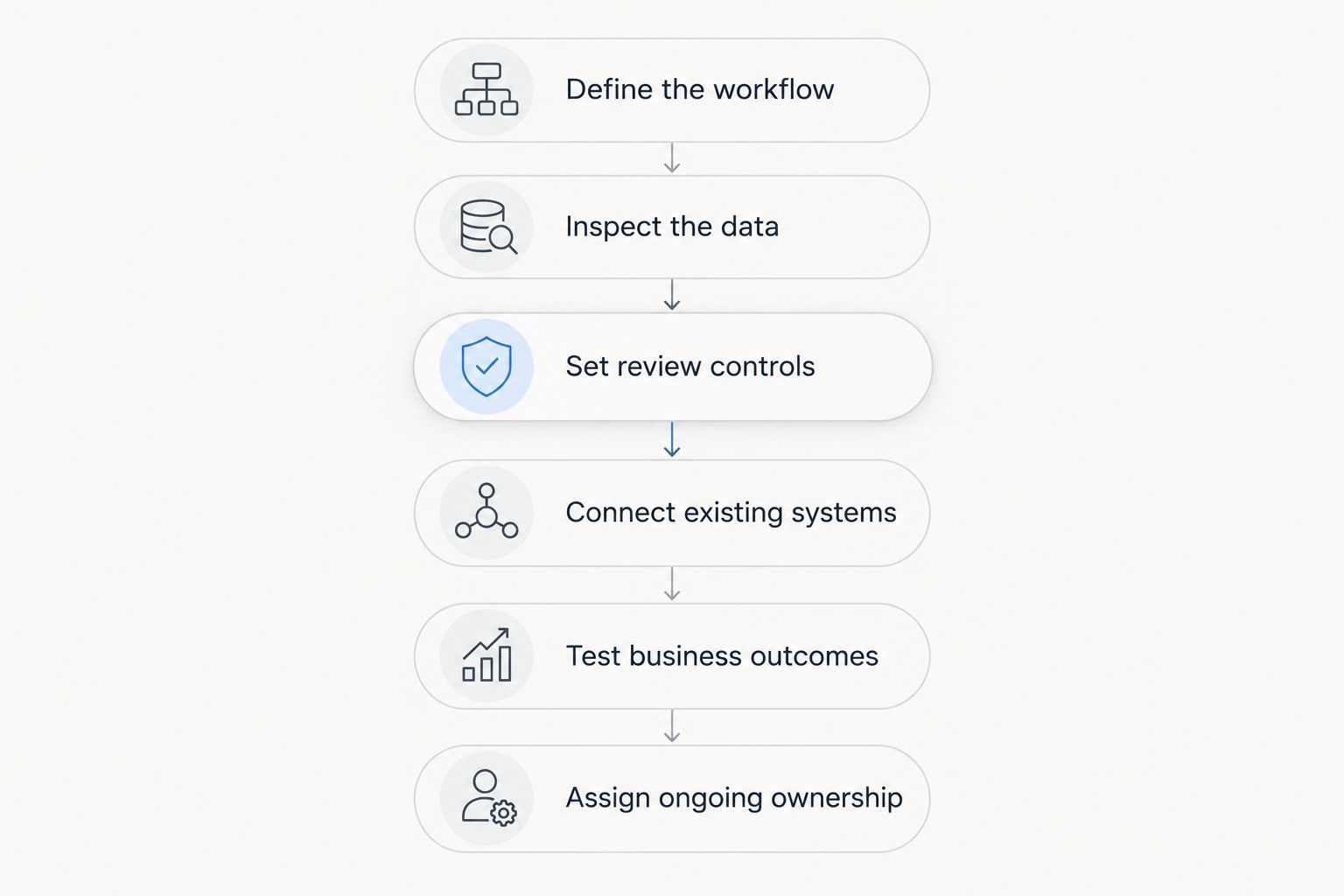
Connect existing systems
Map the current handoffs before adding an integration. Identify where records originate, where staff work and where approved outputs belong. A useful pilot should reduce copying without creating a second, conflicting record of the customer.
Start with read-only access when the task does not require changes to source systems. If write access is necessary, define the exact fields and actions permitted. Approval to retrieve a document is not approval to update an account.
Ask the delivery team to explain failure behavior in plain language. Your operations lead should understand what happens when a connection fails, a record changes during processing or the same request arrives again.
Keep access control consistent across retrieval and output. A summary should not reveal information that its recipient could not access in the underlying system.
- Map source records to the employee's working system.
- Limit permissions to the approved task.
- Preserve record identifiers and source references.
- Define retry, duplicate-request and failure handling.
- Specify where approved outputs and audit records are stored.
Test business outcomes
Run a manual comparison against the proposed system using cases with known outcomes. Include incomplete documents, conflicting records, unusual formats and requests that fall outside the approved scope. A polished demonstration does not test these boundaries.
Track 3 measures separately: task completion time, correction rate and total review effort. These are recommended evaluation measures, not promised improvements. Compare results using the same definition of a completed case.
For your 2026 acceptance review, assess operational failures as well as answer quality. A correct extraction delivered to the wrong account is still a failed case. A summary that requires extensive checking can also erase the expected time benefit.
Agree acceptance criteria before reviewing results. Otherwise, the team can end up redefining success around whatever the system happens to do well.
- Test against an approved reference outcome.
- Measure processing and human review together.
- Record material errors separately from formatting issues.
- Test refusal, escalation and unavailable-source behavior.
- Require business-owner approval before expanding access.
Assign ongoing ownership
Put operating ownership in writing before launch. Assign 1 accountable business owner for workflow results, then identify the technical, security and support responsibilities around that role. Shared involvement does not replace a named decision-maker.
Define what triggers another evaluation. Changes to models, prompts, document templates, source systems or internal policies can affect behavior, so the release process should identify which changes require testing before deployment.
Keep operating cost visible without reducing the business case to model usage. Include integration support, monitoring, review work and correction handling in the assessment. The relevant question is whether the complete workflow improves the business outcome.
Require a handover that supports internal control. Your team needs to understand how to stop the service, restore the manual process and obtain its records if the supplier relationship ends.
- Name business and technical owners.
- Define incident reporting and escalation responsibilities.
- Record change-control and reevaluation triggers.
- Maintain operating instructions and fallback procedures.
- Specify data export, access removal and exit responsibilities.
Compare delivery options for your firm
Buy against the workflow, not the technology label. Compare each option using the same source records, exception cases and acceptance criteria. The right choice depends on how distinctive the process is and how much responsibility your team can retain.
The table compares delivery approaches rather than named suppliers. Each approach has a useful role, but none removes your firm's responsibility for customer data, financial decisions or operating controls.
| Option | Best for | Main advantage | Key limitation |
|---|---|---|---|
| Manual process improvement | Unclear workflows that need definition | Exposes unnecessary handoffs before development | Still depends on staff execution |
| Rules-based automation | Stable tasks with explicit conditions | Makes prescribed actions easier to trace | Requires maintained rules and exception handling |
| Packaged AI software | A standard workflow that fits the product | Provides an existing application to evaluate | Fit depends on its controls, configuration and integrations |
| Custom AI development | Distinctive workflows requiring tailored connections | Lets you specify behavior around your process | Requires development oversight and ongoing maintenance |
| Internal development | Firms with available engineering and operating capacity | Keeps implementation decisions within the team | Competes with other internal priorities |
A combined approach also deserves consideration. Rules can validate required fields while an AI component prepares a draft for human review. Evaluate the combined workflow as one system; separate components do not justify separate standards for reliability.
Ask every supplier to distinguish demonstrated capabilities from proposed development. That separation prevents a roadmap item from becoming an unstated dependency in your business case.
Common mistakes financial services firms make
Treating extraction as financial judgment
Reading a figure from a document and deciding what that figure means for a customer are different tasks. Keep extraction, interpretation and decision authority distinct in the specification. Test each responsibility against its own acceptance criteria.
Giving a pilot production-level access
A narrow experiment does not need unrestricted customer records or broad write permissions. Start with the least access required for the approved task, and review any request to expand it. Do not let convenience determine the access boundary.
Measuring machine speed instead of completed work
A faster draft is not automatically a faster process. Include checking, corrections, escalations and duplicate entry when measuring the result. Otherwise, the business case rewards speed at the point where work starts rather than where it finishes.
Leaving policy interpretation to the supplier
A development team can implement specified controls, but your firm must establish its applicable obligations and internal approval requirements. Obtain advice from the appropriate legal and risk owners. Do not treat a supplier's general security statement as approval for a particular financial use case.
Deferring the exit plan
Ending a supplier relationship should not make customer records, evaluation evidence or operating instructions inaccessible. Define ownership and export requirements during procurement. An exit plan is part of operational continuity, not an administrative detail to settle later.
FAQ
What are AI development services for financial services firms?
They are services that design, integrate and maintain AI-assisted financial workflows, such as document extraction or case preparation. The scope should specify the business outcome, permitted data use, review controls and ongoing ownership.
Should a financial services firm build custom AI or buy packaged software?
Choose packaged software when its existing workflow and controls meet your requirements; consider custom development when important requirements remain unmet. Compare both approaches against the same cases, integration needs and operating responsibilities.
Can we start an AI project without using live customer data?
Yes, initial development can use synthetic or appropriately approved records. Before using customer information, establish permitted use, access restrictions, retention requirements and the approvals required by your firm.
Should AI make lending decisions without human review?
Do not treat an assistance pilot as authorization for autonomous lending decisions. Establish the applicable legal requirements, decision authority, validation and oversight before considering that scope.
How do we know whether a financial services AI pilot worked?
Compare the complete assisted workflow with the existing process using predefined acceptance criteria. Measure completion time, corrections and human review effort, and assess failures involving permissions, record matching and unavailable sources.
One last thing
Make your final 2026 pilot demonstration include an intentional failure: an unreadable document, a denied permission or a missing source record. Require the system to stop or escalate as specified, then ask the employee to complete the task through the fallback process.
A controlled failure is part of a successful demonstration. It shows whether your team can recognize the problem, protect the record and keep the operation moving without trusting an unsupported answer.
Related guides
- AI development companies for enterprises
- API integration platforms for businesses
- Mortgage software platforms for lenders
Schedule a consultation with Hexagon IT Solutions to discuss one workflow, its data boundaries and the acceptance criteria for a controlled pilot.


